Now, that’s how it’s done!
La Cieca proposes a new weekly competition: she provides the theme, you provide the examples. This week: “Now, that’s how it’s done!”
The concept is: if you want to know how an aria or operatic scene should be performed, look no further. Your task is to find and to properly embed a YouTube video exemplifying some operatic superlative, then append a few sentences explaining why your choice is indeed the best of the best.
La Cieca will now offer an example.
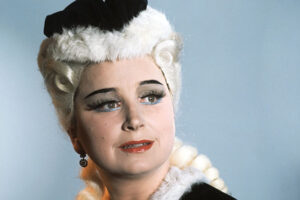
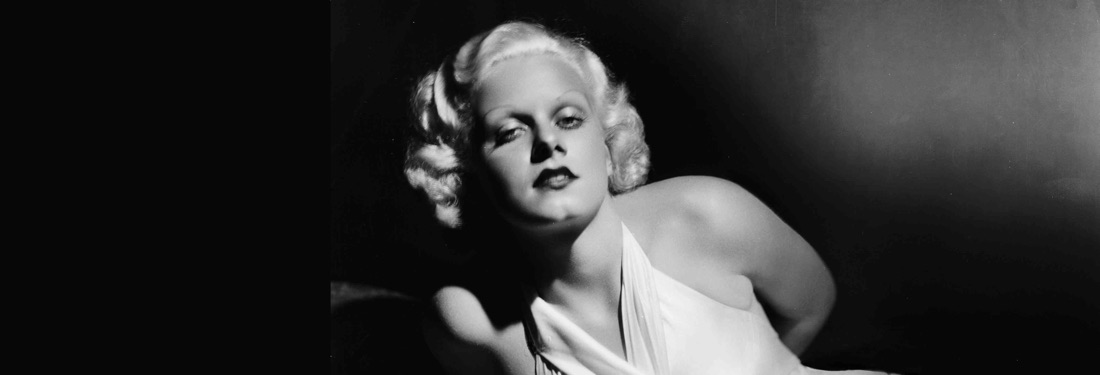
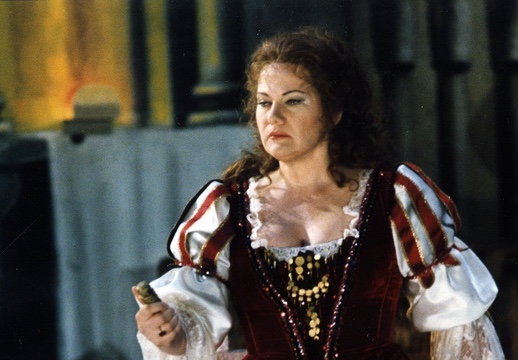
Everything about this Renata Tebaldi clip if pretty fabulous including (especially) the hair, but what really is “how it’s done” here is the expert and fearless use of chest voice. Especially impressive is the soprano’s deliberate contrast of timbre between the hard, snarling chest tone and the limpid mezza voce in the middle register. Some Giocondas are good at expressing rage, others vulnerability, but Tebaldi can modulate between the two almost instantaneously without sacrificing the quality of the voice.
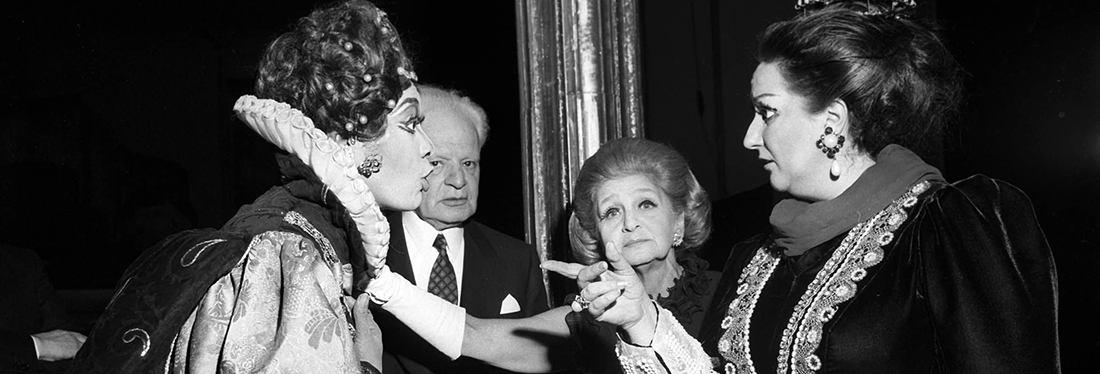
So, go look for a YouTube clip of your favorite “Now, that’s how it’s done!” moment, and post it in the comments section for this posting, along with your commentary, by midnight on Sunday, June 20. The clip and comment La Cieca judges the best (and her whim is final) will receive a copy of the newly-released DVD The Metropolitan Opera Gala 1991: 25th Anniversary at Lincoln Center, documenting this performance. (If the winner resides outside the United States, La Cieca reserves the right to substitute an amazon.com gift certificate of equivalent value.)
So, show La Cieca how it’s done!
here is a late additin to the list, but I think no one has touched this selection yet:
This is the one Renee Fleming recording I openly love. While most sopranos start with a detached quality to their performance, Fleming is immediately distraught and I think it serves the music and the text much better.
While this isn’t a bad recording by any means, I think this performance by Elly Ameling shows much more control and a sustained despair that builds until the exhaustive final conclusion. She is not the least bit detached.
Agreed, this is a nice build up. I like the build up that Ameling takes and the nervous intensity that Fleming bring to that brutal ending.
Surprisingly prefer Fleming here at the faster tempo than Ameling – but the singer for this song
is Irmgard Seefried (more than a half dozen
versions of her rendition available here and there not as fast as Fleming’s) both for the controlled passion, limpid tone, superb diction and then the impulsive climaxes. Seefried truly tells a story as she sings. Seefried sang it at her Town Hall debut in 1951 tearing out the hearts of everyone in the audience after which Elisabeth Schumann, who was in attendance, supposedly asked “Was I ever so good as she ?” When asked in an interview years later who were the finest lieder singers Christa Ludwig responded, “for Schubert Seefried, for Hugo Wolf
Schwarzkopf and for Brahms, me”
Thanks Bill – you said it better than I ever could have so it must be so! I don’t like the faster tempo though. I think the slower tempo leaves more room for a crisper interpretation from Dalton Baldwin.
I’m glad we’ve expanded the field beyond opera arias, since this gives me a chance to offer an example of my all-time favorite singing. What makes it great? The variety and control of her dynamics and vocal colors, the ease of her movement between registers, and primarily, of course, the way she uses her skill to achieve what is for me the most effective tone for this song, perfectly judging the balance of sentiment and restraint so that she avoids either preciosity or bathos.
One of my all time favorite recordings.
The most erotic voice preserved on disc. I always need to wipe myself off and have a cigarette after hearing her.
Regine divine.
I do not believe anyone has ever surpassed Crespin in these Berlioz songs. She is haunting to hear – touching beyond belief. It is surprising but many of my favorite sopranos had ravishingly beautiful middle voices and perhaps (at least later in their
careers) short tops – Crespin was one, and Seefried, Jurinac, Tebaldi, de los Angeles, Pilou, Janowitz.
Headsup -- I’m re-uploading this (and a lot of other things), hoping to trick youtube into giving them better sound quality…
This is how you do a prayer, and hold a pianissimo on a high note:
From her lips to God’s ear and now, fortunately, to ours. Thank you so much!
I’m going to say that when she was on, Leontyne Price could school sopranos on “how it’s done” like no other:
And here are Sutherland and Gedda in La Sonnambula, truly showing how “Son geloso” should be done. I love their simultaneous descending trills.
That Marietta’s Lied isn’t necessarily top-drawer Price for me. But the “Depuis le jour” (which I’ve listened to many times) is a master class in floating high notes — one ravishing example after another. And thanks for the Sutherland/Gedda clip — exquisite.
Only three words for this one: legato, floated pianissimi.
And it’s not yet midnight my time, mind.
Exquisite singing. Also, how not to direct a magical scene. Definitive proof that lousy directing did not originate with Regie. I felt I could hardly hear her because of the visual distraction of all those urchins galumphing pointlessly around the set. Guarda mamma, sono nella TV!!
And how about that prosthetic nose?
LOL yeah, it’s remarkably convex compared to the 2.0 version.
BM- have the aria on its own, peerlessly sung, without any distracting galumphers.
Also lovely AJ, thank you so much. But as long as I don’t watch the galumphers, I think Moffo’s version floats even more ethereally, don’t you?
And out of the confines of the contest. How about this one?
fourth and fifth – fairy princess – incredibly beautiful.
And this is, quite simply, how it’s done: with sheer guts. Great technique doesn’t hurt. But all the others wtih great technique don’t even come close on this one.
What a wonderful start to my day–my mom showing just how it should be done; she truly was glorious!
Actually, as much as I love Callas in Bolenna I think she was surpassed by both Sills and Gruberoba in this Cabaletta. They both bring technical and stylistic assurance to spare.
No doubt that the glory of Callas’s final scene is the recit and cavatina that come before. The phrasing and the emotional investment become one seamless whole — what every singer should aspire to:
(This is a studio recording as opposed to more famous live La Scala recording).
Yeah, but that’s exactly what I meant — despite the fact that Sills and Gruberova may be technically more skilled in this (though the breaks between Sills’ very different sounding registers are exposed here, and Gruberova always sounds shrill to me), with more tricks, for me they don’t capture the raw emotional power of Callas. They just sound petulant while Callas rages. To be fair, these are both studio recordings, and I intentionally chose Callas’ live 1957 La Scala performance, even though it’s technically less polished than the 1958 studio recording, which I will add here.
Actually, Whils Sills’ is a studio recording, Gruberoba’s recording of Bolena was captured live.
Since we’ve decided forays into non-operatic repertoire are OK, here is some Janowitz singing Bach. Neither the artist nor the composer are terribly near the top of any of my lists, but I came across this recently and it is just sublime:
I also think it’s a bit of a scandal that a thread like this so far doesn’t feature any Pavarotti (unless I didn’t notice):
Ponselle in Ernani.
Nice. Also love this version (by which I don’t mean to say I think it’s better, I just like it also).
My goodness, how time slips away. I remember when that recording was released in this country (1958 or 1959) on Angel records. OF COURSE, I was first in line to purchase it (the album “Mad Scenes”) and played it so much and so loud that my real mom tried to throw it out the window. (I think the neighbors complained) Great photos too. Thanks for the memories.
My memory is bad–it was NOT the “Mad Scene” album but the Verdi album that came out the same time. I purchased them at the same time much to my real mom’s horror. She was not an opera fan and felt that I listened to that “Callas woman” far too much.
And surprisingly not bad at all, all things considered.
Ponselle as Gioconda.
The greatest singing that the we have had perhaps ever.
Certainly, Mr. HvK thinks so.
I agree. Whenever I hear in this performance all that I can say is OMG!!
She is simply gobsmacking there. I was raving about this performance to someone just yesterday, as it happens. Does anyone know whether the audio was recorded at the same time as the video? It doesn’t look as though she is doing it to a backing track.
I think it is actually dubbed. Either that or the voices were recorded separately and added as a separate entity to the video.
If you compare it to other videos of the period (actually almost anything like that up to the 80′s you will notice the difference (look for example at the Caballe Preghiera from Stuarda)
Let me add one layer to this: Part 2 of the aria does indeed answer whether the artists were sinked to a sountrack. The video shows some sinking issues:
Lindoro:
I agree that they lipsynched some of the film but much of it is not.
More to the point – she sang it this well EVERY FREAKING TIME SHE SANG IT!!!!!
My mother heard her do this in London in the 70′s. There were spontaneous outbursts (mostly gasps) after the requiem aeternam section. Price was furious until she realized that folks just couldn’t help themselves
But saying that she sang it like this is not the same as saying that she was singing WHEN she was in front of the camera; those are 2 different statements, completely unrelated to each other.
I am not offering any opinion as to whether I find this performance acceptable, I am offering a fact that there are sinking issues and it sounds like this the performers were not singing in front of the cameras, but lip-sinking.
I am sure there is documentation out there that would tell us one way or another. I seem to recall that HvK did not want to record this live and insisted on creating a soundtrack to which the singers performed.
I will let the HvK experts and probably Alto, with her recording industry expertise clear the air and correct us both.
Simply divine. This DVD gets a lot of play in my home. Cossotto and Ghiaurov are magnificent as well. Pavarotti is great too but falls just shy of the other three.
The utter precision of Price and Cossotto is almost amazing. How on earth could such amply endowed singers blend so perfectly?
Complete control of overtones. The sort of control that most singers don’t even bother to achieve unless they are singing Bach.
BUT finally, what makes this so great for me is that she sings the score like it was embedded in her DNA. Every legato marking, every dynamic, every expressive marking. Legato is maintained across the broadest intervals, and unlike Caballe, whose pianissimi had a disembodied quality and were not produced the same way as the rest of her voice, the softest tones and the loudest tones are supported in exactly the same manner so her dynamic control is complete down to the semiquaver.
That is what you can do with a true legato. I would post some Sutherland that demonstrates the same mastery but youtube is acting up.
Lindoro:
I think the answer is that there was a performance recorded in its entirety both visually and aurally- there are times when that is clear and accords with what I have read of the film. That said, I think that HvK insisted on redoing certain parts of the visual portion of film for one reason or another. It is the reshoot part that results in the lypsynching to the original aural recording of the performance.
So you have mostly a film of a concert with the soundtrack from that concert. You also have some separately filmed sections where they had to lipsynch to the original recorded performance.