
She’s still here

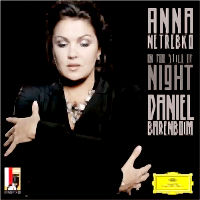
The setting is Salzburg, September of 2009. Anna Netrebko and Daniel Barenboim partnered for a recital with lofty aspirations and difficult works mere months after her unfortunate Lucia at the Met. Thanks to the foresight to record this evening, we now have a record of a great night – hopefully a turning point – in the appreciation of Russian song.
In years past, many people viewed the wonderful works of Tchaikovsky, Rimsky-Korsakov, and the rest of the Russian masters as inaccessible to the western world. The complicated language, demanding emotional intensity of the legendary Russian poets, and often vocally demanding writing can make for a deterrence to the singer considering such repertory. These works require an immensely talented singer, one with great range vocally and emotionally. If anyone had doubts that Anna Netrebko was any longer an artist of this caliber, In the Still of Night will lay those to rest.
In the interest of brevity I will not detail every nuance, every color and every perfectly crafted phrase that Ms. Netrebko uses to great effect in her recital, as the list would be almost endless. The only downside I can find in this performance is the occasional strain in her absolute top register, above A is my guess as almost all of these works I’ve never heard before.
But for all the beauty Ms. Netrebko brings to these songs, her voice is best in the story of a spurned lover begging for forgetfulness in the Tchaikovsky song “Zabit’ tak skoro.” Her voice is so well suited to heartbreak, and the hint of breathlessness that she brings to the opening makes the anger in the climax of the piece seem all the more desperate.
Every opera lover has their own analogy to Ms. Netrebko’s voice; I like to call it “dark-chocolate-covered honey drops wrapped in golden foil.” In this hour-long recital, Ms. Netrebko uses every color available in her shockingly large palette to its perfect ability. Every sound is drawn beautifully from the masterwork poetry, heartfelt and touching. I truly feel that the emotional commitment to these songs is unmatched in her previous work. If this is an indication of things to come I will be devoting many more hours to listening to her.
Daniel Barenboim has a feel for this repertory like few others in this world. His interpretations are playful, doleful, virtuosic, folksy, and all around wonderful. He plays every song as if he has orchestrated it in his mind, and you hear the colors of every instrument in his accompaniment. He supports Ms. Netrebko wonderfully, and together they exemplify the relationship between singer and pianist. One need only listen to “Sred’ mracnikh dney” to hear how expressive several bars of music can be, and how amazingly it can set the tone for the song.
After listening to this album I wondered, where’s the rest? Who among today’s great artists will have the courage to take on a Fischer-Dieskau like project of recording the great Russian songs? For a while I hoped Dmitri Hvorostovsky would be that man, but since his decision to move directly to Eurotrash I doubt his urge to record that kind of Magnum Opus.
I hope dearly that Ms. Netrebko takes the time to cement her legacy in recording the great works of her compatriots. Her voice and skills are uniquely suited to this repertoire, and it would be not only a service to her audience but her country to undertake such a project.
Not to get overly contentious, but, Krunoslav, you “have to disagree” with what? The reviewer never compares Netrebko’s performances with the those of the artists you enumerate and never makes the claim that this recording is “for the ages.” He even goes so far as to say “if this is an indication of things to come,” i.e., he recognizes that this is an early effort and he hopes for the artist to continue to develop as an interpreter.
In a way, this attitude (not written by you of course, but in the more general sense) of “a flea not fit to perch on Galina Vishnevskaya’s rear end” reminds me a bit of those bitter old queens on opera-l who never go to hear performances because, after all, there’s nobody around today who can efface the memory of Apollo Granforte.
(I just realized as well that this review was posted with the wrong byline; it’s by Valmont, not me, and I’m sorry for the confusion.)
“In a way, this attitude (not written by you of course, but in the more general sense) of “a flea not fit to perch on Galina Vishnevskaya’s rear end” reminds me a bit of those bitter old queens on opera-l who never go to hear performances because, after all, there’s nobody around today who can efface the memory of Apollo Granforte.”
Which is one of the reasons I don’t post much at opera-l anymore. I realize that so many listers there don’t ever go to the opera, don’t want to go, will never go, not even to an HD broadcast. Listening on the radio (and complaining) is the closest they ever get.
Ewa Podles and Zara Dolukhanova are/were incomparable artists and possess(ed) unique voices. I’ve not heard this Netrebko CD but what I can imagine is her bringing a youthful sound to these songs that would be unique. Her Iolantha is the best I’ve heard ( and I’ve heard most of the recorded ones) precisely because unique combination of youth/innocence and maturity in her voice.
Netrebko really excels in Russian repertoire, both opera and song.
Wasn’t it Russian opera roles that made her a star? I think her work in other areas does not equal her work in Russian where she really is outstanding.
When I first read Valmont’s review I thought it was in the vein of something that Nerva Nelli might write, but I now see that it is apparently a genuine review.
Excerpts of this recital are being shown tonight on French television (ARTE network) and repeated a few times in the next week or so. And surely the reviewer means August 2009 as the Salzburg Festival is always over by the end of August.
Perhaps you will all enjoy Anna and Maestro Barenboim’s reflections on the new CD:
Saw excerpts of the same recital which was repeated in Berlin on March 29th, 2010 tonight on German TV. It was truly great and made me listen to Netrebkos Russian Album again which I like a lot but have not been listening to for a while. Thanks for the review. I just ordered the CD.
La C-
Yo be more precise, I disagree with the idea that this disc reflects a nuanced interpreter of the material ( the review claims that it does), and with the following straw man thesis:
“In years past, many people viewed the wonderful works of Tchaikovsky, Rimsky-Korsakov, and the rest of the Russian masters as inaccessible to the western world”
,,, and with the idea that Barenboim plays this rep well.
Nice first attempt, but as I said, it does no take a press release to make a song singer but years of work, Hopefully Anna will now doe those years.
Leiferkus and Hvorostovsky are sill active recitalists in a class way above hers, as is the fabulous Ekaterina Semenchuk whose Harmonia Mundi Russian song disc has everything the reviewer (falsely in my view) claims for Anna’s.
It’s always hard to guess why such opinions are stated (if indeed they’re based on knowledge). But I would guess that the “problems” are similar to those that listeners have with other Britten works of the mid-1960s: his musical language was undergoing a change in this and other works of the period (the solo suites for cello, guitar, harp; the church parables; other song cycles like Hölderlin Fragments, the Blake songs). It was transitioning from the accessible, colorful style of the War Requiem and previous works and would end up in the new clarity of Death in Venice and the Folk Song Suite. But in this period, the motivic, heterophonic emphasis leaves some listeners unsatisfied (me too at times, I’ll confess — and Britten is my favorite composer). I still find that these songs reward acquaintance; but that’s my best guess.
I guess by “last reissue” you mean the box Britten Conducts Britten (which does include songs with piano), which does indeed avoid the songs of this period. It was included as filler in the separate Decca CD issue of Owen Wingrave. There’s also a new recording by Susan Gritton.