Headshot of La Cieca

Cher Public

  • Buster: Upcoming: the Salome of Mireille Delunsch! Singing it, not directing it. She will direct Dialogues des... 2:05 PM
  • Clita del Toro: Right but I bet their executives are still giving money to anti-gay causes! I will do some... 1:59 PM
  • Camille: Salomanda, Thinking now that you are a pretty sharp cookie as my husband agrees with you on every point... 1:58 PM
  • Henry Holland: please keep in mind I live in an operatic wasteland, commonly referred to as L.A., and I’ve... 1:54 PM
  • tatiana: Not for me–I have Daniels/Domingo/Mi lnes and heard the other one in the House . . . no, thank you,... 1:46 PM
  • Camille: Barbara Daniels’ hysteria at the end of Act two is the best take on this difficult ending... 1:30 PM
  • Loge: Since the title references Cole Porter I will guess Kiss Me Kate 1. Wunderbar 2. Brush up your Shakespeare... 1:18 PM
  • oedipe: OT (sorry!): The Salzburgerfestspie le, whose artistic director is Cecilia Bartoli, has announced its... 12:49 PM

Winter meeting

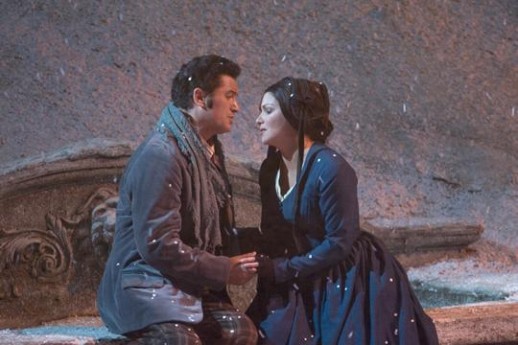
boheme_metThis afternoon’s broadcast of La bohème (beginning at 1:00 pm) is sure to provoke lots of commentary from the parterriani.
Conductor: Marco Armiliato; Mimì: Anna Netrebko; Musetta: Nicole Cabell; Rodolfo: Piotr Beczala; Marcello: Gerald Finley; Schaunard: Massimo Cavalletti; Colline: Oren Gradus; Benoit/Alcindoro: Paul Plishka.

The real-time chat is, as usual, over at La Casa della Cieca.

(Photo: Cory Weaver, Metropolitan Opera.)

74 comments

  • poisonivy says:

    I was at the performance this afternoon. Beautiful performance overall, with maybe the exception of Nicole Cabell’s Musetta. I thought Anna’s voice fits Puccini like a glove — so round and lush, without pesky scales and trills to worry about. Beczala sounds eerily like Nicolai Gedda. I love his secure high C. Together he and Anna made beautiful music this afternoon. Gerald Finley was a wonderfully likable Marcello.
    Catch this Boheme run if you can.

    • traumgekront says:

      I love love love Gerald Finley! He’s one of my favorites. And I think Beczala sounded great as well, and incidentally, looks a little like Jussi Bjoerling.

  • Constantine A. Papas says:

    Netrebko’s fading voice was very effective at the end. She dispensed with the routine coughing. All Mimis I recall they cough. Is anyone else that does not?

  • bigbob56 says:

    I’ve always enjoyed Finley since Rinaldo thru Dr. Atomic. On Harnoncourt’s Messiah he does the very best “The Trumpet Shall Sound” I have ever heard !

  • Dan says:

    I was in the house today…I thought it was a really good performance.

    The comments on Netrebko are correct, although–and maybe this is because I’m a fan of hers–when she’s live and she’s singing at you seven rows back, the sound is just that impressive. The last act was actually kind of heartbreaking, even to me, someone who doesn’t cry (I still didn’t cry, but all the women around me were SERIOUSLY crying like girls…nothing wrong with that, but the Kleenex were out in force).

    Finley was absolutely impressive today…I’d say overall vocal honors go to him.

    Beczala I felt was not in his best voice, but there were still some thrilling moments, and he acquitted himself really well. Not particularly Italianate, but he’s Polish, and a sensitive musician nonetheless.

    The REAL HUMOR was before the first intermission. As the four of them were sitting at the table, Netrebko was GOING TO TOWN on the fries and other food on the table. She must not have eaten lunch. There were obviously very arduous attempts by the cast to suppress laughter, and I thought someone was going to lose it and just corpse.

    I even heard Netrebko turn to one of the supers standing next to her and SPEAK (not too loudly, but from that close you could so hear she was making a comment about her on-stage eating), then smile and laugh.

    When she came out for the curtain call…YUP, she was chewing, and the lot of them could barely contain their laughter. Really funny, actually, and good to see them having fun up there.

    What was also nice to see from up close was that after Che gelida manina, during the applause, you could see Nebs and Piotr smiling at each other and talking. It seemed she was telling him that he sung it well, and he was expressing embarrassed gratitude. Or they were laughing about a mistake he made.

    • Bevi A Tequila says:

      A fond memory of Houston’s Ponelle production of Boheme (1981 maybe?)was watching Mirella Freni’s attachment to her “crema” during Act II. As the soloists and chorus were all drawn downstage to watch the imaginary banda out over the audience, Freni’s Mimi suddenly remembered her dessert and dashed back to the table to reclaim it. She returned to Luis Lima, eagerly gulping spoonfuls and jumping up and down as the parade music played. For me it was a charming touch that I didn’t recall from her stunning performances with Karajan and Carreras in Vienna (1978).

      Did La Freni really turn 75 yesterday?

  • wladek says:

    Dan – no one seems to answer this=
    What is an Italianate sound ?? in
    reference to Beczala – I’ve heard
    good Italian singers and some awful
    and some top non Italian and some awful in this role -and for both some
    had beautiful basic sound and some didn’t but what they did with their voices and their role is what counted .
    Who has what is termed an Italianate
    sound ? Why would this be better ?
    Just curious as to your observation .

    • Alto says:

      You ask a good question. But whatever the answer, I repeat what I may have typed here before: a famous opera singer has challenged me, and I challenge the assembled gentry here with a question. Can anyone find a place where Verdi or Puccini or any of the bel canto worthies EVER talked about needing an “Italian sound” or any other kind of specific sound? They seem to talk only about characterization in their correspondence, etc. They accepted all sorts of national styles in singing.

      Here, however, the easy way to sound discerning is to say: “Omigosh, he/she doesn’t have an Italian-sounding last name. I’ll talk about the need for an Italianate sound.” Anybody can play.

      • Tim says:

        Alto, I ran out of space in my previous post. You are spot on about the “Italian Name” thing. I cited Caruso et al. as only a starting point. Anyone who says Jussi didn’t have an Italianate voice need listen only to his live Cav with Simionato (sp?) from the Met shortly before he died. Same goes for Carreras and many others. On the other hand there is many a singer with an “Italianate” name who don’t have a clue as to what Verdi or Puccini are all about.
        Tim

      • wladek says:

        Alto -Right on !! you are correct . No place does the score instruct
        one to find an Italianate sounding singer of either sex.Unless one
        heard Caruso live comparison is
        of no value-”Jussi” had a timbre to his voice that was only his and
        had nothing to do with Italianate,
        heard him many times and he didn’t sound at all like any Italian tenor troting the boards at the time .Di Stefano had his sound
        as did Monaco his and Gedda his
        own . The real difference lay in the pronunciation and inflexion given to words that make it
        “Italianate” or not to some listeners .Vickers is a perfect example-you knew he wasn’t Italian or German if you only
        heard the voice -and that was due to how he inflected the words.It is all in the nuance of the word, to the Italian singing
        Italian this is all second nature,
        to an outsider like Beczala it
        is acquired as best he can . The
        better his command of Italian, the more “natural” he can make it
        the more “Italianate” he will sound . The one glaring exception to all this was Sutherland ,you couldn’t understand her in any language
        as she yodelled her way into your heart .

    • Tim says:

      This is not Dan but let me give you my gut response to your question. I’m not sure you can give a scientific answer. I prefer to start by simply citing Italian tenors who have/had a certain quality to their timbre that I identified as Italianate. Start with Caruso, Gigli, DiStefano and Luciano. I then like to add some descriptive comparisons e.g. Bergonzi is like honey, DiStefano is ripe olives, Caruso a panne rustica with a Chianti classico. In other words it is a feeling that is entirely subjective. Tim

    • Dan says:

      Tim said what I was thinking…and just as a warning I’m no vocal pedagogue, but it has to do with the timbre, but is entirely subjective. I imagine any discernible differences have to do with the way techniques are taught from different traditions. Someone more knowledgeable will be able to specifically confirm or refute this attribution.

      I’m definitely not saying that anyone’s interpretation is not as good because their sound isn’t the same, or their phrasing and other elements are not perfectly in the style of Caruso or what not. I think Beczala is actually wonderful and has a quite thrilling sound, security throughout his range, and lots of charisma.

      Same with Nebs. She sounds much much darker than other Puccini singers to me, but no less secure in the rep, even if she seems to coast at times on the beauty of her voice and her stage presence.

      I like all types of singers singing all types of repertoire, except things for which they’re definitely not suited (e.g. I wouldn’t want to hear Dessay try out Tosca).

      • Alto says:

        Some good comments above, in my view.

        I’m convinced that what needs to be Italianate is the musical style. Just as we play Italian instrumental music on all sorts of instruments and make it sound authentic if we phrase it, shape it, articulate it idiomatically, the same should be — and I’m convinced is — true of skilled singers.

        The idea that Poles and Russians can’t sing in French or Italian or German styles is an alarming and stupidly limiting one. And it’s funny how Americans tend to forget how little music we’d be allowed to perform if the various prohibitions so often implied here became immutable law.

    • operaddict says:

      If you are able, dig out the wonderful Toscanini recording of La Boheme with Albanese and Peerce, or a later one with Tucker, Merrill and Moffo…THAT is what Italianate sound is. Today’s attempt at La Boheme is a far cry from that.

      • I care a lot for Toscanini’s 1946 radio transmission of La Boheme. But in all seriousness – Jan Peerce – Italiante ????

      • The Vicar of John Wakefield says:

        Nash, Perli/Labette and Brownlee under “Tommy” Beecham fill the bill!

      • poisonivy says:

        They’re both good recordings but neither Peerce nor Tucker sound the least bit “Italianate.” I associate an “Italianate” sound as being extremely round and warm, and not many Italian tenors have it either. Gigli, Caruso, di Stefano, Bergonzi, Pavarotti, Valletti, they are the tenors that have the “Italianate” sound. But as many people have pointed out it’s not necessary to have an Italianate sound to succeed in this kind of rep.

    • That Guy says:

      Well, the technical answer is that an Italianate timbre has a certain balance of chiaro and oscuro (brightness and darkness in the tone). I think by this definition, and according to my ear, Beczala absoulutely DOES have an Italianate tone. He just needs to add a little more marinara sauce to his performance, such as more portamento, a little bit more use of text and dynamics, and maybe a bit more passion in some spots. I think he is very good, though.

      The idea that there is one particular Italianate timbre and that Beczala doesn’t have it is ignorant at best and racist at worst.

      • La Cieca says:

        While I’m generally in agreement with you here, I am hesitant about going along with the idea that Beczala “just needs to add a little more marinara sauce to his performance.” Style is not a sauce, i.e., something to be ladled on and to add a superficial flavor to an otherwise bland dish. Unless portamento and the other elements you mention arise organically from the singer’s understanding of the music, they are going to sound appliqué and artificial.

        Becazla is a lovely singer with a fresh, attractive voice, and he is charming and personable onstage. I’m not sure why he has to be remade into an ersatz diStefano before people will accept him in Boheme.

        • MDtenore says:

          I agree wholeheartedly too much is made of singers’ Italianate qualityn marinara sauce and so-forth. Sometimes a voice taken out of context, so to speak, can be a good thing especially if the singer is comfortable with the language–Bjorling is a good example. However there are instances when a singer’s lack of comfort in the Italian language stands out like a sore thumb. Think Dietrich Fischer-Dieskau in Don Carlo. For me he ruins the entire recording of the Bergonzi opra for me.

        • MDtenore says:

          I did actually mean the Decca recording of Don Carlo with Tebaldi, Bumbry, and Bergonzi.

        • Liana says:

          Which shows how very subjective this whole question of “Italianate” singers is. For me, DFD’s Posa is the highlight of this recording, and I find his duet with Filippo, Signor, di Fiandra arrivo, absolutely heartbreaking; in this particular recorded version of Don Carlo, the whole drama is (in my opinion, of course) between Posa and Filippo, thanks to DFD and Giaurow. And I’ve always thought Fischer-Dieskau gives a meaning to every word he sings there.

        • wladek says:

          LaCieca – quite so concerning
          Beczala !-this all stemmed from
          a comment that while he was fine- being a Pole he was not Italianate enough in his interpretation whatever that meant .You are correct what we
          don’t need is an ersatz Di stefano who at times was being an erzatz Kiepura who
          was off the wall at times. I believe when some people attend a performance, and if it is memorable and the singers
          great enough,it becomes the standard of comparison for
          them ,who then want the same experience over and over.To musicians that is a case of arrested developement .It is much like some symphony
          folk who are “receptive” to
          “modern” music provided it sounds like Mozart or Beethoven otherwise they head for the doors .You are
          quite right concerning the
          “portamento etc.”- it can be shown how it’s done but must
          “arise organically” from the artist.Two artist I heard live
          using portamento with consumate effect was the Pole Kiepura at one end and the Italian Tebaldi at the other.
          Both “singers”.

        • Regina delle fate says:

          Gedda, whose voice Beczala’s sometimes recalls, suffered from the same accusations of not being “Italianate” enough for Puccini and Verdi. Beczala is a wonderfully versatile artist excellent in the French, German and Russian lyric parts and several Italian parts too. His voice has more Italianate juice than Kraus’s did, but he was considered a god in Lucia, Duke of Mantua, Puritani and Favorita.Beczala is probably the most elegant and stylish lyric tenor around right now. I hear he is singing the 2012 Met revival of Hoffmann. Worth crossing the ocean for!

  • Quanto Painy Fakor says:

  • Quanto Painy Fakor says:

  • Quanto Painy Fakor says:

    • wladek says:

      Once more down into the crypt we
      go . I picture a demented hunch back down there somewhere
      attending to candles and all
      kinds of memorabillia of the dead Maria . Thank heavens they threw
      her out to sea . Now if only one
      could throw out some of her terrible
      off pitch videos. Boris Karloff lives!!!! .

  • Bluessweet says:

    wladek: While, at times you contribute things of great interest and at times you appear highly knowledgeable, your recent post (18.1) shows that at times, your highly inflated opinions are completely untrustworthy. You might say what you will about Madame Callas but there is an old Latin phrase, “Dei mortibus nil nisi bonum,” which I believe means that we should speak nothing but good of those deceased.

    As far as Callas goes, it must be admitted that she was a great icon in the opera world and that she has thousands of dedicated fans. (I’d say millions but I’m afraid we may be hard pressed to find a million who really care that much about opera at all.)

    My own taste does not run to Callas. I believe she would have been better off pursuing mezzo roles. Even in the interview so kindly provided by Quanto Painy Fakor, she admits that her top register is gone. You might argue that as early as the 1954 recording, “Coloratura-Lyric” it was scarcely in evidence. Nevertheless, she made opera come alive for thousands of people. She deserves respect for that and for her tenacity, if nothing else.

    Would it be possible for you to tune it down a notch and stick to specific criticism? I think the dialog would be much improved and that we would benefit from your quite extensive knowledge without tasting the bitterness that you must feel about things far beyond the extent of this discussion? I really wish you well and hope that one person’s place in the esteem of the opera loving public does not leave you with such a sense of frustration.

    • wladek says:

      Bluessweet -In the great scheme of things
      the nonsense of who was a great singer or not means little-whether
      QPFakor thinks she is the last word\or I don’t, means nothing- in
      the long run she is still dead as a door nail. By the time she reached the Met she was almost done with .Speaking as a musician she made opera come alive for all the wrong reasons. She was a great celebrity
      and played the diva to the hilt. One would have to live in a cave not to
      see that she used music as a stalking horse for ambitions,which
      ended rather sadly for her .
      Bitterness, good heavens whatever
      for ?Why must people think that just because one has a strong
      adverse opinion to one having
      a pro opinion , that the adverse
      must be coated in bitterness , can
      it be to bolster up a shaky premise?I remember from those
      long past days an American soprano by the name of Benita Valenti also at Met who gave
      a recital of Schubert in which
      the singing was to treasure for a life time. It was the art of singing
      not the art of the diva and there
      is a big difference in that .

  • La Valkyrietta says:

    wladek,

    I find it funny that you like to stir up controversy. You must have been terrible as a young child.

    Going back to the italianate question, well, that is an interesting question. It can be dismissed in two sentences, or it can be dealt with in volumes and volumes of prose. Some wonderful replies to your question were posted, so that was not too bad.

    Imagine a first rate Japanese actor reciting the Gettysburg address. He might make a perfect delivery, but in the minds of everyone, critics or not, will be the thought that he was not quite Kentuckian. Is that relevant?

    Wagner invented a whole style of opera because he thought German singers should not be italianate. Well, that is a simplification, but there you have an endless topic.

    Corelli is italianate in Nessun Dorma, Bjorling not quite. I prefer Bjorling, my Italian barber prefers Corelli. Perhaps eventually the barber will enjoy Bjorling more. I did enjoy those Corelli Nilsson Turandots immensely.

    My point is that being italianate is neither a necessary nor a sufficient condition for a great performance of an Italian opera. It is one aspect of which a good listener will always be aware of. Take two superb singers, say, Domingo and Bergonzi in “Quando le sere…” from Luisa Miller. I love both, but if I have to take one recording of that to a deserted island, I would take Bergonzi’s because, perhaps, he is more italianate.

    Callas is my favorite soprano ever. I never heard Giudita Pasta or Wilhelmina Schroder-Devrient. Still, when it comes to La Boheme, I still today prefer Tebaldi’s Mimi to Callas. I do love the niceties and subtleties in the Callas recording of the opera, but there is something wonderful difficult to explain about Tebaldi’s rendering of the role that one might just say is more italianate than the Callas.

    Callas lived in Italy, was married for many years to an Italian, and she spoke Italian well. She was very good in English and French too, and I’m sure Greek. For me she is the perfect soprano for many Italian operas, without being born in Italy.

    Anyway, you seem to like Boris Karloff. I have not seen his stuff in decades, you will have me renting his DVDs. Maybe not, he does not sing. Have a good day. It is Sunday all day today.

    • wladek says:

      La Valkyrietta -You found me out -
      I was a terrible kid – everything was
      why??? until I was known as – why?
      I am positive that if there weren’t laws against such goings on they
      would have drowned me just for piece of mind.Nevertheless it was a loving fun family where only the arts mattered .My first “opera” so to speak was Die Fledermaus which I loved -
      later at 14 I was taken to Trovatore and
      asked my parents “why” would any one write this stuff ” -they threw up their hands laughing and I remember the comment ” because they didn’t know any better ” which seemed to satisfy me.Such was the terrible child you refer to .
      Concerning the Japanese person -
      if it were as perfect a performance as you say then the audience can
      by viewed as stupid and concerned only that he was not a”Kentuckian”
      and were not paying attention to what he was saying – in other words they lacked imagination .
      Wagner did not invent a new”style of opera since with “Vestale” he believed the opera form to have exhausted itself and there was no where to go with it any more . And
      if you listen carefully to Vestale you will realize the same -Verdi was “caught ” and couldn’t get
      away from the form until Falstaff .It was the same old with just “new tunes ” until Falstaff . Wagner was
      pointing back a little to Gluck .
      Wagner was adamant that what he
      wrote has nothing to do with opera
      in the Italian sense of the 1800s
      and called the new form” music -
      drama”As for the rest it is “chacun
      a son gout “As for Karloff I should
      include Vincent Price also, with all
      the operatic gothic goings on – it was he I believe that kept all the embalmed maidens (sopranos ?)
      under glass in some crypt with the same love and veneration accorded
      a certain American soprano of Greek decent. I blush to give her name .The composers I know would be very unhappy to learn
      there was only one perfect soprano to sing their work .What happens when she dies ? no more performances ? To listen to a performance on record over and
      over -no change ever in nuance
      always the same must be mind numbing to the soul . It isnot
      the love of living music, as it seems to me a case of arrested developement .