
Some day her prince will come
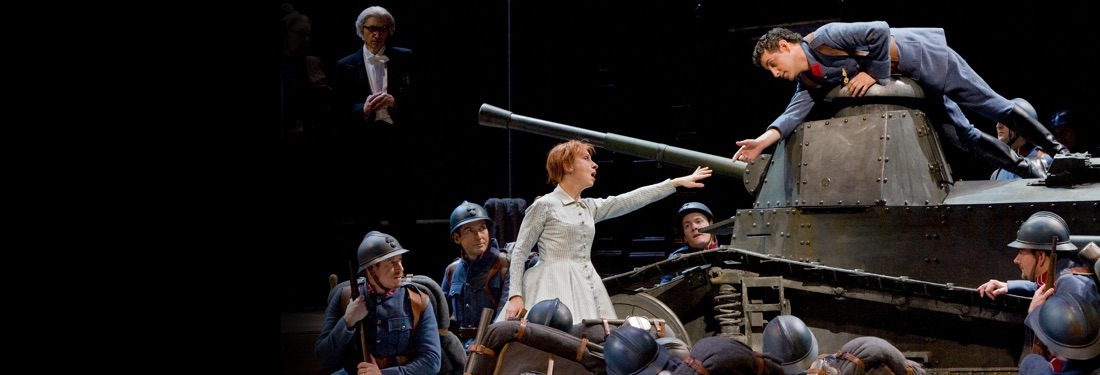
I checked back in on the Met’s revival of Ariadne auf Naxos yesterday, after a messy first night one week ago that left much to the imagination. Tenor Lance Ryan had been sick that night, and the cover who took his place was not much healthier, throwing the whole cast into a panic mode that made higher artistic values almost out of the question. Last night’s show was leaps and bounds forward, both musically and theatrically – a win for Strauss aficionados and an excellent save for the company.
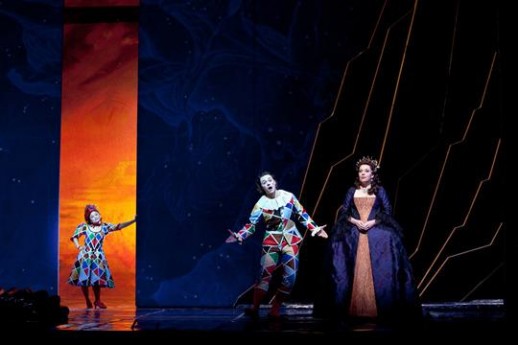
Cleaner blocking gave a sense of purpose to the chaos in the busy Prologue. The Major Domo had his lines down pat. Sarah Connolly cut an imposing and confident figure as the Composer, as she did on opening night, and sang with passionate lyricism if not vocal power. Jochen Schmeckenbecher (just try playing the Name Game with him) sang with more vocal might as the Music Master, and Markus Werba made a particularly fine musical impression as Harlekin, often upstaging Kathleen Kim’s Zerbinetta. She is not dreadfully miscast in the role, but that is about all I can muster for a compliment.
Kirill Pentrenko kept the Met Orchestra playing neat and lively, yet stirred then into a sumptuous swirl of sound in the opera’s soaring tuttis. He seems to have cut some deals with his cast, resulting in tempos that appeared more consensual than before.
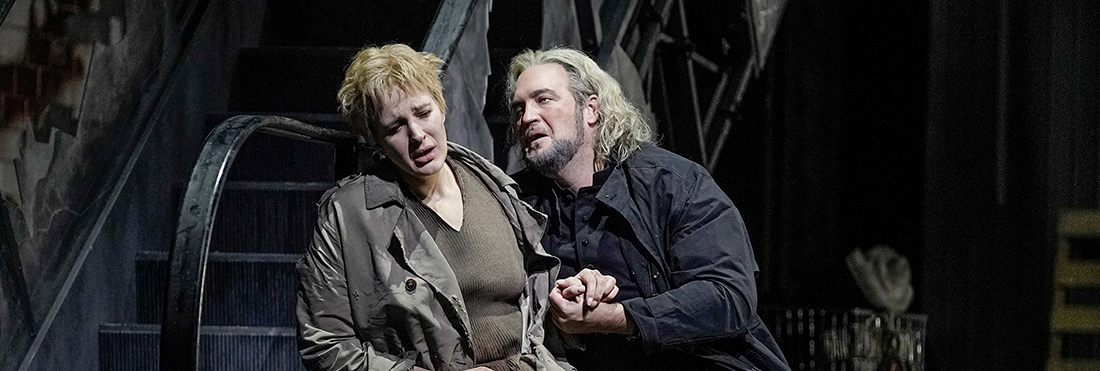
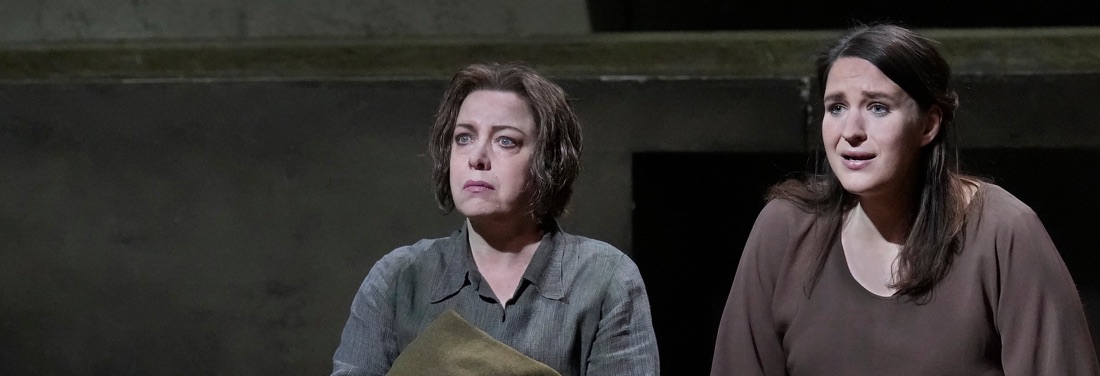
But the real star of this show is soprano Nina Stemme, whose debut here as Senta a few years ago drew only tentative praise. Though her voice has the size and brawny timbre for larger roles, Ariadne comes easier for her, giving her the luxury of full expressivity. Last night she packed pathos and ardent yearning into her portrayal of the morbid, heartbroken princess. Ryan was also impressive as her hero, wielding a lean, powerful tenor that complimented her darker sound. Both are capable of effortlessly curvaceous phrasing, and moments in their final duet interlocked in telepathic cohesion.
Thought it is a selfish pleasure to have more space in the lobby at intermission, these performances have been very poorly attended. With only five Ariadne nights on the docket this season, it is disappointing — even ominous – to see so many empty seats. Perhaps it’s the economy; perhaps the audience for this repertoire has dwindled. But for the lucky few who were there, these are still the good old days.
Squirrel, there are plenty of singers who are dead or soon will be from my early performances at the MET who are not glorified in my memory. Some were real flops (Vern Shinall, Philip Joll, that unfortunate mezzo who was laughed out of the theater the night Sutherland premiered an equally unfortunate production of Trovatore); others were just good, hard-working artists who performed honorably — but would not be “great stars if they were here today”.
There are rafts of singers today who excite me, and who give great performances, who are reviled here by some who will never accept that things are different now. However that doesn’t erase the fact that there were some truly remarkable singers and performances back then. I appreciate having seen their work and look forward to the work of singers who are on our stages today.
I’ll be interested to see how good business is for Ariadne in Boston later this season, at Boston Lyric Opera. Their (wonderful) recent production of Turn of the Screw was sold out, though in a small (~600 seats) venue. Excellent performances by Emily Pulley and Vale Rideout. For the Ariadne (the WNO production), the only name in the cast I know is Brandon Jovanovich, as Bacchus. Marjorie Owens has the title role, with Rachele Gilmore as Zerbinetta. BLO does seem to be aiming higher artistically under its new management, after some pretty dull seasons. It’s not always hitting the mark (the recent Carmen was poor stuff), but at least there seems to be more energy around.
Nelly, the real problem with the Carmen for me was the barbarous cuts–between 20 and 25% of the opera. Many numbers had internal cuts, some severe, while the Chancon Boheme that opens act 2 (one of Carmen’s numbers) and the big smugglers’ chorus in act 3 were eliminated entirely. Frasquita and Mercedes were reduced to walk-ons. Disgraceful!
What do you expect from an opera company that thinks cutting orchestra rehearsals will save money and result in a superior product? If CARMEN is TOO LONG for the attention span of an opera lover or the production causes people to miss the last train home something is very wrong indeed.
Well, the BLO Carmen may have been less filling, but what was left did NOT have the “same great taste”. Dana Beth Miller basically gargled her way through the show. And the action was banal at best. Carmen’s death should not induce snickers, as it did from many near me.
This ARIADNE probably did not sell seats as much as it did in the past for one simple reason: lack of true operatic superstars. Nina Stemme, though she is known (more so abroad) in operatic circles by avid opera buffs, she is not a superstar. The rest of the cast…relative unknowns. The opera – at least at the MET – depends on the singers, I’d wager, rather than the piece itself, to fill the seats.
I see the lack of attendance more a sign of the economic times rather than a judgement as to the suitability of this opera for house the size of the Met. Ariadne works very well in the house. Also this is the 5th season that this work has been performed in my 14 years of living in NYC. I will say that even though I love Sarah Connelly, I had no desire to hear her in a house the size of the Met in an opera with that amount of orchestration. She works best for me in baroque with a leaner orchestra. Though the thought of attending on Monday night with a less crowded house is actually a draw for me. The tourist trap that the Met has become can be quite annoying sometimes.
For some reason I have never warmed to Stimme’s voice, but Squirrel’s review has definitely made me interested. I saw the Norman Ariadne twice, the Voigt Ariadne three times, the Urmana Ariadne once and the Brewer Ariadne once. For me it’s just a matter of summoning up the energy to see one of my favorite operas with a less than stellar cast. There is just no one in that cast that I am dying to see.
The Met p.r. team can certainly sell out a new production or a production with a star, but maybe there have just been too many performances available to the public over the past few years? Plus you don’t have to brave the cold weather right now when it’s coming back next season.
I predict a sold out house for DiDonato next season, plus 3 performances will put a premium on getting tickets.
Is it just me or does Kim seem like a singer who is just not ready for the Met? Wasn’t wowed by her Olympia and from the reviews it seems like she is rather underwhelming as Zerbinetta. Is her cover Rachele Gilmore? Maybe she will get sick and be replaced by her on Monday.
Rachele Gilmore is in Knoxville….singing the title role of Lucia di Lammermoor (Feb 12/14)…so she is NOT the cover Zerbinetta.
But she IS going to be Zerbinetta here in Boston in the Boston Lyric production, with Brandon Jovanovich as Bacchus.
excerpted from from 2.2.1.4:
“young artist[s] who model their technique and attitude on the likes of Dessay, who disdains opera every chance she gets, or Florez who sound[s] like a sheep in distress will dull the expectations of the public.”
This is excellent – thank you, Quanto Painy Fakor.
And there goes the Dessay mythology again.
She’s said she wanted to be an actor or a dancer before she wanted to be an opera singer. She’s said she’d like to be an actor when she has retired from singing. She’s said she prefers roles which provide a challenge for her as actor as well as singer, and she’s said something about not being a huge fan of the libretto to La Sonnambula.
And these harmless comments are spun, wildly, into untrue and unfair accusations like ‘she disdains opera every chance she gets’; accusations which are not only unchallenged but praised. Regie productions are routinely met with comments along the lines of ‘oh, those poor singers having to do that’, unless they’re Dessay/Zimmermann production, in which case it’s all the fault of the singer because- and her we enter the realms of pure projection- she has no respect for the composer, the librettist and the art form. Double standards.
I’m not the hugest fan of hers, by the way- I think the bloom is off her voice and some of her dramatic choices are questionable. But what is depressing is that because she had the temerity to give honest answers to a few questions about her career, she is casually and witlessly crucified for it.
A mythology which is completely and utterly of her own design and making.
Stemme’s voice has everything one could possibly want– power, warmth, and a solid top middle and bottom, which is rare (in my opinion) in sopranos.
I loved her in Dutchman and Isolde. Loved her in Ariadne too though her voice seems a tad more suited to Wagner than Strauss.
uwsinnyc: I wish to ask this in a non-judgmental way, so please take it so: How do you account for that extremely wide, almost at wobble level, vibrato in Stemme’s mid voice? When she puts the pressure on for G or A or above it
consolidates to some nice steady tone, but most of the working voice is very
vibrato-ridden, and quite excessively so. I am not alone in this; two voice
teachers who heard her on the Sirius broadcast are saying exactly the same thing to me. To us, it sounds like a voice in late prime that has regularly been pushed into far too heavy repertory. One critic I trust says “she’s the real thing.” Well, yes — at moments. But the foundation of any voice is health in the mid range, and I do not hear that in Stemme. Are you a voice technician? Care to comment? I am all for this attractive singer, but I hear troublesome signs.
Not alone, mrmyster : I have heard other singers after listening to Stemme in the Domingo Tristan, say the same thing. Yes we want someone like Stemme to realize their full potential, but it is always deflating to hear such comments. Erring on the size of caution in accepting roles, is always better than the typical sad routine of ‘too much, too heavy, too soon’.
I agree with mrmyster. While I was listening, I called it a flutter-cum-wobble. Her tone is warm and beautiful, but it’s instability ruins the music…for me.
Thanks MrMyster.
To my (relatively untrained) ears she sounded solid and lovely but I certainly would not have the expertise to judge the more nuanced technical details of her singing.
May be someone else can comment.
The art of singing to a microphone and singing in a theater are two different beasts. I don’t think the placement of the mics at the edge of the MET stage do justice to any voice. Some smaller voices come off sounding louder, some larger voices come off sounding generic or worse yet, vibrato ridden. Either way they both sound homogenized in an unflattering and unnatural way. I liked her voice in the hall. I thought it warm, lined-up and powerful. The vibrato didn’t bother me at all, although I was aware of it while listening to the broadcast. I’m sure an argument can be made that ones voice should sound the same in any medium. But, when projecting over an orchestra I believe one tends to support differently than when singing in a recording studio. Just as positioning the mics IN the hall would capture the voice quality in a much different way than the current stage mics do.
VivaVivaldi stated “But, when projecting over an orchestra I believe one tends to support differently than when singing in a recording studio Just as positioning the mics IN the hall would capture the voice quality in a much different way than the current stage mics do”
I suggest think again:
(1)Wobbles are lack/and or inability to vocally support what the particular singer is attempting…..pure and simple. If they are also physically tired in mind and body, it will of course, be accentuated to a still greater degree.
(2) As for blaming microphone positioning ‘for showing singers in a poor light’ it will : only if they have bad habits in their voice production technique.
(3)As for pleading that professional singers ‘mindfully change their support’ whether in a studio or in a hall, I find that proposition a preposterous argument, and a mind boggling notion.
Next, by taking that proposition further : we will hear a argument that if any recording of their voices be done, they, the artists have the right to check the brand and technical specifications of the microphones being used. Alas, I know of no ‘sweetener’ microphones being produced ‘as yet” to benefit singers or give their voices a vocal botox injection.
(4)I,E :For a start, during performance of any piece: ‘it would call for continuous adjusting conscious ‘extra musical’ judgements to be made by a singer. If singers start trying to listen to their own voice while at the same time singing, things are going to go arwy. Ask any singer teacher (they tend to find happening often with a pupil)…… watch the teacher correct them ‘pull them up’ instantly. Teachers’ advice ;Disregard and forget all about it! Concentrating on what you are doing. ‘What you hear RESONATING IN YOUR HEAD IS NOT WHAT OTHER PEOPLE ARE HEARING!
(5) The only disadvantage of incorrect microphone placement, are matters of overall sound balance and natural perspective of the ‘atmospheric’ totality of what is being recorded. If a voice is shit to start with. or in the same condition: no positioning of microphone placement will stop the detection of it. The more ‘closer’ it is, allows even a novice to pick up the faults a little faster than they would have. The experienced listener has already so to speak, ‘been trained’ and their ears will to be ‘much more acute’ to detect vocal flaws even if a singer was recorded ‘more distant than normal’..so there is no advantage in the long run.
Perhaps some singers being recorded, need the sonic equivalent of what they used to use for visual purposes on film sets. For fading film stars with many wrinkles and age lines from ‘too much piss or what ever’, that makeup coudn’t disguise any longer. A roll down wire gauze screen in front of film lens to ‘soften facial features’.