
Headshot of La Cieca

Cher Public

  • brooklynpunk: " it does not follow that as many people will embrace opera”...
  • MontyNostry: Presumably JDD was singing that aria, so some of the standin...
  • quoth the maven: Entirely unfair. The union agreed to the contract; the cast,...
  • The Wistful Pelleastrian: That Grammy crowd gave a standing ovation to an opera ari...
  • marshiemarkII: Bravo tenorino!!!!! much as I thoroughly enjoyed the other o...
  • iltenoredigrazia: Thank you, thank you (bow down to the floor, hands to my che...
  • Betsy_Ann_Bobolink: Is it all right to say "John Huston," "Angelica Huston," or ...
  • kashania: Extravaganza is the word, all right. What fun! Congratulatio...
  • brooklynpunk: thanks, S-conductor!..... a much more "up-beat" rig...
  • whatever: mille grazie, IL3!

blog advertising is good for you

The People’s Courtesan

Thais2Like Liza Minnelli at the Palace or Nomi Malone in Goddess, Renée Fleming‘s Thaïs is better understood as diva event than Gesamtkunstwerk. It’s an opportunity to watch a star lady do her voodoo in a work that exists largely to showcase her glamour and appeal.

The raison dêtre of this particular showcase is undoubtedly the most polarizing contemporary opera singer, and whether you love her or hate her, a new Metropolitan Opera DVD of Thaïs is likely to reinforce your opinion

Acclaimed tenor/baritone/conductor/Live in HD host Plácido Domingo sets the scene on the Metropolitan Opera’s production of Massenet’s Thaïs in his pre-show introduction. After sharing that he’d love to sing the male lead but can’t because it’s a baritone role (this was filmed in 2008, pre-Simon Boccanegra; perhaps now he’ll give it a shot), he gravely intones: “And now, Renée Fleming in… Thaïs.”

An endless scene and a half transpires before the above-the-title lady in question finally makes her grand — and stunningly gowned — entrance, but to be sure when she does finally appear everyone onstage screams “Thaïs!” just in case we might have otherwise missed her. Fleming is not an exact physical fit for the role; her blond, dimpled good looks are more suggestive of a regional beauty queen (Miss Indiana? Pennsylvania, perhaps?) than the impossibly gorgeous and exotic lust object the libretto is constantly reminding us Thaïs is.

Thais3

But her singing is mostly strong and accurate — and, for the most part, refreshingly free of the bad habits that earned her the nickname La Scoopenda. The bulk of the role lies in a comfortable soprano mid-range that suits her voice, and she handles many of the higher notes with grace and musicality. Her interpretation of “Dis-moi que je suis belle” at the beginning of Act 2 is a particularly moving and well-sung performance sure to please her fans. She only resorts to screaming at the very end of act 3, where Massenet wrote a repeated phrase escalating to high D (finally settling to a pianissmo high A) that could confound almost any soprano without a superhuman instrument. Even then she hits the correct pitches with at least fifty percent accuracy.

As for acting, the character of Thaïs is so ridiculous – a wanton prostitute (excuse me, “disciple of Venus”) so successful at her trade that the entire community riots when she decides to give it up and join a convent – that the production and Fleming settle for creating a series of Diva Moments rather than trying to make the character seem real.

She mounts a ramp just to sing a single high C, then skitters back down to give Athanael the least romantic kiss seen at the Met since Karita Mattila licked the head of John the Baptist! She caps an aria by hugging herself and beaming adorably as the Met audience showers her with applause! She throws herself on a bed and laughs hysterically — then her laughter turns abruptly to weeping! She cackles; she burns incense; she waves her arms over her head!

Fleming’s musicality is strong enough to transcend this nonsense, but she does seem to have a gay old time playing a singing Theda Bara. However, those perpetual dramatic indulgences are a cinch to make the production more appealing for devotees of camp.

Thomas Hampson sings the role of Athanaël, which offers roughly equal stage time to the soprano part but far less musical or dramatic interest. Athanaël is a bit of a Norman Maine/Stedman Graham role – even when Thaïs is not onstage, he’s always going on about her -- but Hampson sings it beautifully, though perhaps his Athanaël would be more compelling if his singing reflected more of the character’s emotional turmoil. His acting skills are much more problematic, especially in close-up. His dramatic interpretation is limited to two emotions: tormented (this involves brow-furrowing) and boyishly gleeful (“Look, ma, I’m singing!”). Neither facial expression offers much insight into Athanaël’s tortured attempts to reconcile his love of Jesus with his lust for Thaïs.

Thais5Concertmaster David Chan offers the musical highlight of the DVD with a brilliant interpretation of the famous violin “Meditation” between the scenes of Act Two. The composition is undoubtedly the most beautiful melody in the opera -- Massenet liked it so much he repeated it almost non-stop for the third act as well -- and Chan gives an emotional performance that traces Thaïs’s difficult journey from the empty glamour of sin to the simplicity of saintly living. The Meditation is the one moment in the entire opera with true emotional resonance; it’s impossible not to be disappointed when it ends and the curtain rises on yet another closeup of Tom Hampson’s scowl.

John Cox’s physical production is a potpourri of Art Deco and period elements – dreadlocks for Athanaël and his fellow monks, Roaring Twenties costumes for Thaïs’s decadent circle of friends. The sets are mostly spare desert scenes or under-furnished interiors with the exception of the palace set in Act 2, a disaster in gold plate (even the palm tree sparkles!) that suggests Brighton Beach more than the banks of the Nile. The Christian Lacroix gowns for Thaïs are the one visually stunning element of the production; even the robe she wears to walk across the desert until her feet bleed is a stylishly draped off-the-shoulder number. Jesus López-Cobos (“my countryman,” Domingo helpfully reminds us in the introduction) conducts a dignified, nuanced reading of the score by the typically excellent Met orchestra.

Thais8

The only special feature is a compilation of the intermission interviews that aired during the original HD broadcast. We are granted the opportunity to hear Domingo repeatedly pronounce Massenet as though it rhymed with “bassinet,” learn a bit about the costumes, and discover that Fleming is particularly fond of Thaïs’s Act 2 aria because it addresses the uncomfortable but eternal truth that “youth fades.” The (sadistic?) director chooses a tight close-up of the star for this interview, but it must be said that whatever you think about Renée Fleming in Thaïs, the diva looks good.

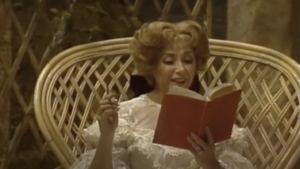
Thais1

114 comments

  • kashania says:

    Nice review, La Cieca. I have to say that I watched the PBS broadcast and was quite happy not to have to watch it ever again. Didn’t care for the opera, the production, or the acting. It obviously has some beautiful music but it’s best heard and not seen. The role suits Fleming very well and I thought she did a wonderful job, as long as I didn’t have to watch her.

  • CwbyLA says:

    It is a frustrating opera in my opinion. Indeed Renee Fleming did a remarkable job, Thomas Hampson was very good but the opera itself didn’t move a bit. The musical highlight was the meditation of course. I still think the cast did an excellent job with the material they had.

  • MontyNostry says:

    As I was always told, if you can’t say something Nicias, don’t say nuttin’ at all.

  • Sanford says:

    “Even then she hits the correct pitches with at least fifty percent accuracy.” Is that the definition of damning with faint praise?

    • MontyNostry says:

      Much as I adore Leontyne, and her rendition of that aria, authentique elle n’est pas. And her cheveux ain’t ‘or pur’. But that would never stop me enjoying that singing! And she has a bigger heart than Renee could ever dream of having.

      • mrmyster says:

        But that final note! Yipes!!

        • MontyNostry says:

          Yipes indeed. Those ‘Prima Donna’ albums of hers are treasures, even the 1977 (?) one where she is a bit past her best and mic’d too close. Not that her (naughty) top E at the end of ‘Caro nome’ is disappointing, though! I’m not sure whether she sounds anything like a young Mantuan virgin, but I’ll forgive her.

        • mrmyster says:

          Monty, dear Monty, as you grow older you will find there is
          more in Life than Miss Price. She’s sort of fun along the way,
          like lots of girls, but for the long haul — well, nothing you’d
          take home to Mother. What am I saying? Was Miss Price
          a vocal lady-of-easy-virtue? Well, she had one helluva
          gorgeous voice, but yes that is what I am saying. I’ll
          explain it more fully over our next lunch. Takes time and
          I don’t want to be quoted in the wrong places.

        • MontyNostry says:

          mrm – I know in a way what you mean, but she was one of my first soprano loves — along with La Norman (who fell off her pedestal with a thump for me about 15 years ago), Popp and Price (M). There are limits to Price (L)’s interpretative insight, certainly, but there’s a generosity of both voice and spirit that is most disarming. And, even when she’s being mannered (as she certainly was on a regular basis after about 1970) she’s somehow sincere about it — she’s never as sophisticated as she’d like to be. You can’t help lovin’ her!

      • Lucky Pierre says:

        wasn’t thais the role that precipitated lee’s vocal crisis at the time?

  • Will says:

    As I’m crazy about French opera by personal choice as well as genetic predisposition (are the gay gene and the French opera gene related? linked?), I enjoyed myself at the MET’s Thais a good deal.

    I agree about the Act 2 set but also have loved pictures of a guest room at Dolce & Gabbana’s Portofino palazzo — the entire room, wall tiles, furniture, fine chain window curtains and a grouping of sculpted palm trees — is gold plated. It looks kind of like living inside the sun and would probably have worked much better on stage for showing the ultimate in hedonistic decadence.

    May I suggest that Athaniel may actually be the leading character in the opera? His is really the more compelling story as his obsession with Thais leads him to trade his soul for hers, destroying himself in the process. It would have taken a greater actor than Hampson — or at the very least a stronger director to propel him — to realize that idea, but I do think that his is the real story.

    • dallasuapace says:

      I’ve always thought of Athanael as the main character. The recording of Thais I’m most familiar with it the one with Renee Doria and Robert Massard. Massard makes much more of a vocal impression in the role than does Hampson, IMO.

  • mrmyster says:

    Gosh! This is wonderful stuff. Well first of all, it’s not Boccanegra — and that’s a big advantage. Then, Renee seems to be having such a good time — I love it when she’s in a good humor and sharing the vocal wealth and smiles. What a doll! Eat your heart out, Sybil Sanderson and Grace Moore and Dorothy Kirsten, you sluts!, and Florence Quartararo!!! Hah! I guess Renee showed them! You see, that’s what I LOVE about this piece — it’s a diva showcase, twenty-four caret. And it’s delicious, genuine ‘fake religiosity (H. Schoenberg’s term),” if I ever heard it. I do wish Renee’s high-C had been just a tad more free, but I guess she did too — her huge smile makes up for it, though. I have heard that Renee is very partial to young studs — and you know, I think you can tell! Just something about that look on her face – a kind of a not-well-kept secret. T. sings her life, as set by Massenet, is such long hours; ummmmm. I have always thought that a rather obvious joke. Well, maybe I better not continue this line of thought. I just do want to say that I love Cieca’s write-up; Thais IS camp, but it is GOOD camp, and is there anything better in 19th C. French opera than really GOOD camp? One does have to wonder. I think we know the answer, and it is so hard to find, that good camp. Let me be serious for a second: It takes a singer who believes in the material to really whip up this schlag, and I give my admiration to Miss. F. that she does so and pulls it off brilliantly; no easy task. Brava!
    Oh, the indignity, the PREsumption of them putting on wretched old ugly smelly Placido to introduce this opera! How DARE they! What do they think we are, the great public, a bunch of dunces? Humpf! Why, I saw this opera about 100 years ago in Chicago with beatified Miss Price in the title role — to some extent that ruined the opera for me for quite some decades, even more than Leopold Simoneaux in a short apple green skirt as Nicias — you see, they meant it seriously, not campyly; always a big mistake. But, that’s behind us now. And I am already wondering who is the next great Thais? Renee certainly commands the role for the moment and I hope she comes back in it soon. Long range — no one in sight. Any thoughts from the Parterre? NO! Not Netrebko.
    It really does not matter who is Athanel – even Usutillo could not save that ungrateful role. I must say, Massenet’s preference for sopranos certainly shows. Nothing queer about old Jules!
    PS: Cieca, on the high Ds at the end, did you ever notice in the Kirsten recording she cracked her first high-D? Why did they not re-take?
    Was that the best she could do? Or maybe Merrill could just manage it
    one time.

    • La Cieca says:

      La Cieca thanks you for these kind words, but she doesn’t deserve them. The review above is by Critic of the Future, and La Cieca apologizes for getting the byline wrong until now.

    • MontyNostry says:

      mrmyster — you saw The Big L as Thais in Chicago? Were you a little melted heap by the end. The mere thought of her hitting those top D’s in that final duet is completely overwhelming. Even Renaaay got my spine tingling there. Hell, so do Bubbles and the clapped-out (but still adorable) Moffo. But Leontyne! (Swoons helplessly on the floor …)

      • mrmyster says:

        Monty, mon vieux, it was so long ago in Chicago that I do not remember the closing duet. Here is what I remember: Leontyne in the mirror aria was sitting at a prissy dressing table looking rather comical — I mean come on, this woman is not what the fictional French T. looked like in anyone’s imagination, including Miss Price’s — and she was so uncomfortable and
        self-conscious; it was just baaaad casting; embarassing. And the tenor’s
        fruitcake costume was ridiculous, had us laughing, and it was all treated so seriously — no clues as to style of any kind. And the Chicago opera house is waaaay too big for Thais, which should be in Monoco, Bordeaux or Brussels — or on a Met DVD. Bubbles was badly over the hill for her Thaises, she had had ovarian cancer surgery a year or two before, her persona was not right, and we all remembered her Manons, which were so successful. Moffo we will not mention.
        So…..I have never been melted by Thais. I am admiring of
        Miss Fleming’s technical and to a degree theatrical success — and I love the soft float of her voice in French music; it is RIGHT for all concerned.
        Price could not be more wrong on any count. I think the Price was right
        (ouch!), was at her best, recently when she bowed to one knee upon being introduced to Supreme Court Justice Bader!! Now THERE is theatre! :)

    • MontyNostry says:

      Eglise or Ailyn, maybe? Again, neither has a particularly French timbre, but they both make a gorgeous sound and know how to phrase. Ailyn also has pretty good French diction.

      Are there any suitable French sopranos around these days for this kind of role? I can’t think of any, sadly.

      • armerjacquino says:

        Delunsch could probably do it.

        • mrmyster says:

          Jacquinao, well now you are cooking! Mireille would play it so well, and
          of course has the lingo — but the top voice? Not sure there. I love her to death as Louise. But that stops at high-B.
          The Cuban Eglise sounds interesting, Monty! She is
          prodigiously talented — voice and stage abilities too.
          Huge bosom, equal to Racette, which is always nice
          in a soprano playing a worn-down courtesan
          Keep ‘em coming boys, more ideas! (Perez is badly
          over-rated; dull singer; voice patchy; she and her
          husband sort of deserve each other.)

        • Krunoslav says:

          She could have done it in a Colmar-size house before her worshipful coterie in the French opera world indulged her fantasies of singing Elsa von Brabant and the BALLO Amelia. Now she can’t get through Elettra without trouble. Thais isn’t going to happen.

        • Buster says:

          I vote for Inva Mula. Her Ah ! Je Suis Seule… is very beautiful.

          Delunsch has to survive her Jenufa’s first. Looking forward hearing her do that in May very much.

        • MontyNostry says:

          Buster, I have to say I was very disappointed by Mula’s recent CD of French and Italian arias. She made heavy weather of the French stuff — very surprising from someone seen as one of the leading ‘French’ sopranos of today.

        • Buster says:

          Sorry to hear that Monty – I wanted to hear her Mireille last fall, but it was completely sold out. She is an old love of mine – I heard her Nanetta in Chicago long ago, magical!

        • CruzSF says:

          I saw Mula in Elisir a couple of years ago and thought she was OK. Her voice and singing was surprisingly not distinctive, but pleasant. Her acting was the weaker aspect of her performance. But I wouldn’t balk on seeing her live again (I didn’t hear her latest disc).

        • Buster says:

          CruzSF: here is the Thais from that album:

        • CruzSF says:

          Hmm. I liked that. Maybe not as distinctive as La Scoopenda in the HD Broadcast, but I suspect some here will see that as a plus. At the very least, I’d give her a chance in a staged producion of Thais, since singers usually give more with greater focus while on stage.

      • iltenoredigrazia says:

        Monty, but of course, Natalie Dessay!
        :)

        • MontyNostry says:

          No one would have paid good money for the favours of a skinny little thing like that.

        • mrmyster says:

          Buster – Thanks for the Mula, above. What can one say?
          She omits the high-C at the end of the aria. What’s the
          point? The diction is lousy, legato and phrasing not
          great, and the voice missing some of the pleasing ‘float’
          which Mme Fleming supplies so generously, not to speak
          of the high-C. Not a role for Mula, I would say.

      • iltenoredigrazia says:

        Perhaps a bit more seriously, Gheorghiu could probably do it.

        • MontyNostry says:

          I was thinking that too — but could you get the bitch away from the mirror?

        • La Cieca says:

          AG would probably not do the big ascents to the high D in the final duet, opting for the “Geraldine Farrar” ossia, but other than that I think this role would be a terrific fit for her. Find her a director and a baritone she likes, and she might give it a try.

        • AG has the glamour not the top. Dya think Massis could do it? Too high for Delunsch.

        • Critic of the Future says:

          I agree; I think she’d really be terrific, minus that little bit of the death scene that Renee can’t sing either.

          And I think AG is a much better actress, so we might get more from her Thais than I did from Fleming’s performance, which seemed, as I mentioned in the review, like a series of Orientalist poses with no character behind them. One thing Fleming particularly seemed to be missing was any sense of dread or remorse or shame in the early scenes; she really projected a wholehearted enjoyment of Thais’s amoral lifestyle, which made the overnight conversion even tougher to believe.

        • kashania says:

          I don’t know if AG is a much better actress. While she can act with her voice, her stage acting is very self-conscious. One always gets the impression of La Gherghiou “acting”, rather than the character she is supposed to portray. With Fleming, it’s “Look at me, I”m ACTING!!”. As you can tell, I don’t care for either of them as actresses. I guess if I had to choose the lesser evil, I’d go with AG.

        • MontyNostry says:

          Renee = Junior League Mom does summer stock.

  • chaka says:

    I’ve never been a fan of Renee–she just bores me. I did, however, like her in this role. Sadly, the entire opera is so slow and plodding, most people will think, “I never need to see this again.”

    Another generation will have to go by before everyone forgets what a bore this is and revive it.

    • mrmyster says:

      chaka, all things are relative – even boredom! Have you seen Le Prophete in the theatre, Dalila, other Massenet (not the great Manon, I would never be bored by that) — things like Herodiade? Urf! I sometimes think that Carmen is the only French opera of the 19th C. that is really good theatre. But sometimes (Manon, Werther, Thais) Massenet’s music is of such quality that it carries the show. I do
      find that now and then in Thais, and as a singer friend said, “Thais is where Renee’s voice wants to be!” And I think that is true. One can take great pleasure in watching her sing this not-easy score. In other words, Thais is only a bore for me, when the soprano is not up to the job — it’s HER opera, or it’s nobody’s.
      Sorry, Mr. Hampson.

    • almavivante says:

      Another generation DID go by before the Met revived Thais. I saw Sills do it in…was it 1979?…and although I suppose I enjoyed it I retained no memory of it at all and was looking forward to revisiting it. Now I must concur: I never need to see Thais again.

      And as to the other comment (9.1) about 19th-c French opera being not-so-good theater, perhaps I would cautiously agree, EXCEPT for the intoxicating Orientalism of Lakme. Would that the Met not wait another half-century before they revive it!

      • BETSY_ANN_BOBOLINK says:

        I’ve always thought ‘Faust” was reasonably good theatre, and in its way “Romeo et Juliette.” another suggestion might by “Les Contes d’Hoffmann” and by stretching a point”La Perichole” and “La Belle Helene.” Another I know only from recordings but it sounds very viable theatrically and musically — Reyer’s “Sigurd.”

        “Pelleas et Melisande” is 20th Century by a nostril, which takes it out of contention. “Hamlet” we will soon be able to judge for ourselves, but what about “Mignon”? None of these are negligible musically and require only the right production team to gie them the proper sparkle. And voices, of course.

        • queen amahelli says:

          I think French opera (if I can be permitted a crass generalization) is infinitely capsizeable compared to the more robust Italian genre. And people tend to expect the direct unsubtle dramaturgy of realist Puccini when they come to Massenet, who is erroneously seen as a French equivalent. He’s less fail-safe and far more diverse when it comes to subject-matter and mood, even if he’s not a match for Puccini as a composer. The tone is hard to capture – Anglo-German cultures get uneasy when lightness, sensuality, sentiment and tragedy are mixed up – when you get it in Wagner (minus the lightness) there’s usually a punishment to make us all feel superior. French juices are subtler and more elusive. I bet Thais would work a treat if the kitsch were banished, and someone alive to its ironies and atmosphere were to get their hands on it.

          And, as a ps, whenever I’ve seen it, Hoffmann always strikes me as astonishingly modern in its dramaturgy – it’s not the works fault if its shoved on as a vehicle for various divos/divas – its very embittered, ironic and macabre. These pieces need to be done very very well indeed. The reason Tosca and such ilk get shoved on, is it’s much easier, theatrically, to do.

        • No Expert says:

          Ah, Mignon: Girl working as attraction in traveling sideshow hates girl working as actress in traveling Shakespeare company; inspires arsonist; discovers crazy old guy is her dad.

          With a plot like that, you know the music has to be beautiful!

        • mrmyster says:

          I love Faust and all its arias, but theatre is not. It is just
          a series of numbers — a commentator recently called it
          an “opereatta.” I think he has a point. Manon is fine
          theatre, sometimes I feel Werther is – well Pelleas is
          impressionistic theatre — and I find it dramatically
          effective in a pale sort of way. Lakme strikes be as
          kitsch or high-camp, neither one a bad word in my
          operatic vocabulary — there is certainly room for that
          kind of self-conscious “show biz” mentality PROVIDED
          it is really well played and sung — like the Met’s
          Thais last year. I wont argue with people who like
          Hoffman — I heartily dislike it; find it a sick-sick
          piece and I always feel bad after seeing/hearing one.
          So I try to stay away from it. However, none of this
          need be taken too seriously — after all, it’s just
          opera!

    • Alto says:

      I can easily imagine someone feeling that way on first viewing. But I saw that show four times last season — in the in of duty, mind you — and must say that I came to admire the craft of it.

  • No Expert says:

    Yes, on the surface Thais is the story of the holy man who falls for the hooker with the heart of gold. But the underlying theme is the eternal, metaphysical tug-of-war between Jehovah and Venus which manifests itself in a battle for the souls of these two human beings. The deities (both of them invisible yet ever-present) basically wrestle each other to a draw, leaving in their wake the corpse of Thais and the shattered faith of Athanael. And it has one of the saddest endings ever.

    • Batty Masetto says:

      N.E., I’m with you that there’s more to this work than its shiny surface. Besides everything you mention there’s the dilemma of two intense people who are looking for profundity and permanence in a world where the only alternatives appear to be complete renunciation or triviality. Both are rootless, existentially driven and more perceptive than everyone around them, but they get their answers wrong. There’s a fairly intense critique of spiritual values hidden among the religiosity, which I think is exactly why the religiosity seems fake – on one level, it’s meant to.

      • No Expert says:

        I think that’s why I see the struggle as a draw. Neither Thais nor Athanael gets the concept of human love quite right, either at the beginning of the opera or at the end of it when they “switch sides”

        • Batty Masetto says:

          Exactly! And the irony is that they’re drawn to each other – he obsesses about her, she submits to him when she never has to anybody else – because they both sense they do have the potential to maybe get it right. But they’re blinded by religion and disillusionment. So they literally go wandering off into the wilderness and the end is sad, sad.

          I like the way the production puts the block party in a street that’s already filling up with sand that nobody bothers to clear away. The Alexandrians are celebrating on the Titanic.

    • mrmyster says:

      Well, Dr. No, you got it just about right! Typical 19th C. French/Latinate
      opera — Venus/Eros has to be allowed some victories, but in the
      end Jehovah, or more exactly Mother Church, has to be allowed to
      “win,” though always with a wink! Don’t you think? I find so much of
      it like that — I mean it is just soooo French, and their love/hate
      relationship with the Pope and his Church. I am just reading
      Mr Brown’s new book “The Soul of France,” a history of the
      church/state struggles in France in the 19th C — it is a knock
      out, wonderful book and gives the perfect context for Massenet’s
      faux religiosity as incorporated in music, a kind of tongue-in-cheek
      salvationism. The French are nothing if not Latin — and we tend
      to forget that. They are really more naughty than the Italians
      in that time at least, and no question had a lot more fun while
      feeling very guilty about it. Sort of like US Politics today :)

    • Alto says:

      I’m sorry, but I’m quite sure that an opera cannot be all about a two characters who are never seen and — much more to the point — never sing. That sounds very deep until you think about it. The drama is in the singing. No character is truly portrayed in opera without singing — the novel attempts of the old women in Tobacco Road and Vanessa not withstanding.

      • Batty Masetto says:

        Alto, Jehovah and Venus are not characters, they’re forces or themes. Thais is about them much in the way that Don Giovanni is about sex, or Fidelio is about freedom, or Otello is about jealousy. They’re part of the energy that propels the thing. Call them asceticism and sensuality if it makes you more comfortable, though that’s neither as precise nor as evocative as N.E.’s choice.

        • Alto says:

          Of course I see where you’re coming from; it’s a commonplace of literary criticism. But I persist that opera is different. Forces are not what matters in opera; characters do — singing characters. That’s why opera at its birth and at the reforms of Gluck — and Wagner — are replete with the appearance of gods. They knew that “forces” needed personification, vocal personification, in opera.

        • Batty Masetto says:

          Alto, but why must it be an either-or? Thais and Athanael are singing characters – far more complex than they’re usually given credit for – who are propelled by a whole constellation of motives, and some of those motives gel into themes. Remove the themes and you no longer have the characters either. Would Don Giovanni even exist without sex?