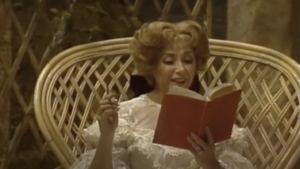

Le snore
What is it about Natalie Dessay, La Cieca wonders, that provokes journalists to badmouth La sonnambula?
As, for example, Christian Merlin in Le Figaro, who characterizes a new production of the Bellini gem thusly: “À l’Opéra Bastille, Natalie Dessay domine de tout son talent une soirée grise, dans une œuvre à l’intérêt limité.”
It is unfair, yes- hence his description of it as ‘an idiotic formulation’.
People seem to be answering what they think HH wrote, rather than what he actually wrote
Thank you for that, it was getting a bit Bizzaroworld around here.
Oh, so I’m not banned, I’ll have to break this up I guess.
It is unfair, yes- hence his description of it as ‘an idiotic formulation’.
People seem to be answering what they think HH wrote, rather than what he actually wrote
Thank you, it was getting a bit Bizzaroworld in here.
At most I may suspect you might have been influenced by a certain prejudice of so much Anglo-Saxon and Germanic musical intellighentsia
Again with the patronizing “tsk tsk, you just don’t *get it*, do you, poor child” pat on the head. I can’t possibly have my own thoughts and preferences, oh no.
My, what a pompous windbag you are, MJC. I’m in awe. I just finished reading your Wikipedia bio and you’ve likely forgotten more about opera than I’ll ever know about it. However, your post reminds me of this Monty Python sketch
(Mmmmmm…..Graham Chapman……mmmmmm):
I’ve heard Bellini’s operas, mainly through Met broadcasts. I’ve read through the piano/vocal scores of Norma and I Puritani, I’ve even willingly paid money to go to a performance of Norma. So, spare me the “you don’t like something I like, it’s a *failure* on your part” style of “arguing”.
1988. I go to the LA Operas A <Midsummer Night's Dream mainly because the composer was gay and had a religious experience and that was that. I was an opera queen. I read up on opera and I immediately focused on 20th century works. It’s my favorite period of orchestral music and I recognized some of the composers. First opera recordings bought: The Pears/Britten Peter Grimes, the Wergo Die Soldaten, the Fischer-Dieskau Lear and Penderecki’s Devils of Loudon.
I soon fell in with a group of older men (I was 28 at the time of my conversion) who were more than happy to bloviate *at length* as MJC did above on the subject of opera. They instantly turned their noses up at my avant-garde leanings and at gatherings, played me Bellini. And Verdi. And Rossini. And Donizetti. The lot of ‘em. Their idea of “20th century opera” was Fanciulla.
I’d want to talk about the 48 note chord in the storm scene of Lear and instead I’d be stuck at these parties where it was “Let’s hear 35 versions of the same aria so we can play Name The Singer” night. I wanted to scream sometimes.
(to be continued)
My, what a pompous windbag you are, MJC. I’m in awe. I read your Wikipedia bio last night and you’ve likely forgotten more about opera than I’ll ever know about it. However, your post reminds me of this Monty Python sketch (Mmmmmm…..Graham Chapman……mmmmmm):
I’ve heard Bellini’s operas, mainly through Met broadcasts. I’ve read through the piano/vocal scores of Norma and I Puritani, I’ve even willingly paid money to go to a performance of Norma. So, spare me the “you don’t like something I like, it’s a *failure* on your part” style of “arguing”, you remind me of the opera queens I met when I first was getting in to the art form.
I tired of that but luckily the Internet came along and [Korngoldian-sweep in the background music] *sob* I realized I wasn’t alone in an uncaring, unfeeling musical universe! There were other people that liked post-WWII opera, who could discuss intelligently the operas of Birtwistle, Sallinen, Henze, Penderecki, Reimann and so forth! *SOB* [/sweep] In the years since then, I’ve heard stuff from Monteverdi to Pintscher, I have my likes and dislikes, for reasons good and bad.
I also have always had a limited amount of time to listen to music and I never, for the life of me, could understand the attitude of “I’ve been told this is great, I’m not getting it, *I* need to try harder“. That sounds so….so….English boarding school. My attitude is “NEXT!”, there’s a whole universe of music out there, why waste the effort listening to stuff you don’t like or, if you know the composer, have a reasonable expectation that it won’t trigger another religious experience and avoid it? The piece is always their for reappraisal later.
Why go into more detail?
Indeed.
There is a lot of supposedly serious music that is “insipid” but the word doesn’t apply to Bellini
I love how you lecture me, Aschenbach-like, on the need for Apollonian detachment when considering the arts --passion leads to the Abyss, as you know-- but you can’t wait to make a purely subjective statement as if it were fact.
Dear sir, you made the ‘purely subjective’ statement about poor Cavaliere Bellini. “Insipid”. Is that of value as a description?
Let’s define ‘value’ as being 1/accurate (it is inaccurate unless you don’t understand English), 2/relevant (being inaccurate it is not relevant to an intelligent discussion of art), 3/illuminating (being inaccurate and irrelevant it also shows a substantial ignorance of the entire romantic movement in music — Bellini was an inventor of that movement. It arguably would have proceeded much differently had he not written as he did and enjoyed such success and so many performances that as far away — then — as Russia, Glinka ‘the father of Russian music’ was shown a way into a personal and national style, though he was also heavily influenced by Donizetti and wrote delicious chamber ensembles using the themes of Anna Bolena).
I don’t care about your personal taste. Had you stopped with saying “I don’t care for Bellini and much prefer Penderecki” I would hardly have had a comment (a private opinion perhaps since I am wondering where the Pole shows anything like the mastery and invention of Bellini in his operas; his earlier work though less singular than it was thought when new is still quite striking the first time around or after a long period away from it — oddly he retreated from his earlier modernest posture into a kind of haute Slav pastiche — sounds like a loss of nerve or inspiration to me). It’s your leap from a personal taste with its limits and idiosyncrasy to a Philistine and uninformed dismissal that bothered me.
And I believe the irony for Aschenbach (you might try reading the story) is that there is no such thing as Apollonian detachment, which if one takes the tale at face value (one needn’t as Mann criticism has shown), he learns to his cost.
There is however such a thing as critical judiciousness, which really was my point. A critic might well prefer Schumann as the greatest romantic and I don’t think one would argue with that judgment, though he was not a success as an opera composer (beautiful as much of the music in Genoveva is). But even that critic, inclined to sneer at say the conventions of Italian opera in Bellini’s time, which dictated all his subjects except perhaps for Norma, and insisting that they co-opted and severely limited a composer’s musical options, would in honesty have to concede Bellini’s imaginative solutions to the problems of those conventions, including the melodic recitative for example, or the phrases of irregular length and the exploration of unusual meters (9/8 for example) — were all used later to ‘free’ the imaginations of romantics like Schumann. I don’t feel that if the discussion is to be intelligent one can simply dismiss someone like Bellini and his music is certainly not ‘insipid’, though one can as an individual with free will to listen to what one pleases, avoid his music.
Again if you really “studied” Norma, then you would not say it was insipid. You might say ‘it was not to my taste’ but to be unaware of how remarkable so much of the writing is is an intellectual flaw.
Since you invoke and link me to the ‘old opera queens’ I will say that I had no patience with them either. I am not interested in defending the familiar merely because it is familiar. Popularity is not an endorsement for me in any art form, the popular is often the worst of a given period (and for a long time aside from unstylish performances of Norma Bellini was not a popular composer).
The argument that Tosca and Rosenkavalier have lasted and therefore must be good is an idiot’s argument usually hiding a very lazy and ignorant mind. The insistence that Chenier and Adrianna are somehow defensible as music (though they may be fun when well performed) is ridiculous. I am not interested in the bizarre people who fixate on Wagner with no understanding of what he is doing (for better and worse).
I detest the idiot at Opera Nostaglia who refers to ALL the serious music written after Turandot as ‘noise’, when Turandot is a mixture of noise and preposterous banality (Lehar and Kalman easily wrote prettier and more expressive music than the tenor arias; Liu’s music is short breathed and unremarkable save perhaps for ‘quanto amore segreto’ which is an imitation of Ravel.) To be unable to hear the beauty in Berg or Britten or Henze or Adams to name only four relatively conservative composers is a confession of utter stupidity the holder of which ought to be whipped for — and yet how lazy the opera people who accept that judgment!
But enough of an argument that must bore all but me. I personally have a fiend’s delight in exposing idiocy and Philistinism (while being vulnerable I suppose to the latter charge from the genteel and intelligent M. Croche for not being all that impressed with a self described second rater such as R. Strauss).
Dear Mrs John – no reference or downright outpour on my DG posting ?
?
Madame CerquettiFarrell it is an indictment of me that I have written too much of equivocal value and no interest for this site to bear and must soon be banned and thus have not commented on your brilliant defense of Don Giovanni.
Yes everything you say makes sense to me from a musical perspective and I adore Idomineo surely one of the greatest operas ever written, something that even perhaps transcends the form (I would rate Clemenza somewhat lower but not much lower).
But DG seems to me unresolved, despite the many astute points you make about the women. The first DG was only 22, six year older than Cherubino and more of a tenor than a baritone (he later sang only as a tenor). So I must wonder about the ‘Catalog’ aria. What are we to make of it? Given travel at the time poor DG would have had to sprout wings and be flying from place to place from infancy to have bedded all those ladies. And it is difficult to see him clearly as any recognizably human figure, good or evil. A sexually self indulgent youth hardly seems so horrible — and it is not clear from the text that he raped Donna Anna.
Moreover Da Ponte’s jokes are often at his expense (he brags about his acute nose when it comes to women but the point is strongly made that he has quite failed to smell Donna Elvira though she claims he married her and they have certainly been intimate and she gets mighty close without his ‘smelling’ her. This is one of the former priest’s dirty jokes but I wonder how to take it in the larger context of the piece). Then there is the continual frustration of his attempts on Zerlina’s honor. In fact, its a joke in the opera that he NEVER succeeds in seducing ANY woman he approaches not even Donna Elvira’s maid. Finally the Commendatore only secures his soul by a school boy’s trick (he has the stronger grip evidently not supernatural power).
If DG is a joke than the reactions to him begin to seem false even if some of the expressions they are given are powerful, as you rightfully aver “in quelli ecessi” is, or “Don Ottavio, son morta!” — however is Elvira merely a hysteric and is Donna Anna telling the truth? Even Zerlina does not seem a model of purity — she gives DG every chance even going into a private room with him during a noisy party — but then again he keeps her close to her intended, he doesn’t abduct her as a true villain would have.
Thank you though for your illuminations, your posts are invariably thought provoking.
Hey, but somehow I tend to think all the dramatic flaws you’ve mentioned are exactly the ingredients that contribute to my admiration and appreciation for this stage work. Everything is so unclear! Nobody is what they seem to be. And Giovanni is a big hole in the middle which we all tend to fill with our own ideas. Yes, I know Luigi Bassi was a high baritone and around 22 at the premiere. But have you read Gobbi’s (very) interesting thesis about Giovanni, the seducer with the shadow of middle age already hanging around him? It strikes dramatic truth, despite the fact that Mozart tailor-made his music for the respective creators.
I also find fascinating the infiltration (or rather left-overs) of buffa traditions still inherent in the libretto. It spices up the action and provides exactly the “sane” refuge from all the highbrow mulling-overs. These are the things that make up DG. I don’t know that the characters are not to be taken seriously, they are invariably forced to live in two different, contrasting worlds. It is this ‘twighlight zone’, inhabited by Giovanni (possibly also by the ridiculous yet heartbreaking Elvira) that conjures for me the fascination of it all.
A classic example of the score’s many ambiguities: Why on earth does Anna intone “gente servi” in the MIDDLE of the stave instead of shouting it an octave higher? and what is the meaning of the E Flat transition in “ti sapro perseguitar?”, Anna and Giovanni singing in thirds above Leporello’s buffo mumblings? And the drawing out of Il Commendatore’s death with triplets burrowed later by Beethoven for his Op.27? Three male voices lost in the dark? It is as potent for me as Beethoven’s 131, where you can’t really explain why it works so well together, but in some mysterious way, it does.
DG is ever fascinating, ever mysterious, piled up, pretentions, illuminating and ridiculous.
And the orchestration is absurdly dense for its time. I have never heard the violin figuration (surely the important element)below the Anna-Elvira diatonic / chromatic scale at the very end. These are details unheard, live or recorded, and they live only in the score.
And I have yet to deal with the astonishing sequence of Si – No – Si – No (commendatore scene) in which DG “pulls” into diminished sevenths and even more obscure and ‘modern’ harmonic regions, while the old man’s Si’s are more conventionally harmonized, until DG himself ‘solves’ the problem by a terrific dominant, leading into the statue’s ultimate resolve into D minor (where you get the strings imitating hour-glass). Mozart is the explorer of human psyche and perversion, and also the patient therapist. Note that this has nothing to do with the libretto, deliciously banal and puppet-play like in these closing pages. No, this is all Mozart’s doing.
CF, your thoughts on DG are well-considered and very interesting. In the end, very persuasive indeed.
Since you invoke and link me to the ‘old opera queens’ I will say that I had no patience with them either
You are *exactly* like them, to the letter, you’re the same age cohort as well. You remind me of this one man I knew in New York named Bob: the pronouncements from on high, the bombast, the mind-numbingly tedious sidetracks, the pomposity, it’s all there.
It’s your leap from a personal taste with its limits and idiosyncrasy to a Philistine and uninformed dismissal that bothered me
“Uninformed”? Balderdash. *You* assumed I’d not studied the scores, which is risible. I’ve heard the man’s operas, I’ve studied the scores, I’m not bloody well “uninformed”, I just *gasp* come to a different conclusion about them than you do. Again, your opinion on Bellini’s music carries no more weight than that of my mail delivery person. You keep acting as if YOU have the final word. Ding! Wrong! So I dashed off “insipid” instead of writing huge, discursive paragraphs why his operas bore me to tears, big deal. I’m certainly not the only person on this planet who has no use for Vincenzo Bellini’s operas, it’s a shame that fact agitates you so.
My 2 cents:
I ADORE Bellini. I can listen to it all day. Everytime they play Puritani on Sirius I listen to the whole opera–even with Nebs??
I like Dessay’s singing, but don’t give a shit about her comments on anything–she is obviously a little nutty.
Anyway, I will always have Callas–and, on occasion, Sutherland!
I am not as crazy about Donizetti–don’t know why. And I like Rossini a lot!
I am not of fan of Baroque music or Bach, but I love Beethoven, Schumann, Brahams and Mozart’s instrumental music; Mozart’s operas interest me less and less as I get older (used to adore them)–e strano.
Anyway, who cares what I like–only myself (why am I writing this?)
From the Fact Checking Department:
But if you say, the worst of R Strauss is great and he is the greatest composer of the 20th century that is a different statement. Sadie Moskovitz-Klitstain (I believe that is Opera Chic’s real name) made that statement
Klitstain? Really? Ah, casual misogyny, that’s sooooo 70′s. Opera Chic is a 20-30-something Asian-American woman, not Jewish. The fact checking: Hans Werner Henze is OC’s “Greatest Composer of the 20th Century”, as she’s made repeatedly clear.
I’ve been banned from her joint for pointing out the blatant hypocrisy of her excoriating any chance she gets people like R. Strauss, Pfitzner and anyone else who didn’t rise to Toscanini-esque levels of anti-Hitlerism but bans people who want to know when she’s going to acknowledge HWH’s radical chic embrace of Castro and Communism in her snark.
Well, if you’ve been banned from Michiko Dragonphoenix-Klitpalace’s place (sorry about my confusion concerning her name) then you didn’t see the glorification of R. Strauss — it was there, as part of an encomium to a certain tome. I have stopped reading it since then, I hardly need the idiocy she parades when trying to be ‘critical’. Henze took a turn Strausswards (Auden referred to Elegy for Young Lovers with embarrassment as ‘our Arabella’) perhaps that is her bridge to his music, beyond their personal acquaintance? I love all his symphonies and found the Seventh quite remarkable, in fact I own not only the score but about six performances and weep every time. I also love Kammermusik l-Xll and recommend the Pears/Bream pirate as one of the great performances of anything ever. The operas appear to me to vary but I do love Die Bassariden, which I think is gorgeous. I believe he renounced doctrinaire Soviet style Communism as did many leftists of his generation when they realized all the lies successfully promulgated by Lenin and Stalin, horrors both, though the latter loved music and opera and had it is said a glorious bass voice. He worshipped literally the tenor Kozlovsky and they would sing Ukrainian songs into the dawn (he also worshiped the very greatest Yudina who would tell him to return to Christ and repent, and lived, though I doubt she played the Berg sonata for him, one of her party pieces).
Stalin may also have been a closeted homosexual, a theory just beginning to be explored in Russia. But I had my suspicions when I learned that in the seminary, where as a teenager he was writing poetry in between robberies and assassinations he memorized ALL of Leaves of Grass evidently in the first edition (the one I am told was published in Russian first) where the glories of fellating young men clearly preoccupy Old Walt and the Live Oak with Moss section documents a sad love affair between the randy aging poet and a feckless boy (as are not they all?). This was the edition Mr. Lincoln also memorized of a night when in Springfield before retiring for a cuddle in that tiny bed with Joshua Speed (Mr. Lincoln was a large body).
Walt expurgated it when the Alcotts (including the morphine addicted likely lesbian Louisa Mae) visited D.C. to beg him to and Emerson opined that it was a work of genius but too often obscene. As for Castro, was not the attraction for Hans Werner rather Che, a gay icon on the left for those inclined in that era (from pictures they all look too unwashed for me, but then I am not German and was raised to bathe and expect the absence of odor from interlocutors, even cute ones).
Pfitzner hated Hitler (the feeling was mutual) and also hated Jews so that is a tricky situation (he is also hilariously withering about Evil Incarnate). I adore Palestrina (and I AM Sena Jurinac and Irmgard Seefried as Silla and Ighino) and Die Rose vom Liebesgarten — Furtwaengler said the last had a first act that rivaled the first act of Die Walkeure. I’m afraid Von deutscher Seele has glorious music in it despite some ‘iffy’ texts. The songs are also (mostly) gorgeous and so is the chamber music. We must avert our eyes from the symphonies, though I’ve heard worse.
You make me hate her more.
Well, if you’ve been banned from Michiko Dragonphoenix-Klitpalace’s place
Another reason you’re just like the dreary old opera queens I knew: the casual misogyny common to gay men of your vintage.
As the song goes “You’re nearly a laugh, but you’re really a cry”. What the fuck does Stalin’s sexuality or Abraham Lincoln have to do with anything on this board, you absurd old windbag? Opera Chic’s opinions of the Strauss operas are not what I was addressing, it’s her intense dislike of his conduct from 1933-1945 viz a viz the Nazi’s that’s the nub of the gist, but of course, you don’t care about that minor detail, you just want an excuse to bloviate about any topic that flits through your head.
Yes, Henze woke up and renounced Castro and Communism, but he did that long after the purges, show trials and Gulag were known in the west and that still doesn’t erase the fact that he jumped on the bandwagon for the most shallow of reasons. It’s almost as embarrassing as Lenny Bernstein hosting the Black Panthers for cocktails.
You make me hate her more
What a sad, small man you are, to get so worked up over an opera blogger who spends half her time writing about fashion and Milan and Roberto Bolle.
You’re being unfair to Mrs JC. She can’t help being the way she is. To me she is the Natalie Dessay of posters. When she’s good, she’s very very good; when she’s bad she’s at least interesting, and when she can’t make her point any other way, she rolls around on the floor and screeches.
Well, Henry Holland, you are an idiot, which sadly is not what I meant. By all means continue like this. If you are not interested in the variety of human species than by all means ignore the psychology of Stalin and Lincoln, opera lovers both, but I find people fascinating and unless La Cieca puts certain topics off limits and she hasn’t, your criticism is that of a limited, slow witted dolt with no imagination and sensitivity, hence the characterization of someone with a great talent as ‘insipid’. It isn’t necessary to write paragraphs though it is not a fault to do so (strange that in a medium where writing is of the essence, you dismiss its value, I assume you are quite slow) but talent should be done justice, even if one is finally unconvinced by its output (I contributed several paragraphs to what I admire about R. Strauss).
You are a typical grotesque queen that haunts these sorts of boards and while I doubt you are really young you are truly an immature nonentity as too many people on these blogs are — a sad prophicy for what future is left with your limits, shallowness and crass stupidity.
Like Michiko Klitpalace (and I’m more anti-goon such as you than I am misogynist), You seem to be unaware of the complexity of Strauss’ relationship to the Nazi’s. He was not a hero, but he was by no means a supporter or opportunist as were many others, he had his daughter in law and two grandsons whose possible fate terrified him (and it was the sudden appearance of the Americans that rescued them as the local Nazis were on their way to kill them when the GI’s drove up to the villa). He was also quite an old man.
And I will read you no longer (but you will read me, that I promise, because you wouldn’t have bothered with your uninteresting but stupid self revelations if in someway my opinions didn’t matter to you — though by all means ignore me please. Grotesques like you rob me when they read me).
Oh dear! I’m alarmed by all these posts. Is this the start of World War III? I hope not, at least not through opera. All those gals from Pasta to Callas, including afterwards Sutherland and Scotto, but maybe not Dessay, were all for “amore, amore” and not “guerra”. Oh dear!
You’re not the only one. I can’t help thinking of the phrase “this is why they hate us”. I’ve never seen so little respect for others deeply held opinions nor such a lack of any semblance of underlying joy in the musical experience. I know we like to bicker over arcana, but the vitriol in this thread is astounding even for a bunch of opera queens. I didn’t realize the purported opinions of Callas, Britten and Henze etal. were deadly weapons. Why some of the masters do not appeal to all is a question that can never be answered (and I am not naming my least favored in this thread of all places), so why burst precious blood vessels trying.
I thought Dessay was touching in the Met’s Sonnambula, for all its flaws, and for me the production was certainly less off-putting than the gruesome traditional staging that showed up in another thread here a few days ago. Whatever others may have seen, watching close up in HD I saw nothing resembling condescension in Dessay’s approach to the role, and in fact she persuaded me that I may have been wrong in dismissing Sonnambula all these years. (Just for comparison, Moffo’s gorgeously sung sleepwalking scene on YouTube only persuaded me that this was one of the silliest operas ever!)
I’ve seen Sutherland in her prime as Lucia at the Met, and was thrilled and impressed. I saw Dessay as Lucia in San Francisco, and for the first time ever with that opera, was charmed and moved to tears. (Could be I would have felt the same way if I’d ever seen Callas, but I never had the chance.) Anyway I’m glad I got to see both and can’t for the life of me understand why people are treating Dessay as though she were doing opera some kind of disservice.
The sneers toward Bellini are unwarranted. Musical snobs will scoff at anything so obvious, which is, simply,that Bellini created some of the most beautiful music to ever have been composed. It must be said, though, it is beauty with a purpose; whatever Bellini wanted to convey in a melodic line, scarcely anyone did it more arrestingly. “Casta diva” alone IS the aria EVERY soprano wants to sing, it is the piece everyone wants to hear.
There are sections Bellini composed, which in my opinion, have no peer. More skilled and “better” composers have worked far far harder for less.
For me that moment always happens at the end of NORMA, at the precise moment where Norma’s final ‘di lor pieta’ from the “Deh! non vollerli vittime” modulates into her “Padre tu piangi,” with Oroveso and the chorus backing. Right at that modulation, when those penitent, remorseful flute “tears” purl in, I am immediately overtaken by the haunting, hypnotic, eerie power of the tonal palette. My reaction is so automatic, yet it catches me off-guard
every time; my intellectual response is replaced entirely by an emotional one. Scarcely another piece of music conveys a character’s transformation of absolution as devastatingly as this does. It is almost impossible to ruin, as it practically plays itself; only a cold fish of a soprano could
fail to respond to such a magnificently peerless piece of writing.
Bellini said, “Opera, through singing, must make one weep, shudder and die.”
There were certainly better composers, more consistently talented and
skilled craftsmen, but few ever reached a single pinnacle of sublimity as
Bellini did at the end of NORMA.
As for Dessay’s assumption of Amina, and her inveigling to “change” SONNAMBULA (to suit HER), she missed the boat by about oh, a couple of centuries. Clueless to the gills about what the character and the piece is about: her mindset is of a hopelessly contemporary cynicism so acute, you couldn’t even explain it to her how thunkingly she doesn’t get it.
I’m sorry, I also absolutely love the 1st act finale cannon
Oh! di qual sei tu vittima
Crudo e funesto inganno
Pria che costui conoscere
T’era il morir men danno.
Am I the only one to adore it? Utterly unsingable (for a real Norma voice) in modern pitch.
Here’s a very good stab, all around.
Yes, not bad! Nice to hear it. Anyone know where and
when? Outdoor arena it seems — I thought the light
breeze rather helped!
You are not alone, dearest Cerquetti/Farrell…count me in as a lover, too
Why say you that it be unsingable in modern pitch, and by that are you referring to 440? Probably around 432 in 1831?–but I truly do not for absolute sure.
A big hug to you from halfway around the world!
Is not the real tragedy that Bellini died before his talent had really consolidated itself? It’s as if Verdi had died at 35, and left ‘Macbeth’ and several immensely promising scores. Obviously, ‘Norma’ hits the jackpot both musically and dramatically. But the elements don’t quite seem in synch in the other works. For me ‘Puritani’ is a work of great musical beauty, but many commentators blame the absence of Romani for its ramshackle storytelling – convenient no doubt, but ‘Norma’s follow up was ‘Beatrice di Tenda’, libretto by Romani – and I’ve tried with that piece several times and always tuned out long before the end – Bellini’s memorability seemed to desert him: does anyone – maybe Mrs JC – know why?
As for the earlier works, ‘Capuleti’ is rather beautiful and poetic if you banish Shakespeare, and ‘Straniera’ rather fascinating, in an Ann Radcliffe gothic silly-thriller sort of way, ‘Sonnambula’ elusive and almost too refined and delicate for a real theatre – they strike me as studies of uncommon interest, or stepping stones rather on the way to a culmination, of which we were cheated. Rather like if we had ‘Luisa Miller’, but no follow up in ‘Traviata’ maybe?
“‘Capuleti’ is rather beautiful and poetic if you banish Shakespeare”
But, marketing ploys aside, CAPULETI has nothing to do with Shakespeare and didn’t intend to, It is not based on Shakespeare’s play but on Luigi Scevola’s play GIULIETTA E ROMEO, which draws from medieval sources.
Oh – thanks for that nugget – I stand corrected!
O dear Queen Amahelli –
If I do recall correctly, Bellini and Romani had a HUGE row over intricacies of Beatrice and there was a hassle over the timely delivery of the libretto, thus putting a major crimp/cramp in Bellini’s writing m. o. — constraining him to write very quickly and possibly to borrow from himself, but I’m not sure on that point as it has been a while now since reading this bit. At the initial performances there was a great deal of protest that sections had been swiped from either Norma or Sonnambula, not quite hard to believe as he had to accommodate the precarious means of a voice of G. Pasta.
Perhaps Mme. Claggart will come forth to expostulate and fill in on my rude sketch.
I am struck by your thoughtfulness re B’s early demise. Even Rossini said he had made great progress with Puritani (how much of that may have been Rossini himself, as he borrowed the score to oversee in media res)…what might have been!!!
This is a …ehmmm… less successful attempt
Misguided wench:
http://www.elle.fr/elle/Loisirs/Musique/News/Chic-Nathalie-Dessay-chante-a-Paris.-La-voix-la-!/(gid)/1133453
Sorry for the broken link. This works:
http://tinyurl.com/yz5f6v5