

Three things I learned from Werther

1. Webcast technology has been refined enormously in the barely two years since the pioneering (and frustrating) effort at streaming a performance of Il Sant’Alessio. The embeddable (!) player didn’t skip once that I could see, and the sound was consistent. Neither, obviously, was exactly HD quality, but the experience felt quite seamless.
2. The “chasing” format is a good idea that deserves to be emulated. As La Cieca understands it, the webcast began an hour after the start of the actual performance, then omitted most of the intermissions, finishing with the performance more or less in real time. The savings in resources and to the audience: nearly an hour of filler.
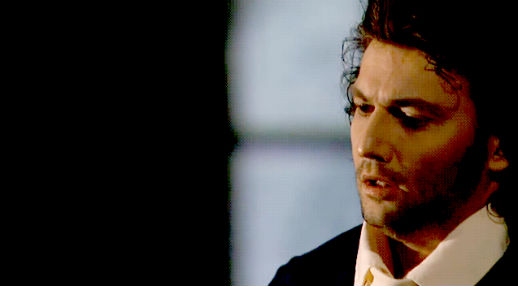
3. In general, the filming was done using simple camera angles and fairly sedate cross-cutting. This format put more emphasis on the performers’ movement (or, in the case of the remarkable Jonas Kaufmann, stillness) and even on a small computer screen offered some sense of being in the same theater as the performance. (The shots from the flies, as if from the POV of the Citizen Kane stagehands, were an exception to this tendency, and La Cieca thinks also that we don’t need to see into the wings as performers prepare to make their entrances. What if Kaufmann needed to hawk up a loogie just prior to taking the stage? Not that anyone so dreamy would ordinarily do such a thing, but La Cieca thinks it’s nice for artists to have options.)
All three of these observations, La Cieca thinks, could apply to the Met’s already very successful video program. In particular, the thrilling experience of a live transmission of an opening night performance (already beamed into the Plaza and Times Square) would be redoubled by making it available via a webcast, adding hundreds of thousands of viewers to the already high-profile event. (This and other live events shared via webcast could, it seems to me, be served through the MetPlayer technology, since obviously a buck has to be made here.)
Furthermore, the Met might consider “chasing” the Saturday afternoon HDs (beginning the movie experience at 2:00 pm instead of the usual 1:00), which would have the added benefit of minimizing those inane backstage interviews.
As for the minimalist camera work, La Cieca has her doubts whether such a thing is the cards for the Met, invested as they are in razzle-dazzle. But it would be lovely if, eventually, there were offered the choice of a less frenetic edit of a telecast for those of us who prefer to see the singers’ and stage director’s vision of the work, not the film director’s.
I concur; sitting through an opera without intermissions is way too long (think Wagner! now that could be deadly). As for age, during the Somnambula HD an elderly gentleman graciously explained to me that since at my age I could have no idea about real art, I could not understand what a great artist natalie dessay is, with such a huge volume of the voice and pitch-perfect coloratura with resonant top notes. Since I had an uncontrolled fit of laughter listening to this, he then went on with his opinion of today’s youth, obviously, not a very high one. But actually I found it quite nice, because I’m not that young anymore
.
Watch Kaufmann’s eyes. I note that he does not
often seem very expressive with his eyes — does not
use them to send a message – I wish I could put that
more cleverly, but you know what I mean. At least he
does not close his eyes very much; Netrebko is another
performer who does very little with her eyes. That is
too bad — good eye work can be quite effective. Such
necessarily makes the whole face expressive.
Mrmyster has a great point: a local diva I know is fierce about the eyes being the window to the soul. Not that Pavarotti was ever much of an actor, but on video his eyes were dead things. (Of course, these huge low-angle closeups of singers are almost always cruelly unflattering.) Kaufmann is eye candy, but eye contact still matters.
For what it’s worth, Sant’Alessio worked very well from a technical point of view when I watched it. But I streamed it after the fact, which surely made a difference. Maybe that’s a better option. Give ‘em time to get the kinks out.
What I couldn’t believe was that William Christie said that the music of Sant’Alessio was comparable in quality to Monteverdi. WTF? (The performance was very good, though.)
I tried to use the player on livearte’s site and it never connected but I’ve watched the excerpts on youtube. Sounds very good and Sophie Koch is a convincing Charlotte. I was at the encore HD broadcast of Rosenkav; when I saw it in October, the final trio moved me to tears but because of the constant closeups, that amazing scene lost its force. That has to be seen full front, all three at once. BTW, Fleming does wonderful work with her eyes–she said so much with those expressions. Netrebko does, too, in the Manon from Berlin with Villazon.
Three things I learned from Werther at the Bastille
1. How not to stage WERTHER (where’s the dramaturgy? Where’s the drama?)
2. How not to direct the TV Broadcast (when in doubt, pan to the orchestra in the middle of an aria, and that’s just for starters)
3. How not to conduct Werther–turgid tempi, molasses soup romanticism, missing instruments at key moments (the harp, seen but not heard)
Jonas Kaufmann was great, though.