
Three things I learned from Werther

1. Webcast technology has been refined enormously in the barely two years since the pioneering (and frustrating) effort at streaming a performance of Il Sant’Alessio. The embeddable (!) player didn’t skip once that I could see, and the sound was consistent. Neither, obviously, was exactly HD quality, but the experience felt quite seamless.
2. The “chasing” format is a good idea that deserves to be emulated. As La Cieca understands it, the webcast began an hour after the start of the actual performance, then omitted most of the intermissions, finishing with the performance more or less in real time. The savings in resources and to the audience: nearly an hour of filler.
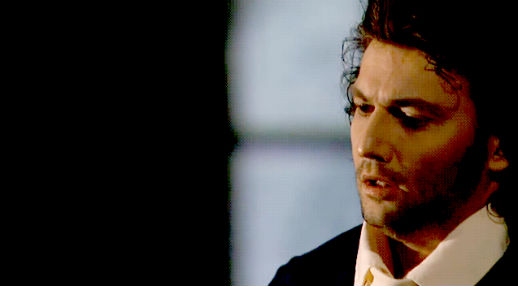
3. In general, the filming was done using simple camera angles and fairly sedate cross-cutting. This format put more emphasis on the performers’ movement (or, in the case of the remarkable Jonas Kaufmann, stillness) and even on a small computer screen offered some sense of being in the same theater as the performance. (The shots from the flies, as if from the POV of the Citizen Kane stagehands, were an exception to this tendency, and La Cieca thinks also that we don’t need to see into the wings as performers prepare to make their entrances. What if Kaufmann needed to hawk up a loogie just prior to taking the stage? Not that anyone so dreamy would ordinarily do such a thing, but La Cieca thinks it’s nice for artists to have options.)
All three of these observations, La Cieca thinks, could apply to the Met’s already very successful video program. In particular, the thrilling experience of a live transmission of an opening night performance (already beamed into the Plaza and Times Square) would be redoubled by making it available via a webcast, adding hundreds of thousands of viewers to the already high-profile event. (This and other live events shared via webcast could, it seems to me, be served through the MetPlayer technology, since obviously a buck has to be made here.)
Furthermore, the Met might consider “chasing” the Saturday afternoon HDs (beginning the movie experience at 2:00 pm instead of the usual 1:00), which would have the added benefit of minimizing those inane backstage interviews.
As for the minimalist camera work, La Cieca has her doubts whether such a thing is the cards for the Met, invested as they are in razzle-dazzle. But it would be lovely if, eventually, there were offered the choice of a less frenetic edit of a telecast for those of us who prefer to see the singers’ and stage director’s vision of the work, not the film director’s.
la cieca, are you obsessed with jonas this week? it’s about the 5th thread on the kauffmann boy already. is he your new BF?
I really enjoyed the telecast…but dislike the “backstage” shots during scene changes. The one “stupid” stage direction was having Koch come thru the auditorium of the Bastille BEFORE the final scene. It was just idiotic.
why does he pronounce “jetee” and “restee” so bizarrely? je-tee-yeh… shouldn’t it be je-teh-yeh.
The first “e” in jetee and restee is a closed vowel and was pronounced correctly.
http://www.languageguide.org/francais/grammar/sound/pronu/mp3/vs7.mp3
what do you mean? jetee is pronounced je-tea-ay? i always thought it was je-teh-ey?
Name a non-native-French-speaking Don José of the last 30 years who sings better French at this level, please!
Kraus? Gedda? Both very much still singing in 1980.
One answer is Marcus Haddock. And has Gregory Kunde done Jose? He has great French.
Kraus surely never sang Jose and Gedda certainly gave it up some years before 1980.
Jonas is very good withal.
Yes, dumb of me. I was concentrating on ‘singing in French’ rather than on ‘Don Jose’. Apologies.
I see your point about the “chasing” format, La Cieca, and all its advantages, but I would psychologically lose some of the thrill of experiencing a truly live, as-it-happens performance. I know it’s not rational, but I’ve always enjoyed the Met’s live radio broadcasts much more than the various delayed broadcasts of LOC et al.
Change the Met format? What, and miss the chance to see Renee, Deborah, Susan et al and their fabulous interviewing skills? Miss the wonderful things that singers have to say right after they come off stage? No splits? No dancing? It’s like taking all the fun out of opera.
Maybe in the future when the Met releases the HD broadcasts on DVD there could be a choice between “audience view” and frenetic edit much the same way there is “full screen” and “wide screen” in some DVD releases
I like having intermissions when listening to a live performance. I think the solution isn’t to eliminate the backstage features but to make them better. Sometimes they are fun and other times they are lame. But keep them, I say.
I completely agree, however, with less fussy editing and camera angles. I, too, would prefer to see the stage director’s vision as opposed to the film director’s.
Yes, indeed. I am a particular non-fan of Brian Large’s work–in fact, I’m sick of him. I know that the stage is the stage and video/film is video/film. Got it. But trying to force a stage production to be a video/film is a compromise of both media. With his relentless close-ups that frequently eliminate any sense that a character is part of a scene or is getting important reactions from others, Large violates what the singers and director are trying to do, while making a lot of personality close-ups that become boring very quickly, particularly when the mechanics of singing is so cruelly highlighted.
I remember fondly the work of Kirk Browning. He gave us close-ups when it was important to do so. Otherwise, he provided medium shots that let the opera “breathe” and allowed us to see stage groupings and pictures. And he used full-stage shots to give the big picture. Browning respected that a stage event was happening while adapting it to the home screen. I miss his work very much.
While I like the idea of making the Met HD broadcast chasing, have you noticed tha average age of those audiences? They need the bathroom breaks. As do I after the supersized Lemonades, though I guess I could resort to diapers also. Personally, I admit to enjoying visiting with people at intermissions and watching the sets being changed. I did think that yesterday was miles beyond the first one that I tried to watch years ago — WERTHER with Bocelli and Graves from, i think, Minneapolis. Was that the first ever opera webcast?
Hey, I need my bathroom break, too, and I certainly bring down the average age of the audience (as one kind gentleman noted to me recently). Because of the timing here, I drink my morning au lait during Acts I and II.