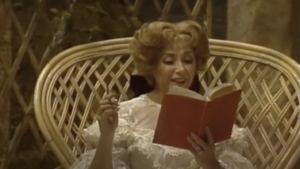
Votre chat, je peux vous le rendre
The last parterre chat of 2009, Carmen from the Met, begins at 6:00 pm for a 6:30 curtain.
Copyright © 2012 parterre box - All Rights Reserved
Powered by WordPress · Parterror Theme by Nick Scholl for DIS Magazine
Lucky Pierre says:
January 1, 2010 at 10:06 PM
nobody seems to have mentioned one of the great carmens in the latter part of the 20th century: verrett. it was one of the great crimes that the studios would not record her carmen.
The subpar American was to record it with Solti ( the “Burrowes” CARMEN– yet when something went wrong they called not Hood , Pring or Veasey but another subpar American.
Now, Troyanos, bless her, sings a Carmen with far too few consonants.
No-one but you, Vicar, calls the Solti Carmen, the “Burrowes” Carmen, and it is regularly chosen by British critics as the first choice studio Carmen, largely thanks to the performance of the “sub-par American” in the title role. Troyanos was well-loved at Covent Garden and sang there all too rarely in her latter years. Even so, it is surprising that Verrett wasn’t chosen for the Decca recording. Her live performance with Solti, Domingo, te Kanawa and Van Dam from Covent Garden has appeared as a “pirate” edition, on Opera d’Oro, I think.
Decca’s Carmen started out as a Berganza project but she withdrew – Verrett was approached but wanted a huge (Bumbry-size) fee – they’re lucky to have got Troyanos!
Ann Hood? Wasn’t she a soprano?
Here’s a revised list of phrases can be tossed around to feign sophistication and knowledge:
1.”As a singer myself …” Where do you sing? The shower? The local community church?
2. “Atrocious French diction.” Somehow, “atrocious Russian” doesn’t seem as popular …
3. “Lacks musicianship.” Unless one is prepared to back this one up with knowledge of the score, it’s usually just said to sound more snobby.
4. “She might be good but she pales compared to …” (a totally unknown singer). Maybe the most famous example of this is the pronouncement on Birgit Nilsson: “She might be good but she’s no Amy Shuard.
5. “I will reserve judgment until I have heard the performance but I am sure …” In other words, you don’t know what the hell you’re talking about.
6. “Decline of standards.” If you heard Rosa Ponselle’s Leonora you might be onto something but all too often this is followed by “Place totally mediocre forgettable singer into some role.”
7. Ranting about the Gelb administration by interjecting discussion about a displaced Volpe refugee in the discussion of an opera, without thinking that said refugee singer couldn’t even touch said opera in the shower. For example: “I really miss Ruth Ann Swenson and Hei-Kyung Hong in times like this. Will we ever see them on the Met stage again?” When the opera in discussion is, say, Carmen, and the discussion is about the lack of good Carmens. Or Elektra.
8. Using such gag-inducing phrases such as “creme de la creme” or “Italianita.”
9. Making broad generalizations about a singer, including her fitness to sing whatever repertoire, and her “French diction,” based on a 6 minute youtube clip posted upthread.
10. *And this is my biggest one.* Giving a singer a backhanded compliment/put-down by saying, “Jonas Kaufmann/Alagna can be good, but only in the French repertoire.” Or “Trebs is acceptable in Russian repertoire.” This is akin to the infamous quote about Leontyne Price’s ability to sing “Bess.” What else? “Um … Bess.” And totally ignores the fact that “French repertoire” could mean anything from the standard lyric (Werther) to a voice killer like Enee or Benvenuto Cellini, and that a singer who excels in Werther is much more likely to have a success in Boheme than L’Africaine, also in the “French repertoire.”
4. Unless these comments are tongue-in-cheek (see the Vicar).
10. Werther actually was created not by a “standard lyric” but by a dramatic tenor, Ernest van Dyck, who also sang Lohengrin, Tannhaeuser at the Met, and Parsifal at Bayreuth.
Ernest van Dyck, a heldentenor, however, also sang Des Grieux in Manon in Vienna and was very popular there in a variety of French roles together with Marie Renard (who was not French but from Graz nee Poetzl – reportedly had 100 curtain calls for her farewell Carmen at the age of 40). Van Dyck was from Antwerp, sang also Parsifal at Bayreuth but seems to have had a short career 1887 to 1905 or so and was portly and not terribly comfortable with the German language though surely the world premiere of Werther was actually in the German language.
I think our notions of ‘heldentenor’ and ‘hochdrammatische’ are not those of our ancestors. Not only were theaters smaller, so were orchestras, playing on gut strings and routined to support rather than compete with singers. No one had heard a voice like Melchior’s or Flagstad’s back then. But that also meant that sweetness and beauty of tone were valued highest of all so that a Behrens could not have gotten into the chorus, but a young Ricky Leech might have had a great career even getting to heavy roles without wrecking a marvelous voice by screaming and pushing.
It must be said though, that act two of Werther is a killer stretch, those arias are murder and the orchestra is very loud there. The declamation is indeed Wagnerian. The model is probably Parsifal where there is one stretch of very heavy singing (Amfortas! Die Wunde…) but very little singing in act one (as with Werther) and very lyrical singing in act three.
I am always very surprised when lyric tenors like Kraus survive it so well (so does the 60 year old Schipa on a live b’cast from Rome).
Exactly what I think, Mrs John. And while on the subject of gut strings, I’m pretty certain that I can discern gut strings on the 1935 Walkure act I from Vienna / Walter. Does anybody know whether gut strings where still en vogue before WWII?
Re Nilsson-Shuard – that must be a Vicar comment. No-one serious would make such a remark.
“Van Dyck, ya know…”
Poisonivy, your phony-sophistication hit list is hilarious. But you see, they can’t NOT.
And how about the dreaded “overparted.” Ha.
TT: “The baritone Mariusz Kwiecien absolutely looks the part of the dashing, cocky toreador Escamillo, a role that straddles the bass-baritone divide.”
Talk about fantasy prose! Why does the NY Times let this guy to embarrass himself every time he reviews a hunky singer?
URL: http://www.nytimes.com/2010/01/02/arts/music/02carmen.html?scp=2&sq=c
P.S. Lindoro_Almavia you’re sweet and knowledgeable so ignore the dragon lady who disses.
Oh sweetheart, I have said it before, if you can’t stand the heat, don’t start a fire. We all diss here and there are some of use who do it with sharp claws.
I am not bothered by it because I know my opinions are not always popular and sometimes the tone is not the best either. People dissing is a way of life in this site because that is what we do, we challenge each other, sometimes nicely and sometimes not so nicely.
The whole pretending to know something personal about a poster is an old trick that might have been invented by Adam himself. Besides, it is well known that the fastest way to get under a singer’s skin is to openly question his/her abilities and talent. It is known because it works in most cases, just not with me.
True story, about a year ago, in a different forum, someome who was pissed at me (privately) callem me a castrato with no high C. I wrote back I have not given you permission to grab my crotch, but if i did let me assure you there’s enough there to keep you busy for hours. My High C says hi, it is as fabulous as ever The guy never bothered me after that…
Caro Lindoro: Would you kindly submit a photo and your recording of ‘Salut demeure’ as soon as possible. I always
knew there was something about you
that I liked!
Do the grope and the high-C occur
at the same time?
Well, depending on the mood, you might get to hear the high C before the grope, somedays you’ll need to grope before you hear the high C. Then there are days that if youn’t grope and sqweeze there’s no high C.
Isn’t that the way it is with all tenors?
I’ve never heard any opera queen complain about corn-fed crotches, Lindoro. I agree with MrMyster: let’s see a video, though I’d opt for your singing “Pourquoi me revellier” as you reach downward.
His use of the word “straddles” is particularly telling
Welcome back MrsJC, we always miss you. But Please don’t tarry too long here, the world does wait for you to finish the idi amin liederbuch. Will the harmonic language be complex, like in madame butterflee. or better melodic like stravinsky? we here at the Dushanbe opera understand the world premier has to be in South Philly, at the Teatro dell’Amaro Pianto, local for the great artiste Benita, but we have as good here too. Think that after dushanbe you can do Bishkek, Ashgabat, and last but not least Tashkent, then your reach will really be global, worldwide, famous. Maybe Anya from Krasnodar can also sing it in grozny opera, I know Anya no good artyiste as Benita Valente from South Philly, from amrika, but we try sovok style.
And on the way here, you caould stop in dresden and sing contessa perdono to the firebombing victims, and irak is also on the way. there you can apoligize with L’italina in Algieri (no pun intended) to victims of amrikan soldiers.
And last, we have a big store by Hagen Daasz here in dushanbe, a choke a full.
Chinchilla, I think I like you! Would you please post some more?
Thank you MR, can i call you just that MR. You honor me and meke me feel smallisch. You know so much, write so well and are so kind, sometimes a bit naughty as when you flirt with lindoro, but he was telling he has a big, hoo do you say it schwanz. Anyway I am so far, but if you can come to visit in Dushanbe, please ask la cieca for my email address, I give full permit for you. And when you come to dushanbe we will kill many goats in your honor, and rub your body with goat oil, our special treat for honored guests. And maybe we can ask Anya from Krasnodar and Valeri from Ossetia to come to perform for you at the Teatro dell Amaro Pianto East just for you. Do you also love the dame Jones from Welsh?
Why Chincy, how you do go on! Of course everything you say is true, but all things considered it might be best if we met in Wales rather than
Dushanbe. I am about out of my Calday lavender anyway, so we could visit the Monks for a fresh supply. Actually, there have been times
when I found Mme Jones quite effective, as in the Bayreuth Ring of
long ago with that French producer! Stay warm now.
MR, I would love to meet you anywwhere, but Welsh is beautiful da, I just received the DVD for that ring, from my friend in dresden, he wants to teach me wagner, german, and other things. I will tell more about that ring with gwenith jones later but I am sure it will be the beste. Write me privately anyway, I want to know you, I have no friends here in dushanbe
Chinchi
mrmyster, you can get Caldey Island Lavender online
http://www.caldey-island.co.uk/
They even send you a hand-written receipt!
Whew!
Jack Jikes, yeah!
I have a moral aversion to fur – or fur trim – and being something of an acolyte of Mrs JC, I find it odd to be so dazzled by the linguistic pyrotechnics of La Chinchilla. But after enduring a certain review of the Met’s Hoffmann I suppose I have a disposition toward anything that is not Squirrel.
La Chinchilla’s prose is worthy of Nabokov. I have read the damn post 50 times. The assault on Madame Claggart’s political asides is Swiftian in its savagery.
Who’s afraid of Madame? I am.
Chinchilla, once again – Whew!
Hi Monty-Nostry: Yep, that’s where I’ve been getting it, but I also
want to visit that little Welsh Island one day, and to pick up a
supply of all the goodies they make at Caldey!! We grow the
flower/herb very abundantly here in New Mexico, even in my
own garden, but nobody makes the essence like those monks!
Thanks.
Jack Jakes: “… and being something of an acolyte of Mrs JC … La Chinchilla’s prose is worthy of Nabokov. I have read the damn post 50 times. The assault on Madame Claggart’s political asides is Swiftian in its savagery.”
You must very stupid darling. I can do without you as an “acolyte” (nor am I looking here or anywhere for such). You haven’t read or certainly understood any Nabokov if you think this grotesque’s vomit displays anything like his control, precision, cross linguistic puns or insights — and while a place like this doesn’t conduce to a serious writer’s discipline in revision, even Nabokov’s casual letters and postcards reveal a remarkable off the cuff verbal virtuosity.
Nor have you really understood Swift. The key to brilliant polemic is an underlying logic and precision, not scattershot free association and reverse pretension along with lies.
The loathsome nonentities’ gloss on comments I may have made elsewhere is lost on most of those here and irrelevant to them as ought to be the case. But what you and the preposterous goon think of as ‘my’ political asides are humanitarian concerns with pointless, mindless slaughter of innocents regardless of the lying justifications of those who defend such slaughter. Neither Swift nor especially Nabokov were taken in by tyrants and the slobbering adulators who are too stupid to think for themselves and support them. In fact their contempt for the dumb fellow travelers like you and I assume your hero(ine) was terrifying. It seems to me that you and the fool you admire are moral nonentities and that is far worse than loving Behrens.
So please ignore me or join in with your hero (ine) — fools belong in peepods where being empty above they can at least keep their cockles warm.
Madame – your post is a howler.
Liebe Jack Jikes, I left a little farewell surprise in the Act Five thread. Enjoy the swiftIAN and the nabokovIAN even if I am rossian and not armenian, but sovok all the same. You and doberdawg the velikyi will always be in meine ganzen herz. dresden for ever, ewige, ewige.
leb wohl
chinchi the rossian amrikan
sorry, forgot to sign Chinchi from frigid Dushanbe
i’m so hoping all of you would stop with all this vicious attacks. a lady can’t come in here without having to cover her ears.
Re the compliment paid by Nilsson to Shuard I remember reading it in an inteview with Nilsson when she and Shuard shared performances of Turandot at the ROH.You could say the english star was no competition,but on her good days she was a formidable singer.Shuard was a big fan of Nilsson but she told me the soprano she admired most was Varnay.She had a lot of success in many major houses but never at the Met.I think that recent recording of The Trojans gives a good idea of her unusual talent and very un-english intense sense of drama.
Has anyone *ever* seen in print (other than from our resident Behrens groupie, I mean) any reference to Sills having had poor Italian or French? I sure haven’t, much to the contrary. I am fully conscious of her faults, vocal and personal, but that wasn’t one of them, not by a long shot.
Whereas Behrens was dreadful to hear in Italian and French (as was Obraztsova, whom the groupie seems to imply I consider “an artist”- far from it, though she did some thrilling singing for a while, certainly in Russian. Elena O. sucked in German, too.
I made no statement about Elias other than that she appears in those clips with Gedda. I heard her only late in her career and in congenial rep ( i.e. not as Azucena or Rosina) in which she was highly comptetent rather than wonderful, but her recorded Italian and French were also markedly better than that of Behrens and I wonder at the groupie’s savagery about her. Maybe she refused him an autograph once?
Kruno – I have to laugh over this little tempest because one time I was quoting some line of Manon to Sills (over lunch, we used to be friends), and she very nicely corrected my French and discussed it a bit. Her French was singers’ French, rather like Eleanor Steber’s; it wasn’t French French but it was eminently singable and she got her vowels right. Her bright ‘squeaky’ voice was a lot closer to being ‘French’ than Italian timbre and I think that’s why her Manon was fine, whereas her Italian ladies were less so. I admired Behrens enormously — she was very talented in lots of rep, but not as Tosca and I don’t think I ever heard her sing much French. Not to make generalizations, but have you ever heard a German speak really idiomatic French? [Not that it matters, mind you!] French is formed forward in the mouth and mask, German is from farther back so much of the time; there is a long distance between.
Meier’s French is pretty impressive, for a German that is.
Great Krunoslav, as you and others well know, I detested Sills as a sunt and also wonder about her hysterical and rather stupid super fans, sort of like the monkey and its Behrens doll.
Yet Sills was a highly accomplished singer in nearly every respect. Certainly she was naturally a very high soprano (Dessay like for example) and her ambition caused her to ‘build’ downward with not always felicitous effects even in her prime, which in any case she shortened.
Yet she could do what she could do, sometimes to stunning effect — as in her three Hoffmann heroines, Baby Doe, not to mention Lucia, Violetta and especially La fille de regiment where she really was terrific.
Certainly I preferred others in most of this material but her velocity, accuracy, brilliance and the keen focus of her tone were all very impressive. I detested aspects of her Cleopatra, the ridiculous Gagnon ornamentations from never never land and her campy girlishness and flat footed pathos (that’s when you knew she was serious, she walked on the edges of her feet, the ‘oh my bunions of sorrow effekt’)– but she delivered brilliantly and for those with no idea of the real opera it was a great evening (those who consulted a score, realized that everything was wrong from the brass band rescoring, to the horrendous cuts, to the rearranging).
In a role like Manon, where there is a long tradition of high, fluttery sopranos with an easy ascent to very high notes (see Korsoff who knew the composer, Luart and Feraldy), she was absolutely stylish and well considered interpretively too. I know she spoke French, had some Italian and even some German.
Her articulation was about par for American singers of her generation — vowels a little twangy and flat but unlike others, clear and well differentiated. Unlike Caballe, say, she did not drop consonants or change vowels no matter how difficult the music. Her live account(s) of the original Zerbinetta aria (though it is doctored somewhat) are quite remarkable — the Boston live telecast is on a VAI DVD and I saw her do it in NYC with the greatest Claire Watson.
I did not like her Marguerite or her Louise but even there she knew what she was doing, and many did love what she accomplished. Her Maria Stuarda was actually rather spectacular even if she was starting to show signs of wear and yes Caballe had the more innately beautiful tone and Sutherland the more stunning heft and impact and Devia is better than all combined (but how varied, imaginative and resourceful Sills was in the final scene!).
Her will in the other Tudor queens was to be respected and she wasn’t ineffective live and in context though I thought her Bolena rather weak even if its writing suited her marginally better than Roberto Devereux — but that again had a most impressive final scene.
By her Met debut as Pamira much of the bloom had been rubbed from her tone, yet she handled herself skillfully there. In some performances of Violetta and Lucia that followed soon after, though she had been better five or so years before, she still was capable of strong effects in a huge theater and with no compromises — unlike Berhens, there was no screaming, no hysterical catching of breath, no insane tuning issues, no barking of words, no chopping of phrases meant to be long sustained into tiny bits, no bizarre carrying on meant somehow to camouflage vocal distress as ‘acting’ or temperament.
And Sills had not only legato, piano, pianissimo, forte, strong declamation but a full range of effects from trills and the most elaborate florid work. Behrens could do nothing but bark like a newly neutered puppy amplified by some demon — no legato, no well supported piano and only screaming for forte.
However Sills could not hold off disaster forever — both the Thais and the Pasquale were ghastly and there was nothing she could do to redeem herself, hence the coarseness and the camp. She was very unsteady by then, but earlier on, though the middle was fluttery and not always precisely tuned, she had been able to draw a fairly firm line even in simple music — unlike Behrens who was always wobbly and unfocused and needed to snatch breaths, shortening note values and hurrying the tempo.
It’s interesting that while Sills certainly had less in the middle and had to handle her chest register carefully, that she projected superbly in an ‘old fashioned’ way. At least until the last three or four years of her career her voice had a lot of bounce and ‘ping’ even in a huge barn with the orchestra going full blast as she had been taught by her teacher Estelle Liebling, reportedly a horror who however was herself well schooled. Behrens always forced and screamed.
Sills’ fake cozy manner, mock intellectuality and phony bonhomie were appalling; her various attempts at lighter music showed surprising limits in style and even sometimes in vocal skill (compare how wonderfully Steber and Moffo could do this sort of music) — I think that went to an essential lack of sincerity. Of course the complete recordings, most of them made rather late, are sometimes terrible, the Rosina, Norina and Gilda especially. The late Violetta that was televised is god awful and its an unpleasant characterization. When Scotto’s voice began to fail her, her artistry was still thrilling and abundantly evident. The same could not be said of Sills.
Yet one must be careful in judging from either a very late performance or some of the commercial records. There are a plentiful number of live in house recordings from her prime, including rather improbably a strong Trittico, that do convey a sense of what Sills could do in context. It’s not generally for me, in the sense that I have no desire to hear her, but I am sane and informed enough to hear (and to have recognized live) genuine unfaked accomplishment when it is there.
As for the monkey with the sticky Behrens sock puppet, the put down of Elias is ridiculous. She had a beautiful voice which in her prime had a lovely bloom, though it was a small sound and she nearly collapsed after her one live Amneris and never tried Azucena live (her recording though is nicely sung and very respectful of the musical text). In other roles she did well, had charm and feeling and her recordings of American standards are wonderful. Hardly a great singer and never a legend, she was a fine professional with obvious limits, which she lived within.
Mrs John, thanks for this most interesting appreciation of Sills. To me she seems at her most relaxed and authentic in Donizetti and perhaps the lighter French rep, which is obvious of course. But I really can’t stand her Bellini, and with that I don’t mean the preposterous Norma (shame about Verrett), rather the Puritani Elvira and Giulietta. One would have thought, with a really fine Lucia behind her, she could have made something out of Elvira. But no, the singing is out of sorts with the music and there’s a lack of long line and real scenic and musical intelligence. I wonder why’s that. The Stuarda is perhaps the high point of her career on record, and very evenly matched with my namesake, on a rather let outing. Two big personalities who are rather well informed about the style and never overstep the boundary of decency in their encounter. Still that is tremendously exciting and IMHO a great moment in studio opera history.
Madame C/F thank you but I wonder if you have Eileen’s Ocean Thou Mighty Monster from her FIRST appearance on the Met stage — 1960. She throws in the extra high C — just like Bahr-Mildenberg. I was there and the audience gasped and then screamed. It was probably her greatest showing there though I enjoyed her Gioconda and Forza (the entire Alceste debacle was sad for under different circumstances she would have been wonderful). I thought she was even better in Philly as Gioconda and Forza Leonora also in concerts with the Philly Orchestra (one astounding Immolation, two Wesendoncks about five years apart, A Verdi gala with a fabulous Ernani Involami, D’amour sul Ali) and an appearance with the Bach Aria Group where she poured out improbably glorious tone with an even flowing ease. There were also the Tristan highlights and the Walkeure act one with Mo. Bernstein — she was amazing.
I think the main problem with Farrell was her virtual unavailability to the European market. I knew her only from the Toscanini Beeethoven 9th, in which she is rather unspectacular. But then I came across an LP pressing of Bernstein’s NYC Missa Solemnis, which is anyway a grand interpretation. The clinching factor was, naturally, the soap Interrupted Melody (I love Eleanor Parker). At first I thought hmm Carmen OK what a nice sound, rather unsubtle but nice. Then the Musetta (which I didn’t like – or was it the first number?), by the time Delilah arrived I was really intrigued, and totally captivated and amazed by the lucid, warm and honest Over the Rainbow and Waltzing Matilda. The Tristan finale made me a convert, a blind believer in the faith. Since then I got the Testament recital, coldly dismissed by UK critics (unfathomable), and the Ozean is mightly ipressive as it is there. I have the Mitropoulous Wozzeck, the Stuarda, the Bernstein Wagner for the most wonderfully belcanto Brunnhilde Schlussgesang imaginable. The Walkuere act I is a stunner from almost every point of view. I have the Forza highlights from New Orleans. The Gioconda ain’t that impressive IMHO. Needs more belief in the character. I have the Puccini and Verdi studio recordings in their most recent CD incarnations, both utterly glorious, especially the Turandot. And a blues album to boot. Won’t nobody release her spirituals LP? Somebody has sent me some mouthwatering tracks from it. Something in LHL’s voice and manner reminds me of Farrell. The voice is much lighter of course, but the timbre, the sense of warmth and humanity is similar.
AH of course and on youtube I discovered a sensational Es gibt ein Reich in English! One of the most beautiful examples of the art of singing that I have ever had the privilege of hearing. It gives me the same shivers as Arrangi-Lombardi in Elena’s rather silly scena and duet from Mefistofele.
Alas, no youtube snippet from Lombardi’s notte cupa, atroce. But here’s her highly addictive and heartachingly beautiful Suicidio in the studio recording which has not been bettered for overall excellence and conviction. Arrang-Lombardi is a curious mixture of bel epoque schooling and post WWI sensibilities. The voice itself is produced in the old way. The vowels are rather narrow and now glaringly open as in the ‘new’ post WWI fashion. The bel canto arias show a sure grasp of style but the essential technique is lacking. Her Gioconda is surprisingly classical in feeling and beautifully understated, especially compared with Stignani’s very “modern” Laura. The slinging match benefits from this dramatic vocal and interpretative contrast, in which the patrician Laura is more “common” in voice and style than the street singer! Here is the Sucidio.
Mme C/F: Thanks for that great “Es gibt in Reich” (or whatever it’s called in English) from Farrell. A wonderful piece of singing!
I’m being obtuse here, I’m sure, but who is LHL?
Lorraine Hunt Lieberson
Interesting, I’d never think of Hunt Lieberson and Farrell in the same mental breath, as it were. From what I’ve heard of Farrell, I love the breadth and linearity of her voice. LHL is somehow a more ‘curvy’ singer.
Monty try listening to LHL’s favourite encore piece, Deep River, there’s a very similar approach, not just because of the genre. Also Farrell’s Messiah solos are very reminiscent of Hunt.
This analysis of the late Mme. Sills is a brilliant piece of writing, as it takes the good with the bad and there was a lot of both.
I was never, ever a Sills fan but I have to concede, much as does Mme. Claggart, that she had real merit, not to be denied by anyone.
Once, long ago, I knew someone who had sung with her in the fifties and this person said she was really something back then, away before the fame arrived.
That’s my two bits. I’m now ducking and running for the nearest exit.
Sorry, but my Sills bit should have appeared here instead. Please see below.
La Cieca, I feel this new system, which I welcomed at first, is not working out so very well.
Thank you for so eloquently articulating what I’ve always felt about Sills. She is a difficult artist for me to engage with as a listener; although I understand her accomplishments in certain repertoire (Baby Doe) it doesn’t go much further than that for me.
I also heartily agree with this statement: “Sills’ fake cozy manner, mock intellectuality and phony bonhomie were appalling;”
Mr Krunoslav at 68, your reading comprehension leaves much to be desired, as I quite clearly did NOT imply that you considered Obraztsova an “artist”, but rather I was bringing her up as an example of one ***my*** favorite Carmens, having seen her many times at the Met and in Vienna. How could I ascribe to you thinking of her an “artist”, considering your previous savage attacks on her, because of her lack of subtlety and various language deficiencies, certainly in French, would be rather impossible. But then again, now you are changing your tune, and now she was thrilling, good for you. But intellectual consistency is not your forte then. I am on record from the very beginning as an unconditional admirer of her magnificent instrument, and her artistry from Bach (Easter Oratorio) to Rachmaninoff to Charlotte, and everything in between, and I do not recall her having sung any German roles, although Venus and Kundry were among the thwarted plans at the Met. Please learn how to read properly.
My detestation for Rosalind Elias, as also for Elinor Ross, is simply based on them having been thrust on our faces on multiple occasions at the Met in the 1970’s simply because, though singers of no consequence, they were THERE, always available, but now I hear that they were great “artists”. Revisionist history. And no, I never asked for her autograph, in fact the one and only time I have ever asked for an autograph was in 1975, at Boston Symphony Hall, from Birgit Nilsson. She wrote best wishes on my Schirmer score of Goetterdaemmerung. It mattered a lot to me then, as she had been my pre-teen idol, and not at all today. I never again saw the need to ask anyone, it would have been unseemly to ask Bernstein while I was a guest at his apartment, or Pavarotti while I was at his birthday party, or Rysanek while I sat next to her for dinner at the Austrian Embassy in Buenos Aires, and so on. You get the drift.
For someone who is regularly trashing music critics, you place an awful lot of stock on Italian critics, to justify the ludicrous claim that Sills sang with good Italian. This is preposterous if not laughable. I don’t need critics to tell me what I can hear with my own ears. One listen to Vivi ingrato leaves one aghast at the horror. Are you suggesting that Sills declamatory powers are even comparable to the also American-born Maria Callas in the bel canto operas? And please let’s concentrate on the bel canto that matters, like Norma, Devereux, Puritani, Stuarda, etc. I can’t waste even a second of my time discussing how cute she was as Norina or Adina or Marie, or the other inconsequential silly little comedies, and oh just how fast was her coloratura and her trill.
Regarding the French spoken by the great Hildegard Behrens, perhaps you are unaware that her mother was a native of Metz, in Lorraine, and spoke French as her first language. Little Hildegard, as a result, also spoke French before she spoke German, so not idiomatic, huh?
Last but not least, I am not a Behrens “groupie”. I was honored to be her unconditional friend for 27 years. If you had any decency, you would recognize and respect that, but you sir have no decency! That was amply demonstrated when less than a month before her tragic death, you announced her upcoming return to the Met as the Cleaning Lady in The Makropoulos Affair. There would have been nothing wrong with that, after all the great Astrid Varnay had played the Cleaning Lady to the great Behrens’ Emilia Marty in Munich, in 1988. But it was an outrageous LIE. The only work Behrens had lined up at that point was a long succession of Master Classes all over the world, culminating with a very top American University Music School. This alas was not to happen. I repeat, you sir have NO DECENCY!
Marshie, cut out the name dropping. It’s in very bad taste–like your veneration of the mediocre Behrens.
@68.3
Behrens Groupie, you must be beyond question the *most* self-infatuated, obsessive and delusional poster here; that is really a genuine achievement and we must salute it. Some day you must put pen to paper to record your experiences having served canapes to Rita Gorr at Montevideo’s Belgian Embassy and of delivering a candygram to Maestro von Karajan’s personal assistant in Graz.
Since your private Nibelheim apparently contains printouts of all of our past posts, I wonder how you can say that I ever said Obraztsova did not have, initially, an impressive instrument. And how! She just was no artist and had no linguistic abilities. I have heard her live in Mahler in Leningrad and in Weill on recordings; so what matter that she sang no “German roles”?
I don’t care where Ms. Behrens’ mother was born– the Berlioz/Ravel recording speaks for itself as to her abilities in putting across sung French.
How exactly I was meant to anticipate Ms. Behrens’ indeed sadly early death by a month and thus avoid “indecency” (you have been studying tapes of Joseph Welch, I see) remains a mystery.
Very lame, very lame indeed Herr Professor, not the greatest rethorical skills yours! self-pity, the last refuge of the scoundrel! poor you, such bad timing for your lies!
And insisting on “Groupie” name-caling is a bit well…. puerile, no?. Maybe 60 going on 14? what comes next, a class act elevation to “the corpse fucker”?
You are quite frankly BORING, much worse than evil! OVER
Mmes. Cerquetti/Farrell and John Claggart — thank you my dears for your discussion of Farrell, whom I so greatly esteem.
Once I had the great good fortune and pleasure of hearing a private tape of her singing Desdemona in Rossini’s Otello (possibly from Town Hall or similar venue) from the fifties. It was astonishing to hear the same voice which had successfully sung Marie in Wozzeck pulling out all the fioriture and delicacy the Willow Song requires. Her versatility and ease was unbelievable. Had she been around these days, perhaps she would have had a much happier career. I do hope those of you that know will keep her memory alive as she was a kind of unique singer.
Now, dear Mme. Claggart, with all due respect, the high note in the Ocean, thou mighty Monster aria is a B flat, and as you would well know, an oppure. ‘Tis a great shame Frau Bahr-Mildenburg did not leave us a complete recording of the aria.
Mme. Cerquetti/Farrell — Arangi-Lombardi was originally a mezzo-soprano. An oldtimer I knew once had heard her and said it was absolutely thrilling — this, a memory from over fifty years before. I also have that Gioconda and played it all the time after my mother died. I haven’t listened for a long time now, but thanks for reminding me of it.
My favorite is the Elena, though. It IS silly, the duet, but it is a great big sing and I just love it to death.
The high note is a C, 6th measure from the end, page 79 of the Peters score. But I see only one opportunity in it though someone earlier mentioned a second high C
Dear Mr. Sanford, there is is no second high C.
There is, in the first part of the scene, an opportunity for an extra, interpolated B flat. It would be easy for someone to mistake the two, as they both sound very high.
The extra B flat occurs on the second page (I do not have the Peters score), I would conjecture, on the word THOU — or DU auf deutsch –in the phrase, “art THOU, terrible indeed!” — sorry, can’t remember the deutsch of the entire phrase at the moment as it is late, but I’m sure you can figure it all out from here as you have studied singing. Okay? Hope this clarifies.
Me too. Isn’t there a solo big entrance for Elena on B flat or something? A-L just pins me down there! The mezzo origins contributed to some strain here and there, but the quality sounds sheer velvet and lava, absolutely addictive once when “registered” in the memory. I appreciate and love the artist within, the interpretative fire and the humility in the singing. I know Callas said that she regarded Muzio as her ideal, yet the similarity between A-L and Callas is surely striking.
Yes, Mme. CF:
are you perhaps referring to the phrase in Elena’s “Notte, cupa, atroce” in which she sings “In velutabro di sangue” — where she attacks on a high A and descends two octaves to an A in voce di petto? That is a famous passage — one she was noted for, anyway, and the one my oldtime friend told me of, many many many years later.
A very great singer that no one much remembers today. We have to be thankful for Naxos! In particular, I like the I Lombardi selections; very difficult and not for the inexpert.
Anna von Mildernburg later Anna Bahr-Mildenburg (1872-1947), who made her debut at the age of 23 as Bruennhilde in Hamburg and was singing Kundry at Bayreuth at the age of 25, was mainly connected with the Vienna Opera and later became an actress. I have read that some considered her to be the greatest Isolde of them all. Mahler was totally enamoured with her both on stage and off. Her only recording according to JB Steane is the opening section of “Ocean, thou mighty monster” from 1904 and “remarkable for its breadth and grandeur” – She was also Klytemnestra I think in the first Vienna production of Elektra in 1909.
23 is a bit young for Brunnhilde. Did she become an actress in part because her singing voice was shredded? I know nothing about Bahr-Mildenburg (yet). What did your readings say?
Chrys, not Klyt. She wasn’t that far gone by then to sing soprano. Strauss terribly wanted her for the Hauptrolle after the Dresden premiere with Krull, but she said no no no. And went on to sing Chrys and had a big big success in it.
Bahr-Mindenburg sang Klytemnestra from 1908 until 1930 – supposedly she “declaimed it” There are quite a few photos of her as Klytemnestra in various books about the Vienna Court Opera as well as photos of her as Isolde and Amneris. She is rather angular looking – her poses always dramatic. Certainly not a heavy woman. One critic who saw her at the end of her career said he had witnessed her last appearance at the State Opera “she declaimed Klytemnestra’s screams in Strauss’ Elektra almsot voicelessly and with expensive gestures, but still made a strong impression. Sometimes, it must be said, she would make an unintentially comic impression when she gave her all in public performances, using gestural techniques learned during the time of Mahler and Cosima Wagner, which resulted that she was unkindly called Reichsgebaerdenmutter (Reich’s mime-mother) during the Hitler Era. Mahler had an affection for singers who acted (and with their voices) even if they were not Melba types vocally at all (anyway he had Selma kurz) – Marie Gutheil-Schroder was another one who sang almost everythng, Octavian, Musette. all 3 roles in Tales of Hoffmann, Komponist, Carmen. Singers in those days did not consider so much in which Fach they were singing. – look at Maria Nemeth. (Tosca, Turandot, Constanza, Aida, Queen of the Night) And by the way Lilli Lehmann sang the witch in Hansel und Gretel in Vienna in 1894. Bahr-Mildenburg sang Isolde in Vienna in 1900 and she was 28 and her stage debut as Bruennhilde in Hamburg was definitely when she was 23.
Danke, Bill, for this information, I really appreciated hearing about this great singer.
No self-pity in what I wrote, Marsh Gas II — pity must be reserved for such as you.
I realize you are not writing in your native language; that might impel someone self-aware and intelligent not to criticize others’ rhetoric or reading abilities.
BTW, did Signor di Stefano tip you after his meal when you gave him back the keys to the Alfa Romeo you brought from the parking lot?