

Headshot of La Cieca

Cher Public

  • Superconductor: For a review that does not menton Whitney Houston, the Whitn...
  • Lindoro Almaviva: Not long ago we were talking in these pages as to how some r...
  • Will: It simply means that you cast the role with the singer or ac...
  • Will: Camilla Williams, who broke the color barrier for black wome...
  • Signor Bruschino: I think Bobby Brown is the reason that the LePage ring is so...
  • Camille: Thank you, Manrico, for taking time out from plghting your t...
  • kashania: A review of Domingo as Simon B. in LA. I found it interestin...
  • kashania: Wow, the connection to Whitney Houston is pretty desperate (...
  • Gualtier M: Can anyone think of a black soprano singing Violetta Valery ...
  • oedipe: Indiana,Granted, the author seems to have a strictly pos...

blog advertising is good for you

Tosca’s dress

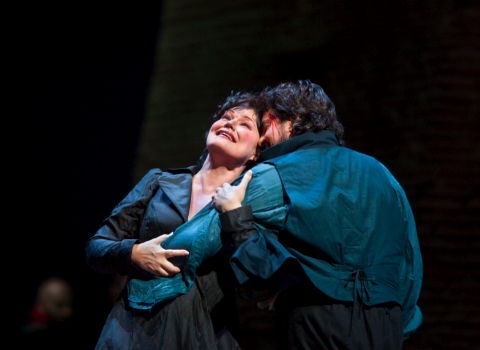
Ken Howard/Metropolitan OperaSo the question was raised (on opera-l, actually, but La Cieca doesn’t mind discussing it in more downmarket venues): in Luc Bondy‘s production of Tosca, Karita Mattila appears in the third act in an entirely new outfit, a sort of tailored trenchcoat of dark leather-like fabric, but whatever she’s wearing, isn’t is a mistake?

Isn’t it Puccini’s intention, or at least most audiences’ notion of Puccini’s intention, that the Roman diva should appear at the Castel Sant’Angelo in the same gown she wore to sing at the gala at Palazzo Farnese and to slaughter Scarpia? Isn’t this yet more evidence of Bondy’s (and, by extension, all those silly stage directors’) ignorance of tradition and contempt for the text?

No.

In the Sardou original La Tosca, Scarpia’s headquarters is located in the Castel Sant’Angelo; therefore after her act of self-defense, Tosca needs merely to go to another part of the fort to rescue Mario, a matter of minutes. Sardou has established earlier in Act 4 that Tosca and Mario have been held at the fort for several hours since they were arrested at his villa. Thus the time line of the action is not only plausible, but is clearly demonstrated to the audience to be so.

But not in the opera. In condensing a five-act, six-setting drama to three acts, Illica and Giacosa provided Puccini with a somewhat different set of situations from Sardou’s. Tosca is questioned not at the Castel Sant’Angelo but at the Palazzo Farnese, not in the wee hours, but immediately following her appearance at a post performance there. Mario’s execution, though, remains scheduled for dawn the following morning at Sant’Angelo.

Now, we are told at the beginning of the second act that the band downstairs is “strumming gavottes” to fill time until the arrival of the diva. Surely we cannot be expected to believe that the Queen of Naples would hang around a ballroom until dawn waiting to hear a measly three-minute cantata, or that even so capricious a diva as Tosca would have the gall to insult the royal lady by standing her up this way. So the librettists are stuck with at least a few hours for Tosca to (ahem) kill between her murder of Scarpia at Palazzo Farnese and her (just pre-dawn) arrival at Sant’Angelo.

Now, here’s the problem. Tosca would hardly require three hours to travel from one location to the other, since the distance between them is barely one kilometer. So the librettists added a line for Tosca in Act 3 with no parallel in the play, “Senti… l’ora è vicina; io già raccolsi / oro e gioielli… una vettura è pronta.” What took her so long? Why, she has been busy during those hours gathering her gold and jewels — to defray the cost of the planned sea voyage — and hiring a carriage for the journey to Civitavecchia.

Under these circumstances, logically she would surely change her (blood-stained, easily identifiable, impractical for traveling) dress as well. If Puccini didn’t want her to change her dress, he shouldn’t have allowed the line about “gathering gold and jewels” to stand.
vaness_tosca

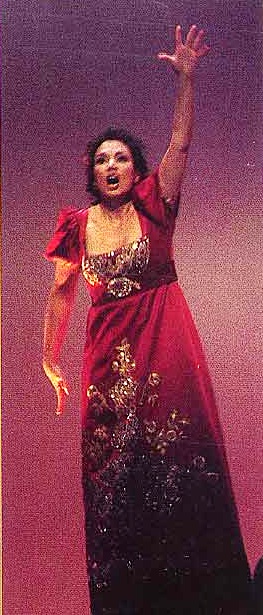
Carol Vaness takes the leap. Note the red silk dress which has held up remarkably well against attempted rape, bloodstains and sight-reading a cantata with a very tricky high C.

But, I hear someone complaining, we always see Tosca in her red dress with a plain dark woolen mantle thrown over it, so surely that must be right! But this drab cloak — can one really imagine the great diva’s wearing such a thing to a royal audience at Palazzo Farnese earlier that night? “So where did she come by it?” one should ask. But nobody ever does, because opera goers are so innured to sloppy traditional habits (many of them contrary to the composer’s stated or implied intentions) that they mistake what they’ve always seen for what is right.

To use an example from another opera, how many times have we seen the entrance of the cigarette girls in the first act of “Carmen” staged along these lines: the bell rings, the doors of the factory open, and the girls saunter out. Eventually Carmen arrives, last of the workers to take her break, and after a hiatus barely long enough to sing the Habanera, all the females return to the drudgery of tobacco-rolling.

This is of course nonsense. Both bells we hear are calling the girls back to work after they have taken a long midday meal and siesta. As with school bells or theater bells, the first bell is a warning, then the next bell is “final.” In fact, the text of the chorus for the young men says very clearly “La cloche a sonné; nous, des ouvrières: Nous venons ici guetter le retour.” And yet, even now one only rarely sees what “the composer intended,” i.e., the cigarette girls returning to the factory, with Carmen taking her own sweet time getting back to work.

You can’t have it both ways. You can’t snipe at those darned stage directors for disrepecting the libretto, then turn right around and say, “Oh, well, in this case I’m used to seeing the libretto flouted, so I’m going to make an exception.”
51 comments

  • richard says:

    The whole dress thing is just soooo silly. I’ve seen many Toscas over (many) years and I’ve seen it both ways,
    with a new dress in Act 3 and with the Act 2 one.
    So what???????

    This is about the silliest criticism of the bondy Tosca yet.
    And petty too as the criticism is based on it being a departure from the Zef production, which like Pius XII and John Paul II, is on a fast track to being canonized , rather on the evidence (which La has displayed for us) in the actual libretto.The libretto actually indirectly supports the change.

    La Cieca is correct, if you listen closely to the libretto, logically Tosca would change to escape drag for Act 3. Both this is OPERA, not a realistic medium.
    Logic isn’t that important as we have to suspend disbelief in the first place. Still, I repeat, to criticize the costume change is not only incorrect, but it is DUMB.

    Having seen the production on TV last week, my reaction was fairly negative, but I was not focused on a few skewed details Bondy threw into his staging. More I was unhappy with some of the more underlying issues; there was little chemistry between Tosca and Cavaradossi in Act 1. Also Tosca herself was not really all that sympathetic, she was more annoying than usual in Act 1 and seemed defeated from the start in Act 2 (I didn’t watch the third act) She had very little charisma and I really didn’t care that much for the dilemma she found herself in. That’s a fatal defect in a Tosca performance in my book.

    Finally Gagnidze was slimy rather than being truly a villain. He came off as a flasher type rather than a truly demonic character.

    I feel these are flaws that are inherent in the staging
    and are far more important than a few silly details which may or may not be justified.

    And by the way, while Bondy delivered a Tosca and a Cavaradossi that didn’t really engage my emotions that much because of the way they came across, Zef did very little with the main singers characterizations. He pretty much allowed the three singers to repeat the characterizations they had done before on other stages, in other houses. While Bondy failed the challenge, Zef didn’t even bother to address it.

    • figaroindy says:

      I also find it hard to understand how you aren’t supposed to notice the “time-lag” between the acts – the opening of act III, with the shepherd boy, and the interminable “sunrise music” make it clear that it’s morning/dawn. No cantata would have taken place at 4 a.m. so how could Tosca have run straight from Farnese to this moment?

      I think I have to agree with Lindoro Almaviva, but state it differently. People don’t like the new version, but they can’t just say “I don’t like it” – they have to come up with what they consider to be an “artistic” reason. And, what they come up with is lame…..stand up for yourselves, you like it or you don’t – it’s visceral – it’s art….quit trying to make “erudite reasons” for your like or dislike.

      I haven’t seen the Bondy “Tosca,” so I can’t comment. I wasn’t in the chorus for it, so I did see Indianapolis’ with Amy Johnson, which was an excellent production….(she was great to work with in the Boheme a couple of years later, also). The “stabbing moment” was very well done in that one…I also liked her “Vissi d’arte.” Stella Zambalis did it at Indy in 2008, I think….sets were not great, jump was not good. Singing was good, though!

    • RDaggle says:

      Also Tosca herself was not really all that sympathetic (snip) and I really didn’t care that much for the dilemma she found herself in.

      I totally agree, having only seen the PBS broadcast.

      The characters seemed caricatures: the ditzy Actress, the kinky Cop, the weaselly Henchman, the airhead Tenor (hmm, that last one…)

      When Tosca is fretting just as Mario faces the firing squad, she says something like “I know it’s a farce …” It struck me that was the basis for this staging. And the production was built out from that idea – a farce.

      Not to say that this version was played for laughs, but that it was presented more as a black comedy than a thrilling melodrama.

      Or maybe it was just my mood at the time.

  • paddypig says:

    In the old production of Tosca, Shirley Verrett in the tel 3ast has changed her outfit. I have heard this discussion for some thirty years about Tosca. Did she or didn’t she have time to change? Would she take the time. I think the choice of having her use the Act 2 gown in smaller companies is usually dictated by cost considerations rather than more theatrical concerns. In non-Met productions I have seen it seems to be evenly divided between those who have a different frock in act 3,and those who just throw a cloak over the act 2 gown. Either choice can be justified, It seems to me at this point that the argument is rather pointless and tiresome, and reminds me to much of comic book man in the simpsons and his constant arguments over sci-fi issues.

  • rysanekfreak says:

    Wasn’t it Olive Middleton of La Puma Opera who showed up in Act 3 with 17 pieces of matched luggage because, “A diva who travels cannot travel light.”?

  • arepo says:

    I hate fiddling around with the composer’s and librettist’s intent but in this case it does not interfere with the singers or the music so I figure there are 2 ways to safely go.
    1. I see no problem with a woman, so devout in nature and who is not normally bent on murder, to be in such a state of shock that she would have to sit for a minute and gather herself together by fanning herself on a bench in the only safe place for her to be at this moment (remember she is there for a dalliance at his insistence and his underlings wouldn’t dare interrupt his tryst with her). Then, she would rush to her place to gather up her jewels, wash the blood evidence off her hands and change from the bloodstained clothes which could give her away to the guards, and continue on to the appending execution with a little more control.
    2. On the other hand, our original Tosca, after “pardoning” Scarpia in death and placing the candles to affirm her devoutness to God, would get out of there as fast as she possibly could so that she could break the good news to her lover and make sure he understands clearly the details of his mock execution. He hears what she did, sees the blood of Scarpia still fresh on her hands and takes her hands in his and sings, “O dolci mani…”
    How very real this would be for him to be caressing the bloodstained hands that did the deed to free them both.

    So, both of these scenarios work without detracting from the singing. I never mind fresh and creative thinking that doesn’t change the original intent of the writing (and I really don’t think the composer would either).

  • Krunoslav says:

    8.1 “Tosca still knows nothing of Angelotti, so she is gay and brilliant”

    http://media.tmsmail.us/pop_tms_sfopera/Tosca2009.jpg

  • iltenoredigrazia says:

    Tebaldi was my first Tosca and she changed costumes for the last act. I’ve since seen many Toscas change and many Toscas keep their Act 2 gown but without the jewels. According to photographs, Callas changed earlier in her career but kept the same gown in the Zeffirelli London production.

    I’m usually bothered by the change in costume mainly because of the incident in Act 2 where Scarpia tells Tosca that she has no time to get the queen to intercede. That – and the drums – always give me the feeling that the execution is imminent, or at least must appear as such to Tosca. Going home to change doesn’t quite agree with Tosca’s state of hysteria that I would expect.

    Now the timeline by La Cieca tells me that indeed Tosca does have time to go home and collect her things. Actually, it makes sense that she would go home not only to change but to collect her things, arrange for a carriage, etc.

    So I guess either way can be justified by the opera’s libretto. What happens in the Sardou play is interesting and illuminating but I’d rather have the opera stick to its libretto. For example, I wonder why or how Tosca knows about Angelotti’s hideaway. Mario knows it’s not smart to let Tosca see or know about Angelotti in Act 1. Why would he trust her with that information? Instead, I would have my Tosca say “Nel pozzo nel giardino” not as a revelation but as a question or guess. (I don’t know where he is. Try the well, that would be my guess. Just stop torturing Mario.) Cavaradossi did say earlier that she doesn’t know anything, why not take that as the truth? And her asking for his consent to talk doesn’t necessarily mean that she knows where Angelotti is but that she knows the place and can help them in their search.

    That’s the appeal of Tosca. Seemingly a straight and simple plot line but one that allows every soprano to make something special out of it.

  • chaka says:

    I would like to see TOSCA staged like the movie THE WIFE, THE THIEF, THE COOK, AND HIS LOVER, in which the costumes change every time the actors enter a new room, even if it’s in the same scene.

    It woudl be far more interesting than the singing I’ve been hearing lately at the MET.

  • Lucky Pierre says:

    also, when mario is finally executed, i think it’d been a good choice to have him shout or groan. i mean, if someone is shot dead, wouldn’t they make a sound? they always stage his death silently. and it’d add more to tosca’s “ecco un artista”.

  • casualoperafan says:

    That is the least problem of his lame-%%s production

    of course it could be either way

    first how about assenble three leads who can sing it

    then make a good production for 90% of the actually important stuff

    then after all that worry about changing dresses or not. Of course if they did the rest no one would be splitting hairs about a costume change!

  • MontyNostry says:

    Tosca is such an effective opera that I have never been bothered by these legitimate points of logic. Just goes to show how the music not only helps suspend one’s disbelief but can also do sleight of hand with the dramaturgy.