

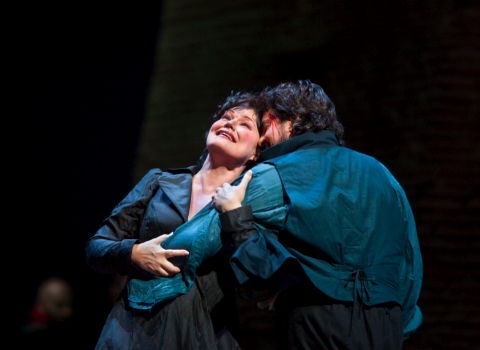
Tosca’s dress
So the question was raised (on opera-l, actually, but La Cieca doesn’t mind discussing it in more downmarket venues): in Luc Bondy‘s production of Tosca, Karita Mattila appears in the third act in an entirely new outfit, a sort of tailored trenchcoat of dark leather-like fabric, but whatever she’s wearing, isn’t is a mistake?
Isn’t it Puccini’s intention, or at least most audiences’ notion of Puccini’s intention, that the Roman diva should appear at the Castel Sant’Angelo in the same gown she wore to sing at the gala at Palazzo Farnese and to slaughter Scarpia? Isn’t this yet more evidence of Bondy’s (and, by extension, all those silly stage directors’) ignorance of tradition and contempt for the text?
No.
In the Sardou original La Tosca, Scarpia’s headquarters is located in the Castel Sant’Angelo; therefore after her act of self-defense, Tosca needs merely to go to another part of the fort to rescue Mario, a matter of minutes. Sardou has established earlier in Act 4 that Tosca and Mario have been held at the fort for several hours since they were arrested at his villa. Thus the time line of the action is not only plausible, but is clearly demonstrated to the audience to be so.
But not in the opera. In condensing a five-act, six-setting drama to three acts, Illica and Giacosa provided Puccini with a somewhat different set of situations from Sardou’s. Tosca is questioned not at the Castel Sant’Angelo but at the Palazzo Farnese, not in the wee hours, but immediately following her appearance at a post performance there. Mario’s execution, though, remains scheduled for dawn the following morning at Sant’Angelo.
Now, we are told at the beginning of the second act that the band downstairs is “strumming gavottes” to fill time until the arrival of the diva. Surely we cannot be expected to believe that the Queen of Naples would hang around a ballroom until dawn waiting to hear a measly three-minute cantata, or that even so capricious a diva as Tosca would have the gall to insult the royal lady by standing her up this way. So the librettists are stuck with at least a few hours for Tosca to (ahem) kill between her murder of Scarpia at Palazzo Farnese and her (just pre-dawn) arrival at Sant’Angelo.
Now, here’s the problem. Tosca would hardly require three hours to travel from one location to the other, since the distance between them is barely one kilometer. So the librettists added a line for Tosca in Act 3 with no parallel in the play, “Senti… l’ora è vicina; io già raccolsi / oro e gioielli… una vettura è pronta.” What took her so long? Why, she has been busy during those hours gathering her gold and jewels — to defray the cost of the planned sea voyage — and hiring a carriage for the journey to Civitavecchia.
Under these circumstances, logically she would surely change her (blood-stained, easily identifiable, impractical for traveling) dress as well. If Puccini didn’t want her to change her dress, he shouldn’t have allowed the line about “gathering gold and jewels” to stand.
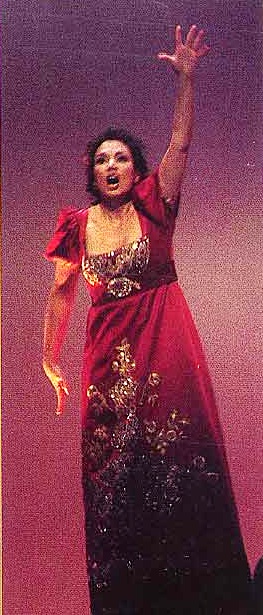
Carol Vaness takes the leap. Note the red silk dress which has held up remarkably well against attempted rape, bloodstains and sight-reading a cantata with a very tricky high C.
But, I hear someone complaining, we always see Tosca in her red dress with a plain dark woolen mantle thrown over it, so surely that must be right! But this drab cloak — can one really imagine the great diva’s wearing such a thing to a royal audience at Palazzo Farnese earlier that night? “So where did she come by it?” one should ask. But nobody ever does, because opera goers are so innured to sloppy traditional habits (many of them contrary to the composer’s stated or implied intentions) that they mistake what they’ve always seen for what is right.
To use an example from another opera, how many times have we seen the entrance of the cigarette girls in the first act of “Carmen” staged along these lines: the bell rings, the doors of the factory open, and the girls saunter out. Eventually Carmen arrives, last of the workers to take her break, and after a hiatus barely long enough to sing the Habanera, all the females return to the drudgery of tobacco-rolling.
This is of course nonsense. Both bells we hear are calling the girls back to work after they have taken a long midday meal and siesta. As with school bells or theater bells, the first bell is a warning, then the next bell is “final.” In fact, the text of the chorus for the young men says very clearly “La cloche a sonné; nous, des ouvrières: Nous venons ici guetter le retour.” And yet, even now one only rarely sees what “the composer intended,” i.e., the cigarette girls returning to the factory, with Carmen taking her own sweet time getting back to work.
You can’t have it both ways. You can’t snipe at those darned stage directors for disrepecting the libretto, then turn right around and say, “Oh, well, in this case I’m used to seeing the libretto flouted, so I’m going to make an exception.”
La Cieca, I promise you this: if I ever have the opportunity of Directing Carmen or Tosca, I will incorporate your very solid points into my staging. You rock.
Baritenor, did you see Tosca in SF this past summer? I remember this Tosca wearing a different dress in Act III than she did in Act II, and figured that she had changed clothes when she went home to get her stash. Do you remember her changing clothes? Or did she just wear a cloak over the Act II dress?
Cruz, Tosca was the only opera in the past two seasons that I saw once rather than multiple times (I was out of town for most of the run) and honestly this isn’t the kind of thing I usually focus on, so I would trust your memory rather than mine. But I seem to recall a black dress when she did the swan dive rather than the red one from act II.
One of those “Gee, I never woulda thought about that” kind of things. Very interesting article. But Matilla’s act 3 costume was the least of that productions problems.
Thank you Cieca. I had no idea about the arguing on opera-l because I have ignored all posts referring to the Bondy Tosca.
To add one more layer to this, the Arena di verona staging with Eva Marton, a highly traditional production itself, has Ms Marton wear a completely different costume for the 2rd act. i have yet to hear any complaints about that. Furthermore, the NYCO staging, failty traditional too, if updated, also had Amy Johnson change from her gala gown to something more appropriate for traveling. I never heard any quibbling about that either.
So what is the problem? As i said in the Decade in review threat:
The Met replaces its traditional Zefirelli Tosca with another traditional production. Some people bitch because it is too traditional, some people bitch because it was not traditional enough, some bitch because it is not by zefirelli….
La Cieca, your article is beautifully thought out and deftly written. But I respectfully disagree, all the same. There are SOME things that neither composers nor librettists expect or even WANT their opera-goers to think about. Do you really believe that either Verdi or Boito expected us to wonder how Otello’s ship could nearly founder, Otello could disembark to “Esultate,” the storm could abate, Iago could sing his drinking song, Rodrigo could get drunk, Cassio could become discredited, and Otello and Desdamona could sing a lengthy, ecstatic love duet all in the realtime that is required to play Act I of “Otello”? Verdi’s and Boito’s whole idea was that the audience WOULDN’T NOTICE the time compression. Similarly, I don’t believe for a second that either Puccini or his librettists ever dreamed that the “realtime lag” between Acts II and III of “Tosca” would even enter opera-goers’ heads.
I don’t understand how one could not have a sense of the “realtime lag” between the two acts. Act 2 takes place after Tosca has finished singing a concert at night, while Act 3 begins at dawn the following day. I had never even noticed it before this topic came up, but I’m not sure I’ve ever seen a Tosca production where she didn’t enter Act 3 having changed into toned-down, “travel” clothes. I suppose that’s what I get for not being NY based.
In other news, the Marton Tosca filmed a year after that Verona production in Australia is MUCH better than the Verona one (excepting perhaps the most horrendous tenor ever to sing Mario). Marton and John Shaw (now THERE’S a name for the Vicar) are fantastic, and it does not suffer from the horrible camera angles and shit (see: Vissi d’arte) that the Verona one does…I do wish someone would upload it to Youtube instead.
schweigundtanze; Surely you are joking about that Marton /Furlan/Shaw Tosca (the Australian video). “Marton and Shaw fantastic”…Marton perhaps yes, Shaw certainly NOT (tried to desperately model himself on Gobbi, but failed miserably) ….. and the tenor. let’s just forget him !
The unprofessional Shaw, during that video: clearly tried to set out, to out-sing Marton and came off a bad second …or third best. There is special tension between the Tosca and Scarpia there- alright, but it is because of Shaw’s upstaging stage antics…..not the ‘natural development of the 2 characters in an opera called Tosca.
I admit the sets were fabulous, totally real life-like , and enormous. Used for some 25 years….and seeing them later (without that old balling -cow Shaw, I might add) set out on a vast much larger stage………..wow!
If anyone wants undeniable proof of the above-mentioned friction, just watch the curtain call of that video! …Shaw the prick goes over to kiss Marton’s hand, …and with a angry ‘sharp as daggers’ look, gladly Marton glares and pulls her hand out of his. Shaw was what you would call ‘a provincial hack’ who stayed around with undue influence to benefit himself, for far too long.
Even today speaking to people that performed closely with him back in the 50′s, he was notorious for all sorts of back stabbing antics, behind the scenes.
Then he went to Covent Garden and reputedly tried more of the same caper…. before returning to Australia. ‘ Being totally over -rated ..he was a case for a disdainful comment whenever he was listed to appear…..of ‘Ah! HIM, again!’
Are you listening Vicar of Wakefield? Shaw is after all, one of your glorified ‘to be mentioned & remembered’ singers. Don’t put yourself down Vicar, lease!
John Shaw formed part of the great line of Commonwealth Scarpias from John Brownlee through today’s John Avey.
Oh, you’re right about Shaw’s vocals. I should have clarified that I meant the interaction between the two of them. Tosca, for me, centers entirely around the interactions between Tosca and Scarpia. When Scarpia is played as a crotchety old, powerful man (as Shaw portrayed him), I have no problem with him barking his way through the role. Since the Scarpia part isn’t very lyrical or memorable anyway, I find it detracts nothing while adding to his character. Were we talking about some other baritone role, I would have no interest in Shaw. In any event, I find the chemistry between him and Marton to be fantastic and riveting. That may just be my tastes, however, since (as I mentioned in my earlier post) I can also look past that DVD having the absolute WORST Mario I’ve ever heard in my life. For me Tosca is all Act 2 or nothing, I suppose.
Marton IS fabulous in that Opera Australia Tosca but I don’t recall John Shaw being anything more than competent.
Comically also I remember from that video: How John Shaw tries to rape and mount Tosca on the crouch. I giggled…..like ‘imagining a old arthritic horse thinking it is a dog .then having the horse (mimicking the dog in ts mind) by trying ‘cocking its leg’ up for a pee!
When Dame Eva sang Tosca, she clothed her in sensible shoes and a practical tweed traveling suit, no nonsense about it!
WoW! La Cieca is now Columbo. Well, I think that La Cieca makes a point but she hits it with a baseball bat. Noel makes the most relevant comment, that the dress was the least of the issues with the production.
There are so many in that crappy Tosca. I mean it is really, really bad- no matter where one sits on the creative license spectrum. I think that directors can take some liberties but it is a delicate thing.
However, when the action onstage does not make any sense given what the words ( libretto, sung, supertitles) are saying, well then that is where the audience starts to fall off. Having been in the Palazzo Farnese and the church of San Andrea del Valle, one appreciates the Zefferelli not so much for its slavish reproduction of reality but for capturing the essense of real places in history AND what the composer generally wrote. Carmen? A bit more fictional and perhaps that is why directors play. Has La Cieca seen the Lyric’s version of Carmen? Very good. Sometimes doing a straight production is radical, even if many find it to be traditional.
The Bondy is tasteless and bad and that is why everyone is up in arms. The spinmeisters at the Met created that disaster.
I agree with Lindoro that to some the production is too traditional. I do not mind the NYCO Mark Lamos?
version at all. But that one still makes sense this one does not and yet it is or rather was, Gelb’s big work. What a mess. Hopefully the Ring won’t fare as badly.
La Cieca makes an overstated argument but I did not follow the previous thread that motivated this piece.
Want to talk about a dress? What about Netrebko yesterday on the on air interview? God Bless her. She was so wrong, she was right. Voigt struggled to rephrase what Netrebko said (I was not and would never be at the theater but it played on the radio). Netrebko talked about her chinchilla (sorry ) coat and Prada shoes. Um- budget? I am no PETA person but it was priceless. That brings up the question of cost but funny, no one seems to rant about that.
How was La Cieca’s argument “overstated”? I think it was made rather plainly. I just reread what she said, and failed to unearth the “baseball bat.”
quoth-
Thank you, but the bat is there. It is overstated in that he, oops she, is making a very strong response, in my opinion too strong about an issue begun on another blog. Without that context, and context seems to be central here, the piece which is thought out seems far too earnest, almost overzealous. I agree with Richard and others in that the dress is “no big deal”. Though I appreciate, and yes, really admire Zef’s for historical reasons and for the artistic effort that is central to his formula, I do not think that his Tosca or his other productions are in anyway definitive. No way. Tosca comes close but no cigar. But to outright trash his works because they are “done” does not acknowledge what was right. Why not?
I refuse to believe that anyone can just reduce the noise about the Bondy version to “people hate it because it is not Zef’s”. Come on. It is bad- you know it when you see it, if not when you hear it which I think IS more important. Again, even a regional Tosca was better than this Bondy. Bondy is not bad, this Tosca is and for all it was supposed to be, it is a bomb. Why does it matter?
It matters because on principle, Gelb is right, new productions must be created. Absolutely.
However, the measure of what is right is not a gamble if there is good judgement. That is more relevant. Forget the dress.
LC’s post did not discuss the relative merits of the two Tosca productions. She has done that elsewhere, including (if we can assume that Mr. Jordan speaks for her) in the pages of the New York Post. Here, in fact, she didn’t even mention the Met’s previous production. She simply addressed a relatively minor detail—but one that detractors have presented as proof of Bondy’s failings. If I may extrapolate from her quite (in my eyes) temperate posting, she was saying “Go ahead and disparage the Bondy production. But don’t use the costume change as a reason.”
Still, it seems that any suggestion that the Bondy production isn’t putrid in all respects strikes you as an “overstatement.”
(In case you’re wondering, I myself found the Bondy production uninspired and dull–a true dud, with the unexpected effect of making Zeffirelli’s frou-frou nonsense look good in comparison.)
for me, it never bothered me whether tosca had changed for act III or not — either way, it makes sense.
what i wonder often is about tosca’s kiss. how did a (relatively) smaller woman kills a (presumably) bigger person with one stab, one stroke, to the chest? i always thought it made more sense for her to slice open his carotid (neck vein), but i think the libretto clearly says something about “tosca is now in your heart” or soemthing to that effect?
One thing I found interesting about the Bondy Tosca is that this reference means Tosca thought Scarpia’s heart resided in his balls. And to Scarpia, they probably did, so the libretto still works.
If I were in a hurry and had some distance to travel from the Farnese to my home and back to the Castel, changing clothes might be the last thing on MY mind. And throwing a coat over might be a quick and sensible solution. But it is MORE likely that Tosca WOULD change into something comfortable alla Marton.
The Carmen staging as explained should happen. Playing devil’s advocate, what if she had been arguing or sexing with someone inside all this time? There are so many dramatic reasons for anything happening. Or not as the case might be.
What I don’t like are the blatant bigger staging directions that get ignored. For instance, I recently saw an opera where someone gets murdered, you hear a loud scream and yet no one on stage reacts to it. That kinda disregard is a problem for me… whether in a traditional or regie staging…
You can’t expect everything to be obeyed – but jeez the big stuff kinda matters.
This change, which seems very slight, from libretto to play, is of the type often discussed between Boito and Verdi in their adaptations. For example, in Otello Verdi insisted on finding a place for a big concertato movement, and the logical moment in the plot is when the message recalling Otello to Venice. The problem, then, was how to end the act after this interpolation. Verdi, I think, suggested a sudden offstage announcement: “The Turks! The Turks are attacking again!” Otello would cast off his sorrow and lead the people in a rousing battle cry before rushing offstage.
But Boito objected, saying that Otello in the opera was like a man trapped in a room from which the air was gradually being drawn out — he is gradually but inexorabily suffocating. The call to war, Boito said, amounts to smashing a window in the room, dispelling the atmosphere of menace that had been so carefully built up over the three acts.
Something similar (though less severe) happens in the adaptation of Tosca. There is simply too long a gap of time between the end of the second act and the beginning of the third, and modern audiences (that is from the late 19th century to our own era) have a strong sense that offstage time needs to be accounted for.
Sardou’s accounts for his offstage time brilliantly. We see Cavaradossi and Mario rush off toward the villa near the end of Act 1. The second act takes place fairly early in the evening at the Palazzo Farnese, and Tosca still knows nothing of Angelotti, so she is gay and brilliant, flirting with the men, including even Scarpia. He very gradually turns the subject around to the Attavani fan he discovered in the chapel, and she slowly grows suspcious, finally grumbling that she cannot wait for the silly cantata to finish so she can confront Mario. Finally, just as the cantata begins, a messenger rushes in with the news that Melas has been defeated after all. Sensation, and Tosca rushes off to the villa.
In Act 3, Mario and Angelotti arrive at the villa, and we understand that it has taken most of the duration of the previous act for them to reach this relatively isolated spot in the suburbs of Rome. They have a long conversation, finally interrupted by the arrival of Tosca. Angelotti goes to hide, and Tosca throws a jealous scene. Eventually Mario calms her down, but allays her last suspicion by revealing to her that Angelotti is hiding in the garden well. Just then Scarpia’s forces arrive, question and then torture Cavaradossi, and Tosca blurts out the hiding place (which in this version is only a few steps away). Angelotti’s corpse is discovered, and Mario is dragged off to the Castel Sant’Angelo for execution. The final line of the act is Scarpia’s: “And the woman as well!”
The next act is at the Castel Sant’Angelo, where Scarpia has a provisional sort of office/apartment set up. In the first few lines, it is established that several more hours have elapsed and it is nearly dawn. So the attempted rape, the deal for the safe-conduct, the murder, the escape… and then, in the following act, Tosca’s arrival at Mario’s cell, the execution and the final catastrophe all occur one after the other with stage time identical to real time.
The big problem with the Tosca libretto is that the first four acts of Sardou’s play had to be condensed into two, and the important scene of Tosca’s arrival at the villa and learning about Angelotti’s hiding place had to be left to the audience’s guesswork. But what grabbed Puccini’s attention was not the carefully worked out melodramatic plot but rather a few visually suggestive scenes, e.g., the murder and the subsequent placing of the candles, the spectacular final leap. Along the way, he “cracked” quite a few windows, which is why the stage action of Tosca is something less than airtight.
When Indianapolis did the show in 99 with Amy Johnson, at the crucial moment, she threw wine at Scarpia’s face, he turn to wipe his face and she stabbed him in the back. It was quite brutal and effective.
I guess i will never stop saying it, for meny people the problem with this production is the fact that it is not Zefirelli’s. they try to reason it away, but by their reasoning, it becomes even clearer to me that that is all there is. The text is clear: Listen carefully, after this farce is over we need to leave at once. Do not worry, I went home and got us some money and some clothes. Now, you need to play your part so these bastards believe you are dead.
How could someone not see it plain as day I do not see it. how could someone say, yes BUT… The whole discussion has been (apparently) that Bondy is a philistine because his Tosca changes. Well, it is in the libretto. How could you argue that Bondy is not respecting the story when he took his cue from the libretto?
Again, I just see these arguments and it just makes me believe that the main beef is that it is not Zefirelli and they are fishing for reasons to bitch about Bondy.
People, if you are going to bitch, bit about how ugly the production is. Bitch about the fact that Marcelo Alvarez barely made it alive and his singing of Mario is substandard; bitch about the fact that the jump is laughingly bad. Bitch about anything else but this whole He is not respecting the story; because it looks like unsuccessful fishing for a reason to bitch.
Of course Tosca does not know the information about the “garden well” in the first place.