

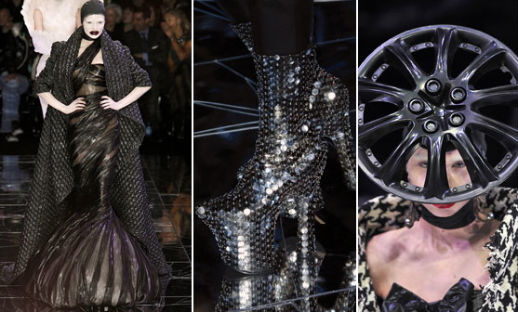
House of Atreus: Fall Collection
Elektra occupies a special place in the Met’s rep, in a cheap way. It’s no easier to cast than any number of things that inspire well-rehearsed refrains of “put it away for fifty years,”* and really over the last quarter century many a somber compromise has been made in casting. What sets it apart is that folks seem willing enough to lie back and think of Mycenae while Gabriele Schnaut humps the leg of Strauss’ towering score, content to soak in the piece under any conditions.
Much is forgiven when one role is sung particularly well. Deborah Voigt‘s Chrysothemis, for a time, was unofficially the above-the-marquee draw, and if you ask me, it was maybe her finest role and an absolutely sufficient reason to go. Me, I don’t remember much at all about how Hannah Schwarz sounded that run through except that I was pretty sure I wouldn’t remember it in fifteen years. Sometimes you know.
Maybe it’s that the orchestra does so much of the work of characterization and the Met’s orchestra is ridiculously fluent in this particular idiom. But it’s more gratifying to think we Straussians who love his brief tragedy best, we the Elektoral college, if you will**, are just that hardcore that we leave the endless kvetching and melodramatic wilting to the bel cantist hothouse flowers.
Yeah I’m just trying to start a turf war there. I like Beatrice di Tenda as much as the next guy at the sports bar.
Elektra has also escaped another sort of pearl-clutching, on account of having existed at the Met since 1992 in an uncontroversially mopey production by Otto Schenk. (The angry slash of red on the curtain is, sorry to say, false advertising.) Not that Elektra, already considered rough going I guess, has been a lightning rod for radical reënvisionings as Southern Gothic or punk rock.
Thursday’s prima (at one point this week I found myself asking someone “is the first night of Hannukah the same as the Elektra prima?”*** which, I know there are supposed to be no original utterances but now I wonder) represents no big splashes, nothing to rock the boat. There’s no new production and in the marquee roles we have a mezzo well-established and well-loved in the house doing a role she’s sung the fuck out of elsewhere (at Tanglewood she pulled off the feat of unstaged dementia), an established if not exactly on-the-sides-of-buses soprano in a role she sang very solidly indeed in the much smaller house in Toronto, and… Voigt.
Some academic whose name I’m not going to google wrote a piece about how Ben Heppner‘s incessant cracking has affected our perception of his roles. (Right, in academia this is not called highly subjective bitching—it’s called a tenure dossier.) Surely much the same could be bloviated about where Ms. Voigt is concerned. The obvious topics of weight and black dresses consigned to Blogatory, there’s no reason to deny that the last five years have been vocally eventful ones that have raised many questions about the next fifteen. As someone wiser than me said, at the mention of one of her off nights, “she’s done too many years of good service to kick her to the curb, but opera companies may not know quite what to do with her.”
What I find confounding and at the same time reassuring is that what roles are going to work out in her voice and what roles aren’t isn’t easily divined. Gioconda, though not fully idiomatic, found her sounding healthy and on top of things, while Tosca has been a struggle, to say the least. The Siegfried Brunnhilde, on the evidence of the 125 gala, is a bit of a minefield; meanwhile, her Chrysothemis is as good as anything she’s ever sung.
Including her Chrysothemis. Yes, the sound is radically different from how she sang it in the 90′s. The plushness that used to go all the way up and all the way down is now largely gone, replaced by something harder and at times more strident, but whereas this stridency wrecked her gala Rosenkavalier trio, it is well-absorbed into Chrysothemis’ music, if anything adding urgency and making the girl a little less of a drag.
Effectively, Voigt now sings more like a dramatic soprano, which lent some air of Opposite Day to her pairing with Susan Bullock. Ms. Bullock, though equal to the role of Elektra, sings it with a certain lyric quality that gives to and takes from the role about what you’d expect: singing against orchestral fury gets lost at times, while a good deal of the recognition scene is sung with more tenderness than many have to lavish on it. There’s a vulnerability inherent to the sound that makes this unlike a Deborah Polaski Elektra (with her hypnotic fury verging on possession) and indeed more like a Hildegard Behrens Elektra, appropriately—fitting, as the production is dedicated to that artist.
And, like Behrens, there is some curdle to the voice that helps cut through the orchestra at times, but for listeners mostly looking for brute force in their Elektra, probably not enough. The scale of Ms. Bullock’s voice allowed, also, for a welcome degree of inflection (“Ich, Mutter? Ich?” rarely enough sounds incredulous or interrogatory, and I don’t think I’ve heard anyone slather as much venom on the words “Tochter meiner Mutter.”) The physical performance was a bit much for some, not least the nod to Elaine Benes in the Beilentanz, but I give the woman credit for aiming too high rather than too low.
Felicity Palmer, now safe to call a house favorite, was also, in her way, slightly, fruitfully miscast. In certain of Klytämnestra’s utterances (“sie redet wie an Aaaaaarzt!”) we expect an element of true grotesque available only to the contralto. Dame Palmer is not a contralto, and though she indulged in some appropriate barking on a few such lines, it was the role’s few mezzo-range money notes that she killed with. This made for a more patrician Klytämnestra than many (including some I adore) who find the Ethel Merman in the role and run with it. I’m never certain of her age, but she’s in fine form and, oh ok this just in from the internet, she’s 65.
As Miss Golightly was saying when she so rudely interrupted herself, the voice is in fine shape and the lady has no compunction about, say, lying on a big chunk of Schenkian detritus on an awkward incline, and so forth. It’s a game portrayal, even if not as forceful and menacing as some.
Fine support came from such as Evgeny Nikitin, a bass with the requisite Orest voice the color of regret, and a good loud set of maids with Wendy Bryn Harmer, compelling in the plummy role of IV (The Phantom Menace.) And the set looked really clean, so you could tell they were totally competent maids. Wolfgang Schmidt as Aegisth made some noises I’m pretty sure weren’t character-driven.
Fabio Luisi found much of the grandeur but little of the drive or brutality in the score, save perhaps for the last moments. And either he has a low strings fetish or I should try an odd numbered Balcony Box next time.
*to the tune of “Mademoiselle from Armentieres.
**but there’s really no reason to.
***no.
I have to say that as someone who loves to be snarky, I loved this review. It was snarky in the places I would have been snarky, and complementary when called for.
“That is what fiction means.”
Goodness. She not only knows her Lupone but her Wilde, too. She’s the Renaissance Hag.
Rysanek/Jones, Orange 1991.
Thrse two ladies sure tear up the pea patch!
Those of you who go to see Catherine Zeta-Jones in ALNM may find her speaking voice uncannily similar to Dame Gwyneth’s speaking voice, at least the voice I heard decades ago. Not surprising, given that both Zeta-Jones and Dame Gwyneth are from Wales. Zeta-Jones says she’s lost a lot of her Welsh accent but as I listened to her as Desiree, it was like hearing Dame Gwyneth speak in her beautiful lilt.
Well, Dame Gwyneth’s Welsh lilt has cross-bred with Swiss German, whil CZJ’s Welsh lilt has fused with Southern California …
At least CZJ won’t be a superannuated Desiree like Dame Judi Dench (Official British National Treasure) was back in the 90s at the National Theatre. She looked older than her mother, played by Sian Phillips (Welsh too, ya know) and really didn’t do fluffy and sexy too well. On the other hand, I see from an interview that CZJ is ’40′, which I have a feeling is quite creative thinking. She was 37 for years, wasn’t she?
CZJ made a very highly publicised West End debut in 42nd Street when she was 17, so unless she was lying then she ain’t lying now.
I reckon she was lying then too. She’s a strategic thinker.
Regarding Dame Gwyneth, the lilt I recall was from 30 years ago so she doubtlessly sounds differently now. Underneath CZJ’s Americanized accent, there is still a pronounced Welsh lilt, though as noted, she admits she’s lost a lot of her Welsh accent. Re: CZJ’s age, she looks to be older than 40 on stage, at least as seen from that steeply raked Walter Kerr mezzanine (going up and down those stairs is like rappling the Alps!). On various vid clips when she’s not in makeup, CZJ looks younger. As for her exact age, ???
Some reminders of other quite unforgettable Klyts:
I know, I know, Varnay is beyond vocal repair here, and surely over the top, but so much fun to see the two work together.
Resnik was a great singing actress and, as peculiar as her Klytemnestra sounds (a bit like a Brooklyn Yetta, and grossly sent up in the bad Solti recording), here the level of commitment and originality is surprising. I have a notion this is Klytemnestra as Hofmanstahl-Strauss intended: nto a ragged old hag, but still a beautiful woman, her mental powers intact, crumbling under a terrible guilt complex.
Kuchta is pretty impressive too!
Damn, Kutcha is a name you don’t see too often here. Gladys did a concert Brunnhilde with Sena Jurinac as Sieglinde back in the 1960s. Jurianc was the show. There’s a Youtube clip of Gladys with Regina Resnik:
As others have mentioned, I love Dame Felicity Lott…. her recordings of Richard Strauss songs are stunning.
Regarding Electra and the character of Klytaemnestra, who can forget Regina Resnik on the famed Nilsson recording. Her ‘warums’ I can hear in my head right now…..so steady and supported beautifully.
As far as the laughing cackles go,some people like them played down. Dramatically …they are as much been made in front of Electra……but more importantly in Electra’s maddened tormented mind AFTER Mother has gone with her entourage, back into the castle.
On the question of voice longevity regarding singers who have sung Klytaemnestra, try the late Maureen Forrester on a complete live recording from Paris back in 1984. The voice was huge. At 73 she made a recording of songs ‘from all parts of / from around the World’. Jeepers….. the voice was musical, even, and fully supported. Many a current singer I am sure would like to have had the same vocal estate that Forrester had …at age 73! That is what I call ‘a singer’. A person of intelligence, who knew their own voice: all its strengths and its limitations!
In the current fluttery times where ‘the newest things on the block’ gain absolute total attention….
much is lost, by quickly forgetting what other singers achieved, ‘only yesterday’. Those that quietly produced good, even ,truly professional steady work: without having ‘accidents and disasters’ along the way. It is rather mandatory for glittery stars be made as Product – for others to watch as they incandescently ‘burn’ their voice like comets. They are but mere ‘road-kill’ for opera’s devouring spotlights . Careers and voices: that are like ‘the big dipper’ at an amusement park. And haven’t we seen a lot of major, out of control vocal crashes through the top rails, of late!
How many singers toward the end of their career can honestly say ‘ Yes the voice may be showing signs of wear after long use…..but wear, that has worn well?
Actually Harry, it’s quite simple. The score NEVER says anything about cackle or shouts or anything. She just signals for light, then more light, then GESTURES triumphantly at Elektra and goes inside. The laugh has a long tradition encouraged, no doubt, by the horribly grotesque screamings on the Solti set. I guess an audio representation has to have some sort of an auditory equivalent for stage business. But this, as usual with Culshaw, is overdone. Culshaw viewed opera as some sort of a Hollywood spectacle, and totally missed the human angle. The Elektra characters are still very three-dimensional. It’s a shame when they are reduced to grotesque, hysterical marionettes and it makes the whole piece less interesting.
I agree that Forrester was a wonderful singer but she was born in 1930 and couldn’t have been 73.
I differ with CerquettiFarrell regarding Electra’s characters ‘being 3-D’ in themselves. They are firstly symbolic parts for ‘a case study’. Yes, marionettes! They are all grotesque figures. And these three main clashing women are all suffering various forms of hysteria set to produce certain collision courses. We only get the real riches when looking at the the shocking psychological points it throws up. The opera is blunt, raw, and certainly not what you would call ‘a nice night’s entertainment’ but we are drawn to its sheer brutal impact..
Hell I hope some feminist director does not come along and put a new twisted spin on the work.
As far as the statement “I guess an audio representation has to have some sort of an auditory equivalent for stage business”….is concerned: in a recording ‘louder laughing’ would have the perspective effort of someone being closer…not more distant. In such case, it: ‘the ridicule’ is drilling into Electra’s mind, after the mother -daughter encounter. A reinforcement for the revenge for what Electra plans. I do not see this as any more detracting, than
(1) Staging Electra as some mod -dress looking thing, re- titled almost as ‘Murder in The Big House…Tonight’ as so many productions do.
(2)Those productions that finally have blood raining down the walls of the castle. Now THAT is ‘over the top’ in expressiveness.
Well, Harry maybe it’s my problem after all, having inherited from the Mozart operas a keen wish for the characters to be 3-D. I think Strauss is THE composer to look for that kind of depth. Maybe not Salome, but for me definitely Elektra. Maybe the play is a study in hysterics, but how can you explain, for example, the delicious oboe solo (borrowing from the string ritornello in Elektra’s monologue) just after Klyt says “einmal nicht stoerrich finde” and before Elektra’s “laesset du nicht den Bruder nicht nach Hause, Mutter?”. For me the orchestral fabric tells us much more about what COULD have been, were the characters not obsessed with their proper idees fixes. There’s an uneasy closeness between Elektra and her mother, for me, and I find it in Strauss’ scoring. The interview here is much, much more than a slinging match a-la Gioconda – Laura. Of course, it’s all lost when Klyt is portrayed as something out of a nightmare. As with Ochs, I always like to feel a bit sorry for the queen. In the Friedrich film, you just wish somebody would rid her of her misery. I find it less humane and intersting. Klyt, in a way, is a forerunner of the Marschallin. They share similar attributes. Anyway, that’s the way I like to think of it, and regarding Elektra the opera as nothing more than a study in hysterics draws me away from it. The Met performance under Luisi stressed the humane and lyrical points within the score, kudos to him and to La Palmer for that.
“I found myself too monstrous, somewhat like a bird of prey. I felt this negated the fact that the woman had once possessed great beauty and dignity. The bloom of youth may have faded from her countenance, but she still retains traces of it along with her regal bearing. Left to my own devices, I certainly would have transposed the brutality of the character to other facets of the dramatic and vocal interpretation…but Mr. Friedrich was adamant and simply ‘outvoted’ me.”
Varnay, on the Friedrich film of Elektra.
Very well put, CerquettiFarrell. Thank you.
“there it was, the greatest night in the theater’s history”
Says you!
……………….
Metropolitan Opera House
January 9, 1891
United States Premiere
DIANA VON SOLANGE {1}
Ernst II-Prechter
Diana……………….Pauline Schueller-Haag
Armand………………Andreas Dippel
Katharine……………Marie Jahn
Fuegos………………Conrad Behrens
Heinrich…………….Juan Luria
Pedrillo…………….Edmund Mueller
Celema………………Bruno Lurgenstein
Dance……………….Martha Irmler [Debut]
Dance……………….Miss Leontine
Dance……………….Miss Francioli
Dance……………….Miss Polednik
Dance……………….Fanny Lengyelffy
Conductor……………Anton Seidl
The best Klytaemnestra I heard was Ute Priew. The most over the top, and by far the scariest, was Anny Schlemm.
Did anyone here see Kuchta in the theatre? This video is from 1968, the last year of her` Met career. The extreme top is going ( though more present than for the Met’s new “Home Counties” Elektra) She certainly seems like a useful person to have around an opera company. Any recollections?
Kuchta was American wasn’t she. The only recording I have of her is the dress rehearsal of the Karajan condcucted Frosch when Janowitz sang her one and only Kaiserin. Of course they were replaced by Leonie and Christa at the premiere.
Any discussion of top-flight Orests must include Norman Bailey, trained by “Reggie” to be the greatest Wotan of the 20th century.
With that, Vicar, I concur wholeheartedly. To me Bailey is THE Wotan. The voice is surpassingly beatiful and the wealth of emotion is staggering.
Oh what a funny hat, oh what a funny little cat.