

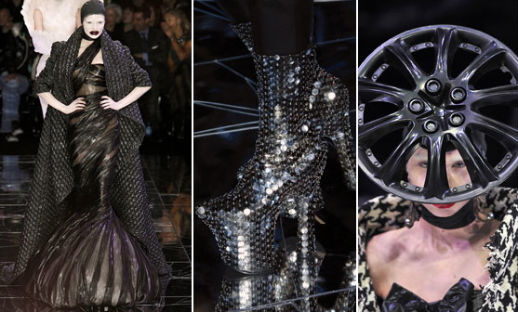
House of Atreus: Fall Collection
Elektra occupies a special place in the Met’s rep, in a cheap way. It’s no easier to cast than any number of things that inspire well-rehearsed refrains of “put it away for fifty years,”* and really over the last quarter century many a somber compromise has been made in casting. What sets it apart is that folks seem willing enough to lie back and think of Mycenae while Gabriele Schnaut humps the leg of Strauss’ towering score, content to soak in the piece under any conditions.
Much is forgiven when one role is sung particularly well. Deborah Voigt‘s Chrysothemis, for a time, was unofficially the above-the-marquee draw, and if you ask me, it was maybe her finest role and an absolutely sufficient reason to go. Me, I don’t remember much at all about how Hannah Schwarz sounded that run through except that I was pretty sure I wouldn’t remember it in fifteen years. Sometimes you know.
Maybe it’s that the orchestra does so much of the work of characterization and the Met’s orchestra is ridiculously fluent in this particular idiom. But it’s more gratifying to think we Straussians who love his brief tragedy best, we the Elektoral college, if you will**, are just that hardcore that we leave the endless kvetching and melodramatic wilting to the bel cantist hothouse flowers.
Yeah I’m just trying to start a turf war there. I like Beatrice di Tenda as much as the next guy at the sports bar.
Elektra has also escaped another sort of pearl-clutching, on account of having existed at the Met since 1992 in an uncontroversially mopey production by Otto Schenk. (The angry slash of red on the curtain is, sorry to say, false advertising.) Not that Elektra, already considered rough going I guess, has been a lightning rod for radical reënvisionings as Southern Gothic or punk rock.
Thursday’s prima (at one point this week I found myself asking someone “is the first night of Hannukah the same as the Elektra prima?”*** which, I know there are supposed to be no original utterances but now I wonder) represents no big splashes, nothing to rock the boat. There’s no new production and in the marquee roles we have a mezzo well-established and well-loved in the house doing a role she’s sung the fuck out of elsewhere (at Tanglewood she pulled off the feat of unstaged dementia), an established if not exactly on-the-sides-of-buses soprano in a role she sang very solidly indeed in the much smaller house in Toronto, and… Voigt.
Some academic whose name I’m not going to google wrote a piece about how Ben Heppner‘s incessant cracking has affected our perception of his roles. (Right, in academia this is not called highly subjective bitching—it’s called a tenure dossier.) Surely much the same could be bloviated about where Ms. Voigt is concerned. The obvious topics of weight and black dresses consigned to Blogatory, there’s no reason to deny that the last five years have been vocally eventful ones that have raised many questions about the next fifteen. As someone wiser than me said, at the mention of one of her off nights, “she’s done too many years of good service to kick her to the curb, but opera companies may not know quite what to do with her.”
What I find confounding and at the same time reassuring is that what roles are going to work out in her voice and what roles aren’t isn’t easily divined. Gioconda, though not fully idiomatic, found her sounding healthy and on top of things, while Tosca has been a struggle, to say the least. The Siegfried Brunnhilde, on the evidence of the 125 gala, is a bit of a minefield; meanwhile, her Chrysothemis is as good as anything she’s ever sung.
Including her Chrysothemis. Yes, the sound is radically different from how she sang it in the 90′s. The plushness that used to go all the way up and all the way down is now largely gone, replaced by something harder and at times more strident, but whereas this stridency wrecked her gala Rosenkavalier trio, it is well-absorbed into Chrysothemis’ music, if anything adding urgency and making the girl a little less of a drag.
Effectively, Voigt now sings more like a dramatic soprano, which lent some air of Opposite Day to her pairing with Susan Bullock. Ms. Bullock, though equal to the role of Elektra, sings it with a certain lyric quality that gives to and takes from the role about what you’d expect: singing against orchestral fury gets lost at times, while a good deal of the recognition scene is sung with more tenderness than many have to lavish on it. There’s a vulnerability inherent to the sound that makes this unlike a Deborah Polaski Elektra (with her hypnotic fury verging on possession) and indeed more like a Hildegard Behrens Elektra, appropriately—fitting, as the production is dedicated to that artist.
And, like Behrens, there is some curdle to the voice that helps cut through the orchestra at times, but for listeners mostly looking for brute force in their Elektra, probably not enough. The scale of Ms. Bullock’s voice allowed, also, for a welcome degree of inflection (“Ich, Mutter? Ich?” rarely enough sounds incredulous or interrogatory, and I don’t think I’ve heard anyone slather as much venom on the words “Tochter meiner Mutter.”) The physical performance was a bit much for some, not least the nod to Elaine Benes in the Beilentanz, but I give the woman credit for aiming too high rather than too low.
Felicity Palmer, now safe to call a house favorite, was also, in her way, slightly, fruitfully miscast. In certain of Klytämnestra’s utterances (“sie redet wie an Aaaaaarzt!”) we expect an element of true grotesque available only to the contralto. Dame Palmer is not a contralto, and though she indulged in some appropriate barking on a few such lines, it was the role’s few mezzo-range money notes that she killed with. This made for a more patrician Klytämnestra than many (including some I adore) who find the Ethel Merman in the role and run with it. I’m never certain of her age, but she’s in fine form and, oh ok this just in from the internet, she’s 65.
As Miss Golightly was saying when she so rudely interrupted herself, the voice is in fine shape and the lady has no compunction about, say, lying on a big chunk of Schenkian detritus on an awkward incline, and so forth. It’s a game portrayal, even if not as forceful and menacing as some.
Fine support came from such as Evgeny Nikitin, a bass with the requisite Orest voice the color of regret, and a good loud set of maids with Wendy Bryn Harmer, compelling in the plummy role of IV (The Phantom Menace.) And the set looked really clean, so you could tell they were totally competent maids. Wolfgang Schmidt as Aegisth made some noises I’m pretty sure weren’t character-driven.
Fabio Luisi found much of the grandeur but little of the drive or brutality in the score, save perhaps for the last moments. And either he has a low strings fetish or I should try an odd numbered Balcony Box next time.
*to the tune of “Mademoiselle from Armentieres.
**but there’s really no reason to.
***no.
Thanks, Maury! Glad for the in-house report, and I’m glad that I’m not crazy (or, at least, alone) for thinking Voigt did a fine job. I agree with the Opposite Day observation–I did find myself asking, now and then, “Wait–isn’t that Elektra’s line?”, then realizing that that WAS Elektra, though an unexpectedly girlish one. Still, that deviation from the norm was, for me, within the realm of interestingness.
Well, I was going to write this in my review and then forgot because it was 1:30 am, but when the earth was cooling and sopranos didn’t generally have webpages, Voigt did, and an email address that I truly believe she answered herself, not a publicist. (I don’t know why I think this. Occasionally I have a little faith in people.) I wrote and asked if she might someday sing Elektra, and she sent back a short, friendly note to the effect that it wasn’t really on the horizon. But this was 1993. All night I found myself thinking: maybe now?
it’s kind of cute to think of you e-stalking debbie like that, I’m sure she found it flattering and not all that creepy.
A entertaining and insightful review. Thanks, Maury. I love the comment about Opposite Day. When I first heard of this casting, I thought that it would be odd having a Chrysothemis with a bigger voice than Elektra.
As`always I enjoy your writing. As often, I wonder why we hear things so differently. I thought Voigt was really just making loud, ugly, empty noise– when she wasn’t veering off pitch, that is. It got better later in the opera but I found it very sad to hear, given what pleasure she used to afford in this music. No less generalized in her words than ever.
And, p.s., she brought almost nothing to GIOCONDA in my view, vocally or in any other way.
Luisi’s was the memorable contribution of the evening.
And those 5 Maids may be the starriest I’ve ever heard.
Thank you, Vicar, but you must concede my writing isn’t a patch on what one reads in Gramophone and other fine Commonwealth publications.
We do all hear things differently–all I’ll say, and I know this always comes off as a bit of a pointless conversation-ender, is that as I heard Voigt in the house, I thought “this may sound shouty over the airwaves.” But if you didn’t like it, you didn’t like it.
I was misinformed– none of the Maids were Britons. In retrospect they were not very good.
I’d be a little scared of Voigt taking on Elektra, given what seems to be the recent unreliability of her high notes, crucial in the role (though last night her final Bruder was a beaut!–something I’m pretty sure I’d remember in 15 years, I should live so long…). The generalized response to words (and relatedly, in Italian roles, the indifference to phrasing) has always been a puzzle for me re Voigt, who seems like an intelligent person; but I sometimes think (maybe wishfully) that she’s improving in that regard.
You know where I heard her engage with the words best, actually, was in Salome. Part of the reason I think she might make a good Elektra is that I think unhinged is something she actually has more of a knack for portraying than nobly suffering, which is what is most often asked of her.
nice maury, we enjoy your dispatches so much!
I too enjoyed Elektra being a smaller voice, even though I gripe that it wasn’t big enough. Maybe if it had just a bit more volume, not heft, i would have been able to hear her more. Debbie sounds better than she has in recent years but oh that video that Stanford posted did you see it? (!!) It was all better back in the days when.
err, Sanford! (sorry Sanford)
I don’t think I saw this video. What was it of? I hope it wasn’t of the 125 Gala, which really was not her finest quarter hour to say the least.
almost jessye-like in its opulence.
She’s wonderful in that one, Squirrel, but I think she’s even slightly better vocally a year later (and we are picking nits here, as she sounds fabulous in both)
well Schweigundtanze, perhaps but i wasn’t around for any of this fine work, catching up with her only in 2003 for FroSch. What a shame.
On a side note, it occurred to me that Jessye may not have actually recorded any of the roles in Elektra – did she sing them?
Zschau seems to have come dressed for the cover shoot of a Harlequin Romance novel entitled “Love’s Burning Hotflash”.
The video with Behrens shows why Voigt made such an impression when she burst onto the scene. I mean, thant kind of tonal oppulance right to the top of her voice is just incredible.
Dearest Squirrel, it won’t let me reply to you above, for some reason. I actually have no idea about Jessye and Elektra, although it’s a rather interesting question which I would like to know as well. I am equal parts horrified and fascinated by the prospect of a Jessye Elektra.
I also meant to give kudos to Maury above…I most enjoyed this wonderful review. Always interesting how what was in the house compared to what came across the radio.
Yeah I don’t know about Jessye in Elektra either but why not? I think she might have done concert performances with Ozawa and the BSO at symphony hall in the 90s (Anyone?) and was shocked to find via the interwebs that no CD of that is extant.
I am sure that Norman could never have got through an entire performance of Elektra, and Chrysothemis would have been too high for her anytime after around 1980.
Norman as Elektra? hmphh, apart from tessitura problems and sheer vocal strain, I think the temperament was wrong, again imperious rather than an underdog. And Elektra needs to connect with the other characters – Chrysothemis, Klytemnestra, Orest. It’s not a stand and sing role. Elektra is theatre and theatre is not Norman. Then again, she might be an interesting Klytemnestra. The tessitura is surely right and it’s a faily short role.
I think the closest she came was recording Salome, regarded by most as a mistake, though perhaps less so than Carmen around the same time? Hm, I have the sudden sensation I might be making the Salome up, but the internet tells me I’m not.
Vocally speaking, I agree that neither of the sisters would have suited Jessye. The tessitura of Chrysothemis was too high and while most of Elektra would have been doable, I think that there some crucial high notes in the role where Jessye’s upper range would have been tested and where she wouldn’t have been able to deliver teh cutting power. Other than that, she didn’t have a problem with stamina. She sang Didon and Cassandra in the same performance on two occasions. Klytamnestra would have been interesting but I don’t think that Jessye liked to do character roles.
I totally agree in the assessment here of Debbie, and I agree with too many years of good service to be kicked to the curb.
She’s always been difficult to cast, hasn’t she? Early on, when one loved the voice because it was so beautiful and even and large, one wanted to hear her in everything, from Verdi and Puccini to Wagner. The simple fact of the matter is that no one, including her, seemed to really know what she could sing well. I probably would have made the same mistake early on when casting her. Despite the fact that the voice really doesn’t have the heft for it, I wanted to hear a “beautiful” Isolde and Brunnhilde from her the moment I heard her sing. Her voice is actually somewhat fragile, and just can’t handle that repertoire and will never be an achievement for her. She’s a bit like Renee in that her voice fits a very specialized niche, but what it fits, it fits perfectly.
A wonderfully written review PLUS really funny jokes.
Encore!
Check out MD’s blog, My Favorite Intermissions. The same high standard is kept on a magnificently and incredibly regular basis. And I’m not even his agent!
also re: Deborah Voigt
the first time I heard her live was in the ’03 revival of Troyens. Sure, the star that evening was Lorraine Hunt-Lieberson, but Ms. Voigt really impressed me with her passionate performance.
And even though it was before her weight-loss she certainly was physically expressive onstage.
The last time I heard Wolfgang Schmidt, he was singing Siegfried in San Francisco. He’s down to character roles at this point, having destroyed whatever voice he had with too-heavy repertory.
Oh…and that’s Dame Felicity, not Dame Palmer.
Huh, is that the syntax of knighthood? (And is it still called knighthood with a female subject?) This is something I never once thought about.
Yes, you’d not more say Dame Palmer than you’d say Sir Olivier or Queen Windsor.
She’s not a Dame – she should be, but she isn’t. You’re thinking of the other, less deserving Dame Felicity – Lott.