
Headshot of La Cieca

Cher Public

  • Indiana Loiterer III: September 24 – Elisir 26 – Turandot September 27 – L’El...
  • oedipe: Let's not be reductionist ourselves: I don't believe the art...
  • armerjacquino: http://parterre.com/2011/08/08/rip-brad-wilbers-met-futures-...
  • grimoaldo: Has anybody posted the classical Grammy winners?Engineer...
  • almavivante: When I read an inspired extravaganza like DharmaBay's, I rea...
  • OpinionatedNeophyte: Is this the same Laquita Mitchell? Is she ready for prime ti...
  • Betsy_Ann_Bobolink: An interesting sidebar is that to be historically "accurate"...
  • grimoaldo: Yeah, I missed both of those too. Very good, very funny, con...
  • CruzSF: Congrats to DharmaBay and iltenoredigrazia. I don't know HOW...
  • OpinionatedNeophyte: *sigh* The far more interesting "racial edge" to the story i...

blog advertising is good for you

Ten Rules for Stage Directors

brokeback_onegin1. DON’T STAGE THE OVERTURE. Surprise: Verdi and Rossini and Wagner Mozart actually worked in the theater most of their lives, so give them credit for knowing that the overture is there to get the audience in the mood, to ease their transition from “outside” to “inside.”

Resist the temptation to interpolate a mimed prologue. During the Siciliana to Cavalleria rusticana, we do not need to see Lola and Turridu making out in their underwear. Corollary#1A: this holds true for interludes as well — no dream ballet during Siegfried’s Funeral March.) 

2. SPARE US THE OLD RAZZLE-DAZZLE. Some operas are a little weak musically or dramatically, and it’s reasonable enough to want to jazz them up a bit with clever staging. But if you feel you have to overhaul the opera completely, better let it alone. No acrobats doing backflips during Handel arias; no bands of Merry Commedia dell’Arte Players mooching for applause during Rossini. And the Tenor-with-the-Hanky gag deserved to die about 20 years ago. Think of yourself as a chef: choose the freshest, best-quality ingredients, prepare them with care, and lay off the sauces.

3. IF YOU WANT TO SEND A MESSAGE, USE E-MAIL. It’s Act 4 in some German Bohème production. Mimì is expiring downstage, while upstage (in an apartment across the street from the bohemians), a well-to-do family welcomes a well-to-do doctor who makes their little well-to-do daughter all better — just as poor indigent Mimì barfs her lungs out. Those darn inequities in the health care system! Yes, I know art is about serious issues, but when an audience realizes you’re preaching at them, they either lose interest or get angry at the director. But if you can make your points subtly and entertainingly, the public can have their entertainment and then go home and think about the issues you raised.

4. IT’S THE CHARACTERS, STUPID! Human behavior is like an analog recording: there’s an infinite amount of data there waiting to be accessed. Lighting effects, moving platforms, smoke machines and giant puppets with Ara Berberian‘s voice basically are interesting only the first time, and even then not so interesting as living, breathing humans acting human. Personenregie, please. It’s not so hard as it looks, because most opera singers are pretty decent actors, if you take the time to learn what they can and cannot do. Even so notoriously inert a stage figure as Pavarotti could come to life in Bohème, delivering one of the most moving dramatic performances I have ever seen. Sure, playing with lasers is fun — but is the stage of an opera house really the proper place for boys and their toys?

5. YOU CAN’T DO MOZART WITHOUT BENCHES. A properly designed set will encourage interesting and characterful movement from the performers; a lousy set will leave them just standing there (in the dark, probably). In an opera with long reflective ensembles, it’s good to offer the performers the option of sitting now and then, if only to add a little variety to the stage picture. And doesn’t it irk you when Donna Anna or the Countess have to sit on the floor? Yes, I know those benches are “traditional”, and that’s a dirty word these days. But has it occurred to you that traditions become traditional because they WORK. Corollary #5A: You can’t do TRAVIATA without a chaise longue.

6. ONE SIZE DOESN’T FIT ALL. “That dress looked great on Scotto, but somehow it made Caballe look sort of, you know, fat…” No, costumes designed for one artist’s figure don’t always flatter another’s: and the same is true of stage movement and business. For almost 40 years, every Nedda who sings at the Met has to attempt the hyperactive staging Franco Zeffirelli devised for Teresa Stratas: you know, that aerobics routine she does during the Ballatella. But you know, that skipping and stuff looked fabulous when La Stratas did it — in fact, she needs a lot of physical activity on stage or she’ll tense up and the high A-sharp will go to hell. But other performers obviously have different needs.

7. SAD IS BAD. Of course some operas are sad. But it’s the audience who’s supposed to cry, not the performers. Sorrow is not an energizing emotion — in fact, it tends to suck the force out of anyone’s performance. Mimì when she is saying “Addio” should be brave, or bitter, or hopeful — something that will give her character some dignity and backbone. If Mimì is just feeling sorry for Mimì, then the audience needn’t bother.

8. UPDATED IS OUTDATED. Exactly what is gained by resetting, say, The Rake’s Progress  in the 1920s? Are today’s audiences really all that better acquainted with the habits and that mores of that period than the 18th century? Very often, it seems like a director changes the period of a piece simply because he can’t think of anything else to do that looks “different.” (See Rule #2.) Besides, updating risks distortion of the social background of the piece. What employer in 1985 New York would dare hassle such hard-working, smart, and (let’s face it) white servants as Figaro and Susanna? The best bet is to stick to the original period (without turning the opera into a historical costume parade) or else to use simple, non-specific garb suggesting no period in particular: what Dr. Repertoire likes to call Star Trek Clothes.

9. LET THE GAMES NOT BEGIN. Creation in the theater is a collaborative process, with no room for dictators. Keep in mind that when a singer questions one of your ideas, he may not really intend a power struggle: in fact, he may just think it’s a lousy idea. Bend. Compromise. Discuss. And for God’s sake, stop sniping at that poor girl who’s singing Zerlina. She’s doing the best she can. If you’re directing because you’re into the whole power trip, do us all a favor and go to an S&M club instead.

10. SAFETY LAST. (And first and always.) No effect, no matter how spectacular, is worth injuring an artist — not even a chorister. It’s your job to make the production as safe as humanly possible. Be there when the blank pistol is loaded. Walk the set and make sure it’s solid. Do a fall on the rake and see if you end up in the orchestra pit. And take a nice big lungful of that Roscofog and then try to sing Wotan’s Farewell. If you survive, then you can give the cast a try. And if ever they refuse to do anything on grounds of danger, it’s not fair to whine, to bully, or, worst of all, to threaten, “If you don’t do it, we’ll find another singer who will.” Better they should find another director — one with some regard for human life.

[Originally published in parterre box #21.]
79 comments

  • OK Cieca Cara, I have (I think i am) to use one of your own dictums against you: One size does not fit all:

    I am not sure i agree 100% with the whole don’t stage the overture part. When done well, it can be just as effective in getting the audience in the mood.

    Yes, it is done to death, but the staging of the Traviata overture is still effective. I have seen several versions, from Violetta on he own death bed, to Violeta already dead and Aldredo crying by her coffin. Now, some of these ideas worked better than others, but it is still a fact that this overture is prime for a good staging.

    The 4-act version of Don Carlo is another one that can use some staging. When the French act 1 is completely cut, what the audience sees is a Don Carlos moaning over Elisabetta but they have no background. I have always disliked this version because of this. This summer, Cincinnati Opera presented the 4 act version and during the interlude, they projected a 4 sentence background and then the courtain open to a small scene of Carlos falling on his knees and crying. This small moment set the stage for his mindset and the rest of the story. i thought it was effective and at least for me, made me enjoy the 4-act version a lot more, because I had background and a point of reference.

    No, we do not need Lola and Turiddu doing it on stage, but if you have a turiddu that looks good and it athletic, why not stage his exit from Lola’s climbing down the balcony while Santuzza hides? Then Turiddu can sing the serenata right there or do it as he walks off the stage leaving Santuzza behind, bitting her teeth.

    Unfortunately, the things audiences expected back in the 90′s have changed. There was a time when the overture WAS used to get people in the mood. Now, it is usually used as a greeting for late comers and background music to sit them. Maybe having some pantomime might help get the audience in the mood, since these days the music has lost that purpose.

    Any chance that we will get more articles by Dr. Repertoire? He has been sorely missed.

    • armerjacquino says:

      I agree with this. Aida and Figaro are also examples of operas where there can be some dramatic value in staging the overture or prelude. I don’t think it’s claiming to know better than the composer; yes, they were men of the theatre, but theatrical mores have changed.

      Saints preserve us from a staged Rosenkavalier prelude though. Nobody needs to see that.

    • Byrnham Woode says:

      Well, I’m largely with Will on this one: Never say “Never”.

      Tnat said, the best way to make people focus during the Overture (staged or not) is for the House Manager to forbid entry to the theater once the conductor takes the podium. That prevents the overture from becoming accompianment to the farce of latecommer seating. It’s a rule easily laid down, and not at all impossible to enforce.

    • Baritenor says:

      I’m not totally against staged overtures, or even the occasion silent prelude, but it’s got to WORK.

  • Tamerlano says:

    “And doesn’t it irk you when Donna Anna or the Countess have to sit on the floor?”
    Love it!

  • La Cieca says:

    but if you have a turiddu that looks good and it athletic, why not stage his exit from Lola’s climbing down the balcony while Santuzza hides?

    This one I do have a very specific answer for. In the duet later in the opera, there is this exchange.

    SANTUZZA
    No, non mentire;
    Ti vidi volger
    Giù dal sentier…
    E stamattina, all’alba,
    T’hanno scorto
    Presso l’uscio di Lola.

    TURIDDU
    Ah! mi hai spiato?

    SANTUZZA
    No, te lo giuro.
    A noi l’ha raccontato
    Compar Alfio
    Il marito, poco fa.

    So if we have just seen Santuzza spying on Turiddu, then this dialogue makes her a liar and a hypocrite who doesn’t mind swearing to an untruth. That changes the whole character of Santuzza, and for what? To give the audience something to look at for a minute or two so they don’t get bored barely five minutes into the opera?

    • Point well taken, but Santuzza is in a desperate state and she is trying to save her relationship. In her voi lo sapete she speaks not of her fears, but of her certainty; making it seem that she herself has seen some of the suspicious behavior.

      I would not see a problem if it is staged as Santuzza accidentally finding out. That way she can swear that she was not spying on him (since she found out by accident) and would lead credibility to all the bohooing she does in Voi lo sapete.

      That been said, you do bring a very good point. Thank you.

    • manou says:

      Absolutely – and this would lead us to another rule (if we have to have rules) : “Do not alter the text by messing around with the surtitles to fit your concept (or Konzept)”

      • So that means that all those beautiful Toscas set during the 30,40 and 50′s should cease to exist since Napoleon has been long dead?

        How about the Tito’s set in modern eras, should they also cease to exist since Tito is long gone and not everybody in the audience worships the roman gods anymore?

        How about the the Filles set during the wars. Those are not France against Italy anymore, so should we stop doing them?

        There are good points, but taking the libretto and the “translation” as if they were some kind of bible would lead us where?

        • manou says:

          It would lead us to respect the original intentions of the composer and librettist within the confines of the text – a straitjacket perhaps, but you might as well alter the music if it happened not to fit your purpose.

          ….If we have to have any rules, that is.

        • Zerbinetta says:

          I agree with you, but I do hate it when the surtitles (translation) misrepresent the words that are being sung. I don’t care if the text doesn’t match the staging, as in the examples you gave, but to mistranslate what we’re hearing is dishonest.

        • Zerbinetta says:

          oops, I mean that I agree with Signor Almaviva, not with Manou’s clarification. actually, I don’t agree with Manou’s comment 13.2.1.1 at all.

        • E-news says:

          No, I think he meant even if you set it in the 40′s, don’t put “Mussolini” in the surtitles if the character is singing the word “Napoleon.” If you do Tito in a modern era, don’t say “gun” in the surtitle when the character is singing the word “sword,” even if the singer is holding a gun. The audience is smart enough to figure out that the character is referring to their gun. I hate inaccurate translations.

        • But you talk about a composers original intentions like they are made out of stone and they would have not approved of anything else but. In that case, the original intentions of, say, Puccini in Tosca are confined to that 1st set of productions and anything beyond Puccini’s death is not respecting his intentions because he didn’t oversee the production.

          That is the problem with the phrase respecting the composers intentions, those are open for interpretation. We do not know if Puccini would not have approved of a Tosca set during Mussolini because he didn’t live through that. I could continue but you get my drift.

          Opera is a recreation and as a recreation is always open to reinterpretation. We might or might not like a persons recreation or reinterpretation, but that doesn’t make them all invalid or all disrespectful of the composers intentions.

          I have found that, even when I am the one doing the criticizing, the moment the phrase the composers intentions is uttered, that is code for my own interpretation of what I believe should happen here and what I believe the composer would say if I was the composer

        • manou says:

          Lindoro – I am actually answering your point at 13.2.1.5 which does not seem to have a clickable link.

          I do concede your point about such comments as “the composer’s intentions” being entirely subjective, but could you perhaps comment on whether it would be OK to interfere with the music as well? Some might feel that the orchestration is outmoded and could do with jazzing up – or be performed on electronic instruments. Would you be happy with this kind of updating?

          My original comment was about my “bete noire” which is to read surtitles that do not fit the text – does this mean that say Italian or French speakers are allowed to hear the original, whilst those reading the titles get a different purpose-built meaning? I do agree with many of the others who ask that the translation be faithful whatever is happening on the stage. We are all able to make our own judgements.

    • werther says:

      you could still do it, and NOT have santuzza spying on him, right ;)

  • Alto says:

    “Sad is bad.”

    I feel you’re right in a way. But having just last night seen Fauré’s PENELOPE, in which the heroine spends all but the last moments of three acts in deep mourning, I’m reminded that there are exceptions to this.

  • werther says:

    “you can´t do mozart without benches” “you can´t do traviata without a chaise long”. WOW, next thing i´ll hear is that gays can´t marry. Oh, wait…

  • rysanekfreak says:

    I saw one of those Toscas set during WW II, and the surtitles were changed only slightly. “Napoleon” was changed to “the enemy.” I think “Melas?” was changed to “and us?”

    The worst case of this madness came with a Barbiere in San Francisco. When people were urging each other to be quiet, on the word “Piano,” someone pointed to the wings from whence an actual piano was pushed out, and when people thereafter said “Piano,” they pointed to the piano. That was one of those “red chairs hanging upside down near the ceiling” productions. And lots of black cloaks whipped away to reveal more red chairs.

    Are some of our readers too young to remember that vogue for red chairs nailed to the wall near the ceiling? You’ve never experienced a real Trovatore until you’ve seen a red-chair-near-the-ceiling production of it. That and the pieces of broken statuary cluttering the living room.

  • kashania says:

    Some really interesting points here but generally speaking, I don’t believe in hard and rules, if only for that one out of ten attempts at a staged overture that actually works.

    • Verdilover says:

      More like 1 out a 100 in my experience.

      • Cassandra says:

        More like never.

        • louannd says:

          I vote never for Traviata. It’s one of the few I really know well, and I want to hear all the subtleties of the conductor’s interpretation without distractions. I think I feel the same way about Mozart overtures as well. All of them.

          OK …maybe…more like never.

    • RDaggle says:

      Somebody correct me if I am wrong* but didn’t Renata Scotto direct a Traviata for City Opera with a staged prelude?

      Well, maybe staged is the wrong word. But I seem to recall a tableaux vivant where the curtain rose on the scene as soon as the music began.

      I do love me a tableaux vivant.

      *like you have to ask for that around here.

  • kashania says:

    oops, that ws supposed to be “hard and fast rules”.

    • Alto says:

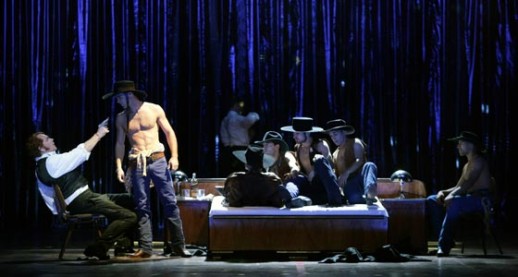
      “Hard” and “fast” were two words that came to mind when I saw the pic at the top of this page.

  • NYCOQ says:

    I am sure that we are all in agreement that these rules can be bent if it actually works. A good example of a recent staged overture was the Iphigenie a couple of seasons back at the Met where Stephen Wadsworth gives you a little “back story” when Diana rescues Iphigenie during her sacrifice. It bookended the deus ex machina at the end of the opera quite well, but then again this was apparently well thought out. Considering that there are quite a few people out there that don’t know there history or their mythology for that matter, a little explaining goes a long way. Kids certainly are not being taught the classics these days and for the most part can place little historical reference points most of the goings on in a lot of operas.

    Updating or moving an opera forward a few decades isn’t always a bad thing. It’s when the concept is half-assed or half-baked is when it doesn’t work. I find baroque operas can work no matter what time period they are placed in as long as the concept is not idiotic. Come on people opera requires a suspension of belief to work to begin with.

    I completely agree about the “show within a show” rule unless it’s in the libretto. We all remember that hideous Sonnambula?

    • prunier says:

      It’s a Stephen Wadsworth trademark not just to stage the overture but sometimes to begin the stage action before the music has even started at all (or continue it after the final notes of the opera).

  • rysanekfreak says:

    We can also mention “Don’t Change the Ending.”

    How about the Ariadne I saw in Houston where the Composer comes rushing out during the final seconds and shoots himself in the head? That sort of goes against the comedic grain of what has gone before.

    How about the Puritani I saw in San Francisco where Riccardo runs up to Arturo and stabs him fatally in the back (at the end of the happy ending cabaletta) to explain why we have been seeing a crazy Elvira in flashback?

    Did Puccini really okay the alternative ending of Magda drowning herself in Rondine?

    Do we want Amneris to commit suicide like Cio-Cio-San?

    Should Azucena stab di Luna in the chest?

    Should we put Octavian in a WW I uniform and send him off to fight in the trenches?

    Is Ulrica really supposed to come out and cackle victoriously over the corpse of Riccardo?

    This changed ending game is almost as maddening as “Perform Opera X in the Sets of Opera Y.” (Aida in the Rosenkavalier sets. Billy Budd in the Turandot sets. Fanciulla del West in the Adriana Lecouvreur sets.)

    • armerjacquino says:

      I don’t actually hate the idea of Amneris committing suicide. I wouldn’t do it if I were directing the opera, but it doesn’t seem a particularly horrendous interpretation of ‘pace t’imploro’ to me.

      I guess the point here is that it’s possible to interpret the text and the music that a composer or librettist has written in an infinite number of ways, and to do so while having ultimate respect for the work they have created. Look at the end of ‘Cosi’- the C Major and Da Ponte’s words tell us unequivocally that this is a joyously happy ending. But ‘Fra Gli Amplessi’, ‘Per Pieta’ and ‘Il Core vi dono’ tell us equally unequivocally that there is some pretty powerful sexual and emotional energy pinging around between the four central characters. A ‘Cosi’ where Fiordiligi and Ferrando give each other a telling look in the finale (or indeed leave together) is, in that sense, very faithful to what Mozart and Da Ponte have done in the course of the opera, while being diametrically opposed to what the music and the words of the finale say. If anything is insulting to composers and librettists, it’s the suggestion that the works of genius they have produced are so flimsy and one-dimensional as to be able to survive only one possible interpretation.

      • armerjacquino says:

        Sorry for double post, but I’ve just noticed the reference to the Komponist shooting himself in a production of ‘Ariadne’. Again, it’s perfectly arguable as an interpretation of the work: his last words, roughly translated, are ‘Who has dragged me into this world, let me die in my own’. It may ‘go against the comic grain’ but bringing a tragic moment into a comedy, or a comic one into a tragedy, is the oldest trick in the book.

        • How many times have composers set the words morir mi sento, or the more poetic mi sento morir, or sento la morte per me avanzar to music and yet the women do not drop dead?

          I agree with you that it can be argued, but taking those words that literally seems shortsighted.

        • armerjacquino says:

          Lindoro- per your post below, which I can’t for some reason reply to, I utterly agree. That, I hoped, was my point- that there are endless possible interpretations for what the libretto is saying (and even more for what the music is) therefore to say ‘this is wrong’ is a sterile approach.

        • Violetta says:

          I have to disagree that it is at all a good idea for directors to try being “new” by taking some expression in the libretto literally.

    • Alto says:

      I was once in London during a stagehands’ strike and all the plays had to be performed in whatever set had been left on the stage. Was quite thrilling in its way.