
Ten Rules for Stage Directors
1. DON’T STAGE THE OVERTURE. Surprise: Verdi and Rossini and Wagner Mozart actually worked in the theater most of their lives, so give them credit for knowing that the overture is there to get the audience in the mood, to ease their transition from “outside” to “inside.”
Resist the temptation to interpolate a mimed prologue. During the Siciliana to Cavalleria rusticana, we do not need to see Lola and Turridu making out in their underwear. Corollary#1A: this holds true for interludes as well — no dream ballet during Siegfried’s Funeral March.)
2. SPARE US THE OLD RAZZLE-DAZZLE. Some operas are a little weak musically or dramatically, and it’s reasonable enough to want to jazz them up a bit with clever staging. But if you feel you have to overhaul the opera completely, better let it alone. No acrobats doing backflips during Handel arias; no bands of Merry Commedia dell’Arte Players mooching for applause during Rossini. And the Tenor-with-the-Hanky gag deserved to die about 20 years ago. Think of yourself as a chef: choose the freshest, best-quality ingredients, prepare them with care, and lay off the sauces.
3. IF YOU WANT TO SEND A MESSAGE, USE E-MAIL. It’s Act 4 in some German Bohème production. Mimì is expiring downstage, while upstage (in an apartment across the street from the bohemians), a well-to-do family welcomes a well-to-do doctor who makes their little well-to-do daughter all better — just as poor indigent Mimì barfs her lungs out. Those darn inequities in the health care system! Yes, I know art is about serious issues, but when an audience realizes you’re preaching at them, they either lose interest or get angry at the director. But if you can make your points subtly and entertainingly, the public can have their entertainment and then go home and think about the issues you raised.
4. IT’S THE CHARACTERS, STUPID! Human behavior is like an analog recording: there’s an infinite amount of data there waiting to be accessed. Lighting effects, moving platforms, smoke machines and giant puppets with Ara Berberian‘s voice basically are interesting only the first time, and even then not so interesting as living, breathing humans acting human. Personenregie, please. It’s not so hard as it looks, because most opera singers are pretty decent actors, if you take the time to learn what they can and cannot do. Even so notoriously inert a stage figure as Pavarotti could come to life in Bohème, delivering one of the most moving dramatic performances I have ever seen. Sure, playing with lasers is fun — but is the stage of an opera house really the proper place for boys and their toys?
5. YOU CAN’T DO MOZART WITHOUT BENCHES. A properly designed set will encourage interesting and characterful movement from the performers; a lousy set will leave them just standing there (in the dark, probably). In an opera with long reflective ensembles, it’s good to offer the performers the option of sitting now and then, if only to add a little variety to the stage picture. And doesn’t it irk you when Donna Anna or the Countess have to sit on the floor? Yes, I know those benches are “traditional”, and that’s a dirty word these days. But has it occurred to you that traditions become traditional because they WORK. Corollary #5A: You can’t do TRAVIATA without a chaise longue.
6. ONE SIZE DOESN’T FIT ALL. “That dress looked great on Scotto, but somehow it made Caballe look sort of, you know, fat…” No, costumes designed for one artist’s figure don’t always flatter another’s: and the same is true of stage movement and business. For almost 40 years, every Nedda who sings at the Met has to attempt the hyperactive staging Franco Zeffirelli devised for Teresa Stratas: you know, that aerobics routine she does during the Ballatella. But you know, that skipping and stuff looked fabulous when La Stratas did it — in fact, she needs a lot of physical activity on stage or she’ll tense up and the high A-sharp will go to hell. But other performers obviously have different needs.
7. SAD IS BAD. Of course some operas are sad. But it’s the audience who’s supposed to cry, not the performers. Sorrow is not an energizing emotion — in fact, it tends to suck the force out of anyone’s performance. Mimì when she is saying “Addio” should be brave, or bitter, or hopeful — something that will give her character some dignity and backbone. If Mimì is just feeling sorry for Mimì, then the audience needn’t bother.
8. UPDATED IS OUTDATED. Exactly what is gained by resetting, say, The Rake’s Progress in the 1920s? Are today’s audiences really all that better acquainted with the habits and that mores of that period than the 18th century? Very often, it seems like a director changes the period of a piece simply because he can’t think of anything else to do that looks “different.” (See Rule #2.) Besides, updating risks distortion of the social background of the piece. What employer in 1985 New York would dare hassle such hard-working, smart, and (let’s face it) white servants as Figaro and Susanna? The best bet is to stick to the original period (without turning the opera into a historical costume parade) or else to use simple, non-specific garb suggesting no period in particular: what Dr. Repertoire likes to call Star Trek Clothes.
9. LET THE GAMES NOT BEGIN. Creation in the theater is a collaborative process, with no room for dictators. Keep in mind that when a singer questions one of your ideas, he may not really intend a power struggle: in fact, he may just think it’s a lousy idea. Bend. Compromise. Discuss. And for God’s sake, stop sniping at that poor girl who’s singing Zerlina. She’s doing the best she can. If you’re directing because you’re into the whole power trip, do us all a favor and go to an S&M club instead.
10. SAFETY LAST. (And first and always.) No effect, no matter how spectacular, is worth injuring an artist — not even a chorister. It’s your job to make the production as safe as humanly possible. Be there when the blank pistol is loaded. Walk the set and make sure it’s solid. Do a fall on the rake and see if you end up in the orchestra pit. And take a nice big lungful of that Roscofog and then try to sing Wotan’s Farewell. If you survive, then you can give the cast a try. And if ever they refuse to do anything on grounds of danger, it’s not fair to whine, to bully, or, worst of all, to threaten, “If you don’t do it, we’ll find another singer who will.” Better they should find another director — one with some regard for human life.
[Originally published in parterre box #21.]
My favourite kind of polemic- something feisty and intelligent where I agree with half the points made as passionately as I disagree with the other half. Bravo.
I don’t care what the director does as long as he sends the shirtless guy in the hat to my dressing room after the performance!
OK. I’ll send him when I am done with him.
I think I’d be more comfortable with Ten Guidelines, Ten Recommendations, or something like that. As the French found out at the beginning of the Romantic Age, all attempts to straight jacket the arts, including to stop them at a certain phase of their development (as the Nazi’s tried to do, as Stalin tried to do, as reactionary Republican lawmakers tried to do) are bound to fail. Art is always changing, acting, reacting, moving forward as society does. Attempts to impose laws or rules are just tilting at windmills. In fact, trying to impose limits on art will just kick it further into revolutionary mode.
Um, trying to honor Rossini, Verdi, and Puccini’s intentions is hardly putting art in a straight jacket. They were revolutionary, and maybe it’s time to get away from the contemporary conceit of liberating them from their ideas.
Time takes its toll on the revolutionary.
One of the ideas repeatedly expressed by Verdi was the call for reunification of Italy. Is that going to keep us coming back to the theater today?
If artists can’t find good-faith expression of contemporary concerns in older works, maybe it is time to leave them alone for a while.
Well, if you’re tired of Old Verdi and his reunification ideas, and are so tired of any non-delusional take on his work (by that I mean on-deconstructivist take on the work, where you can make ANYTHING out of ANYTHING if you suspend your rational mind long enough), well then *write* a new work, focus on new works exclusively that contain all the nudity, sex, jigglies and heavy-handed unsubtle symbolism. Then satiate to your heart’s contents… but yes, do leave Verdi alone.
This is the kid of tirade that is non sensical. Why spew this much poison when Daggle is actually right on the comment.
If we were to take Verdi’s comment literraly, then the new cause would have been the Unification of Europe and the fact that more and more countries choose to join the union and the fact that in a future, distant or not, the countries of the EU will find that some of their differences are strong enough to have one of them threaten with leaving the union.
These self appointed overseers of the composers intentions are getting tiresome.
I posed this question about Verdi and the reunification here some months and commenters then could only identify a handful of his operas where the Risorgimento was a factor. Not all of the Verdi operas are about reunification, people.
I meant that I posed the question here some months ago …
‘Struth, these self appointed overseers of the Derrida approach- where there is never any original intention but only what you want to see – are getting tiresome.
Sounds like this was written by an actual performer. A welcome change from the standard fare on this blog! Thank you!
Agreed… to a certain extent.
Better to update Figaro to 2009, right? In this economy, God knows Susanna would put up with a hand on her thigh.
Please forgive this intrusive question but I live in the southeast/southwest part of the USA and rarely see live opera other than student/college performances.
I don’t have the wide experience or opportunities of many who post on this blog.
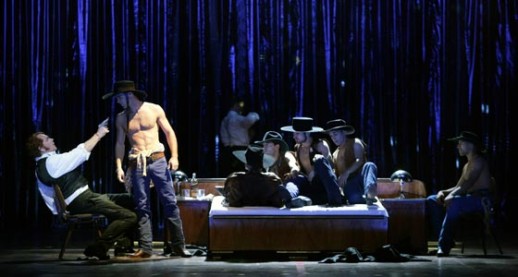
Would someone please indentify the stunning photo at the top of this thread: What opera and who are the singers? It’s not nautical enough for Billy Budd.
Is it the opening scene of Girl of the Golden West?
I may be wrong but this looks like the infamous Onegin from Munich.
Yes, it’s the Munich production of Tchaikovsky’s Eugene Onegin nicknamed the Brokeback Onegin.
Thanks for the YouTube link, that made my day. I got all nostalgic for the mid-90′s when I would go boot-scootin’ with my ex-boyfriend Gregg.
If you truly do live in the southwest (?) then I highly recommend you find yourself in Santa Fe next summer for some “professional” and, in my opinion, mostly wonderful opera.
There are some rules to we need to follow, but rules imposed on creativity are just retarded. Who the heck wrote this, some armchair critic? Someone who doesn’t have a real career int he arts? I’d like to see anyone who is really important take this seriously.
Anyway, nice pic at the top. I like it. At least the directors know who their audience is: a bunch of gays.
Love “Don’t Stage the Overture.” That’s the hallmark of an amateur director (even if they’re working professionally) and a fool.
I would add to that:
DON’T STAGE A SHOW WITHIN A SHOW. I can’t tell you how many productions I’ve either been in or seen where the director says in the first rehearsal, “Oh, you’re a troop of actors putting this performance on,” and then proceeds to unveil the production design where either a stage is on the stage, or a traveling stage will be dragged on at some point. This is one of the WORST staging cliches in the business (I would include Broadway,) and is the absolute pinnacle of directorial laziness, generally a result of the fact that they don’t understand the plot, characters, or didn’t bother to translate the opera. The ONLY exception to this rule is Pagliacci which calls for it, but I can’t think of a single other theatrical circumstance that requires it, and I’m immediately done with any director stupid enough to try it.
I agree totally, though I guess Ariadne is another one that has it in the plot.
Of course, Ariadne.
If it’s in the plot, then fine. Otherwise, no.
Mines of Sulphur has a show-within-a-show…but otherwise, unless the details are rigorously worked out and it actually makes sense, it should probably be avoided.
And yet, when it is done well, it can be quite fun. This last year there was a production of Giovanni that was staged like a commedia dell’arte troupe putting on a show. It was just fabulous! I wish i could remember the venue, but i can’t. i saw a telecast of the performance and lemme tell you, it worked.
The commedia dell’arte staging within a staging cliche is the worst of the worst. I would have killed everyone around me and myself if I’d had to do a production like that, ESPECIALLY of Giovanni, which doesn’t need that kind of bullshit.
Wee you involved in it in any way? Did you see the performance?
If not, then you are criticizing sight unseen and you have criticized people for doing just that.
Yes, sight unseen I criticize it because in the eternity it seems I’ve been performing and sitting in an audience I have never once seen this amateur, eye-rolling cliche work. Based on what you described, I’m fairly sure it’s easy to make that assessment.
So sorry Cassy, I forgot that among us you are the only one with any stage experience and the knowledge to make any such judgments.
Cassandra,
To be fair to Lindoro, La Cieca did tell us to stop criticizing productions “sight unseen.”
La Cieca has lots of shirtless photo but this one is best UBER ALL, may I know what performance and where?
see 6 above.
This is the best thing I’ve ever read on this site!
I do miss the old ‘zine days when La Cieca and her stable of top-notch writers would regularly produce features like this one, balancing wit and seriousness perfectly. I still laugh at the glossary of opera queen terminology.
La Cieca can only dream of a time when her writers were simultaneously top-notch and stable.