 Everything I need to know about Bizet I learned at a Judy Chicago exhibit in 1996. Brutality against women is pervasive, and society is culpable by permitting it.
Such grievances were aired at the expense of the composer’s chef d’oeuvre Carmen yesterday at La Scala’s Gala opening, viewed dal vivo at Symphony Space on 95th and Broadway.
The new production was the first of La Scala’s annual high definition broadcasts and a glimpse into the white-tie and red-carpet opener that takes place every December 7th at the storied Milan opera house. While mostly a snooze, this Carmen is retrofitted in spots to address “thorny contemporary issues,” flattening Bizet’s lyric masterpiece into an activist rant.
Directed and with costumes by avant-garde theater artist Emma Dante, the production is in other respects typical of more conservative Carmens. Her high-concept directing was obviously watered down in rehearsals to be more palatable to a worldwide live audience, lacking many “heretical” elements previously reported in the Italian press, such as Carmen being portrayed as a nun in a convent.
It is unfair to discuss what ideas did not, finally, become a part of Ms. Dante’s staging, much as it would be unfair to judge a novel by its discarded sentences. But the hype swelling around this production’s shocking elements, many not evidenced in the premiere, smacks suspiciously of a public relations-driven succes de scandale.
Ms. Dante’s costumes were only shocking in their ordinariness, with women in cliché gypsy dresses, and the men in dirty military outfits and linen shirts. The sets – stark, dusty, and minimal impressions of Seville – were by Richard Peduzzi, who designed the flop Tosca to open the Metropolitan Opera season in October.
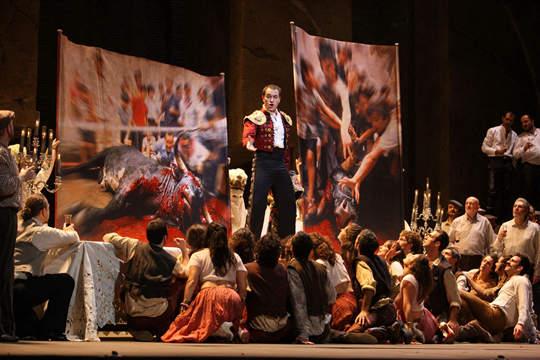
Like the Met Tosca, this Carmen takes few theatrical risks but fails miserably where it does venture out. During Escamillo’s “Toreador Song,” onlookers swoon to his bravado while his companions unfurl enormous, grisly photographs of savagely slaughtered bulls lying in their own blood, like a PETA advertisement. A rhetoric of Feminist clichés also pervades. After the fight between Carmen and Manuela (“C’est Carmencita qui porta les premiers coups!”), in which Ms. Dante’s girls of the chorus engage in a highly stylized hair-pulling catfight, one of the brawlers (female) is brutally beaten back by a police officer (male) and kicked repeatedly (brutal) even though she is lying motionless (excessive) and bleeding from the mouth (disgusting and brutal). You get the point.
Erwin Schrott: "I'd rather go nude than sing Carmen!"
A few clever and innovative touches interpolated symbolist currents into the stage drama. In Act One, young boys hiding on the backs of adult soldiers fall out of the men’s coats, running amok in their underwear before scampering off – perhaps to suggest the innocent souls of young men lost to war. Children “double” Carmen herself, who has several young girls at her heels through much of the first act.
In the danced scenes, including the spectacular “Danse Boheme,” Carmen and her entourage move in the familiar flamenco way. Holding their skirts and sweeping them at the floor, they also go to pains to lift them and expose what’s beneath. In one scene they lie back onto tables while Carmen splays each girl’s legs open. Why exactly? To show us a glimpse of the Patriarchy’s loathed and cherished bounty? As a symbol of female strength? The gesture reads crudely and its possible explanations smack only of clichés.
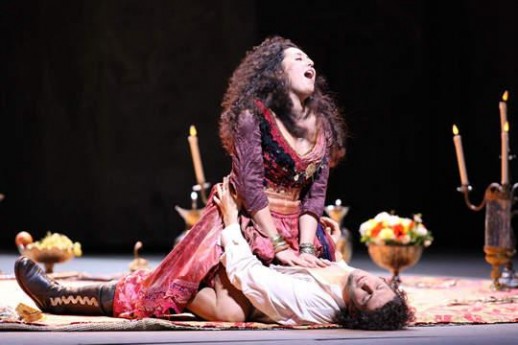
Then there is the controversial decision (which had tongues wagging when leaked from rehearsals last week) that in the final scene Carmen would not only be killed by Don Jose but raped as well. We see crazed Don José forcing a listless Carmen against brick walls, while the offstage chorus cheers Escamillo with shouts of “Victoire!” To me, this addition only makes explicit those ugly forces within Don José that we already acknowledge – a disappointingly literal extrapolation. What is the difference between Don José, in a murderous rage, raping Carmen before killing her, or knifing her to death straightaway?
As an artistic work, Carmen’s story is rich – and durable – because it is ambiguous. Is she a victim or a villain? Does she intentionally court her own demise, seducing men to madness, or is she a tragic captive of men’s urges? And what does all this say about femininity, and those women who are not, strictly speaking, femmes fatales? To militantly take sides on these issues is foolish and unrewarding, and it gratuitously politicizes a work that already cogently addresses these topics.
Fortunately Dante made few unreasonable demands on her cast, allowing them to present a musically stable opening night performance. Georgian mezzo-soprano Anita Rachvelishvili sang the role of Carmen with a creamy, unctuous tone, sounding much older than her 25 years. Though her acting needs work, and her French was quite bad, the real trouble was the consistently loud and hefty singing that made her somewhat unbelievable as a coy seductress.
Jonas Kaufmann scored the biggest success of the evening as Don José, winning huge ovations – the only mid-act applause of the night – after his aria “La fleur que tu m’avais jetée.” The La Scala audience was generally reserved and tepid all night, greeting his Act One duet with Micaela and her later aria “Je dis que rien” with stony silence.
Kaufmann’s haunting and focused tenor is best in its ringing upper register, which never lacks for depth or warmth in spite of its bright plangency. His mezza voce has an unusual tension that can be captivating, but grows tiresome when the covered, darkened sound is applied to all occasions. In this Carmen, which is lacking in specific Personenregie, the singers are mostly left to their own devices. Kaufmann proved to be the most natural actor among them.
Much of the supporting cast was just so so, but Mathias Hausmann should earn some special mention for his particularly bad Moralès, singing with shoddy French and a thin baritone that reflected shamefully on La Scala’s casting administrators. The powerful, dark bass of Erwin Schrott helped cut a profile of a commanding bullfighter Escamillo, but his French, too, was off the mark – or was he singing Russian? (Poor French was the rule for this performance, though it was performed ambitiously in the original opéra comique version, with extensive French dialogue.)
Our true champion of the evening, however, was Adriana Damato, who was cruelly – one might think intentionally – miscast in the role of Micaëla, yet pulled it off. She furthers Ms. Dante’s idea of Micaëla as the literal embodiment (rather than just the messenger) of Don José’s mother. In Act One, looking dowdy, she uses her warbly, dark soprano to suggest a nagging mother. Then during the duet she turns her reversible black cloak into a wedding dress. When a white scrim becomes her veil, she sings the last bars of the duet in a state of Lucia-like stupor, pawing at the bridal veil like a helpless animal.
In Act Three, Ms. Dante has Damato appear with grayed hair. As Micaëla sings of Don José’s dying mother, the chorus members erect a death bed around her with a sheet and a pillow. Right there, she dies. Though it sounds funny to describe, it was, for me, the one true glimpse of a penetrating avant-garde perspective that, had Ms. Dante carried it further, could have made a Carmen at least worthy of its own controversy.
Daniel Barenboim conducted a Furtwänglerian, foursquare reading of Bizet’s music, almost managing to stifle its effervescent magic. His tempo for the Act One duet (“Parle moi de ma mere”) must have been the slowest in history, and the “Habanera” did not swing with the lilt of Barenboim’s beloved tangos. In louder and more energetic passages, he slashed and whipped his arms, throwing angry sforzati at the orchestra, and cranking the crescendos toward some imagined orchestral climax.
The Symphony Space audience was the kind of crowd you might expect on the Upper West Side at noon on a Monday, with many retirees present. They greeted the live broadcast, after some initial technical difficulties, with a curious mixture of enthusiasm and misbehavior. Folks made chitchat during the orchestral preludes. Shushes were countered by shush-shushers. Great laughter greeted all of Daniel Barenboim’s entrances to the orchestra pit. (He’s grown portly in recent years, and had some trouble getting onto his rostrum, making faces that suggested a visit to the proctologist. This was not handled discreetly by the camera directors.) This laughter elicited laughter-shushers and, finally, furious shouts of “Stop laughing! It isn’t funny!” Of course, it was all very funny.
The applause from the Milan audience was warm for Kaufmann and Rachvelishvili, gently graded for the rest of the singing talent, tepid for Barenboim, and at long last, forcibly hostile to director Emma Dante, who clutched Barenboim’s hand and tried to put on a pleasant face. There is a contingent of the audience in most European opera houses that will boo any unconventional production, and this faction is usually small. Last night’s vote of “no” suggested something far more unanimous and is bound to be a lasting topic of discussion: La Scala’s Carmen, a failure of imagination and of art, will die hard.