
La Scala Upper West
Everything I need to know about Bizet I learned at a Judy Chicago exhibit in 1996. Brutality against women is pervasive, and society is culpable by permitting it.
Such grievances were aired at the expense of the composer’s chef d’oeuvre Carmen yesterday at La Scala’s Gala opening, viewed dal vivo at Symphony Space on 95th and Broadway.
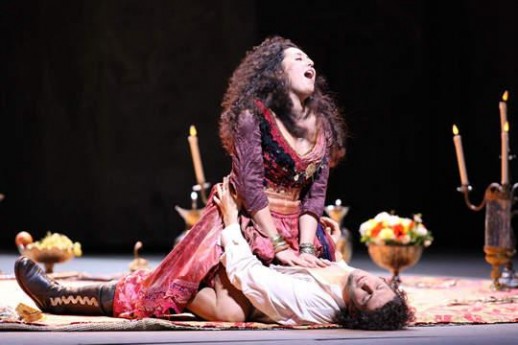
The new production was the first of La Scala’s annual high definition broadcasts and a glimpse into the white-tie and red-carpet opener that takes place every December 7th at the storied Milan opera house. While mostly a snooze, this Carmen is retrofitted in spots to address “thorny contemporary issues,” flattening Bizet’s lyric masterpiece into an activist rant.
Directed and with costumes by avant-garde theater artist Emma Dante, the production is in other respects typical of more conservative Carmens. Her high-concept directing was obviously watered down in rehearsals to be more palatable to a worldwide live audience, lacking many “heretical” elements previously reported in the Italian press, such as Carmen being portrayed as a nun in a convent.
It is unfair to discuss what ideas did not, finally, become a part of Ms. Dante’s staging, much as it would be unfair to judge a novel by its discarded sentences. But the hype swelling around this production’s shocking elements, many not evidenced in the premiere, smacks suspiciously of a public relations-driven succes de scandale.
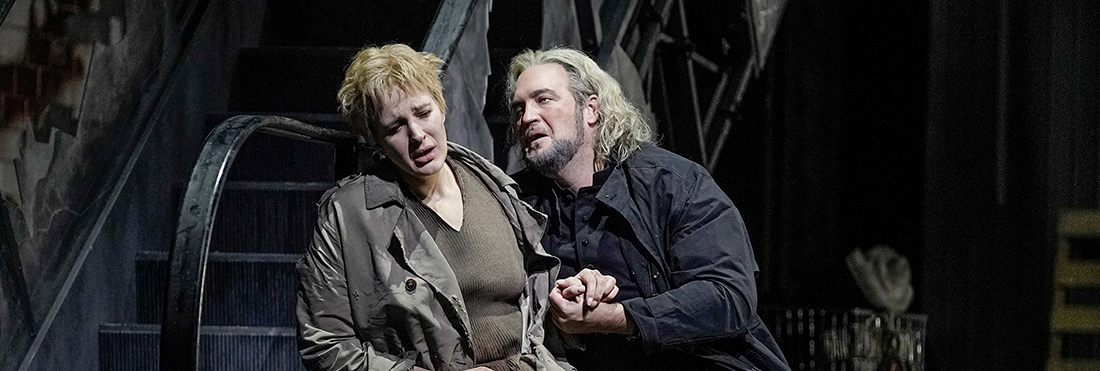
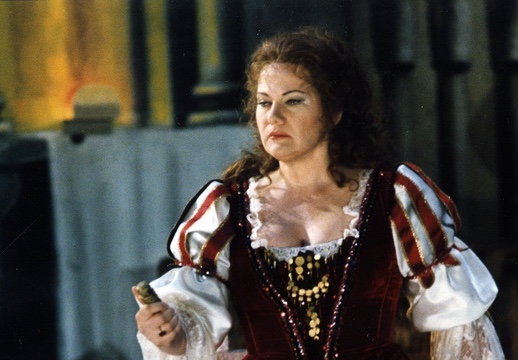
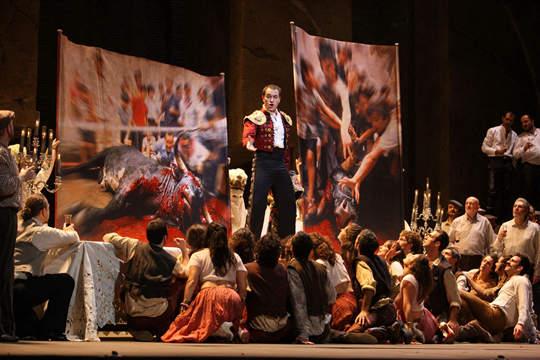
Ms. Dante’s costumes were only shocking in their ordinariness, with women in cliché gypsy dresses, and the men in dirty military outfits and linen shirts. The sets – stark, dusty, and minimal impressions of Seville – were by Richard Peduzzi, who designed the flop Tosca to open the Metropolitan Opera season in October.
Like the Met Tosca, this Carmen takes few theatrical risks but fails miserably where it does venture out. During Escamillo’s “Toreador Song,” onlookers swoon to his bravado while his companions unfurl enormous, grisly photographs of savagely slaughtered bulls lying in their own blood, like a PETA advertisement. A rhetoric of Feminist clichés also pervades. After the fight between Carmen and Manuela (“C’est Carmencita qui porta les premiers coups!”), in which Ms. Dante’s girls of the chorus engage in a highly stylized hair-pulling catfight, one of the brawlers (female) is brutally beaten back by a police officer (male) and kicked repeatedly (brutal) even though she is lying motionless (excessive) and bleeding from the mouth (disgusting and brutal). You get the point.
Erwin Schrott: "I'd rather go nude than sing Carmen!"
A few clever and innovative touches interpolated symbolist currents into the stage drama. In Act One, young boys hiding on the backs of adult soldiers fall out of the men’s coats, running amok in their underwear before scampering off – perhaps to suggest the innocent souls of young men lost to war. Children “double” Carmen herself, who has several young girls at her heels through much of the first act.
In the danced scenes, including the spectacular “Danse Boheme,” Carmen and her entourage move in the familiar flamenco way. Holding their skirts and sweeping them at the floor, they also go to pains to lift them and expose what’s beneath. In one scene they lie back onto tables while Carmen splays each girl’s legs open. Why exactly? To show us a glimpse of the Patriarchy’s loathed and cherished bounty? As a symbol of female strength? The gesture reads crudely and its possible explanations smack only of clichés.
Then there is the controversial decision (which had tongues wagging when leaked from rehearsals last week) that in the final scene Carmen would not only be killed by Don Jose but raped as well. We see crazed Don José forcing a listless Carmen against brick walls, while the offstage chorus cheers Escamillo with shouts of “Victoire!” To me, this addition only makes explicit those ugly forces within Don José that we already acknowledge – a disappointingly literal extrapolation. What is the difference between Don José, in a murderous rage, raping Carmen before killing her, or knifing her to death straightaway?
As an artistic work, Carmen’s story is rich – and durable – because it is ambiguous. Is she a victim or a villain? Does she intentionally court her own demise, seducing men to madness, or is she a tragic captive of men’s urges? And what does all this say about femininity, and those women who are not, strictly speaking, femmes fatales? To militantly take sides on these issues is foolish and unrewarding, and it gratuitously politicizes a work that already cogently addresses these topics.
Fortunately Dante made few unreasonable demands on her cast, allowing them to present a musically stable opening night performance. Georgian mezzo-soprano Anita Rachvelishvili sang the role of Carmen with a creamy, unctuous tone, sounding much older than her 25 years. Though her acting needs work, and her French was quite bad, the real trouble was the consistently loud and hefty singing that made her somewhat unbelievable as a coy seductress.
Jonas Kaufmann scored the biggest success of the evening as Don José, winning huge ovations – the only mid-act applause of the night – after his aria “La fleur que tu m’avais jetée.” The La Scala audience was generally reserved and tepid all night, greeting his Act One duet with Micaela and her later aria “Je dis que rien” with stony silence.
Kaufmann’s haunting and focused tenor is best in its ringing upper register, which never lacks for depth or warmth in spite of its bright plangency. His mezza voce has an unusual tension that can be captivating, but grows tiresome when the covered, darkened sound is applied to all occasions. In this Carmen, which is lacking in specific Personenregie, the singers are mostly left to their own devices. Kaufmann proved to be the most natural actor among them.
Much of the supporting cast was just so so, but Mathias Hausmann should earn some special mention for his particularly bad Moralès, singing with shoddy French and a thin baritone that reflected shamefully on La Scala’s casting administrators. The powerful, dark bass of Erwin Schrott helped cut a profile of a commanding bullfighter Escamillo, but his French, too, was off the mark – or was he singing Russian? (Poor French was the rule for this performance, though it was performed ambitiously in the original opéra comique version, with extensive French dialogue.)
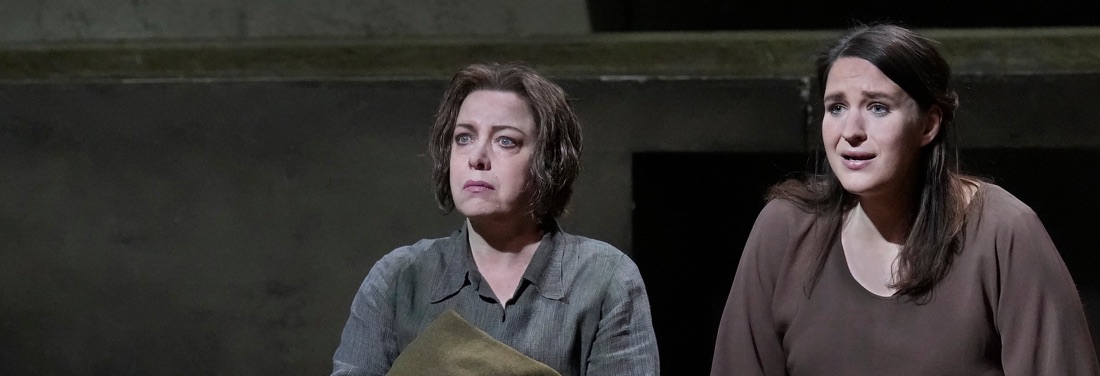
Our true champion of the evening, however, was Adriana Damato, who was cruelly – one might think intentionally – miscast in the role of Micaëla, yet pulled it off. She furthers Ms. Dante’s idea of Micaëla as the literal embodiment (rather than just the messenger) of Don José’s mother. In Act One, looking dowdy, she uses her warbly, dark soprano to suggest a nagging mother. Then during the duet she turns her reversible black cloak into a wedding dress. When a white scrim becomes her veil, she sings the last bars of the duet in a state of Lucia-like stupor, pawing at the bridal veil like a helpless animal.
In Act Three, Ms. Dante has Damato appear with grayed hair. As Micaëla sings of Don José’s dying mother, the chorus members erect a death bed around her with a sheet and a pillow. Right there, she dies. Though it sounds funny to describe, it was, for me, the one true glimpse of a penetrating avant-garde perspective that, had Ms. Dante carried it further, could have made a Carmen at least worthy of its own controversy.
Daniel Barenboim conducted a Furtwänglerian, foursquare reading of Bizet’s music, almost managing to stifle its effervescent magic. His tempo for the Act One duet (“Parle moi de ma mere”) must have been the slowest in history, and the “Habanera” did not swing with the lilt of Barenboim’s beloved tangos. In louder and more energetic passages, he slashed and whipped his arms, throwing angry sforzati at the orchestra, and cranking the crescendos toward some imagined orchestral climax.
The Symphony Space audience was the kind of crowd you might expect on the Upper West Side at noon on a Monday, with many retirees present. They greeted the live broadcast, after some initial technical difficulties, with a curious mixture of enthusiasm and misbehavior. Folks made chitchat during the orchestral preludes. Shushes were countered by shush-shushers. Great laughter greeted all of Daniel Barenboim’s entrances to the orchestra pit. (He’s grown portly in recent years, and had some trouble getting onto his rostrum, making faces that suggested a visit to the proctologist. This was not handled discreetly by the camera directors.) This laughter elicited laughter-shushers and, finally, furious shouts of “Stop laughing! It isn’t funny!” Of course, it was all very funny.
The applause from the Milan audience was warm for Kaufmann and Rachvelishvili, gently graded for the rest of the singing talent, tepid for Barenboim, and at long last, forcibly hostile to director Emma Dante, who clutched Barenboim’s hand and tried to put on a pleasant face. There is a contingent of the audience in most European opera houses that will boo any unconventional production, and this faction is usually small. Last night’s vote of “no” suggested something far more unanimous and is bound to be a lasting topic of discussion: La Scala’s Carmen, a failure of imagination and of art, will die hard.

shit. hard-hitting review squirrel.
1. she’s 25. wow. that’s a risk for la scala to do innit? an opening night for an artist that isnt really well known.
2. perduzzi seems to have a very one-dimensional design esthetic. some of the stills remind me of Tosca.
3. La Scala opening nights are so boring now. you know the audience is going to boo the production team. bah. just like Don Carlo last year. whoopdeedoo. whatever happened to screams of ecstacy? to the mob carrying the diva to her car???
all in the past i guess.
The first act looked a lot like the Tosca set. Brick.
Squirrel – there is nothing more to say. You have got it all, and exactly right. Bravo on the review. Not so much the production.
is that Jonas Kauffman’s cumface?
HA!
i can’t believe you just soiled my post with your filthy comment!
there goes Squirrel’s legit writing career!:)
squirrel dont hate me. i just am really really curious.
Thanks Squirrel. I would like to point out, though, that a stronger awareness in your text that you saw, and especially heard, a broadcast might have been helpful. I was there in person, and I would rather say that:
“The applause from the Milan audience was ENTHUSIASTIC for Kaufmann and Rachvelishvili, gently graded for the rest of the singing talent, EQUALLY ENTHUSIASTIC for Barenboim, and A MIXTURE OF BRAVAS AND BOOS (NEITHER DOMINATING) for director Emma Dante. [...] Last night’s FAR FROM UNANIMOUS REACTION suggested [I am not sure what it suggested...]
I know it has been said over and over again on this blog, but it clearly needs repeating: microphones are placed with the pit and the stage in mind, and do a very selective job at conveying sounds coming from the auditorium.
Ciao.
Peduzzi designed Chéreau’s Lulu and the Paris Opera and his Bayreuth Ring, no?
OK, since I seem to have appointed myself resident feminist: how is a “hair-pulling catfight” a “feminist cliché”? I didn’t see it, but it sounds like the opposite to me. (Actually, I would argue that the fighting women, as they are written in the score, are another way the opera portrays women as animalistic and less rational than men.)
But thanks for the report, Squirrel, I couldn’t go but it doesn’t sound like I missed very much.
A resident feminist is not exactly what this blog has been crying for…
Hair pulling is easier if you have long hair.
I don’t think that the reports in the Corriere della sera give the impression of an equal mixture of bravas and boos.
Of course, the usual Zeffirelli couldn’t help keeping his mouth shut. This is what he said today in an interview to Corriere della Sera: “(Emma Dante” is an irresponsible woman, the fruit of a fallacious culture, author of ugly costumes one wouldn’t even find in a provincial opera house, and assisted by a worthless set designer (Richard Peruzzi). It is a scandal that La Scala has done this kind of crap ( “porcata is the word he uses) with the presumptuousness of teaching young people what opera is about. This lady has transformed Carmen in a demon, demonstrating that she ignores nineteenth century literature, which is full of women rebelling to male abuse of power, without however becoming devils. And Carmen is one of them. Baremboin, extraordinary pianist and grandiose conductor, is a prankster and this time he made himself accomplice of a crime. Such a thing would have never happened with Kleiber or Karajan”.
Much esteemed Squirrel, with a special accent grave over the fourth “e” in esteemed so as to give it a very formal sounding syllable of its own:
This is a fine and literate review, but I must, Miss Gorightry, plotest the Tosca-Flop shorthand! You’ve said exactly what was wrong with it in the next paragraph, but why add into the Coliseum mentality with which productions are in danger of being judged? Anyway isn’t it rather well sold for a flop, I thought?
On another subject entirely, it is amusing to think of Schrott singing in Russian, and then get lost in non-homoerotic reverie about how maybe growing up in Baritonia or wherever he’s from, he was this huge Arkhipova fan with pictures of her in his locker, and did it as a tribute to her famous trilingual Carmen with del Monaco. I mean it isn’t impossible.
Anyway this was a swell read.
Au contraire, a resident feminist might be not such a bad thing for the occasions when old school “let’s call women ‘fish’ because we homosexuals say the damndest things” gaydom prevails in an embarrassing way. I’m going to risk serious smarm here and mention briefly the non-monolithic, nuanced nature of actual feminism and suggest that plenty of us, I’d hope, are part-time resident feminists.
Ya know, Eman, I wish mike placement could have sped up Barenboim’s sleepytime tempi, or given Micaela an actual singing voice. /Polite bit of clapping/ from Violetta, because she’s just not rude enough to holler boos at musicians.
Indeed, Maury, well spake!
Thanks, Maury. I meant that partly in jest in the hope that I’m not actually the only one.
But I’m just a loudmouthed harpy, I can’t help it.
Wow. it’s rough being on the same side of an issue as Zeffirelli. I’d better watch my step!
I think I’m another part-time feminist, and I was surprised by that part of Squirrel’s well-written review. I left the (movie) theater thinking Dante seemed to have gone out of her way to be as un-feminist as possible. Pervasive, if stylized, violence against female characters doesn’t seem feminist, nor does the notion that “Women” (i.e. Carmen) have/has no agency in life beyond sexual infidelity. That kind of bugged me about the production (at least as it came accross on a cinema screen in small-town New Mexico).
I kind of figured Dante set herself up for booing no matter what by her smart-alecky remarks to the press in the past few weeks. A Sicilian telling the Milanese press that she has never bothered to set foot in La Scala before being employed there is going to get crucified (and she had to know that, didn’t she?)
Despite ticket sales,after the dust settled the Bondy Tosca has proved both a critical and a popular failure, or that seems to be where the failometer is reading. But let’s all please not start going there!!
I once participated in a “trilingual carmen” but now my college days are over and I have stopped smoking Peyote.
def. squeezing “Porcata” into my next review tho….
Squirrel: Your review is really interesting, but tell us this–can you realistically make such definitive and analytic comments about voices based on broadcast sound? I have never thought that quite accurate or fair.
From this account of the Scala production, I’ll take Peter Brooks’ The Tragedy of Carmen any day — one of the original pieces of regie opera theatre and a success by my perception.
Thanks for your report Mr. S.
Eman: it’s a good point. I only know what was heard via the broadcast. I can say, however, that the look on ms. Dante’s face during the booing was consistent with someone being booed loudly – she was pale as a sheet, biting her lip, and seemed to want to run off the stage as soon as possible. Many of the Symphony Space viewers had already left by this point and came rushing back into the hall to see what the booing sounds were all about.
Let me say here that I have absolutely no fights to pick with Feminism, nor PETA for that matter, but rather I question “issues-based art” that relies on rhetorical devices to ply the audience into sharing the creator’s political or social views. It’s essentially propaganda.
Given how often people (here and elsewhere) make judgments about singers based on Youtube videos, positive and negative, a review of the broadcast seems valid and legitimate. At least as long as we all understand that it’s not quite the same as hearing the performance live in the house.
I think it’s a bit much to presume a stipulation that the Bondy Tosca is now ackmowledged to have been a failure. I saw it four times, and each time I found it musically thrilling and dramatically incisive and excting. Audience response was wildely enthusiastic and lengthy for all performances.
Wasn’t perfect, but SO much better than many others I’ve seen over the last few decades. The FZ production had long since seen its day.
And Pedruzzi also did the sets for the most-definitely-not-a-flop “From the House of the Dead.”
BTW, the Bayerische Staatsoper is renting out the Tosca for next summer, it seems.
I was asked to review the HD transfer of the event, and did the best a squirrel can do to judge the performance through that lens(/microphone)
Not to jump too quickly to Squirrel’s defense, but the producers of the Carmen HD and indeed the people who create any sort of opera recording are at least implicitly saying to the listener, “This is a representation of how the performance sounds in the theater.” So I think it’s fair for a reviewer to make judgments on the singing, orchestra balances and so forth based on the HD experience. The problem would be if the reviewer tried to trick the reader into thinking the critique was based on a live in-house experience.
ITA, Squirrel. My beef with Dante was that,as a meditation on gender, the production was just thuggish & dumb.
YO! Youse guyz! Lay off The Squirrel! He’s got a lot of nuts to gather before the snows really come down on us.
“Must the winter come So SOOOOOOOON??”
Emma Dante’s web site is NSFW!
(turn sound on)
http://www.emmadante.it
I DO apologize for my recalcitrant Blackberry’s misbehavior in sending this message thrice. Perhaps it will work a charm. However, I do apologize.
As far as Tosca, methinks I recall Alex Ross sizing it up in one apt and rarely applied word these days, “FIASCO”.
Camille: You have convinced me! I am laying off Squirrel!
(Not that I was ever giving him a bad time.) But his nuts
are another matter, fair game. Squirrel is, of course,
a highly prized member here, I was just questioning
a certain (familiar) critical issue. I have the problem
myself — reviewing from those HD movie presentations.
I absolutely know they sound quite different in the house.
Oh, how I dread the upcoming Hoffman. That opera is
really sick-o. “Without redeeming qualities.” And
Levine takes it sooooo seriously. Icky! For sheer
theatrical enjoyment give me Parsifal any day.
Please tell me, La Cieca, it isn’t so. (Bad cliche enough for starting out here?) You mean that Micaela appeared on stage with greying hair without even a touch or stronger hint than that (hopefully) of Bunuel (or Dali)-esque irony? (Take your pick). If not, it looks like Barenboim, Lissner & Co have invited us to Zambello-land, in terms of all the layered on and one to two dimensional cliche and hype surrounding this.
Where was anything about the music, how it got played, to complement what Dante did with the staging? You certainly made the case, though complimenting Kaufmann too much (but I trust more astute in judging diction of about the entire cast) that there was as much a lack of connection or focus to the whole thing, such as happened with both the Met Tosca (Bondy) and Salome (Flimm). Barenboim, with what producers he has worked with before, definitely knows better, so he is one the two involved in all this, with Lissner, who is without excuse the most.
Thank you very generously in advance, unless you have something strong enough to say otherwise, for saving my time and effort come a Sunday afternoon in March,
when I most likely will not be attending this. Any twinge of doubt I had about prejudging anything, in what I’ve written on my blog) has most certainly vanished now, as though into thin air. Your review, and I feel it haughty for me to say it, is equally as worthy as mine. I had plans, had intended to see it, but neither one of the two theaters here (Rave and Santikos) that do world opera in HD were willing to show it, whereas had I lived in Tulsa instead of Houston I might’ve had even a very easy time getting there to do so.
http://www.thedavidsoperaworldblog.blogspot.com Not that it needs it, certainly not as much as mine, but notice of review on your site will post on my blog straight away.
David S
“…the FRUIT of a fallacious culture…”?
How utterly delicious, coming from la bocca della verita di Frego!
Oh, Sir MM, not directed at you, just in general, as I think Squirrel has to banter a great deal to defend his position. It seems to me he has a great deal of potential and I want him to be able to get on with it. Actually, the question you raised is apt.
May I ask you, as you are quite the Steber expert, which of her two Vanessas do you think the better, and why? Just recently have I purchased her Salzburg Vanessa, which I enjoy enormously for Gedda and Elias. I feel she was slightly better in the studio recording but it is now a long while I’ve not heard it.
What do you have to say about this marvelous singer, whom I’ve only gotten acquainted with, in the last ten years.
Her Kaiserin and Minnie are very fine — I have not heard her Elsa, but am aware she sang it.
As well, at the time of the Vanessa premiere at the Met in ‘58, what were the reactions of the press and public.
Thank you.
I only ask as you appear to me to know the difference between scheiss und shinola.