
Fire and Music

With Händel’s canon largely rediscovered and audiences hungry for more music from the Baroque period, opera houses and recording companies have increasingly turned their attention towards the stage works of Antonio Vivaldi. In only the past decade around 25 of Vivaldi’s operas and pasticcios have been revived, and more and more artists are performing and recording recitals completely or partially devoted to his music.
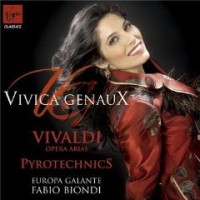
Both mezzo-soprano Vivica Genaux and violinist/conductor Fabio Biondi have been in the forefront of this Vivaldi renaissance, joining forces for a complete Bajazet as well as Alessandro Scarlatti’s La santissima Trinità.
Pyrotechnics, the team’s new CD (released by EMI/Virgin Classics) focuses on Vivaldi’s most vertiginous coloratura arias, most of them receiving their first performance in modern times.
Although Vivaldi claimed authorship of 94 operas, only about 50 titles have been identified, and around 30 scores have been found, usually in less than complete state, creating incredible headaches for musicologists and conductors. Some of his better known operas (Bajazet, for instance) are pasticcios, where arias from other composers abound. Bajazet’s most famous aria, “Sposa son disprezzata” was originally composed by Giacomelli as “Sposo non mi conosci”. As in most of the other pasticcios, Vivaldi wrote new music for the heroes of this opera, while keeping the other composers’ original music for the villains.
Interestingly enough, he took the trouble to write the recitatives in all of his operas, a task most composers of the time would delegate to their students or even to the singers.
The opening aria on Pyrotechnics, “Come invano il mare irato”, from Catone in Utica, is indicative of the tone of the recording. A quintessential “aria di tempesta”, this Allegro Molto in C major exceeds two octaves in vocal range and features every possible ornamentation the human mind can conceive and the human voice can perform: cascate scempie, cascate doppie, gruppetti, simple trills, ribattuti trills, mordents, trills with mordents, double cadences with mordent, and more. The singer is also required to sing fast coloratura for twelve bars without taking a breath.
Numerous are the “arie di furore”; the most interesting excerpts are “Destin avaro” from La fida ninfa, and “Vibro il ferro” (probably from the opera Ipermestra), where frenzied semiquavers evoke the character’s inner tumult.
Another staple of Baroque opera was the “imitation” aria, which is here represented by “Nella foresta leone invitto” (Catone in Utica), where Emilia compares her suffering to the moans of a wounded lion, with the horns imitating the beast’s roars. Even more emblematic of the genre, “Quell’usignolo” (L’oracolo in Messenia) embodies the time-honored metaphor, the nightingale’s love song.
A few slower-paced arias are welcome in the midst of such relentless, dizzying fireworks. The Larghetto “Vorrei dirti il mio dolore” (from Rosmira fedele) is a touching, subdued love song that makes ample use of the so-called coloratura di grazia, or galante, a light graceful agility to be performed as a gentle arabesque.
My personal favorite aria of the disc is the lament “Splender fra’l cieco orrore,” composed for a revival of Tito Manlio. Vocally more restrained and less demanding, its true allure derives from the orchestral accompaniment, particularly the opposition between the sustained viola and violin parts, and the basso continuo with its brisk semiquavers, which create an uneasy and anxious atmosphere of inexorability, perfectly in tune with the sentiments expressed in the text.
Genaux is squarely in her element and this music fits her instrument like a glove. Although she labels herself a mezzo-soprano, her powerful, sinewy timbre sounds more like a contralto to my ears. Armed with an extremely clean, yet energetic and vigorous agility, the Alaskan singer overcomes the infinite difficulties of Baroque singing with amazing nonchalance and aplomb, demonstrating what “coloratura di forza” really means.
The top is not the very best part of her voice: anything above a high G can often sound a bit squeezed and pinched, especially if sung forte. In this particular recording, however, this limitation is not so pronounced because the tessitura tends to be low, with excursions to the highest register only very rarely sustained.
I am happy to note that on this disc Genaux avoids a mannerism I have noticed in other performances of hers: the straight tone she often employs on a sustained note, particularly at the beginning of an aria or one of its sections. Here she sings almost always with a controlled but full vibrato. Before I get excoriated, I must mention that I am perfectly aware of the controversies surrounding this particular issue. Nonetheless, I am firmly entrenched in the camp of those scholars (these days the majority) who believe that Baroque singing required a vibrato rich in overtones, where the straight tone (nota fissa) was employed as an occasional effect, and not as the norm.
Sicilian conductor Biondi and his orchestra Europa Galante are nothing short of magnificent. The rhythmic vigor with which Mr. Biondi leads the original instruments of his ensemble is infused with a sort of enthralling, gripping nervousness and tension. This irresistible race towards an objective embodies the highly imaginative expression of the Baroque aesthetic, with its taste for “wonder” (“il meraviglioso”) and its desire for the impossible. Such a vibrant and intoxicating musical route makes his interpretation extremely original and distinctive. His dynamics are clean and sharp, electrified by feverish excitement. It is a vision of Baroque music light-years away from so many anemic Baroque specialists.
In a few succinct words, this CD is a valuable, exhilarating addition to the growing number of Italian vocal Baroque recordings. Listening to it is pure pleasure, not a “sacrificium!”
E news (comment 4.3): Of course after 30 minutes in baroque opera…..we have ‘heard it all’. This is called baroque development of the plot. Then it is a case of soap opera. For the next couple of hours the characters start endlessly regurgitating and telling every other character in the opera the same thing, hanging onto some curtain or pillar. The audience is expected to want to sit with baited breath and see their reactions. All that exclaimed ‘Oh woe is me, from what you tell me ‘ shit as well as that same continued ‘limpid’ droning speed of the music, pisses me off.
Fair enough. I get pissed off when I doze off during Act 3 of Valkyrie and when I wake up 10 minutes later, they’re still on the same supertitle. To each his/her own.
LOL.
I think there is something they can do for that sleep problem. Or perhaps the nursing home can leave you in your room next time?
One da capo aria after another. Boring!
Are we going to have another Baroque-vs-Wagner tirade? E-news, at least I know I’m not alone. I at least know to shut my trap if I don’t like something.
OK, operabitch, you’ve said in 4 or 5 comments here that you think Baroque opera is boring. We get it.
I am NOT in a nursing home.
I have a home-health nurse that comes by twice a day to change me and read me Metastasio libretti. Artaserse and Demofoonte are perennial favorites. Catone in Utica gets a little dry, to be honest.
Harry, you need to read a little Winton Dean.
Try as I might, I find it nearly impossible to listen to Genaux. Her voice has a “fingernails on a blackboard” quality that I find excruciating: wiry and unsteady. Perhaps it IS getting a “bit” less so as I have found the Vivaldi CD less painful than the Farinelli arias or her complete Rinaldo. Also, I think the microphone does exacerbate this quality as the few times I’ve heard her in person–Juno/Iris at NYCO, Irene in Bajazet in Venice and Arsace at Caramoor–the voice seemed a bit rounder and less harsh.
One must admit that the coloratura is pretty extraordinary (the slower arias on the Vivaldi are FAR less successful), but I just can’t watch her sing it–has ANY singer ever made such weird faces? And don’t feel sorry for Genaux just because she doesn’t get big gigs in the US–she’s a huge star in Europe doing solo concerts at major concert halls and having just starred in a new Tancredi in Vienna and is about to do a new production of a Haydn opera with Harnoncourt there as well as a major revival of Handel’s Semele in Paris (opposite Danielle de Niese–heaven help us from THAT combination!).
Weirder faces than Bartoli? Wow!
See for yourself:
http://www.youtube.com/watch?v=hTpIRFiKTqo
Having seen Vivica live several times, I guarantee you those wild faces are not made on the stage. Now, when have you NOT seen Bartoli making faces anywhere?
As I said before, my one complaint is how her jaw moves. And as I already said, obviously, that has not stopped her.
From the few things i’ve heard, I think Genaux is a wonderful singer. I just can’t bare to watch her (and I have a pretty high tolerance for facial ticks). That flapping of her jaw is just too distracting. A singer friend of mine told me that it has to do with tension, which causes the flapping. If you notice, there’s even some flapping on sustained notes, not just in the coloratura.
But if I don’t have to watch her, she is wonderful.
Genaux, like my mama likes to say, is an acquired taste. Just thank God there’s someone equivalent (mezzo/coloratura/obscure music/facial tics) to bat Bartoli around with.
Glory be! “Fingernails on a blackboard?”
Some people need to get to their ENT’s right away.
This woman is a prize!
First we had the English Joyce Hatto record pirating affair ‘the so called great top pianist that never ever, was’…..
Now I give you a presentation for today’s world : The Baroque recipe formula ….for rip-offs.
Hasn’t the clue dropped yet why record companies are so eager to record Baroque music (AND Baroque opera too!) over other repertoire? It was not that taste ever changed: ‘it just got far cheaper to record endless hours of this Baroque woe & drone’. Doesn’t THAT sound SO Norma Desmond???!!!
The ever lesser number of forces used to create these works is seen by its fans ever-increasingly, as ‘some new marvel of guaranteed authenticity…. ‘.
Now:
1. Give such small group of orchestral players some highfalutin name llke the ‘the 17th & 18th Century Early Concertus Pro Musicus Scholars of Bratislavabremenhaaven’ and you are in business.
2. Put out publicity that the performed work is in a new rare previously unknown edition but yours is now the most authentic. Transpose madly the various parts of the piece…that should not only confuse but give rise to fascination and endless chatter.
3. That takes care of funny non- traditional amateurish sounding inconsistencies in the performance, since the conductor or singers paid ‘bread-line fees’. What can you expect?
4. Also, that should take care of some critic on the ball, questioning the quality.
5. And if you can swindle your way through with that fraud, then be brave and release some medieval A Capella CDs with the great little known choir of St Bozo of the Forbidden Cloisters of the Mount of Timbuktu.
6.To get awards, you do not have to bribe. Start up your own fictitious group that hands out cheap plaques and medals. Make sure you also give just one or two, to other companies that manufactures the same type of dross. Otherwise someone might smell another Baroque rat amongst its present load of pretender castrati, divas, and ratty scrawny sounding instrumentalists..
7. Man, those new found Baroque fans of the 21st Century are just waiting to be ripped off. They shallow ‘for real’… everything you could throw at them as they sip their cat pee chardonnay. Must now find some ‘undiscovered’ works of Vivaldi for them, and increase that already over bloated reputed output.
These modern fans even think Harnancourt is old hat and old fashioned. And as for him dabbling and conducting such mod works like Verdi, Schubert and Beethoven today…… he is therefore proclaimed ‘banished’. Since he is now considered by them, a veteran that turned into playing a form of ‘metal punk music’ That is real living breathing classical music from the 19th century. .
This is all true except I prefer Riesling.
This is about as accurate as possible which is why no artist I know takes more than a very few “Baroque” recordings and their attendant ensembles and conductors seriously. The whole “Baroque” movement in general has been riddled with mediocre to flat out awful musicianship since it emerged in the seventies. Anything with the moniker “genuine Baroque practice” attached to it is to be generally avoided by any serious artist. Like the practitioners of “Modern” music, “Baroque” players are generally regarded as lesser musicians with lesser talents who couldn’t hack it in real music.
Whether or not this is true is, I guess, up for debate, but I would say that the majority of my experience has borne this truth out.
Yes, we all know the closed-minded crowd you’re referring to — focused on a narrow repertory that excludes both early and new music — but they are hardly a model of what is exciting in the music world. They are specialists like any others who are uninterested in the larger sweep of musical experience.
(And, by the way, my comment below beginning “I really, really …” was meant in response to Harry, but it may be applicable to you, as well. I don’t know.)
It can’t be applied to me. I adore Handel and Vivaldi. Some of the greatest moments I’ve ever had in a theater were sitting through five hours of a Handel opera. I also enjoy performing Handel and do quite frequently. I however do NOT enjoy performing them with, or seeing them performed by the crowd I described (and there are a lot of them out there.)
I really, really hate to see genius treated with contempt in this way.
You don’t get anything at all about Baroque opera. We get that. Then you talk about these ensembles and virtuosi like Biondi as though they were pulling some sort of imposture. This is not a matter of taste. It is ignorance. Those very few people like Biondi, Brueggen, Harnoncourt, Leonhardt, René Jacobs, are geniuses to compare with any the music-world has known. To treat them with disdain and speak of them with contempt is either ignorant or contemptible.
Seriously. If you don’t like something that you clearly know nothing about, that’s just fine. But why this zeal to tear it down and to misrepresent it?
And I can’t imagine where you get the idea that record companies are doing this stuff just because it’s cheaper than Wagner or Meyerbeer without any interest from the public. Where on earth have you been?
Biondi, Brueggen, Jacobs, and Leonhardt are geniuses? Are you serious?
Harnoncourt I can take more seriously. He’s very good. His complete set of the Beethoven Piano Concerti with Aimard is brilliant.
But those other 4 are specialist hacks who when the history of conducting is written won’t even get a mention.
Of course they are only incidentally conductors — partly since the role of conductor had not been invented in that repertory. It’s a later development for later repertory. They are not conductors but virtuosi.
On unrelated news: Mary Curtis-Verna has died. Click on my name to go to a tribute page and listen to some samples.
operabitch seems to have been subsumed whole into their nom de venom, and needs to give it a rest. At this point I venture that any one of us could write a comment just as sour, on any subject, from the operabitch archives.
Before: I mis-read part of the review of this Baroque CD, when it got to “….requires more vibrato”
My eyes did a double take, seeing it as ‘requires a vibrator’.
Then again agree with that, I thought : thinking how it might improve some Baroque voices into producing a little projected excitement along the way.
Harry,
Between the “St Bozo of the Forbidden Cloisters…” To the “cat pee chardonnay” to now, the “requires a vibrator” I have been laughing all day.
RANT ON! You are right on.
To all those who say baroque opera is boring, what do you say about Monteverdi operas?
My favorite is Poppea. Fantastic opera as far as i am concerned.
Mine too, Lindoro. I think the music for Seneca and Ottavia is some of the finest and most deeply moving music ever written. Seneca’s death scene when sung by a really great Bass is a marvel. I also love the scene in which Ottavia commands Ottone to dress in drag in order to kill Poppea…it’s such a great scene! The way in the two characters are so firmly delineated is astonishing. I am not sure any other composer past or present could have done it better.
And what about Arnaltas Lullaby? It is as hard and exposed as Un aura amorosa. It is just as beautiful too.
And that last duet, those minor 2nds are orgasmic. Besides the whole historical creepiness associated with the story, I think it is the perfect wedding song.
Here are some of my favorite renditions:
Núria Rial & Philippe Jaroussky. Ethereal.
From the Renee Jacobs recording. I love his version because it is the perfect marriage of dreamy and sensual energies. Perfection:
From the Ponelle Poppea movie: Rachel Yakar & Eric Tappy. What I like about this is how Ponelle brings in the crown and creates a trio.
Monteverdi is GREAT, specially when done like this:
Now, to be honest, I would much rather have this sort of quality singers to do the Monteverdian repertory. We already have great instrumentalists (Alessandrini’s group for instance plays very good Monteverdi), but really subpar singing ruins most of the rep for me nowadays.
I love Monteverdi, especially Poppea. There’s a serene, other-worldly beauty to the music that is so special. I’ve heard that the gorgeous final duet actually wasn’t composed by Monteverdi himself. Anyone have any insight on this?
The duet does not exist in Monteverdi’s hand nor does it exist in at least 1 of the libretti that is used as a reference for editions of the opera.
Scholars have put forth the theory that the opera could be a collaborative effort in which Monteverdi took part and somehow, through time was given the full credit.
Thanks, Lindoro. As well as the highlights that have been mentioned (all of Ottavia’s scenes, Seneca’s death, the Nurse’s lullaby), I love the scene where Drusilla is accused for attempting to murder Poppea.
Thank God for BOTH Genaux and Bartoli. And a pox on the whole “authentic instrument” craze, which is a whole symdrome of awful ailments: 1) the conductor must take everything far FAR too fast (“He shall feed his flock” must become an allegretto and “He was despised” must become a moderato to suit them); 2) only the scrawniest, scratchiest sounds a violin can produce will do, thank you; and 3) all vibrato, color, and interest must be rigorously leached from every voice so that even bassos begin to sound exactly like Emma Kirkby (who is everything I despise in a singer all rolled into one.) Let’s just be glad that today we HAVE two such mezzo-sopranos of such great technical proficiency who actually believe that Baroque music should be INTERESTING. And while we’re at it, let’s enjoy the contrast between them, along with the vibrant skills they offer, instead of playing the silly “Who’s-the-top-dog?” game.
Are you really unaware that the singing of both of these ladies in this rep is directly a result of the “craze” that you despise?
Interesting that one of Genaux’s key teachers was Virginia Zeani. Shame Zeani never got her hands on Emmea Kirkby. We’d have been spared all those years of vibrato-free piping in baroque repertoire. By the way, I’ve been very impressed by Karina Gauvin in Handel and co (not an especial love of mine, though I enjoy it in small doses and if it’s not sung in a bloodless fashion — or by babbling Bartoli.)
I think it’s a stretch to say that one of Ms. Genaux’s ‘Key’ teachers was Virginia Zeani. To hear Ms. Genaux talk of her time with Ms. Zeani, it was torture and she had to ‘unlearn’ many habits from her time at Indiana. She has been with Claudia Pinza for much of her career, almost 20 years I believe, but I don’t have dates on hand. The two are very, very close though and if you ask Ms. Genaux, Ms. Pinza is the teacher that made her who she is today.
Well, Pinza ain’t a bad name for a singing teacher either, is it?
It’s no coincidence, Claudia is Ezio’s daughter, and learned from her father. She was quite good, she sang at the major houses in her short career, even performing a few shows with her father.