
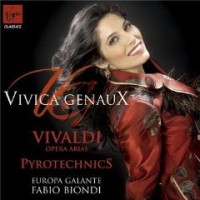
Fire and Music

With Händel’s canon largely rediscovered and audiences hungry for more music from the Baroque period, opera houses and recording companies have increasingly turned their attention towards the stage works of Antonio Vivaldi. In only the past decade around 25 of Vivaldi’s operas and pasticcios have been revived, and more and more artists are performing and recording recitals completely or partially devoted to his music.
Both mezzo-soprano Vivica Genaux and violinist/conductor Fabio Biondi have been in the forefront of this Vivaldi renaissance, joining forces for a complete Bajazet as well as Alessandro Scarlatti’s La santissima Trinità.
Pyrotechnics, the team’s new CD (released by EMI/Virgin Classics) focuses on Vivaldi’s most vertiginous coloratura arias, most of them receiving their first performance in modern times.
Although Vivaldi claimed authorship of 94 operas, only about 50 titles have been identified, and around 30 scores have been found, usually in less than complete state, creating incredible headaches for musicologists and conductors. Some of his better known operas (Bajazet, for instance) are pasticcios, where arias from other composers abound. Bajazet’s most famous aria, “Sposa son disprezzata” was originally composed by Giacomelli as “Sposo non mi conosci”. As in most of the other pasticcios, Vivaldi wrote new music for the heroes of this opera, while keeping the other composers’ original music for the villains.
Interestingly enough, he took the trouble to write the recitatives in all of his operas, a task most composers of the time would delegate to their students or even to the singers.
The opening aria on Pyrotechnics, “Come invano il mare irato”, from Catone in Utica, is indicative of the tone of the recording. A quintessential “aria di tempesta”, this Allegro Molto in C major exceeds two octaves in vocal range and features every possible ornamentation the human mind can conceive and the human voice can perform: cascate scempie, cascate doppie, gruppetti, simple trills, ribattuti trills, mordents, trills with mordents, double cadences with mordent, and more. The singer is also required to sing fast coloratura for twelve bars without taking a breath.
Numerous are the “arie di furore”; the most interesting excerpts are “Destin avaro” from La fida ninfa, and “Vibro il ferro” (probably from the opera Ipermestra), where frenzied semiquavers evoke the character’s inner tumult.
Another staple of Baroque opera was the “imitation” aria, which is here represented by “Nella foresta leone invitto” (Catone in Utica), where Emilia compares her suffering to the moans of a wounded lion, with the horns imitating the beast’s roars. Even more emblematic of the genre, “Quell’usignolo” (L’oracolo in Messenia) embodies the time-honored metaphor, the nightingale’s love song.
A few slower-paced arias are welcome in the midst of such relentless, dizzying fireworks. The Larghetto “Vorrei dirti il mio dolore” (from Rosmira fedele) is a touching, subdued love song that makes ample use of the so-called coloratura di grazia, or galante, a light graceful agility to be performed as a gentle arabesque.
My personal favorite aria of the disc is the lament “Splender fra’l cieco orrore,” composed for a revival of Tito Manlio. Vocally more restrained and less demanding, its true allure derives from the orchestral accompaniment, particularly the opposition between the sustained viola and violin parts, and the basso continuo with its brisk semiquavers, which create an uneasy and anxious atmosphere of inexorability, perfectly in tune with the sentiments expressed in the text.
Genaux is squarely in her element and this music fits her instrument like a glove. Although she labels herself a mezzo-soprano, her powerful, sinewy timbre sounds more like a contralto to my ears. Armed with an extremely clean, yet energetic and vigorous agility, the Alaskan singer overcomes the infinite difficulties of Baroque singing with amazing nonchalance and aplomb, demonstrating what “coloratura di forza” really means.
The top is not the very best part of her voice: anything above a high G can often sound a bit squeezed and pinched, especially if sung forte. In this particular recording, however, this limitation is not so pronounced because the tessitura tends to be low, with excursions to the highest register only very rarely sustained.
I am happy to note that on this disc Genaux avoids a mannerism I have noticed in other performances of hers: the straight tone she often employs on a sustained note, particularly at the beginning of an aria or one of its sections. Here she sings almost always with a controlled but full vibrato. Before I get excoriated, I must mention that I am perfectly aware of the controversies surrounding this particular issue. Nonetheless, I am firmly entrenched in the camp of those scholars (these days the majority) who believe that Baroque singing required a vibrato rich in overtones, where the straight tone (nota fissa) was employed as an occasional effect, and not as the norm.
Sicilian conductor Biondi and his orchestra Europa Galante are nothing short of magnificent. The rhythmic vigor with which Mr. Biondi leads the original instruments of his ensemble is infused with a sort of enthralling, gripping nervousness and tension. This irresistible race towards an objective embodies the highly imaginative expression of the Baroque aesthetic, with its taste for “wonder” (“il meraviglioso”) and its desire for the impossible. Such a vibrant and intoxicating musical route makes his interpretation extremely original and distinctive. His dynamics are clean and sharp, electrified by feverish excitement. It is a vision of Baroque music light-years away from so many anemic Baroque specialists.
In a few succinct words, this CD is a valuable, exhilarating addition to the growing number of Italian vocal Baroque recordings. Listening to it is pure pleasure, not a “sacrificium!”
Your clip certainly sustains you high opinion.
And I’ve worshipped Biondi and his crew for a dozen years. They make us understand why Vivaldi’s music once inspired uncontrolled passion in his hearers — a fact obscured by the sewing-machine playing we heard in the Sixties and still too often.
VIVICA is glorious!
When I saw this disc was been released, I canceled my purchase of Anja Harteros Bella Voce and bought this instead. I can not wait for it to arrive.
I am glad it is already gathering good reviews. Seems like Vivica Genoux is one of those rare artists that knows what will sound good and her voice and performs it with conviction. I have yet to hear a bad recording coming from her.
In other words, we are going to be getting a lot more boring, dull, lifeless, all sounds the same, baroque opera?
What is your point? Did you listen to this? Boring, dull, lifeless? Those with souls have been moved by this music passionately performed.
er, performed passionately.
Nah, the Met already has a copyright on that.
Yeah, I hate all those 4 1/2-hour-long park-and-bark operas where all the characters go on and on about nothing for endless minutes at a time without any kind of interesting staging. Oh, wait…I’m thinking of Wagner.
Seriously though, I find Handel to be pretty action packed compared to Romantic opera. 30 minutes into Giulio Cesare we know that Caesar has won the civil war against Pompey, seen him offer clemency to Pompey’s widow, find out that Pompey has died (and seen his severed head pulled out of a box), witnessed Caesar’s fury at the murder, Cornelia’s lament, Sesto’s vow of revenge, and Cleopatra’s and Tolomeo’s political machinations. 30 minutes into Eugene Onegin, all we know is that Tatiana has a neighbor named Eugene Onegin. 30 minutes into Traviata, we know that Flora likes to throw parties. Apparently, I’m supposed to find that much more fascinating than actual plot developments.
There is more going on musically in 5 minutes in a Wagner opera than in 4 hours of any baroque opera.
Giulio Cesare is a great work; not a single other Handel opera comes close. As for Vivaldi, boring, boring, boring. There’s a reason they are most unperformed. They are dull.
The only people with “souls” who like this stuff are people whose souls are preserved at 20 degrees below zero.
Unicuique suum. I can sit through 4 hours of Vivaldi and be ready, after a short bathroom rest, for 4 more hours of Scarlatti. I’ve tried so many times to enjoy Parsifal and never did. I consider my inability to appreciate Wagner as a limitation of mine. For some reason in over 30 years of opera-going (I am still young: I started going to the opera when I was 5) I have not yet found the key to enter his world. I do find it boring, but boring TO ME.
E-news, who said your supposed to? You’re entitled to your taste.
To respond to Operabitch, though, Wagner, to me, is like watching soap operas. You tune in on Monday and a plot is started. 5 episodes later, and they’re still setting up the plot. How long did it take Luke, Laura, Robert and Tiffany to defeat the Casadines and destroy the stupid weather destroying machine? And how long did Viki and gang spend in the caves under Lannview looking for gold? And when they found the gold, you know what you hear next? The Rhinemaidens! Do you remember the Rhinemaidens? I’m not making this up, you know!
Sanford: you just described the plot of every baroque opera ever written. 10 different characters, all appearing on stage alone, droning on and on for 7 minutes (while only really speaking around 9 different words and 2 different sentences), then leaving, while another character appears and does the same. And god forbid any of them should sing together except for the 5 minutes at the end of each 90 minute act. Then ooccasionally, some chorus wanders in and sings some joyful thing and all is well. Oh, please. I’m not making this up, you know!
I’ve spent a few summers with Ms. Genaux (most of the time trying not to stare or fall in love, which is far too easy to do with her), and yes, she does know what she can and cannot do, and also what she likes and doesn’t like. A singer performing something that doesn’t speak to them, no matter how well it sits in the voice, will never be as good as this.
Funny enough, she used to hate Handel and Vivaldi. Oh, how an artist grows!
Any thoughts as to why Genaux isn’t an A-list star?
I find her singing much more enjoyable than Bartoli’s.
I suspect it’s hard to make the A-list when you mostly sing Baroque music, however well.
I suppose that’s because baroque opera will never be very popular outside of a few ivory towers, a few oh-so-intellectual universities, many shopping malls, and quite a few minor English and French conductors who never conduct a band of more than 15 players.
I think it’s a real shame, because I love Baroque opera, but it isn’t suited for a venue the size of the Met, and it’s hard to attract a mainstream audience to an out-of-the-way venue, particularly when they’ve never heard of many of the best performers.
Baroque is certainly different from later opera, but I think many Met subscribers would like it if they saw more of it well performed. Unfortunately it just isn’t seen in New York very often, BAM hasn’t done anything in a while.
Bring back the Mini-Met!
Who says she isn’t an A-list performer?
With names like Renee Jacobs and the like, with a Grand Prize du Disc for her Farinelli album and with appearances in important Opera houses and Music festivals in Europe i would hardly call her a C lister.
If you are asking why hasn’t the Met begged her to come back after the Rosinas from 2002 (all 2 of them) and begged her to do the cenerentolas with Larry and more stuff… Or if you are asking why isn’t she more in the conscience of the public the way DiDonato is, then maybe that is a matter of personal preference and repertoire.
As far as a house like the Met, Genaux’s repertoire is too limited: Rosina and Elvira; no Cherubino, Octavian, Dorabella, or roles that are more mainstream. I have a feeling that Vivica likes it that way. She is singing what she likes where she likes and is having a grand all time with it.
Just my perception. I do not know any of this for a fact.
I saw her replace Kosarova as Rosina at the Met in the late nineties. She was unbelievable.
Choosing a delineated repertory need not exclude someone from stardom (or from a personally-satisfying career, if that’s what they want. There’s plenty of work for a Genaux, a Bernarda Fink, a Veronique Gens, and they seem happy — even radiant — in their work.
When Callas started recording all those bel canto operas that couldn’t even get arrested, everyone thought that she and Legge were insane. The profits from those still keep EMI Classics afloat.
You don’t see her that much because she only takes on projects she wants to do, and that rep is rather limited at this point. She turns down more contracts than she accepts by far, and most of the work she does is in Europe. She also has a wonderful husband who she doesn’t like to leave that much.
Bartoli was a case of right place and right time and consistent clever promotion. She is now driven by the relentless momentum of being a ‘phenomenon’ whenever she pops up.
Somehow her singing has come to be perceived as setting some kind of standard in florid repertoire. In truth she is just some kind of bizarre studio creation.
Absolutely! Let’s face it. She is not, and has never been, a stage star. She’s a recording star. She also is smart — and cowardly at the same time — because rather than competing with the great mezzos of the past in standard rep roles she focused her career almost entirely on things NO ONE has sung in the reoorded era. So she has the field — and therefore the standard — to herself. It was smart but also cowardly. She is never judged against anyone else.
It sells records but it’s artistically BORING.
I’m not sure the House in Zurich not the patrons will agree with that statement 100%
Given the fact that she has performed roles like Semele, Fiordiliggi, Donna Elvira and several others plus she has announced concerts of Norma (I shudder), I think she more than has put herself out there for comparisons. Her concerts are well attended and more importantly (to me) well informed and musically interesting.
I agree with you that she is a recording phenomenom, but i would not say it is artistically boring. Her recordings come well researched and performed; hardly what I would call boring.
Lastly, if she has the market all to herself, it is not her fault. Competition is a good thing and the music she is recording is available to every other singer who would like to perform it or record it (specially those with the backing of a recording contract). The fact that they have not jumped to the bandwagon can mean they are not interested (their loss) or they do not see the need to compete with an artists and a product that comes so well researched and performed.
Of COURSE Bartoli has only recorded roles in which she cannot be compared with any one else. She wouldn’t DARE be so brave as to compete with others by recording “La Sonambula,” “Semele,” “Cenerentola,” “Il barbiere di Seviglia,” “Rinaldo,” “Cosi fan tutte,” “Don Giovanni,” “Il Turco in Italia,” “Idomeneo,” “Mitridate,” “Le nozze di Figaro,” “Lucio Silla,” “La Scala di Seta,” “La clemenza di Tito,” the Mozart Requiem, or the Rossini Stabat Mater. A real coward, that La Bartoli. I, for one, am actually looking forward to her “Norma.” Maybe, just maybe, we’ll get the first singer since Callas and Cerquetti who can actually sing the damn part. But of course, Bartoli will never actually do it: she’s much too craven to compete with the likes of THEM.
Not a patch on Pat Kern or Della Jones!
Vicar, have you listened to contralto Maude Warrender’s recoding lately? You know, “The voice that could pierce the gloom of any cathedral,” wife of the Admiral, best pal to Henry James and (probable) lesbian amiga of Lady Baden-Powell? She was quite
something, and I do recommend her one recording as well as her memoir, “My First Sixty Years.” Not to miss.
Girl-Guides and all that.
nice review!
what a name for a CD …. KABOOM!
I have read that she doesn’t have a large (!) voice, at least in an opera house, so she sings more in smaller houses (usually Europe). She sang Isabella in “The Italian Girl in Algiers” here in St. Paul a few years ago. I have the feeling we won’t be seeing much more of her, unfortunately. Bummer, as I would so love to hear more Baroque singing live.
The last time I saw her was in Michigan in Italiana. She sang the shit out of the role. The production was so-so.
My one complaint about her will always be her jaw, but obviously that has not stopped her…
May I use that phrase (sang the shit out of the role), or have you copyrighted it?
Genoux was wonderful in San Francisco Opera’s “Italiani in Algieri” several years ago, and that 3200-seat house is not kind to small voices. Not only an absolute pleasure to listen to but great on stage! I’d love her to add some other Rossini roles to her repertoire.
Is that as in the aria from L’Africaine “Sur mes Genoux”?
I’ve noticed that a lot of recordings are made in churches, especially with these smaller period orchestras. Any reason why, as opposed to a recording studio (cost, perhaps)? The promotional clips, however, have much better scenery this way!
I know the Virgin guys, and in your last sentence I think you answer your own question.