

Lend me a tenor
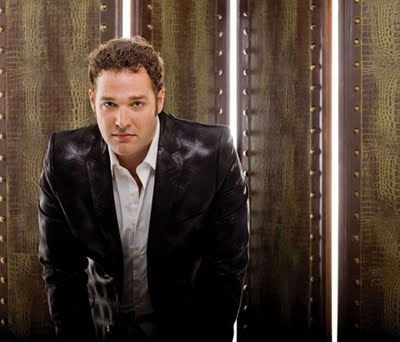
La Cieca hears that bodacious Bryan Hymel will make his Royal Opera debut in June as Don Jose, jumping in for an ill (but recovering) Marcus Haddock. Two months before, Hymel will sing his first Énée for Netherlands Opera under the baton of John Nelson in a production by Pierre Audi.
Closer to home, Hymel sings tonight for Opera Orchestra of New York in a program hosted by beloved Metropolitan Opera commentator Ira Siff.

Hymel is a really nice guy, but the voice is just not that impressive. Vibrato borders on uncontrolled flutter, iffy breath control. Very uneven singer so far. But he’s young and has time to work it out.
Heard Hymel in recital the other week. It’s not always the prettiest sound (can go bleaty), and, as yet, there’s not a lot of voice below about middle C, but it does get more exciting the higher it gets, which is always a plus for a tenor. Stylistically rather uneven. ‘O paradis’ was exquisite — nice French too — but several of the other songs and arias sounded rough round the edges. He needs strong coaching, I suspect. If all goes well, he could be fantastic in a few years’ time.
Hymel is a very good singer. Enee seems premature, though.
Meanwhile, stop the presses for some good news for our Vicar. Emboldened by their having put the now atonal Ann Murray on as Marcellina and not being called on that, Fiend and Billingsgate have hired John Graham-Hall — best Basilio since John Lanigan! — to the Met for that role in 2012!! Of course, “British” means “class”. Why not two more Brits for the Due Contadine?
His Pinkerton in London earlier this year was very problematic (those he sang – he cancelled several) – top is great but the middle is flawed and roles like Enee and Jose at this stage are not going to prolong his career. I believe he already has Manrico lined up. He should be singing the Duke and Edgardo…
Nice guy indeed but not, by my definition, a “very good singer” sadly. I fear he won’t last…
Please see above.
La Cieca – as it happens I’ve heard Hymel sing a lot, including several of those Pinkertons. I am not basing my opinion on one act of a dress rehearsal.
He has a good voice but he is not, in my view, being well-advised and nor are opera companies making him sensible offers.
About Calleja and Hoffmann, I make no comment as I haven’t heard him. I’ve always liked him as a singer but whether Hoffmann in that barn is a good idea is another question… Time may tell!
You are, however, more than ready to prescribe repertoire for him based on nothing more than the conventional wisdom that “young singers” are supposed to sing “Duke and Edgardo.”
That is, unless they’re singing the Duke and Edgardo, in which case you have to say they should be singing Nemorino and Don Ottavio.
New rule: Henceforth, a boring and predictable comment of the form “[Young singer] should be singing [conventional wisdom young-singer repertoire]” will earn the commenter a one-week suspension of commenting privileges.
You’re all been warned.
Cieca: we can’t say that a young singer should be singing lighter, less demanding roles? How totally amazing. All the time there is less we can say! Maybe another cut of coffee was needed at breakfast.
And by the way, the Duke and Edgardo are very very demanding roles, require mature artistry and much vocal strength. Bad choice of roles for any undeveloped young singer. I would say any leading lyric tenor role for an un-ready tenor is a bad choice. The old saw is
“you can’t judge a tenor until he is over age -30; so how old is
Hymel.
Meanwhile, Miss Cieca, you’ve got me wondering what may happen when you hit 30??
Thank you, mrmyster, for making my point for me. “Lighter” is not precisely synonymous with “less demanding,” particularly when we are talking about voices that naturally tend more toward the dramatic end of the Fach. A full-voiced younger singer might learn something about control and breath support by singing a lighter part, or he might also very likely tighten up, sing off the voice, and do himself some very real vocal damage. That is why La Cieca is banning the one-size-fits-all conventional wisdom about what young singers “should” do: because every singer is different, and every singer’s development has to be taken as an individual case.
Now, if someone were to come forward and say, “I heard X sing Nemorino and Ferrando just last year and they sounded superb in his voice; I think this is more his native repertoire,” that’s a very different thing from saying, “Nemorino and Ferrando are what every young tenor must sing, that and nothing else.”
But mostly La Cieca is enraged about the claims some commenters here are making about their infallible abilities to see into dimensions of alternate reality, which is the only way she can imagine they could actually a single act of a rehearsal sung by who can of a singer announced as sick and make definitive sweeping judgements about whether he’s “up to” what the role “requires.”
Well now, Miss Cieca, you have said a mouthful! I heartily
endorse your comments. The terrible truth is that not every
poster on PTB or OpL etc. really knows vocal technique and
the art and wisdom of casting. It was common in my day in
the vocal studio to say, ‘oh he needs a couple of years of
Mozart,’ and that is pretty good advice in fact, for Mozart
exposes everything and to be successful in doing all that
such classical singing requires is to show good command
of the fundamentals of technique and musicality. Last
night’s Figaro at the Met was a study, a veritable vocal
lesson, in these matters — Susanna, vocally poised and ever
so musical; her voice a little colorless, so she may develop
and make that better and color her words and tones; a young
Countess who showed very flawed technique and poor
musicality (where was the conductor, the coach?), and indeed
needs to return to her studio to get fundamentals in place; a
Count with burgeoning voice and much vocal poise — a ‘ready’
artist whom I want to hear in wide repertory; a Cherubino whose
voice has developed nicely over recent years taking on a lot of
tonal interest, but whose musicality may need some work — nothing really nothing shows up the scorecard the way Mozart
does. Adequate vocal maturity for certain roles is another thing. Puccini is rarely good for beginners because he lures you into dark
waters, extreme emotion, a great temptation to force the
voice. And those bad things must be avoided – always, but
esp. in the young professional years. Most people wont
believe this, but the first roles I heard Richard Tucker sing
were Mozart — Tamino and Ferrando, and he was a
consummate vocal master of them, and so it showed us
he was ready for bigger (or course he had already sung
spinto roles), so just to end this — let’s hear Mr. Hymel
sing some Mozart and see if all his parts are in place (ahem)!
And by the way, why were those Jewish tenors back when so
good, so reliable — because cantorial training is very solid in
technical fundamentals. Most vocal problems we hear today are
simply the result of placement, breath and musicianship not being
attended to adequately before the public stage is sought. C’est ca!
La Cieca, is your warning a reference to my saying that, of David Pomeroy, “I would love to hear him in lighter repertoire – such as Alfredo, or even Ferrando.”?
If that is the case, let me just defend myself by saying that this was not an assessment of his age (of which I have no idea) but on the size of the voice and colors. He sounded like a Gerald (Lakmé), or a Nadir. He had a light voice which bloomed prettily, but not powerfully, on the top. Therefore, i think it would suit all those roles I have mentioned quite well.
Dear me. I must note that Tucker’s debut role at the Met was…Enzo in La Gioconda, at age 32.
I also have to add that sometimes, I cast people in roles in which there might be an aria they could sing, but in roles for which they might have been ill suited. I’m sure others do this too. My first experience with Moffo was Verdi Arias. So for me, that’s what every Verdi soprano should sound like. She sang a gorgeous O, Patria Mia, but I think she would have been overparted by Aida.
The finest Albert Herring of his generation!
justanothertenor:
having done a show with him, where he was singing a spinto role, I agree with you about David Pomeroy. He has a pretty lyric tenor voice and he is singing some repertoire that is bigger than healthy for him. I have no idea how old he is, so it’s not about that. I think he would be good in Mozart, and that is not at all to say that Mozart is for small voices. In fact, it used to be that Tamino, Ottavio, and Belmonte were the training grounds for heldentenors. And I own the recording of Richard Tucker singing Cosi, and it is truly wonderful (even in English). Some voices are better suited for Puccini or Wagner than Mozart, but I think everyone should strive to be able to sing Mozart. Like another poster said, he teaches you to sing.
The flaw in this reasoning has nothing to do with Mozart and everything to do with modern conductors and coaches.
If a Richard Tucker (or any other big-voiced tenor) walked into a rehearsal today, the very first thing he would be told is, “Stop screaming! This is Mozart, not verismo!” And then the coach or conductor would proceed systematically to coerce the tenor to sing as far off the voice and off the breath as he could manage. Because, after all, the public attends Mozart operas to hear the exquisite woodwind solos, not some big bellowing (ugh) vocalist!
Then, when the performance finally arrived, the tied-into-knots tenor would launch into his ppppp attempt at “Il mio tesoro” or “O wie ängstlich” only to find that the conductor has decided on the whim of the moment to take the aria at half the rehearsed speed, only occasionally kicking the orchestra to double the rehearsed tempo when there was a bit of coloratura the tenor constantly had trouble with during rehearsal and asked several times if the maestro could give him just a fraction of a second to breathe there.
The “balm” of Mozart will therefore leave our tenor voiceless, exhausted, and angry, with every bad vocal habit imaginable routined into his body. That plus he’d have to read dismissive reviews the next morning about how nowadays singers don’t master technique, and how they should sing only Mozart until they are at least 50.
I have to agree with that la Cieca on that one. I do have an interesting story about that. Back in 96 the school where I was decided to do Giovanni. Pretty much every tenor in the school decided to come to the audition singing Dalla sua pace exactly as Cieca describes.
My teacher and I had yalked about it and I had expressed my intent to go and sing the audition with MY voice and MY idea of how mozart should be sung: At full voice and with plenty of support and add the dinamis prescribed. I wanted to sing the poetry and the feelings of the aria, more than just sing it like every other tenor would.
Well, I was given the role. The entire casting committee bitch and moaned about the fact that every other tenor had sung Mozart with a pee-pee voice; then a but was raised Lindoro didn’t. The casting committee’s reason to give me the role was that I was the only tenor in the school who showed up singing Mozart with his full voice and nuanced it from within the limits of my instrument.
That’s the reason why I can not stand Daniele de Nise’s Mozart and many of the current crop. Add to that Handel singers too. Handel contracted the best singers available for his operas, the big divas and divos of his time, they were not these undernourished singers that walk around like they are about to pass out due to lack of breath. For me, the last truly great Handel singer was Sutherland. These days Laura Claycomb seems to be doing quite well in it and let’s not forget David Daniels…
John Graham-Hall is an excellent Basilio, but I agree, it’s ridiculous of the Met importing singers for such roles. Covent Garden regularly brings German singers for tiny roles which could be done just as well by Brits. Johnny Graham-Hall is probably the best (British) Basilio since Frank Egerton, but never mind. He won’t spoil your evening unless your Anglophobia is more important to you than your love of opera.
Two months *later*
really, John Nelson still gets work as a conductor? I thought it was against the law in the EU!
Thirty years ago he was a regular on the New York scene and seemed to disappear from here. But he seems to be esteemed in Europe. His work I heard n days of yore was solid, if possibly a touch unglamorous. And you know what that means in New York.
Based on recorded performances and broadcasts of Nelson conducting Berlioz, especially his fizzing Benvenuto Cellini, I’d say he’s really a first-rate conductor of that composer’s music.
I can’t really think of anyone I’d rather have conducting Troyens!
Since it would appear that the software is designed to always allow our esteemed Maitresse to have the last word in any exchange, I will add a further comment to the effect that roles which require so much dramatic singing in the middle of the voice as Enee and Jose are perhaps not ideal for a young tenor who appears to have technical problems in that very area. But as we know opinions are like arseholes – everbody has one!
Am I the only one noticing that dear Mme La Cieca gets “enraged” rather often of late? Since the Tosca opening she seems to be awfully sensitive about any opinion that differs from hers. Should we all get together and take her out for a long night of drinking and/or sex and get her back to her old easygoing self.
La Cieca loves to hear opinions that differ from hers. Just not stupid ones.
I find that there’s rarely a difference between the two.
grazia – surely you know that f. hormonal changes come
at around age 33?!! Can make a difference in a girl’s life,
or so I’ve heard.
La Cieca isn’t the only one nauseated by the half-cocked personal attacks that have been prevalent of late. She’s just the only one who can do something other than lurk and keep her opinions to herself.
I somewhat agree with La Cieca on people blaming the repertory. It is ridiculous to assume that all people gradually move from “mozart to bel canto to dramatic to screaming woobling old (wo)man.” In fact, the examples of the above are exceptions in the history of singing and not the rules and usually exceptions that apply to people who did NOT have the natural means to sing a heavier repertory.
I could name countless singers who had more than 3040 years of career who debuted extremely young singing heavier rep. In fact, doing light singing in a heavier instrument voice can be as demandind (and thus harmfull) as singing heavier rep with a light isntrument.
The admonishment of earlier teachers that youngsters begin their training with literature of bel canto (or mozart) comes from the fact that such a literature exposes basic technical faults that need to be corrected while in other rep those faults are less evident and the singer can “get away with it” (I can for instance echo the cries on this forum for Netrebko to head to Puccini. Not because it suits her better, but because she simply doesnt sing well enough to pull off bel canto and in Puccini she can get away with it). Since people sing them today with no regards to the basic technical faults, it is pointless to think that they are “helpfull” to the voice. It is not the “WHAT” you sing, it is the “HOW” you sing.
I have always had faith in the people that work with these singers every day in the casting and rehearsal process. If they felt they can’t sing the part, they wouldn’t offer them very lucrative contracts. Voices change by the day, not just by the year. One bad moment or note or vowel is nothing to grab on to. Let us not forget all the bad moments by great singers.
These moments do NOT mean that they are poor singers or haven’t produced a wonderful body of work, but that they are human. This is, after all, a good thing.
I half agree with you but the evidence is pointing away from it by the meter every day.
Too often we get singers who are unprepared (and not only musically) shoved on the stage because someone has a lot of money ridding on the new kid on the block making it to the big leagues.
Unfortunately this new mentality is here to stay, hopefully not permanently, but I am not THAT hopeful. I believe that in the next several years we will see more and more singers come to the big time and leave in a flash and us wondering what went wrong.
I agree with Cieca that we should give people the so called 5 minutes to see what they have to offer, but the other side is that for the experts -read NOT casting agents, NOT recording engineers, NOT Philanthropists, they come with other areas of expertise besides the technical aspects of voice production;so in this case we have to talk about voice teachers and coaches and voice experts (including those in the medical field)- it wouldn’t take longer than a day or 2 (yes sometimes as little as an aria or song) to hear and see the technical shortcomings of a singer. As much as my mind tells the the opposite, I don’t claim to be an expert, i will claim to be extremely opinionated and I hope you all agree with me.
That being said, while it is true that singers have made big debuts singing big roles early, there is also a plethora of those who started their careers in smaller less demanding parts and worked their way up to the bigger ones. That is part of the conventional wisdom. Now, which one of the 2 should we hope our young singers aspire?
Yes, there is the 1 in a million case of another Tucker, or Caruso, or Pavarotti, or Bumbry; but for any of those how many do we want to sacrifice, better put, how many are we going to see self immolate while we watch and continue saying well, we should give him 5 more minutes to see what (s)he has to say. Is it OK to have collateral damage in this business, even with the fact that there’s always been collateral damage?
For every Pavarotti and Bumbry we have plenty of Villazons or Susan Dunns (who had one of the most naturally gifted voices of her generation and because of that she never developed the technical know-how to handle the repertoire she sang); but we also have plenty of Popps and Gruberobas who started singing very small roles and progressed to the big time) or Krauses (who did sing the big roles early but had the intelligence and the advise to stop it and concentrate on roles that would not tax his voice; or a James King, who knew the limits of his voice and the fact that he had stamina issues and concentrated on shorter roles, even in his repertoire of choice.
Yes, we should all give the new kids a chance, but we should not behave like passive bystanders when we see the wreck coming.
Now, Philosophically, I believe that Cieca cara has a point in the fact that there is never a one size fits all when it comes to repertoire. When I did Ottavio at 26 it nearly killed me, but Borsa the year before was perfect and Spoletta a couple of years after that was a joy to my voice. I think the voice gives you signals that it is in distress and that is when you have to take notice and analyze what is going on and make the changes the voice wants you to make. Now conventional wisdom will tell you, Oh, Mozart, or Nemorino, or Edgardo, or Susanna but the fact is that only the voice will tell you if that is correct. For a singer like Larry Brownlee (whom I know and love dearly so he will not mind me mentioning his name) singing Edgardo at this point of his career would be suicidal (probably same with Juan Diego), for a young subrette singing Susanna would probably feel like singing Brunhilde; at the same time, for a singer like Hepner singing Ottavio would probably feel like a tight jacket (I have an old video of him singing the aria and it is not good)and at the same time roles like Tito and Idomeneo were a perfect fit.
All that rambling to say that I see truth on both sides. I completely agree with Cieca that there is not a one size fits all (even when I appear to believe the contrary) but there is sometimes a one size fits all, it’s just that what will tell you what is that size and what is the fix is not the repertoire, but the voice and though the voice we can choose a repertoire path that will allow the singer a long and productive career.
I think that singers like Freni, Lorengar, Bumbry, Verrett, Tomowa, Krauss, Popp, Gruberoba, Windberg, Hong, te Kanawa, Flika, Vickers, James King, and even Pavarotti are all examples of what I am trying to explain. They listened to their voices and learned the limits it would go to. Then they took a path of singing repertoire that was appropriate to their voices and stuck to it for a long time. Sometimes the role was a big one, but sometimes it was not; no matter what it was a role that was appropriate to their voices.
Now one forgets another stable of the pedagogy of earlier times, which was that a singer would only sing ANYTHING after having completely secured a technique of voice production. And that could take a varied amount of time and it was exercized to the point that most singing manuals of the time are books of vocalizes to be applied and perfected, before the real vocal literature be attempted.
Now I will disagree with our doyenne with regards to the singer in particular. I dont believe he is ready to be exposed to the demands of a professional career (in whatever rep), and it is exactly BECAUSE I appreciate his voice and talent that I would believe he needs a level of technical accomplishment he doesnt yet have. Compare with even the natural singers of ago (Di stefano for instance) at the same age to see how the basic sound has not yet been reached.
And the demands of the stage and of the profession rarely lead the person in the right direction unless the person is already solidly pointed in that direction by nature or diligent study. In fact the need to find a way to “find a way” to perform the music can instead lead people astray.
Now at the same time I understand the circunstances that are involved that are beyond a singers control. They have to make a living and they rarely have had the resources (time, money) to get the needed training (older singers had the privilege of daily lessons for instance, something that we cannot even beging to think about nowadays). I also understand the audience (and our doyenne) who listens to a talented singer who can give a perfectly fine performances with a less demanding schedule and wants to hear more and more.
Having said that, I wish Bryan Hymel the best of luck and may he prove me wrong! I do not enjoy being a prophet of doom.
If we’re talking of singers who chose the right rep to extend their careers and preserve vocal health, maybe di Stefano isn’t the one to aspire to? A natural singer, yes. A lengthy and healthy career, no. A brilliant artist who loved what he did and sang with every bit of his soul every time he opened his mouth, absolutely.
I wished to point out Di Stefano because I agree that he was ruined by repertory choices more than by the basic sound he made, specially being a natural singer. I am not arguing about that, and come to think, it was a bad example, but you can replace that with most any young historical tenor on record and compare.
I believe my mind went to Di Stefano because, even though he had no training, I believe that he had the natural technique to have a longer career had he not gone to the heavier rep.
However, before avoiding being ruined by the rep choices, one must avoid being ruined by singing any rep, period.
See, I disagree. Even as early as around 1949-50, in roles that should have been precisely his fach, DiStefano was already singing erratically. I really think this is not something you can hang on “technique” but, more at least, on the nature of the instrument and the temperament of the singer. It was basically a rather delicate, fragile voice wielded by a crazy man.
The only way DiStefano’s voice could have been made to work efficiently for a longer period of time, I think, would have been for him to take the Pavarotti route, covering low and keeping the top of the voice quite small. But that would be the antithesis of DiStefano’s personality, which was all about generosity (to the point of extravagance.)
I like La Cieca’s general take on this. I think the obsession over technique, in particular this idea of “overparting”, is something akin to archivists who encase things in plastic and acid-free paper in order to ‘preserve’ them, yet making it impossible to be appreciated and enjoyed. Nothing lasts forever, alas, and technique exists to serve the art.
I actually agree with what both you and squirrel wrote to a great degree. Technique exists to serve expression, not vice versa. However the demands of a professional career are taxing enough that singing “too much” is many times much more taxing than singing “too soon” as most would like to believe (they usually refer to that in terms of rep choices) and that was my point. In fact “Too much, too light” can be extremely damaging too.
The singer in question for instance can perfectly sing a very nice Don Jose, I have NO doubt of it. I dont believe though that it would not be wise for him to sing too many Don Joses in a small amount of time – But one does need to make a living, after all.
Correct me if I am wrong but it was my understanding that Pippo did have a good technique but that he chose to change it because he wanted to have what he thought was More clarity in delivering text.
I read somewhere that he did have quite an astounding technique (anyone able to do the diminuendo that he does in Salut demeure should know a thing or 2) but that his open singing was a choice. What is the truth on that?
Damn English. I need to get a proofreading program before I post.
I heard Hymel as Pinkerton in Toronto last month. It’s a nice voice, especially in the top register, but he was getting swamped by the orchestra — not to the point of inaudiblity but still… I think this has to do as much Puccini’s orchestration as with the lack of heft in his voice. So, while I think the tessitura of Enee could be a fine fit for his voice, I didn’t hear enough heft to make me think that he has what I’d like to hear in an Enee.
It’s coming to the point that I pity any artist who gets mentioned here. What ensues must be hard for them to endure.
Alto, if someone cannot take criticism (of both the positive kind and the destructive, negative kind), then such a person is not fit to have a career in basically any performing art. And believe me, they have it easier nowadays since real mean criticism is not printed in papers and audiences don’t usually boo or throw and vegetables at the stage.
It could be a lot worse.
” … such a person is not fit to have a career in basically any performing art.”
It must be marvelous to be so sure of oneself as to be able to make such universal pronouncements.
Though it’s as well that the dictum is not enforced, since it would have excluded some of the greatest artists in history.
Alto, having been an insider for years, you of all people should know that there is truth to that (over inflated) statement.
As artists people need to develop thick skin, you know that.
I did not say that criticism does not hurt. It does, profoundly. I just wanted to make the point that it comes with the job and always has.
And yes, I have a performing career and KNOW first hand how painfull that can be. Lindoro below me is correct, even if my phrase is extreme, it is basically correct – Not because of the way things should be, but because of the way things (and people) are.
I did not criticize his choice of singing Don Jose. I don’t believe he HAS a choice in fact, he either does it or never will be given the chance again. In fact 90% of the time the artist is a victim in this business.
“As artists people need to develop thick skin …”
I’ll agree if we modify that to say:
“As people, artists need to develop thick skin.”
But I would never say that a thin skin disqualifies their art.
Point well taken Alto and thanks for the insight.
Also, I understand that it can seem that some of us have a sadistic pleasure in finding fault with some else’s singing. Believe me that couldn’t be further from the truth when it comes to me. I would love that Kaufmann, Villazon, Alvarez (or any of the younger tenors la cieca usually points out) outsang Caruso, Corelli, Roswaenge, Tucker, etc. And yes, I believe we should set our standards higher, or we will never get to them again.
I’m down with that Alto. And I agree with you on the other part too.
Where is he singing Enee and with whom? The venue and conductor can make a big difference. I won’t comment on it because I haven’t heard it, but didn’t Gregory Kunde (admittedly a veteran performer) sing Enee with Susan Graham and John Eliot Gardiner at the Chatelet?
in Amsterdam’s Muziektheater with John Nelson as conductor. The Netherlands Opera openly admits to “voice-enhancement” as the house doesn’t have a good natural acoustic for singers. It has a “letter-box” shaped proscenium like the Grosses Festspielhaus in Salzburg, which also isn’t great for smallish voices.
You know, curiosity brought me to listen to several excepts of Himmel on youtube (since I have not had the chance to see him live)
After hearing the excerpts I think the problem might not be the suitability of the repertoire (and I’ll reserve my opinion since it might not be popular to do so until after the full moon) or his age. The sense that I am getting is a problematic technique.
I hear a reliance of a low throat (some people would say pushed down, whatever) in his sound production. This makes for a characteristic sound in the middle (some people interpret it as full and husky) and some pretty amazing high notes but it creates a hole in the lower registers and a weird transition to the lower notes.
Now, the people who have heard him have spoken of a problematic (inaudible?) low register and the sound that he makes in the middle and high notes, as judged by the clips, leads me to believe that this is the case here: a low larynx emission. Now, I would have to confirm that after i see him live, but I don’t see that happening too soon, as I have not come across his name in any operas that are in my wish list.
Obviously you don’t understand vocal technique.
LOL! Oh sweetie, don’t make me laugh. It’s bad for the lines around the mouth…
I like the first two, but that Addio fiorito asil is downright amateurish. He sounds like a sheep, can’t keep pitch, and that B-flat is swallowed. This, at Covent Garden?
As someone that had a bit of a tongue tension problem that created the same kind of quick vibrato and poor low notes (leading everyone to think i was a tenor and not a baritone), I will agree.
But, all ‘problems’ aside, this could be the best way for him to make the best possible sound he can make, and it’s a good sound, so I’ll take it. If he figures out a way to make a better sound later on in his career, kudos to him, but for now I’d see him in many roles.
He just looks like another chubby farm boy to me.
He is a great singer, and you are an asshole
Though, as some of us know too well, it’s possible to be both.
Alto, have I told you lately that I love you?
It seems odd to me that Hymel has been signed to replace an ill (but recovering) Marcus Haddock, as Don Jose next June! What in the world is poor Marcus recovering from?!?!
Probably another face lift.
Some kind of cancer, I heard.
I believe a stroke. Let’s hope he recovers fully.
Marcus is quite ill.
mrmyster: Hymel is about 30 years old. He was 19 in 1998, but I don’t know when his birth date.
Thanks, Cruz. I think Hymel has an interesting voice, but from
these sound-impaired tapes I cannot tell much. I did think in the
Butterfly he did not keep adequate support and began to ‘lean’ on
the voice rather than ‘float’ it, but in the Bellini I found him more
than promising. The placement seems good — I just worry
about support.
I’m not sure if it’s just me, but are these voices with that light, caprino sound becoming just a tiny bit in vogue recently? Calleja especially, but I’ve heard quite a few singers recently with this sort of tighter and faster vibrato. Anyone else hearing this?
Valmont, I think you are right. There is something ‘old-fashioned’ about Hymel’s voice like there is about Calleja’s. I didn’t like Calleja the first time I heard him, but his singing has grown on me. Better a bit of caprino than Villazon’s throaty squeezing — he was just on the radio, so he’s top of mind.
Val, I don’t think I am hearing it here in two out of three; but
wait till you hear him live. I think this very brilliant voice is
by far best in person.
I’d love to hear him. He needs to work on stage deportment
and well, what shall I call it, personality?
I certainly hear the caprino quality in his voice, but I personally don’t mind it. The color and musicality is much more imortant to me, which is why I am a huge fan of Calleja. I hope he’s better by the time I get to see Hoffmann in a couple weeks.
Not sure if this has anything to do with Hymel’s singing voice or not – but he’s a smoker.
Ooooo. That can’t be good. I’ve heard of some singers doing this but I just can’t understand it. How could a professional monkey around with his money maker? That just seems crazy!
Wait, you do mean that he smokes cigarettes, right?
I thought only basses and contraltos were supposed to smoke…
Ask Mr Pape.
If this technology to hear Sirius webcasts and to comment instantly on opera blogs had existed back in the 1950s, I guess we would have been saying things like “Leonie should stick to Senta, Sieglinde, and Elizabeth and should never sing Brunhilde or Isolde.” Although I think I would have been typing, “She should be singing Marie in Tote Stadt and Irene in Rienzi.” (Please don’t ban me retroactively for typing it now.)
Would we have warned Corelli that he was singing too loudly too early? “He should sing Ernani, not Pollione and Calaf!” And would we have predicted that Nilsson was going to burn out within five years?
You just can’t predict who is going to be Rysanek versus who is going to be Voigt…who is going to be Leontyne versus who is going to be Susan Dunn or Roberta Knie…who is going to be Dimitrova versus Elena Souliutis or Ursula S-F.
It’s not unreasonable to say “So and so should be singing Mozart in small European houses, not Verdi at the Met.” We’ve all read about so many singers who burned out early. I think a lot of this is just concern and worry on our part, not a desire to become casting agents.
Sorry to hear about Haddock. Hope he recovers and returns to the stage (Carreras did it). I much prefer his timbre to Hymel’s slightly-too-white sound.
I believe Roberta Knie’s career ended because of real medical problems, not vocal problems. I saw her Isolde in chicago with Vickers in 79 and she was wonderful. but remember there was some real medical crisis involving surgery,etc. that ended her career. Don’t remember the details. On the topic at hand, heard Hymel last night at a gala honoring Renata Scotto at the New York Athletic Club. He knocked out Nessun Dorma with real stage presence and nailed it. I am not going to judge him based on one aria though, but I enjoyed his performance, The most impressive singer however was Angela Meade. This is a real Verdi soprano who seems to be ready for the big time. She was impressive.
That’s interesting given the fact that Meade just sang Lucia at AVA.