
Headshot of La Cieca

Cher Public

  • iltenoredigrazia: Thank you, thank you (bow down to the floor, hands to my che...
  • Betsy_Ann_Bobolink: Is it all right to say "John Huston," "Angelica Huston," or ...
  • kashania: Extravaganza is the word, all right. What fun! Congratulatio...
  • brooklynpunk: thanks, S-conductor!..... a much more "up-beat" rig...
  • whatever: mille grazie, IL3!
  • armerjacquino: Oh, that's the wrong one, isn't it? Hang on.
  • Indiana Loiterer III: September 24 – Elisir 26 – Turandot September 27 – L’El...
  • oedipe: Let's not be reductionist ourselves: I don't believe the art...
  • armerjacquino: http://parterre.com/2011/08/08/rip-brad-wilbers-met-futures-...
  • grimoaldo: Has anybody posted the classical Grammy winners?Engineer...

blog advertising is good for you

Gualtier tells “Tales”

gualtier_hoffmann
So, I was asking my friends with Met Opera insider connections about the new Hoffmann production directed by Bartlett Sher. Seemingly conceived under an unlucky star, this production first lost two of its four heroines when Anna Netrebko decided not sing Olympia and Giulietta but kept Antonia and also Stella, leaving the dramaturgy somewhat lopsided.

Then the star tenor Rolando Villazon canceled the remainder of his 2009 engagements. Luckily Maltese tenor Joseph Calleja was willing to rearrange his schedule and make a role debut as Hoffmann.

Then Rene Pape decided not to sing the various bass nemeses of the titular poet, so Alan Held stepped into the breach. Then Angela Gheorghiu and Roberto Alagna finally decided to call it quits as the “love couple” precipitating the willful Romanian diva to cancel her participation in the new “Carmen” production with Alagna. The production’s Nicklausse, Elina Garanca was less than surprised and very likely delighted when she was called upon to don Gheorghiu’s mantilla as Bizet’s gypsy heroine and let her alternate, the talented Kate Lindsey step into her trousers.

[Gualtier continues, with a spoiler or two, you've been warned, after the jump]

So I wasn’t surprised when one source said that she was told “You won’t like the new Hoffmann and my other source said “the production is dark, stark and visually uninteresting” which sounded rather like that other unsuccessful production that opened at the Met just a few months ago…

Well, happily they are wrong. Sher said in an Opera News interview that his conception is part Kafka and part Fellini. The Fellini I could see but the Kafka didn’t seem a good fit. Happily, the Kafka comes in (rather watered down) as the bleak reality that Hoffmann drinks to escape from in Luther’s tavern. The sets are black and stark and the tone somber. However, when we shift into the tales of Hoffmann, the product of his absinthe-soaked imagination, Spalanzani’s workshop/salon is right out of Fellini with bright saturated colors, transvestite clowns and a surreal circus sideshow atmosphere. It works like a charm.

Sher’s very successful Il Barbiere di Siviglia also has rather stark plain settings mainly consisting of moving door frames, orange trees and a mottled beige back wall occasionally enlivened by a giant anvil descending from the ceiling. The success of the Barber is in his personenregie -- evocative stage groupings, inventive physical business, characterizations that are naturalistic but heightened with dramatic gesture and costuming and meaningful, real interaction between his principals. Much of same applies here.

During the orchestral prelude to the prologue we see Hoffmann in a drunken stupor on the floor beside a writing table strewn with papers. Various sordid characters from the later acts lounge in the background while the poet is clasped in the arms of Stella, played by Netrebko, sporting  a Louise Brooks bob and 1920′s flapper dress. During the opening chorus, Lindsey dressed as the Muse in a chemise and top hat enters and chides the poet for neglecting his writing in the pursuit of a singer.

The various characters move offstage and Stella also moves from Hoffmann’s arms into costume as a diva on an opera stage. The students file in to the tables and we are in Luther’s tavern. But the writing desk remains throughout -- even into the Olympia act as a reminder of Hoffmann’s true salvation -- his writing. The Nicklausse/Muse figure becomes the central figure in the drama, onstage throughout, observing and even directing the actions of other characters and seemingly able to be invisible when desired.

The previous Otto Schenk production (of which I was quite fond) had a very strong Olympia act but Sher’s version matches it. The atmosphere is often rather louche -- scantily clad showgirls in garters and pasties show up in every act except Crespel’s bourgeois Munich home. There is a use of doppelgangers -- sometimes there is a stageful of ballerina Olympias all dressed alike and Hoffmann also has a stageful of top-hatted Magritte-like doubles as well. Sher has some lapses in his direction as well. Notably, in the Olympia scene the doll sometimes moves like an automaton and at other times, mysteriously moves like a real girl. Are we to see Olympia as Hoffmann sees her through his rose colored glasses? Then Hoffmann needs to be placed in some kind of relation to her so that we are looking at him seeing Olympia. Also perhaps the lighting needs to be changed to a pinkish glow to indicate we are seeing her through the poet’s eyes. Sher’s use of the chorus (aided by some dancers choreographed by Dou-Dou Huang) is full of variety and life, enlivening each scene.

Whereas the colorful Olympia act matches most of the visual flair and inventiveness of the Schenk production, the Antonia act rather falls short. The set here again is stark and bare. The palette again is blacks and blues with just a few fly pieces -- one of a doorway and others of trees painted on a scrim -- with only a chair and a piano strewn with music (replacing the writing desk of the Prologue and Act I and suggesting the historical Hoffmann’s flirtation with his other muse, musical composition including operas). Sher does have a wonderful silhouette on the upstage scrim of a sinister carriage bringing Docteur Miracle on to the scene.

However, during the entrance of the ghostly vision of Antonia’s mother and then the final trio I was hoping Sher would flash the opera house interior again on the back scrim as Pressburger and Powell did in their movie version and Schenk did in the last production. Evidently he was afraid of repeating this touch so the whole finale is rather visually dull with Wendy White as the Voice of the Mother just strolling along upstage and then coming downstage. The entrances of Dr. Miracle in the Schenk production were tour de forces -- I vividly remember the athletic younger Samuel Ramey in 1991 materializing out of the deceptively solid-looking cloth scrim walls and suddenly appearing out of the fireplace in a flash of smoke and fire. No such feats were asked of Alan Held who just strolled in and out of the scene -- like Niklausse/Muse sometimes visible to the other characters, sometimes not.

The Prologue seems to be set in the 1920′s, the Olympia Act circa 1910 and the Antonia act seems to be in the World War I period. Oddly the Venice Act has the entire cast in full 18th century fig. However, decadence rules with nearly naked female supers in pasties, black-stockings and powdered wigs caressing each other. Perhaps this is a costume ball or else Hoffmann’s imagination has placed him in another historical era? Never mind, it looks good. At the end figures from Hoffmann’s previous loves re-enter the stage -- the dancing Olympias cavort with Giulietta courtesans. In the final tableau Hoffmann sits at his writing desk, surrounded by his characters and engrossed in his writing -- the failures of life transmuted into the glory of art.

Musically, the edition is the one Levine used in 1981 in a Salzburg production and repeated at the Met in the Schenk production -- the framework is Choudens with some Oeser additions -- including the trio for Coppelius, Niklausse and Hoffmann in Act I and the gorgeous “violin” aria for Niklausse in Act II. Spurious non-Offenbachian additions from the Monte Carlo edition of 1904 flesh out the Venice act (probably the work of Andre Bloch -- namely the tuneful “Scintille Diamant” aria and the catchy septet) which is placed last as Act III. Meanwhile more authentic material written by Offenbach and compiled by Michael Kaye in his scholarly edition has yet to be heard at the Met.

Levine seemed rested and more involved in this production than he was in the Bondy “Tosca” dress rehearsal where he rarely looked at the stage and only seemed immersed in orchestral details. Tempos were varied and appropriate and the orchestra played well. The singing was a mixed bag. Evaluation of the lead tenor will have to be put off since Calleja was announced as suffering from a cold and was replaced after Act I by David Pomeroy. The cold was not initially evident and the Maltese tenor sounded sweet yet robust. Later, Calleja showed some strain in a few high climaxes in Act I and apparently opted to rest up for the premiere and preserve his voice. Though this was a dress rehearsal most of the leads sang full-out except for both tenors.

From what I could hear of Calleja, his odd timbre -- reedy with a narrow vibrato in the middle which shifts into a sweet plangent top -- is well-suited to French music and his diction is quite acceptable if not idiomatic. Despite the narrowly focused sound, Calleja’s voice is large and fills the house without forcing. I noticed that he did tire in the upper register at the end of Act I and may have marked one or two high notes.

One of the difficulties of Hoffmann is stamina in a demanding tessitura over a long evening -- the tenor is rarely offstage. Successful Hoffmann’s have either had a baritonal foundation giving them strength (Rene Maison and Placido Domingo) or a very focused tone with pronounced heady ring girded by a sturdy technique (Alfredo Kraus and Richard Tucker). Only when Calleja is fully recovered from his cold will be see if he belongs in the latter camp.

Pomeroy has a bright generic American tenor with one color and dynamic but a reliable command of most of the notes. He seemed musically unsure several times, made some musical and linguistic mistakes and had to drop out of one big note in the septet in Act III. Hopefully, he will not be called upon to deputize for Calleja at the prima.

Alan Held is an artist who never fails to deliver a fine performance but also never quite achieves the recognition that his gifts deserve. He was fine as the Three Villains though this staging asks him to be much the same physically in each incarnation. His singing is secure and stylish and he always delivers the goods. Alan Oke though he got some laughs in Franz’s couplets in Act II failed to bring the gallic touch and humor to the four Servant roles that Jean-Paul Fouchecourt did so superbly quite recently. Oke’s voice is unmemorable and he fades into the background in his other roles. He also missed a crucial entrance in Act II.

Barihunk.com fave Michael Todd Simpson in his Met debut assignment sang Hermann and Schlémil but kept his shirt on leaving us to dwell on a rather ordinary vocal endowment. Veteran bass-barihunk (daddy division) Dean Peterson sang sonorously and well as Luther and Crespel.

The ladies are a mixed bag. In the final ensemble in the epilogue it was the voice of Netrebko that dominated the other ladies and reaffirmed why she is a star, despite the sniping and complaints you read here (not from our doyenne of course). Netrebko is more of an enthusiastic peasant type rather than the frail wilting flower and she displayed the most powerful female instrument onstage. She appropriately concentrates on the reckless passion of Antonia for music and love rather than her more morbid qualities. The concentration, richness and projection of that sound emanating from a plumper but still petite frame is a phenomenon of nature. The diction and timbre is more Mirella Freni than Ninon Vallin or Geori Boué but the acidic tang these sopranos were either blessed or cursed with (depending on your taste -- some wines don’t travel) is entirely absent from the fruity, round punch of Netrebko’s rich sound. Her diction is still not really clear or crisp but more accurate than when we last heard her in French opera as Juliette.

She looks gorgeous, tears the roof off in the trio, sings some lusty high D’s, fakes a pretty good trill by exaggerating her vibrato and walks away with the evening’s honors. Add in the distinctive vocal thumbprint and the personal charisma and say what you will, it adds up to a star. Frankly, she could and should sing the other two roles (transpose the Olympia music down a half-step) since it makes better sense dramatically and the Kaye edition offers a choice of coloratura showpiece arias for Giulietta.

Here the Met opted for a mezzo-soprano Giulietta, the Russian Ekaterina Gubanova who didn’t impress me in her Met debut role as Helene in War and Peace. Evidently she has scored some successes in Europe and England as Brangaene and Amneris, so I was willing to give her another listen. The tone is medium to large, suitable for Carmen and also Giulietta. The tone is attractive and dusky without being really memorable. Flatteringly costumed as Giulietta in corset and crinoline skirt, she seemed attractive enough without really suggesting fatal allure. Good enough but not really a tour de force. Borodina can sleep soundly!

The audience was more taken with the petite Korean coloratura Kathleen Kim, who also is jumping in for another cancelling coloratura as Zerbinetta in Ariadne auf Naxos this season. Kim’s sound has a nice soft roundness about it in the upper reaches and she sang some lovely chime-like variations in the second verse of the Doll Song. Her trill however is not pretty or well-defined. Her doll movements were well done but inconsistent -- probably to a lack of clarity in Sher’s direction. Ruth Welting and Natalie Dessay have outdone her in the physical acrobatics department. However, Kim’s youth and freshness won the audience over.

Kate Lindsey has impressed me mightily as Cherubino and Stephano, so I was happy to see such a plum role land in her lap. The tone has some of the resiny quality that the young Susanne Mentzer had and she commanded the stage in each scene. She gets a final star bow after the other ladies -- including weltstar Netrebko! This role should mark a step forward in her career -- a well-deserved success.

So to sum up: the jury is still out on whether Calleja has a Hoffmann in his dulcet throat. Bartlett Sher has produced a production that while it doesn’t always charm visually is full of dramatic detail and life. Netrebko lashes the sniping parterre chatters into submission with diva vocal delivery and the other ladies do nicely, if unmemorably. Kate Lindsey makes her mark taking one for the team and Alan Held shows why he is still standing while so many others have left the field. Levine seems back in form. The show is worth seeing and will probably improve with repetition as everyone except for Held and Levine is quite new to his or her role.
79 comments

  • CruzSF says:

    reedy with a narrow vibrato in the middle which shifts into a sweet plangent top

    Thanks for this.

  • Tamerlano says:

    As evidenced by this clip, I would say she’s not ready for the Met. The excessive straight tone at the beginning of phrases, the poor line, and the intonation problems are worrisome. She sure is purdy though, ain’t she?

    • mrmyster says:

      Yes, she is really that bad. I dont have room here to analyse it for you, but it would drive any responsible Mozart coach crazy. She is very inconsistent in every way — terrible vocal production, no line, bad dynamics, appalling pitch …. you name bad stuff, it’s there. Some of this
      may be due to unflattering radio dynamics, but over all I’d say she is not of a calibre for major operatic stages. It’s all wrong. If you can’t hear how she screwed her two big arias, we are on a different page, and I have to say the conductor had a lot of blame tonight. The musical values throughout were questionable. A shocker. (And usually I love Luisi; bad night.)

    • mrmyster says:

      Tamerlano: They come and they go. Look for this one to
      fade fast, or become a night club singer.

    • And I am going to beat a dead horse here, but it needs to be said since people at the met read this blog:

      You stupid fuckers got rid of hei-Kyung Hong in favor of this? Really? And you scream foul when people bast your casting and the singers you bring in a review? Do you expect us to have any respect for you when you get rid of a Mozart singer without par and promote this as the new IT? Do you actually think we are that stupid?

      • diva2themax says:

        YES!!!! HKH is amazing i’m still pissed that they got rid of her.

        • La Cieca says:

          Contracts work two ways: an offer and an acceptance. From what I hear, Hong isn’t accepting much of anything these days: in fact, her calendar shows only two upcoming opera productions, Traviata at the Met and Meistersinger in Cincinnati.

          I think I can say definitively that if Hong made a strong commitment to performing Butterfly, she could fill her calendar with as many engagements as she cared to travel to. Like it or not, and consider it racist or not, but Asian sopranos are always in demand for this role.

          Or if she offered, say, Simon Boccanegra, Otello, Luisa Miller, Elsa in Lohengrin and a few other medium-weight spintoish parts and was willing to commit to spending 3 or 4 months in Europe, I am pretty sure she would be working constantly.

          So how is it the Met’s fault that Hong has no contracts anywhere in the world? Is it the Met’s job to provide a sinecure for middle-aged lyric sopranos who are afraid to venture anything heavier than Mimi?

        • Gualtier M says:

          BTW: I think I read somewhere that Hong’s husband has been ill with cancer, so she wanted to stay home. Hong has been successful in Europe but has chosen to stay close to her family in New York and to the Met. I also was told that after the Met stopped contracting her after Gelb took over, she didn’t speak out a la Ruth Ann but quietly took some European engagements including La Scala. Don’t know what happened with that but maybe it went by the wayside after her husband got sick.

          Hong has always been very helpful and willing to step in at the last minute when another lyric soprano cancels. Her “Traviata” contract of just one performance is probably insurance for a likely Gheorghiu cancellation(s). Hong also probably has been offered many roles including Butterfly but is a canny voice preservationist who doesn’t overstretch her resources. You lose some excitement and risk but the payoff is a longer more consistent and satisfying career.

        • messa di voce says:

          Hong cancelled her Mimis at Covent Garden last (or was it this?) season, saying the role no longer worked for her. She’s obviously cutting back.

      • Dan says:

        They’re trying to reach us, the young ones. But little do they know that we, too, like good music and solid performers, and aren’t easily fooled.

        My friends and I like hot women as much as the next, but when a friend and I go to an opera or a recital, we actually DO want to hear something good. I vote to bring back Hei-Kyung Hong. That woman is is gift, and the Met is dumb to have abandoned her.

        • squirrel says:

          Dan is Tru.

          They (The Met is not alone in this) definitely underestimate what tricks it will take to win the Young Hip dollar. Newsflash: Quality!

        • La Cieca says:

          But surely the point here is that Dasch has a recording contract, not merely that she is young and pretty. (Though, obviously, youth and prettiness are most helpful in winning a recording contract these days.) And it’s not like the Met found her singing by the side of the road someplace: on paper anyway her resume is quite impressive.

          Which all goes to show the proof of the pudding, etc. and (more to the point) let’s wait and see if she’s invited back.

        • Gualtier M says:

          Yes, Hei-Kyung Hong is wonderful but we have had her Contessa for several revivals at the Met and her Susanna before that. I don’t bash the Met for trying out a new soprano with some reputation in Europe. Wonderful as Hong is she isn’t going to be around in 8 or 10 years.

          However, the casting office seems to be drinking the kool-aid on overpromoted, undervoiced “it” girls and boys hot on the international circuit. Listening to Dasch on the opening night, she was undistinguished but not incompetent and was a treat to watch with good stage skills.

          What would be lovely is to find some new roles for Hong and yes, I think there is still a place for her at the Met – middle-aged as she is as the voice is still so fresh and her musicianship so elegant. And she still looks a treat.

          Hong maybe needs to explore some more Handel roles rather than trying to stretch her voice into bigger lyric roles like Marguerite and Butterfly. I think she would be wonderful as Magda in “La Rondine” and should alternate with Racette or Gheorghiu when the Met revives that production.

        • La Cieca says:

          Hong maybe needs to explore some more Handel roles

          Yes, if there’s anything that’s in demand in opera, it’s a 50-something soprano who specializes in Handel.

    • Cassandra says:

      EXTREMELY studentish.

      There’s a nice inherent color there, and the potential I think is pronounced, but she doesn’t have a single clue what she is doing. She needs about three years, and then a return.

  • Gianni B says:

    I would have to be in Justanothertenors camp. I think the production today is a sham. The Prologue and First act Started passably, and it all started to go terribly wrong. Theatrically, it is an unmitigated disaster. The Olympia, Antonia, and Giulietta scenes are no more than tableau stand and sings. Kim and Gubanova are amateurs and whoever cast Kate Lindsay as Niklausse has no idea what he or she was doing. She is not even acceptable for the cover of Niklausse. She is virtually inaudible and I was in row T of the Orchestra.

    If Calleja is a troubled Duke and Nemorino, how did they think he was going to get through Hoffman? Perhaps he has been somewhat ill but the underlying technical vocal problems catch up with him, the opera is simply too dramatic, too lengthy, and too demanding for a tenor of his capabilities. David Pomeroy was a comic tragedy, completely overwhelmed and overparted and if he is forced to go on on Thursday evening, the boos for Tosca may seem a resounding success. I suspect that Mr. Alagna, who is in the house rehearsing Carmen, will be singing Hoffman Thursday if Mr. Calleja is not well.

    Bartlett Sher was out of his element here. Kate Lindsay literally stands through all of the Antonia act doing NOTHING? Why? Why is she there?

    Either they need to get Gelb out of the artistic planning side of things or he needs to be fired. He has no ears for singing, and routinely ignores the suggestions of the artistic staff. He is quickly becoming an albatross. In these hard financial times, Donors will not put up with another “new production” sponsored and cast by the MET that goes down in flames.

    • Tamerlano says:

      I must agree with you. The casting is downright bizarre! Who the fuck is Gubanova? Was she really the best choice for Giuletta? And as for Kim, well, I don’t get that it either…there are so many fine coloraturas out there who could make a huge success of the part, and that’s who they choose? odd. No wonder Trebs sounds like a golden age great! You can’t help but wonder what she REALLY thinks about the production.
      The last time I heard the Met do it, it starred Dessay, Racette, and Larmore. I don’t remember Larmore, but Racette was fabulous and Dessay had a triumph. I think Mentzner was the Nicklausse.
      It’s a tricky opera to cast well, I think…remember when Vanness tried the three heroines? Nah, me neither.
      And the role of Hoffmann is a fucking nightmare to sing…high, high, high.

      • javier says:

        The great Edita Gubanova, no less! She’s making her Met comeback this season.

      • tinhtraiviet says:

        I remember Vanness in the early 90s bravely attempting all the heroines with less than resounding success; to be fair she was adequate as Olympia with lowered pitch, an affecting Antonia and glamorous Giulietta; far from a disaster, but just unmemorable on the whole. Domingo was a vocally effortful Hoffmann as expected, but he still had the experience and flair to pull off the role. Alan Held was a magnificent 4 villains at the time (I didn’t see Sam Ramey in the fall run); too bad he’s now a decade or two past that peak to have it committed on HD, but better late than nothing I guess.
        The last time the MET had a Hoffmann who could meet the vocal demands of the title role was in the sensational revival in 1998 with Ricky Leech back when he decided to throw caution to the wind and committed self-immolation with his gorgeous lyric voice by wading into spinto territory — it was not a wise move for his vocal longevity (even though he’s still singing heavier repertoire as of now in the provincial houses), but such thrilling bright flames it was for the audience. Dessay was a manic doll, interpolating high Gs to her aria and scena at will. Racette was devastating as Antonia. Even Antonia’s mother enjoyed super-luxury casting in Stephanie Blythe. I saw the single performance of the first cast with Victoria Livengood (who took over the rest of the run with a second cast headed by Sondra Radvanovsky as Antonia and Jean-Paul Fouchecourt as the 4 servants) instead of Jennifer Larmore as Giulietta; and that was surely a trade-up given how horribly hooty Larmore has sounded on the broadcast a week before (even if she might LOOK fabulously sexy in the role): in Vicky Livengood back in those days you had ample/lusty voice and vampy looks to spare. James Morris was in his growling/snarling phase and even though he sang with authority and projected an imposing stage presence, the quality of the voice grated on the ear after a while; I’d still prefer Alan Held who also shared the role with him in the second cast for that revival.
        Since I had been out of the country for 2 years until early 2001, I missed out on the millennium revival in 2000 largely spear-headed by Ruth Ann Swenson as the last MET soprano to tackle all the heroines; with super-annuated Neil Shicoff back almost 20 years later in one of his signature roles (so the same could be tried for Alagna now to save the day in case Calleja proves he’s not up to the task of the opening and/or HD telecast); Bryn Terfel was the 4 villains. The cover cast lead by Keith Ikaia Purdy (what happened to him?) and a rotating group of female leads took over the last 2 performances. A constant fixture during those years was the superb Niklause/Muse of Susanne Mentzer.
        The last revival of the Schenk took place in 2004-05 with a sweet-voiced albeit over-parted Ramon Vargas in the title role. I didn’t see the early part of the run with Aleksandra Kurzak in her debut role/season (my big regret was to have missed out on Hei-Kyung Hong’s Antonia). With an eye toward avoiding James Morris’ snarling 4 villains, I went to the very last performance of the run (and thus of the Schenk production, little did I know at the time!) with Dean Peterson acquitting himself quite honorably in the task. The Olympia for the second cast was a super-pregnant Jennifer Welch-Babidge, sounding shrill and wobbly at times, though showing some redemption with some very unusual and fanciful decorations to the second verse of her aria. Pat Racette was back for another knock-out series of Antonias. The unexceptionable and unexceptional Giulietta for the whole run was Beatrice Uria-Monzon. I greatly enjoyed Katharine Goeldner’s turn as Niklausse/Muse even if she didn’t quite reach Mentzer’s level. Not a particularly exceptional or felicitous revival, but I’d be far happier to hear something like that than what I suffered through yesterday at the final dress rehearsal of the new MET Hoffmann.

  • Baritenor says:

    So we have one Positive review and two negative ones. I’ll reserve judgement for a while…probably until I see it at the movies.

  • javier says:

    I was just looking at this:


    Their voices blend well so it’s unfortuante that Garanca had to drop out. Although Offenbach is leagues away from Donizetti, I think they’ll make a great pair as Boleyn and Seymour. Knock on wood!

    • MontyNostry says:

      Yeah, both slightly blowsy, with that Slavonic combo of fruitiness and steel. (I know Latvia isn’t officially Slavonic, but you know what I mean.) And not an awful lot going on in the words department.

  • CruzSF says:

    I keep seeing “overparted” used to describe singers. What does this mean, exactly?

    The reviews here are not only positive or negative, they are wildly divergent in the extreme. I will go to see the HD thing on Dec 19 and see for myself. I hope Netrebko has a fantastic afternoon that day because she completely underwhelmed me the first time I saw/heard her and I was hoping for a little magic.

    • Gianni B says:

      Over parted usually means they don’t have the vocal chops for some reason or other. Whether the role requires more weight, color, volume, height, or just plain old stamina.

      I did want to say that Netrebko and Held are exceptional in their roles. I am sorry the Maltese boy is “ill” however he still remains a mystery to me. Why he is at the status careerwise he is seems to be based on potential to me. He is unrefined, and still a troublingly quirky singer.

      • CruzSF says:

        Thanks for the explanation, Gianni B. This really helps me understand what everyone is saying.

        • CruzSF says:

          re: Calleja, I’ve only heard him on disc, but the Met isn’t the only place holding him in high esteem. The classical music mags do, too. Don’t know why. I’m hoping to have a better understanding on Dec 19.

  • tinhtraiviet says:

    Here’s the gist of what I had written to some friends earlier in the afternoon after seeing the final dress rehearsal of Hoffmann.

    After the Bondy Tosca, here’s another cringe-worthy occasion at the MET, but for completely different reasons … Unlike the Scottish play/opera, (or even the recent Trovatores), this Hoffmann is really becoming an accursed new production with cast members dropping like flies even down to the wire. (And Netrebko seems to sustain her “tenor-killer” presence in whichever MET production she has been appearing — other than perhaps War and Peace!)

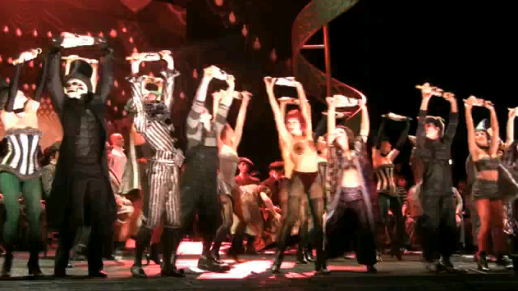
    Despite the spare set with drop/moving doors/screens [a Barlett Sher's signature by now???], the visuals were actually quite easy on the eye. Witty costume evoked more the seedy/campy Berlin of the 1930s than second empire Paris [think Baz's Moulin Rouge morphing into Liza's Cabaret], while cluttered masses of the MET chorus in full force were occasionally deployed in such a way to put even Zeffirelli to shame. The sensory overload sometimes made you yearn for the truism of “less is more”, thus the simpler emotional intimacy (notwithstanding the huge empty space of the spare set) of the bleaker-looking Act 2 turned out to be the most effective of the 3 acts. While it won’t displace my sentimental attachment to the previous Otto Schenk traditional staging, Bartlett Sher’s new take was quite enjoyable if not quite as sunnily dynamic as his recent Barber of Seville. The opening of the Venice Act even got applause for the scenery, and the Barcarolle received quite a production number, with a dozen pairs of ballet dancers scantily clad in black lace/stockings undulating in simulating coitus and then with the women planted upside down speading and closing their legs to the swaying rhythm of the duet! The party scene in the Olympia Act also got an over-the-top Cirque du Soleil treatment with a full contingent of chorus dancers and extras spinning japanese umbrellas with a single eye painted in the center! Those lavish tableaux might be overly cluttered for dramatic flow (and there were still a few execution glitches here and there), but they sure made for much visual pleasure and entertainment value that the MET is obviously aiming to promote to its audience not just in the house but with an “eye” to the prospective HD/DVD audience.

    The singing was quite another matter, and it figured among the worst performances I’ve ever sat through at the MET (or almost anywhere else for that matter).

    The women fared generally better. Looking remarkably like a brooding young Franz Liszt in her black-tail male attire Kate Lindsey acted really well the role of Niklausse (characterized as in league with the devilish four villains to thwart Hoffmann’s love quests so as to claim him all to herself as his Muse) while looking quite feminine as the Muse in a white chemise/negligee. Her singing was fine without being extraordinary (and while you couldn’t really imagine Garanca being much of an improvement in the role as a whole, Lindsey was still a long way from Suzanne Mentzer in her heyday!) Gubanova is a loud cow, without the redeeming sultriness of voice and figure (well, she’s slimmer/shorter but the voice is leaner too — more soprano than alto oriented) as Borodina, and thus did not make for a very sexy Giulietta, alas. Netrebko got a role for which her hysterical bellowing could be put to good effects (no fear of a bull in a china shop approach here), though her French pronunciation remained unintelligibly mushy and there’s little shading/tenderness in whatever she was singing, but still she’s the most vocally impressive member of the cast, in the sense that the voice was big and loud and it pressed itself on you like a hammer. Kathleen Kim was decked up in ridiculously cute pink tutu and pointy-crowned Marilyn Monroe dark pink wig! Save for the more than occasional physical and vocal muggings (a bit excessive, and rather unnecessarily so for the distorted vocal bits), her Olympia was extraordinarily sweet-toned, a bit light and airy (and a bit weak on the chest dips), not brilliant with sheer bravura pyrotechnics but still some stunningly beautiful singing on the whole (and her Doll Song deservedly got the biggest/longest hand for the afternoon). Wendy White also turned in a distinguished cameo as Antonia’s Mother.

    When it comes to the men, you know serious trouble was afoot when the best performance came from Alan Oke as the 4 servants (and he was duly recognized by lusty applause after a charmingly acted and superbly sung number by Frantz in Act 2)! Alan Held is regrettably past his best days as the four villains (10 years too late?), the top a bit worn and tentative (even when he takes a lower option at the end of “Scintille, diamant”) and the lower middle range a bit on the hectoring side with somewhat uneven results. But still he was a solid presence and contribution to the performance. Dean Peterson who should have been super-luxury casting as Luther and Crespel somehow didn’t impress as he should. The same goes for the smaller roles of Hermann and Nathaniel, Michael Todd Thompson looked far better than he sounded, and Rodel Rosel was less effective as Nathaniel than Valzacchi in his debut 2 months ago in Der Rosenkavalier. Veteran Mark Schowalter turned in a finely sung and creepily acted Spalanzani, all decked in white German labcoat with pointy shoulder pads!

    The dreadful thing is that notwithstanding all the idle talk about diva pretension to conquer all 3 (or 4) female leads in the opera, Hoffmann is ultimately still a tenor vehicle that rises or falls with its male lead. And the dearth of adequate (never mind good or great) Hoffmanns has long been a serious blight in its numerous incarnations on stage and on discs. From the moment he entered, Joseph Calleja sounded out of sort, and his rather underwhelming Kleinzach number garnered fairly tepid applause. His bad habits of earlier years such as the wide/fast vibrato (bleaty caprino?), ill-supported phrase ends, covered top with a back-of-throat vocal production, etc crept back in to mar the many felicities he has managed to acquire in the past couple of years.

    Just before the curtain came up on Act 2, it was announced that Calleja was not feeling well from a cold — the MET must be at wit’s end to hedge its bet and keep a good face — and in order for him to get more rest and save his voice for the Thursday premiere, they decided that he would be withdrawn from the remaining 2 acts and his cover David Pomeroy would come on instead. Having heard Pomeroy a couple of years back in the title role of Gounod’s Faust in one of the MET in the Parks performances, I thought he would make a decent cover with a healthy/loud enough voice albeit rather crude/clumsy sense of style (or rather the lack of style/phrasing in his singing). But whether or not it was the sudden call to duty, or the lack of sufficient warm-up, or nerves, stage fright (he has never made his house debut yet?) or a combination of all the above, what ensued was singing that went from passably bad to incredibly worse by the time any Hoffmann singer gets truly tested by the terrors of compressed outbursts of passionate singing in Act 3. Mr. Pomeroy’s bellowing was more miss than hit when it came to the notes, never mind threading them together in any kind of a phrase with any sense of beauty or style; he made other solid second-stringer covers (like poor Mr. Raoul Melo who got unkindly booed when he stepped in for Villazon to sing opposite Netrebko in a Rigoletto several years back) sound like a million bucks! I cringed through my favorite Hoffmann moment: the Act 3 second arioso “O Dieu de quelle ivresse”; after Pomeroy already had gotten through the first arioso “Amour tendre et reveur, erreur!” without applause, and the big lead off to the famous septet was also cringe-worthy, though Mme Gubanova’s bellow in its later section did not improve matter much either, alas … A stagedoor acquaintance of mine was quick to dismiss that Pomeroy sounded worse than a comprimario; I wouldn’t go that far (well, actually, there are quite a few superb comprimarios on the MET roster that I would prefer to hear, though not perhaps as Hoffmann under these unfortunate circumstances!)

    But I do agree that we all (and especially the MET) need to pray for Calleja’s quick recovery or there will — or should — be boos on Thursday; and since Hoffmanns don’t grow on trees, it’ll be very difficult to find and invite anyone on short notice to come as replacement (or to sit around in case of need for it) for the HD cinecast on Dec 19. In any case, it doesn’t look or bode well for Calleja’s role debut as Hoffmann when he’s physically and vocally less than 100% just 3 days ahead of the occasion.

    A friend of mine raised a tantalizing hypothetical afterthought … if Calleja doesn’t recover fast/well enough, or doesn’t prove to be up to the task (no matter how much or skillful the spin after the Thursday premiere), will the MET have the guts to let him save face with the real/actual excuse of indisposition and once again bring in Roberto Alagna to the rescue? Yes, I know it’s also a case of a decade or more too late, but as Alagna had proven in his Romeo HD telecast, it was a lucky save for the MET to have such a veteran of the role on hand. The trickier question, however, will concern ego politics among divas/divos at the MET: if somehow Alagna suddenly gets two HD telecasts and his ex-wife gets none this season, what will Angela say/do about that? :-) I’m sure that’s another scenario the MET is praying won’t come to pass either :-)

    • tinhtraiviet says:

      PS: As for the possibility of Alagna to come to the rescue, he is rather conveniently around in town for rehearsal of the new production of Carmen which is slated to open a mere 12 days after the Hoffmann HD telecast. (Early rehearsals for Carmen had already started last Monday before Thanksgiving). But then it would be quite a challenge for anyone to step into a new production cold (even though probably in recognition of Calleja’s inability to act, the new Hoffmann production actually gives him very little to do other than to stand and sing and makes life easier for him by providing several doppelganger dancers to mime and act out various scenarios with the large cast — be it a bunch of Kleinzach rats or Olympia dolls in pink tutus) while dealing with one’s own new production in its very last stages of preparation.

      • Zerbinetta says:

        I like Alagna’s Hoffmann recording, but isn’t this role a little high for him these days?

  • amoebaguy says:

    Excellent, level-headed review, extremely well written and very informed. My two cents, for whatever its worth.

  • Quanto Painy Fakor says:

    [not funny any more. stop it.]

  • Harry says:

    Something justnothertenor earlier mentioned in a comment was ‘about a Hoffmann needing the ability to sustain constantly round the point of ‘E to G’…….If I remember correctly, this is exactly what Domingo also spoke of, some years ago when talking about the problems of a tenor, singing Hoffmann.
    We should also think that The Tales of Hoffmann is usually at least 3 hours in real time duration; certainly not an opera for some promising upwardly rising tenor to touch before he is ready,……really ready!
    Nor a place either for some singer to run ‘out of puff’, after the first hour or so.