Headshot of La Cieca

Cher Public

  • armerjacquino: Oh, that's the wrong one, isn't it? Hang on.
  • Indiana Loiterer III: September 24 – Elisir 26 – Turandot September 27 – L’El...
  • oedipe: Let's not be reductionist ourselves: I don't believe the art...
  • armerjacquino: http://parterre.com/2011/08/08/rip-brad-wilbers-met-futures-...
  • grimoaldo: Has anybody posted the classical Grammy winners?Engineer...
  • almavivante: When I read an inspired extravaganza like DharmaBay's, I rea...
  • OpinionatedNeophyte: Is this the same Laquita Mitchell? Is she ready for prime ti...
  • Betsy_Ann_Bobolink: An interesting sidebar is that to be historically "accurate"...
  • grimoaldo: Yeah, I missed both of those too. Very good, very funny, con...
  • CruzSF: Congrats to DharmaBay and iltenoredigrazia. I don't know HOW...

blog advertising is good for you

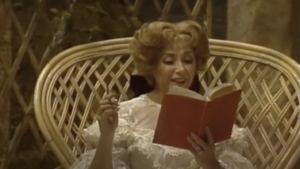
Mara Zampieri: the Cabaret Years!

Or is La Cieca mistaken: could this rather be Alfred Deller‘s “after hours” show? 

54 comments

  • There is one role in which I find Zampieri quite riveting and the voice not at all improper:

  • And for those who have not seen the Macbeth from Berlin:

    Nel di della vittoria:

    La luce langue:

    Una macchia:

    and while I was digging on youtube, I found this clip of her and Marcello Giordani singing Traviata. Is it me or is Marcello Giordani sounding quite a lot like Pippo? What happened to his voice? This was just beautiful compared to the whinning that we get these days:

    • La Cieca says:

      Your question about Giordani, with allusions to Kaufmann, bears some thought. It seems that in both cases these tenors sang one way when they were quite young (mid 20s) but then had to retool later on. I don’t think this is at all unusual for singers who have a fairly easy, well-placed voice early on: basically they just sing instinctively and it sounds fine. Meanwhile, though, the voice continues to develop, reaching maturity in the mid 30s, and a mature voice needs to work from some kind of technical basis, not just “open your mouth and sing” the way kids do.

      The ideal of course is for the very young singers to work hard on technique whether the voice already “works” or not, but the problem is that this is not the way most pedagogy works. The basis of voice teaching in general is to take on a student who has a problematic voice, then fix what needs fixing. Ironically, then, the singer without easy natural facility has a kind of advantage here, since he’s more likely to get a firm technical grounding early on instead of having to wait ten years until the problems become glaring.

      La Cieca would be remiss, though, if she didn’t mention that by far the biggest danger to the tenor voice is… other tenors. Those guys make The Women seem like a support group.

      • Noel Dahling says:

        What you describe about young singers with natural voices not getting the training they need is exactly what Cheryl Suder said was the cause of her vocal problem in the mid-90′s. She said her teachers had an “if it aint broke, dont fix it” attitude when it came to training;she wasnt given the essential foundation and later on she had a crises. Its sad, really.
        And of course the greatest of all such “natural singers” who never had a singing lesson, Ponselle, was a nervous wreck because she really didnt know what she was doing.

      • I will agree with you on all counts. I didn’t have one of those easy voices and had to work HARD at getting everything in line (still do) so I can completely see what you are talking about. Also, I didn’t think it that way, so thanks Cieca Cara for bringing it up.

        The one thing that I would “correct” is your allusion to pedagogy and actually say but the problem is that this is not the way most pedagogues (or voice teachers) work. I have a feeling we are talking about the same thing, but I am not sure.

        A lot of the teachers I have been associated with are the kind that make a big deal about learning your technique whether you have a natural voice or not so you avoid bigger problems in the future. That been said, I have known teachers that act like some sort of vocal coach, they will fix what you have issues with right now and in the future you are on your own. At the same time, I have always avoided that kind of teacher. They never worked for me.

  • kashania says:

    I agree that the top part of the voice is nice (that final note is lovely) but I have to wonder how anyone could hear the rest of the performance? Strange indeed. I am, however, enjoying watching the other clips that people have posted. I quite enjoyed the “La luce langue” (a few strange sounds aside).

  • kashania says:

    Lindoro: When I first heard Giordani (I think it was a recording of “Una furtiva lagrima”), I heard a bit of Di Stefano in his voice and I really liked how he sounded in the “Un de felice” you posted. IIRC, around ten years ago, he retooled his voice. The result was the ability to hit some spectacular acuti but the mid-register developed that thick phlegmy quality. Does anyone know why he did this? Obviously, the voice sound much differently today than it did in this clip.

  • Noel Dahling says:

    Having a debate with another youtuber: I am writing as tristanchord85. Am curious to know what other members of this site feel about it:

  • Harry says:

    My God!!!!!!!!!!!!!!!!!!!! Joan S ………….and you can ACTUALLY hear the words distinctly. Such diction from her, it is amazing. Was Bonygne the conductor….. that day?

  • dorion says:

    yes Harry it’s La Stupenda, and as usual she leaves the competition eating dust.

    I never had a problem with her diction by the way. I always understood each word, as Lucia, Violetta, Norma, Lucrezia, Leonora, etc. I don’t think the Italians would have named her La Stupenda if her diction had been poor.

    It always seemed to me that her diction was the only thing her detractors could vaguely criticize her for, they obviously had an agenda. They couldn’t really cope with a great Lucia, a great Norma, a great Turandot, a great Violetta and a great Wagnerian (if she had set heart and career to it) all at the same time.

  • cpross says:

    I’m also one of the minority who really, really likes Zampieri… In terms of her volume/projection, there’s a ‘Teco io sto’ on YouTube that’s pretty fab, and this, a Don Carlos finale with Domingo from 1992. *lurve*

  • cpross says:

    oops, my bad; the link is here: http://www.facebook.com/video/video.php?v=618007705577&oid=44600669325 (not on YouTube, alas)

    • Feldmarschallin says:

      well I heard Zampieri many, many times from 1981 to
      the early 90′s in different venues. Minnie at La Scala, Tosca in Stuttgart and Zuerich, La Wally in Bregenz, Salome and Odabella in Wien and countless Verdi roles in Muenchen. The voice was large and carried quite well. She was one of my favorite singers at the time along with Popp and Varady. I recall the first time I heard her was on Allerheiligen (1.11.81) as Amelia in Ballo and from the moment I heard her entrance in the first act I loved the sound of the voice. She needed a full orchestra and the piano wasn’t good to do her big voice justice. She had an easy top and very good middle and low notes. She could vary the dynamics from a mere whisper to full forte oversinging the whole chorus and orchestra of Aida. She had a good trill and could start a note softly and gradually swell the note. I heard many of the Verdi roles and here her voice was great. She did an amazing Manon Lescaut as well and she managed to make you believe she was this young girl in the beginning. She was a great actress on stage and NEVER phoned in a performance. She always gave 150%. She was not a generic soprano like so many of them are today. She was very much loved in Wien, Muenchen, Zuerich and Berlin but also sang in Spain, Portugal, London and Italy. I wouldn’t know which role to call her best since I dind’t find any of them mistakes but she did best in active roles. I personally loved the Ballo, Salome and Odabella but of course also the Minnie and Lady and Aida were quite special. The voice was larger than Varady’s and carried a bit better IMO. Also what I thought was very unique was her pronounciation of the Italian language. She is from Padua and I love to here her way with the words.

      • moritz says:

        Count me among those who love Zampieri. And I did so from the very first moment I heard her on stage: the individuality of her timbre, her careful and intelligent handling of the text, the way she threw herself into a performance as if it was the last time on stage or the most important evening of her career.
        „Passion“ and „Wahrhaftigkeit“ (truthfulness?) are the two words that come to my mind first. The voice was (and probably still is) huge and had an incredible dynamic range from a very well projected pianissimo (I remember a most beautiful „Morrò, ma prima in grazia“ when a nearly whispered „spenta per man del padre“ gave more insight into Amelia’s character than other singers manage to give in a whole performance) to a fortissimo that nailed you to your seat. And while I easily can understand that her timbre is not to everyone’s taste I fail to see how one can overlook her artistry.
        Feldmarschallin, I share many of your memories, thanks for reminding me: Tosca, Wally, Manon Lescaut. She was my favorite Verdi soprano (beside Lady and Odabella I particularely loved her Ballo-Amelia and both Leonoras, and Luisa and Amalia, which I unfortunately only know from recordings), and I adore her in Maria Stuarda, Roberto Devereux and Belisario. She was fantastic in Giuramento in Vienna beside Domingo and Baltsa and the commercial recording (Orfeo) shows that quite well (although the voice certainly was difficult to record, which unfortunately many private recordings with insufficient equipment prove). Wonderful both Adriana Lecouvreur in Zurich and Salome in Vienna. And I deeply regret that I didn’t manage to hear her Senta in Berlin in 1994.
        Zampieri certainly was one of the reigning divas at the Wiener Staatsoper in the 80‘s and early 90‘s (though not as unanimously beloved as apparently in Lisbon) and appointed honorary member of the Staatsoper in the mid 90‘s. She decided to concentrate on a few opera houses at different stages of her career: Lisbon, Vienna, Zurich, because she wanted „to leave a trace“, as she once said in an interview. And she certainly did so in my heart and in my perception of opera.

  • Olivero is my Drug of Choice says:

    As strange as MME Zampieri sounds in this clip, I find her oddly compelling. So shoot me!