Wagging the Tale
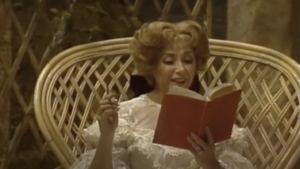
La Cieca’s saturation coverage of the Met’s new Contes d’Hoffmann begins officially on Monday, when one of her most reliable and most devious spies promises a report from the dress rehearsal. You, the cher public, will be expected to sound off loud and clear during the opening night chat on Thursday at 8:00 pm. And, ça va sans dire, one of parterre’s crack team of critics from the New York beat will file a definitive review just as soon after the final curtain as his little paws can type. In the meantime, here’s a teensy preview of the show:
Another production for the garbage heap.
I had a choice of ALNM or Hoffmann on Thursday and I’d rather see Angela as Madame Armfeldt!
That Elisir d Amore clip, there must have been a wrongly consigned load of bridal costumes, sent to wardrobe. Love that chorus girl sliding her hand up the tenor’s leg…it is one way for him, ‘hitting a climatic top note’.
Hi rommie,
simple enough: with Bartoli it was your standard queue-up-after-the-show-and-have-her-autograph-your-Gluck-CD-booklet. Calleja: the support group Friends of Wexford have a party every Friday during the festival and it is expected that all cast members will mingle. It’s all rather Before They Were Famous, and besides, Ireland ‘does’ warmth and informality 24-7 (dear me, you should see the way we Irish men dress). I was fleetingly introduced to Juan Diego Florez there but, face it, a pint with Calleja easily beats that. I made him laugh when I observed that he was the only Malteser I’d ever met that wasn’t called Spiteri.
Arriving thirty minutes early for the Keenlyside recital at Dublin Castle in March 1996, I made for the men’s room and found him singing scales et cetera – it’s not a dedicated recital hall so he made do as he could.
As for Vienna, well, we linked up with somebody who was in a position to help us meet most of the solioists in question – not somebody that they had to be nice to, mind – but let me also say that it pays to stay at the Grand Hotel on Kaerntnerstrasse one block east of the Staatsoper. If it’s good enough for half the soloists, who prefer to by-pass the Sacher, it’s more than good enough for me!
Love the Guinness remark, Cruz (among many other posts from you). But, apart from Calleja as well as (green) tea with Ann Murray and a cousin, and a similar non-alcoholic encounter with Frederica von Stade, Martin Katz and a small Irish entourage – both of these in Ireland but not on the day of their professional engagements – I have made it a life-long habit never to drink with the stars. It keeps them trim.
LOL. Am looking at the Calleja cover of Opera News. He looks pretty stocky to me so maybe he shouldn’t have had that pint with you!
Too true, Cruz – his biogs say he was big into sports in his school days. Well, he was in his twenties when we met and was already showcasing an opulent silhouette to match the vocal talent.
Then again, I am certain that that’s precisely why some of those present sought him out for a pint. For a specialist minority-within-the-minority, it’s always gonna be Callejas over Costellos, Goernes over Gunns…
Based on his pic, I’d buy him a pint.
Although I have to settle for HD production as well, I can’t wait! Calleja sounds marvelous in this clip as does Kate Lindsay(I assume that is Kate Lindsay). I can’t wait!
How one wishes in this music for artists of the class of McAlpine, Eddy, Collier, June and Kern.
a person I know who owns a movie theater that shows the Met HD’s was told not to publish the cast of Hoffmann which they had previously named. wondering if anything has changed…
Uh oh. Is it Nebs?
I think I mean Trebs.
No.
That makes no sense at all. The Met is still publicizing the announced cast. You’re saying that they’re sending out “top secret” info by mass e-mail to pimply faced movie theater managers in Booneyville, USA, but they haven’t given it to their own PR department?
Michael Kaye’s edition is yet to be published but the recordings made back in the 90s were revelatory. The restored music heightened the drama and gave coherence to the opera. Once the Kaye edition is published, I hope more houses will use it. Of course Offenbach would have made changes but that’s moot. Choudens isn’t the last word. It never was. BTW, the recording with Alagana, Van Daam, Dessay, Vaduva, and Jo is remarkable.
There’s a recording with both Natalie Dessay and Sumi Jo? Who sang the doll? What did the other sing then?
Dessay sings Olympia (of course) on the Nagano and Jo sings Giulietta. Don’t be surprised – Offenbach tailored the role of Giulietta for Adele Isaac, a woman with a very high coloratura range. She was supposed to sing all four heroines at the premiere but only sang Olympia, Antonia and Stella – the Giulietta act was cut entirely at the last moment because it was feared that the opera was running too long – a horrible mistake that had severe ramifications which continue to resound even in our own time. The tradition of casting Giulietta as a mezzo began some time in the 20th century.
You go girl! My sentiments exactly. Check out this video of Offenbach’s original finale for the Giulietta act -- it is dark and disturbing (probably why neither Guiraud nor Gunsbourg -- the two men most responsible for the “traditional Giulietta act) decided not to use it) and includes some of the most forward looking music Offenbach ever wrote. The despair in Hoffmann’s music in this scene is heart-wrenching and Giulietta finally gets a chance to explain her conduct. I love it more every time I hear it.
Cut these kids some slack, they are just students, but at least they know what Offenbach wrote!
httpv://www.youtube.com/user/Offenbach1880#p/u/15/TQBKf89wLBU
Michael Kaye has been the major enemy of the Kaye edition. When he first started shopping it around, he insisted on no cuts in a score longer than Parsifal in his edition. He also accused a pair of theaters that had perusal copies of his magnum opus of trying to steal his work, which would not encourage them to want to deal with him. The Kaye edition, which is dubiously described as representing Offenbach’s intention is disastrous in the theater. One of the conductors who recorded the score in the 90′s described it to me as unworkable if done as Kaye insists is correct.
As to it being published, I know that Cologne did do his version in a multi-language version, and that the results were fairly disastrous.
I find it hard to respond to a post which I consider to be ugly, hateful, slanderous, and, most importantly, uninformed. I have a great deal of acquaintance with the Kaye edition and have seen it once live in the theater and believe me – it works. To say that it is as long as “Parsifal” is a gross exaggeration – I don’t have exact timings, but I would not hesitate to estimate that an uncut performance of Kaye would last about as long as an uncut “Faust” or “Romeo”. It’s not nearly as long as “Les Troyens” which is usually performed uncut even though, at one time, such a thing was considered impossible. I don’t want this to become a war, and you are entitled to your opinion, but in MY opinion I find your comment to be excessively mean spirited. And if you’re going to make slanderous accusations, back them up with hard evidence.I would advise anyone interested to compare the various editions (recordings of Kaye and Oeser both exist, as do Choudens, Bonynge, Felsenstein, etc.)and judge for themselves. Ultimately, that’s what we all have to do.
The more people are familiar with Offenbach’s original Giulietta act the more powerful it is. But it’s hard to change the way people expect to see this opera. This goes for stage directors, conductors, singers and the way they perform it. They get so bogged down in the rehearsal process of preparing the first three acts that by the time they arrive at the Giulietta Act with the major challenges it presents (especially when Giulietta is miscast as a mezzo-soprano) the more difficult it seems; the pressure of the final rehearsals looms and the act is short changed. In the case of the MET’s opting to ignore all authenticity, it’s just easier for them to do what they know – really lazy of them and they obviously don’t give a damn.
Yes but the Met is also still performing “Don Carlos” and “Les Vepres Siciliennes” in Italian. They had a cast a few years ago that had performed the opera in French previously (Radvanovsky and Casanova) and the chorus probably mostly had never performed it since it hadn’t been done since around 1982 with Scotto. The Met just went with what it knew.
This is a problem with Levine. His musical knowledge and tastes are stuck in the seventies and early eighties.
And did we note Mr. Sher’s toadying comment in OPERA NEWS that he had listened to several recorded versions and found Levine’s to be the best?
A minority view.
No one cares a whit what Sher thinks about singing.
It seems to me that both of you missed the point of the quotation, part of which wasn’t even direct.
Sher says not a word about singing. Further, it seems quite clear that he’s not offering an opinion of Levine’s recording of Hoffmann, but rather of his “take” on the opera, i.e., what music he keeps, what he doesn’t keep, and in what order. At least on the basis of what is actually quoted here, Sher doesn’t seem to be saying much more than that the Olympia-Antonia-Giulietta running order (Levine’s choice to make, not his) is in agreement with Sher’s vision of the piece as a story about “artistic history” rather than a sentimental love story.
From what Sher says elsewhere in the interview about the ramp in Barbiere, it’s clear that he understands that Levine still wields gigantic clout at the Met and therefore is to be worked with rather than against. So even if Sher took exception to the edition of the score Levine has cobbled together, it would be at best ill-advised for him to complain about it to Opera News.
“the Olympia-Antonia-Giulietta running order (Levine’s choice to make, not his)”
With all respect to our hostess, but do you really believe that in the 21st century, such issues – as well as cuts, textual variations, etc. – are the sole decision of the conductor rather than being determined in collaboration between the conductor and director? Even in the last century when Levine did new productions of this opera with Schenk at the Met and Ponnelle in Salzburg, did Levine make the decision of order on his own, which those directors just humbly accepted?
Arianna: Not “the conductor.” Levine. At the Met, edition and cuts in a Levine show are Levine’s call. And that, of course, is one of the big problems in trying to drag the house into whatever century: nobody dares to defy or even question a Levine decision about anything that starts with “M.”
“How can Hoffmann experience the greatest love of his life [Antonio] after he’s lost his shadow?” This explanation, made in 1981 by one of Ponnelle’s assistants (Zenaida, I’ve forgotten her last name) has stayed with me since I saw JPP’s Salzburg production. The Olympia-Giulietta-Antonia sequence has seemed nonsensical since then.
Giulietta before Antonia may have remained that way for a time because it’s perhaps easier to sing that way for the tenor and the bass? (And showier for the soprano to climax the show with the Antonia trio.)