Wagging the Tale
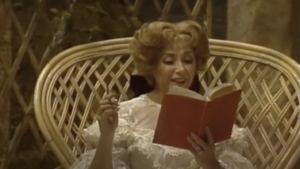
La Cieca’s saturation coverage of the Met’s new Contes d’Hoffmann begins officially on Monday, when one of her most reliable and most devious spies promises a report from the dress rehearsal. You, the cher public, will be expected to sound off loud and clear during the opening night chat on Thursday at 8:00 pm. And, ça va sans dire, one of parterre’s crack team of critics from the New York beat will file a definitive review just as soon after the final curtain as his little paws can type. In the meantime, here’s a teensy preview of the show:
You can never tell anything from these clip medleys, but I am intrigued. Meaning, there’s a lot of weird shit in that preview and we can only hope that some of it sticks. The problem with the Tosca, IMHO, was that there was so little there there. Doesn’t look like this production is going to have that problem.
I’m going to the prima on Thursday and am excited!
I agree, If any standard rep opera practically demands weird shit it’s Hoffmann. I’ll have to settle for the HD broadcast on the 19th but after this teaser I’m exited. The “Ziegfeld Girls” in the Marie Antoinette wigs and glittery pasties are particularly intriguing – extras for the Venice act? I hope so – I’ve always felt that a little sleaze is what makes that act work.
I wish I could see this live, too, but will have to wait for the HD broadcast on Dec 19. And I just remembered I have plans for this Thursday night, too — argh! (A professional event, which I’d rather skip for the Sirius broadcast.)
This looks like the weirdest thing ever…which is Perfect for HOFFMANN. I only regret I won;t be able to see a live performance.
Also, I’m heartened by the fact that the clip shows Nicklausse singing the alternate Act 1 Couplets, which points to a musical score closer to Oesier or Kaye’s reconstructed editions than the traditionally-performed Choudens editions, which is a good thing. Hopefully, we’ll get at least a portion of the “trio des yeux” and Nicklausse’s aria in the Antonia act, which is so beautiful that I can never understand why it was cut.
Surely since the musical edition was planned with the star Garanca in mind for Nicklausse, the “Vois sous l’archet frémissant” was included.
What the Met will probably be using is the version which they’ve used in the past decade or so – concocted by Levine for the Salzburg Festival in 1981 (the performance is now available on Orfeo). It’s basically Choudens with some excerpts from Oeser, but nothing from Kaye. Although the Giulietta act is placed last (as was the intent of Offenbach and Barbier – this point is not debatable, as the recovered rehearsal manuscripts and censor libretto have ruled out any argument)it is performed in Choudens.All the aforementioned material, recovered during the 1980′s, is being ignored, alas. Oeser’s edition was a convenient stop gap, but as he was working from material that dated no later than 1879, before Offenbach had re-worked the score for a new cast and new venue, and before he completed the Giulietta act (and he DID complete the Giulietta act, despite what you might have read), it is full of mistakes and tamperings that make it, in my opinion at least, inadequate today. Contrary to what most people believe (and to what is generally written) Offenbach had the score almost entirely finalized (with the exception of parts of the orchestration) before his death – only the fifth act (generally known as the epilogue) remained somewhat sketchy. The reason why most people do not know this is because impresarios are, in my opinion, too lazy, otr too afraid of public opinion, to let Offenbach’s true intentions be heard – therefore they repeat tired old myths that began with Offenbach’s earliest biographers. I point a wagging finger at Levine for neglecting recent scholarship, although I generally respect him as a musician; it is because I respect Levine that his deliberate neglect has filled me with such disappointment.
I’ll get off my soap box now — as to the music, two points should be clarified in regard to this post: The “alternative” aria for Nicklausse (“Voyes-la sous son êventail”) is not really an alternative, as it had been abandoned by Offenbach himself in favor of “Une poupée aux yeux d’émail” long before rehearsals began; by using it in his edition Oeser gave the incorrect impression that Offenbach preferred this version (many audiences do prefer it, though.) As far as “Vois sous l’archet frémissant” goes, this was another cut made by Offenbach himself, though I cannot fathom why. I can only assume that he felt the Antonia act was too long (as it is, even without the aria, it’s the longest act in the opera), but he certainly couldn’t have been dissatisfied with it – it is arguably one of the most gorgeous things he ever wrote. In this case I vote for vetoing Offenbach and including it – it’s greatly in the spirit of E.T.A. Hoffmann and it gives Nicklausse a glorious moment (without it, Nicklausse has barely anything to do in this act).
As far as Sher’s production goes – I’ll be better able to assess it once I’ve seen it. I’m certainly not opposed to a non-traditional approach to the opera (one of its beauties is that it lends itself to analysis on so many different and varied levels), but what I’ve read recently in Opera News has lead me to believe that Sher has very little understanding of this work, and almost none of E.T.A. Hoffmann’s life and works, which inspired it. That’s just my opinion. I’m sorry if this post seems over-long and pedantic, I am currently engaged in research for a book I am writing on this most puzzling and misunderstood of all operatic masterpieces, a work I’ve been obsessed with since I was eight, and once I get started it’s hard for me to stop!
Amoeba, fascinating! Thank you! Would you answer me this if you can: Cd’H is one of very very few operas that leaves me feeling bad and depressed. I can’t figure out why. I’ve seen it many times, with wonderful casts, yet I hesitate at any further exposure because it is such an unpleasant story, so ‘down,’ so 19thC — in the end so hopeless. And again and again I ask myself, is it worth all this trouble. Mozart or Wagner it is not; they contain some ‘uplift,’ some good reason for being heard: Cd’H does not. I shall avoid it. Have you heard this reaction before? e
To mrmyster:
Thank you for your kind words. I can completely understand your reaction, as the opera does have very dark undercurrents, particularly when the deleted material is restored in performance. As a child I loved the work for its flights of fancy, as an adult I can read more into it and can see how nearly nihilistic it can be. The key, however, is in the apotheosis, the magnificent finale to the work sung by the Muse. For me it is the key to the whole opera, it is about rebirth, rediscovery of self, and salvation through art. Although Hoffmann feels rejected, tormented, and sees his very soul as having been stolen, through his artistic genius he can find himself again – a better self, a transfigured self. In this sense, then, the opera’s original ending is, in my opinion, positive, optimistic and enormously real.
Offenbach himself knew how important this ending was, and had finished a draft of it before he had started working on anything else in the epilogue – it is criminal that it was cut after his death (shortly before the premiere) and not restored to the score until the late 1970′s (albeit in Oeser’s soupy version). The opera as it ended before this IS a real downer: Hoffmann passes out, dead drunk and Stella exits on the arm of Lindorf. Not much hope there. Thank God we rarely see this kind of staging nowadays.
I hope my thoughts might help you come to terms with “Hoffmann”. If not, and if the work continues to depress you, then avoid it (I have problems with “Wozzek” for the same reasons), not every work of art speaks to everyone, so don’t feel bad. But maybe if you see it in the light which I have indicated you may feel differently.
I think Hoffman is so whacked out that it actually benefits from non traditional stagings…and Calleja sounds really good, I think. I loved the Hoffman set in an insane asylum — nightmarish and heartbreaking.
PS…Why don’t we get Claycomb at the Met…she’s wonderful.
I love Laura Claycomb. Such an artist. Every time I hear someone is singing Cleopatra for the first time, I give them a copy of her performance from HGO…it’s quite simply ideal.
Claycomb’s voice is tiny. Sills was much better as Cleopatra.
Well, Enzo, thanks so much for that pat and unsupported comment.
The truth is the truth
Why in the world would they cut the chorus interjections under Olympia’s coloratura? They also make the dreadful cut in the final chorus. Why? Probably because the stage director could not come up with a real coup de theatre for the finale, or just did not care enough to work to find one, so just cut it and get it over with!
What an interesting looking staging. I’m quite excited to see this now!! (and I second Zerbinetta’s comments in post 1)
I predict a triumph for the Met….the cast is sounding great and the staging looks appropriately whacky.
this looks lovely. i think its time to get a standing room ticket for thursday!! la prima here i come!
by the way, last night as I was waiting outside the stage door of the met BY MYSELF (which was weird coz there’s usually this old lady who goes off on so many tangents but she wasnt there) after Figaro, Garanca and Alagna came out. Garanca was so beautiful, but damn, she was cold as ice.
Alagna on the otehr hand looked like he was having the time of his life despite Draculette’s existence.
rommie, I am sorry to learn of Garanca’s coolness. I have met very few major names on perf night – Bartoli after a recital, a pint of Guinness with Calleja at the Wexford Festival and – get this – an encounter in the men’s room at Dublin Castle with Simon Keenlyside (purely warming up, so nothing of niche interest to report) prior to a recital when he later removed his shoes for us all, owing to a poorly-sprung floor – but in Vienna two years back I got to meet most of the headliners from Norma and Die Walkure.
Best impressions came from Johan Botha and la Garanca. Edita Gruberova was lovely, too, but then I broke the ice at the outset by saying that I had once met Ann Murray’s mother and asked her who her favourite performer was. That’s right – Bratislava’s finest!
see, Botha was grumpy when i met him. none of the festivities that you experienced, surely. both he and garanca were like,,,cranky. well, i’ll wait for her reception after Carmen.
Maybe you needed to buy them a Guinness.
good idea CRUZSf.
Balsamic, how did these interactions come about?
Yes, wierd as shit is what this calls for. The stories themselves are even more disturbing. Hoffman is buried in the same Berlin cemetery as Mendelssohn and his family, and Hoffman has the larger headstone. When I visited, someone thoughtfully left a bottle of absinthe (unopened).
Opera Theatre of St. Louis’s production a couple of summers back was based on What Would Offenbach Have Wanted, with Offenbach as a character. I loved it, tho not as much as Carsen’s brilliant production for Paris. We’ll see what Sher comes up with. Have to miss the prima but I rely on you all for the color commentary.
Fantastic! I wish you had taken a picture of that bottle of absinthe at Hoffmann’s grave. I’m sure Hoffmann appreciated it.
I did. Two photos, actually. I’d be happy to email them to you.
Anna, I think the St. Louis production will be given at Santa Fe next summer, 2010. I don’t think their tenor (Groves) can sing it, otherwise cast seems OK.
I know that but there are rumors about which edition will be used.
totally off topic but this is a must watch!
as for this one: repulsive!
Am I in the minority here? I love Hoffmann done…………………the traditional Choudens way. Pity that Pffebach critically died around the period of its intended original premiere. As a result we suffer the on going problems. All the messed up directors’ re-conception shit, like where Olympia may become a Marilyn Monroe doll, or a Dr Jekyll may lurk in the Venetian scene pisses me off. If one has collected the various recording from just the last 20 years, ‘this and that is added or omitted’, or characters moved to a different voice range. It is but a constant ‘re-adaption’ of a score. I.E Instead of being a solid thought -through book show it has descended into a mixed variety show of various Hoffmann tunes.
If any opera calls for Marilyn Monroe dolls and Dr. Jekyll it’s Hoffmann. It may be delightfully tuneful – but ultimately it’s three demented acts dreamed up by a drunken poet (in a seedy tavern) about being thwarted in love by a thinly disguised “Satan”. Choudens turns it into a nearly first rate 19th century French tunefest and glosses over its odder moments. I liked the opera for a decade or so prior to hearing the Oeser and Kaye discoveries. Now it’s one of my favorite operas.
Absolutely. It is a credit to Offenbach’s genius that the opera gained worldwide fame even in the truncated and sugared version(s) which Choudens published (there are at least five Choudens versions, by the way). But now that we have the real deal it’s time to consign Choudens to the garbage heap of yesterday (would anyone today think of performing “Lulu” without the third act?)It’s not that Choudens doesn’t work (it obviously does so)but that it misrepresents Offenbach’s masterpiece and does the opera a dis-service in the process. I believe that most people, once having gained an acquaintance with the original version, will (eventually) prefer it because it makes so much more dramatic sense.
Mis-spelling again. I should have said Offenbach not ‘Pffebach’.