
Postcard from Brabant
On the heels of this, may I direct everyone’s attention to a funny and fascinating article about Stefan Herheim‘s production of Lohengrin from last spring at Berliner Staatsoper? Now we know what to do with those old costumes and sets that gather dust! [via the wellsungs]
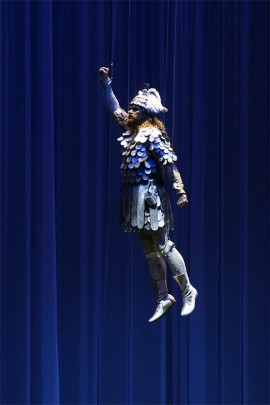
Klaus Florian Vogt in Stefan Herheim's Lohengrin at the Berlin State Opera. "If you can't handle ambivalence, stay away from Wagner!" warns reviewer Per-Erik Skramstad
There is also a video!
I stand by my assertion that Herheim has a lot of ideas and skill but needs a ruthless editor.
Bullseye… the photo looks just like Ludwig II would have liked Lohengrin to look.
i heart
http://www.richard-wagner-postkarten.de/postkarten/loh.php
and
http://archives.metoperafamily.org/Imgs/CampaniniLohengrin.jpg
squirrel, what’s so marvelous about the antique image of Lohengrin in his boat is that the Catholic knight sent directly from God has a little Roman deity, Eros (Cupid) as a bow ornament. Wonderful little mixed signal!
perhaps!
you forgot to mention the brass tit plates!
great costume.
Yes, it is a perfect costume for the director’s concept because it fixes Lohengrin in the bygone world of artifice and illusionistic theater.
It has been interesting to see the transformation in the way Elsa has been presented in the last half century. Her questioning is no longer seen as a weakness, a pathetic inability to just shut up, do as she’s told and accept. I encountered the same attitude in Catholic school in the 1950s, at one point in the classroom being told to stop asking questions. We were supposed simply to listen to the nun at the front of the classroom, memorize everything that was said, and repeat it like parrots on the tests and exams. When Elsa refuses to do that, she grows up and becomes a woman.
Off Topic Warning: Will, I don’t know if you’re a fiction-lover, but for me the best imaginable story on the Catholic-school-no-questions-please pedagogical approach is Jim Shepard’s story “Eustace”–a real heart-breaker–to be found in his collections Batting Against Castro and Love And Hydrogen (the title story of the latter being about how gay romance blew up the Hindenburg).
Thank you, Rapt. I know gay romance (and what inevitably comes of it) is hot–but the Hindenburg!
That costume for Lohengrin reminds me of a big framed print I once had, depicting Lohengrin. It was strange, he had a swan style helmet shaped lie a serpent and generally the overall feel of the print was ‘a fusion of Wagnerism and the mad depths that Germany then subsequently descended to. It captured a disturbing feel of evil madness. I was glad when one day, the picture fell, the glass broke and ripped the print. It finished in the garbage where I felt, it belonged anyway.
Will
Wagner sets Elsa an impossible task: How can a woman love a person she knows nothing about? A fella that gets out of a swan limousine just at the right moment and says ‘trust me’? Marries her, then seemingly has a registered ‘one night stand’. Perhaps Lohengrin was really a medieval politician . The type that if they do not get their way, pick up their traps and move on to other more gullible people?
I agree about Elsa asking the fatal question. The whole premise of “Lohengrin” is a fantasy anyway. You could never marry anyone as “anonymous” or “Held von Brabant” in the Catholic church at that time or any other time. Really it has overtones of Eve and the apple in the Garden of Eden.
The whole center of a marriage is self-revelation, sharing yourself. Elsa is being asked to have anonymous sex on her wedding night! I am shocked, SHOCKED!!! Imagine doing someone who you just met and don’t know (I don’t have to imagine…)!!!!
I think what seems most appealing about Herheim (though I’ve not seen the production) is that it manages to be a postmodern framing, while retaining the romanticism and fantasy that Wagner intended for the piece. There seems to be something loving and sincere beneath the mirth and camp of his presentation, unlike other directors who inflect their work with these same themes, ie: Schlingensief or Konwitschny (the latter being the far more laudable of the two)
I agree; even in his lunatic Forza that really didn’t work all in all (the mostly naked children with KRIEG and KUNST painted on them, everyone in the opera costumed as a double of another character, the setting variously looking like the outside of the Staatsoper or an insane asylum), there was a certain affection for the piece that showed through in the best-staged scenes, and the feeling that sincerely he was trying to stage it in a way to say something more than a straight presentation would. With this Lohengrin and the Rosenkavalier video, there’s a strong sense of using the visual luxuriance in an expressive way. I wonder what he would do with FrOSch.
IMHO, the performance of this production on Nov. 8 that I saw was not only a huge musical delight. While I agree with Straussmonster above that Mr. Herheim may need an editor now and then, to me the production is well conceived and makes sense, and is an inspired comment on the traditionalist vs. regie theater view on opera staging. It was also very well acted and sung by (almost) everybody. Special mention must go to Kwangchul Youn as König Heinrich. The orchestra and chorus were brilliant under Barenboim’s inspired and dynamic conducting. All in all, I have not experienced as impressive a Lohengrin since Konwitschny’s “Class room” Lohengrin in Hamburg. And, yes, the Eden reference with tree growing and apples on stage is also made by Herheim.