Headshot of La Cieca

Cher Public

  • Regina delle fate: Meier gave several series of Isolden in the UK - in German f...
  • brooklynpunk: whatever:..BTW...did you ever make it in to t...
  • whatever: much obliged for the kindness of strangers, armerj ...
  • brooklynpunk: " it does not follow that as many people will embrace opera”...
  • MontyNostry: Presumably JDD was singing that aria, so some of the standin...
  • quoth the maven: Entirely unfair. The union agreed to the contract; the cast,...
  • The Wistful Pelleastrian: That Grammy crowd gave a standing ovation to an opera ari...
  • marshiemarkII: Bravo tenorino!!!!! much as I thoroughly enjoyed the other o...
  • iltenoredigrazia: Thank you, thank you (bow down to the floor, hands to my che...
  • Betsy_Ann_Bobolink: Is it all right to say "John Huston," "Angelica Huston," or ...

blog advertising is good for you

And I am telling you I am not belting

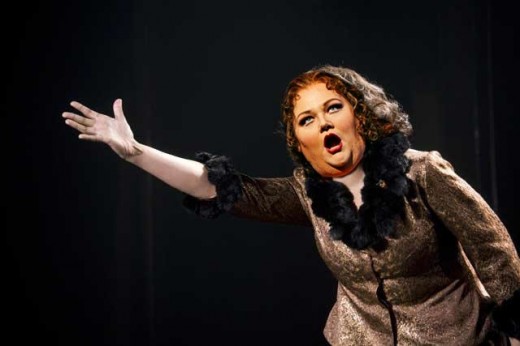
Mezzo-soprano Stephanie Blythe

“Since the 1918 premiere of Puccini’s Il Trittico, only two divas at the Met dared to sing the leading roles in all three of its one-act operas: Renata Scotto, a supreme vocal stylist, and Teresa Stratas, a magnetic singing actress. On Friday, Patricia Racette, who is not quite either of these things, took the plunge.” [NY Post]

72 comments

  • wenarto says:

    somehow I walked out on Racette after her butterfly duett broadcasted from the Met, even if it is free, I doubt if I want to spend my time to see her…hmmm. But I have to admit, my suor Angelica is worst than hers.

  • javier says:

    Blythe is an awesome mezzo with the kind of voice that just stays with you from the first time you hear her, so I don’t think she deserves this. Racette on the other hand is completely forgettable. I can’t even remember what her voice sounds like because it lacked any kind of distinction, but one thing I do remember is her sliding off pitch in her “Senza mamma”, cracking, and running out of breath. I didn’t want to waste anymore time listening to her “O mio babbino caro”. Apparently I didn’t miss much. Aside from the cheap unnecessary dig at Blythe, nice review JJ.

    • Alto says:

      As an inveterate admirer of JJ’s work, I’m wondering if editing slanted his reference to Blythe to make her seem some annoying nuisance instead of one of the greatest voices and most intelligent artists of the age.

      Even “The mezzo-soprano Stephanie Blythe” instead of “Mezzo-soprano Stephanie Blythe” — as in “taxi driver Angel Singh” — would have softened it somewhat. (I know singers who covet or glory over that definite article more than any other thing in Times reviews.)

  • enzo says:

    I agree with wenarto and javier about Racette. Does Antonenko really have a massive voice?? Lucic’s voice is indeed wan. It’s sad to realize that we don’t have one great baritone for roles that require substantial volume.

  • CruzSF says:

    I disagree with JJ, wenarto, javier, and enzo about Racette, but since I’ve already made my feelings about her abundantly clear in previous threads, so I’ll sit the rest of this one out. I appreciate hearing JJ’s and Steve Smith’s impression of her, though.

  • tatiana says:

    I appreciate other critics’ impressions also, but in Steve Smith’s case (or any other critic’s, for that matter)I find it ridiculous to declare that the cracked note at the end of “Senza mamma” was “no doubt intentional.”

    • Ercole Farnese says:

      Yes, I haven’t laughed so hard in ages. I split my sides with laughter when I read about “a cracked note near the end of “Senza mamma” was surely meant as dramatic effect, and worked as such”. Every singer cracking a note will have an excuse from now on.

    • squirrel says:

      Hmm, I tend to think he’s right. The crack was really noticeable and she had the note spun perfectly. My impression was that she tried to do something expressive with the note. Maybe she didn’t mean for it to be a crack, but it was her doing.

      • javier says:

        Did she also try to create this dramatic effect in SF? If not, then I still find this hard to believe.

        • squirrel says:

          I don’t know man, all I can say is she was in fine fettle, then the long note, and it sounds fine, and then she seems to futz with it, like a bend of the pitch or a “Sob” sound (maybe that’s what she meant to do!) and instead, the pitch goes way off and then it cracks.

          If she had just wanted to sustain the pitch pure, it seemed like she could have done so.

          I’m just sayin’

        • CruzSF says:

          Since javier asked: in SF, Racette did incorporate acting into her singing, even if it wasn’t pretty. This included growls and broken sobs. I don’t recall the cracked note at the end of “Senza mamma,” however (and, of course, this was 3 months ago in my memory). I’m inclined to believe that squirrel might be right on this: a bit of acting got away from her on Friday.

          I do remember that her “O Mio Babbino Caro” was unlike those I’ve heard on recital discs. Instead, she sang it a little bit scheming, and more in line with the comedy of the rest of the opera.

        • javier says:

          That’s probably how it should be sung. On recital discs the singers are too heavy handed with the aria and they make it overly serious and sentimental. JJ says she “dragged” it out, but you say it was “scheming”. I should have listened for myself because until I do I’ll never really know what it was like. ;)

        • Ercole Farnese says:

          Yes, I haven’t laughed so hard in ages. I split my sides with laughter when I read about “a cracked note near the end of “Senza mamma” was surely meant as dramatic effect, and worked as such”. Every singer cracking a note will have an excuse from now on.
          This is not a critique of Racette. I am not laughing at her cracking the note: it can happen (and it does happen) to every singer. What I object to is Mr. Smith’s description of the event as intentional. I don’t know of any opera singer who intentionally cracks a note, just for dramatic effect. I agree with squirrel that she was trying to do something expressive with that A natural, and that things went a bit out of her control, but she didn’t certainly say ” well, now I am breaking the note just to show how desperate I am”.

        • MontyNostry says:

          If I’m not mistaken, Callas played ‘O mio babbino caro’ in a scheming manner and Scotto certainly did. Ailyn Perez does a good job with it too. Very appealing in the aria and then showing her true intentions right at the end.

        • Graciella Scusi says:

          My impression from listening on Sirius was that she definitely ran out of breath or support; it sounded like she was trying hard to sustain it, but at the end of the second act of her marathon, she was, understandably you could say, sounding spent and tired. Naturally when this happens a singer will try and make use of it dramatically. But as far as doing it on purpose….I don’t think so.

        • irontongue says:

          I saw the SF Trittico three times. Racette floated the high note at the end of “Senza mamma” once; the other two times, it was unfocussed and without core. I can’t believe the crack at the Met was an intended effect.

          Oh, and otherwise, she killed me as Angelica. Stunning performance, in a good way.

          If “O mio babbino caro” dragged in NY, blame Ranzani. It was uptempo and hilarious in SF.

        • quoth the maven says:

          Cruz–Is “acting” something different from “singing”? Do extramusical effects equal “acting”? I’m confused by what you mean here.

        • CruzSF says:

          Since quoth the maven asked: I do think that acting isn’t the same as singing. A great opera singer will integrate the two into a performance, in my opinion. I’m sure many of us have seen or heard singers who have simply sung all the notes, followed the musical lines, putting little emotion into the song or aria or character. And as noted by others elsewhere in this thread, the demands of a recital performance are not always the same as those of a staged opera. But I’m sure that these points are not the things that confuse you.

          So, “extramusical effects”: yes, I think that extramusical effects are necessary to create a fully formed character on the stage. You ask if I think “extramusical effects equal ‘acting’.” No, I wouldn’t say “equal,” but instead “a part of.” By many accounts, Racette wasn’t successful in the later sections of Suor Angelica and most of Gianni Schicchi. I listened to the Sirius broadcast and even I could tell that she’d given a better performance when I saw her in SF. Her sobs were too broad, the end of “Senza mamma” got away from her, and her two instances of collapsing to the ground, even if they are in the score’s stage directions, were unsubtle (here, I rely on newspaper accounts of the night).

          I do believe that successful acting can come through a sound recording. I’ve no doubt that we all have examples we can cite in our collections. From my own collection, Cotrubas in Traviata, Callas and Gobbi in Tosca , Callas in Lucia, and Neblett in Fanciulla.

        • quoth the maven says:

          And what extramusical effects does Callas employ in Lucia–or for that matter, in the de Sabata Tosca?

        • CruzSF says:

          quoth: Maybe it is I who is confused about what you mean by extramusical effects. From Tosca, I would include growls and gasps. Or would you file those under “musical effects”?

          I don’t have the Lucia with me at the moment and would like to re-listen to it before giving specific examples.

        • quoth the maven says:

          Ok, without the recording at hand, I can’t recall where Callas’s “grunts and growls” occur on the first Tosca recording. Can you point me in the right direction?

          I’m quite sure that she did not employ “grunts and growls” in the first Lucia recording, but then again I am willing to be corrected. Assuming she does not, does this mean that she failed to create “a fully formed character”? Or if I am indeed wrong, does she create “a fully formed character” in those moments in which she grunts and growls, while falling short of that goal elsewhere?

        • CruzSF says:

          maven, I’m getting the feeling that you are focusing on just one part of what I wrote. I didn’t say that “grunts and growls” MADE a fully-rounded character. I said — or tried to say — that they, LIKE other extramusical touches, can be a part of a fully-rounded character. I didn’t say that a performance without grunt & growls was less than fully realized.

        • Graciella Scusi says:

          I remember an interview (I think it was Leona Mitchell, but I’m not positive) where the soprano said something like, well first I learn the music and then before we get on stage I put the acting in. Now, I’m sure there are many different processes for singers preparing a role, but for me, in the best performances, you can’t separate the acting from the singing; it would be like tearing flesh from bone…they should be one.

        • quoth the maven says:

          Graciella–That’s exactly my point in the first place. I’m still reeling from that moronic New Yorker profile of Dessay where she said words to the effect of “It’s harder to sing when you’re acting”–in that case, using “acting” to refer to movement, as if that were inherently more expressive, and more of a contribution to building a character, than, um, singing.

          Cruz–You did indeed say “yes, I think that extramusical effects are necessary to create a fully formed character on the stage.” Not “can be part of” but “necessary.” There’s a difference. In my own opinion, there can be a role for such things in operatic characterization. (I wouldn’t want to do without Leonie’s Sieglinde scream.) But too often, they’re used to signify “acting,” when in fact the harder work is to make the musical line express character and emotion.

          And yes, like you I have heard singers “who have simply sung all the notes, followed the musical lines, putting little emotion into the song or aria or character.” Those are bad singers.

        • CruzSF says:

          Thank you, maven, for reminding me of the words I used. Let me correct my statement: in my opinion, extramusical effects are a necessary PART of creating a fully realized character on the stage. I do not define “extramusical effects” as being limited to grunts, growls, gasps, and sobs.

        • CruzSF says:

          I might be the only one who still cares about this thread, so let me finish it by saying this: after thinking more about the issue of extramusical effects, I realize that I overstated their importance even to me. I realize that while they may have a place in some operas, for some characters, and some styles (e.g., verismo), I think they are certainly not always necessary to create a fully-fledged character nor are they even appropriate in major sections of the repertory (e.g., classical and bel canto era works).

          I still think that acting isn’t the same as singing, and that, for me, the great opera singers integrate acting into their performances.

      • Graciella Scusi says:

        As far as Racette trying to “do something expressive with the note” at the end of ‘Senza Mamma’, to my ears, all she did was try and relax so it would float and she could taper it off. We’ve heard sopranos do this dozens of times, some times successfully, some times not. I don’t think “float” is something that comes easily for Racette. Sills was known for her gorgeous, easily floated high notes, but when she went into heavier roles beyond her natural endowment she eventually lost it.

        • Graciella Scusi says:

          Cruz@5.2.17
          If acting doesn’t come through the music then what are the words for? Peter Mattei in an intermission interview last night on Sirius said that you get into trouble if you try and separate them. Perhaps it’s just a semantic thing and by “acting” you mean movement, which is certainly a part of it. Racette, by the way was in much better voice last night.

        • CruzSF says:

          I think it might be a semantics issue, my continual (over-)explaining. I agree with you and Peter Mattei that separating the two will take an artist into trouble. I think I’ve been saying this all along — if not, I’ve been trying to say this: that acting & singing must be integrated into a performance. Not singing without acting. Not prioritizing acting over singing. The two together.

          I listened to “Il Tabarro” and “Suor Angelica” last night, and listened very closely to Senza mamma. Racette was in much better control of her voice last night than last week. There was no hint of cracking while I listened and I thought her tone was smooth and lush.

  • Baritenor says:

    Like CruzSF, I am a Racette fan and found her Angelica, seen three months ago in SF, absolutely heartbreaking. That’s all I have to say.

  • Feldmarschallin says:

    every house needs singers like Racette to fill in when others aren’t available. She is a house singer and not more but that isn’t necessary a bad thing. But I agree that you don’t know what her voice sounds like 5 minutes after having heard her. What makes a singer great is having a timbre that is unique and that is something she doesn’t have. The picture in the Times showcases those huge tits. I think I can pass on this revival.

  • squirrel says:

    This new photo at the Post does not really resemble the JJ we know…

  • dorion says:

    The Angelica of Racette’s cheap. No depth or nuance, I agree. But Scotto was never a “supreme vocal stylist”, at best a limited vocal stylist.

    • javier says:

      I don’t really know a lot about Scotto, but her “O mio babbino caro” is pretty well acted here:

      I’m not saying it’s the best I’ve heard but I like her acting. The voice is okay. I wouldn’t call her “supreme” either.

      From what I’ve read, Racette tried to drag out the aria a la scoopenda, but she doesn’t have the creamy vocal line to pull it off.

      • richard says:

        I think Scotto takes a good approach interpretatively here. It’s not a dirge and not sentimental. Lauretta is manipulating her father here not, voicing depair.

        The tempo is taken at a good clip. But I was reminded here how much Scotto’s breath control had deteriorated by the early 80s (this was ca 1981)
        She runs out of breath even at this quick tempo
        and I remember now how much she sang off the breath at the ends of phrases during that period.

        I was a huge, huge Scotto fan but from about 1978 on, there were some real down sides to her vocalism. She knew what she wanted to do but it became increasingly harder and harder for her to get there.

        • javier says:

          Scotto’s breaths are actually okay. This is Puccini so the soprano can get away with more than a few audible breaths. This isn’t bel canto where you’re supposed to fool the audience into believing that you can sing all those long phrases without ever breathing.

  • sfmike says:

    Please don’t take offense, but why is JJ writing for a right-wing Murdoch shitrag? I’m genuinely curious.