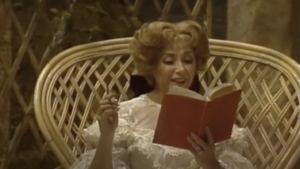
Elisabeth Söderström 1927 – 2009
The great Swedish soprano died earlier today. She was 82. [AP]
Copyright © 2012 parterre box - All Rights Reserved
Powered by WordPress · Parterror Theme by Nick Scholl for DIS Magazine
We were cheated of most of her mature career in New York – some falling out with Bing and his successors, or she just didn’t feel the house or the roles they offered her were congenial. I tremendously envy everyone who heard her in those three Janacek roles. I saw her Marschallin (the only Marschallin who ever seemed afraid Mahomet would notice Octavian’s sword!) and her Countess when she refused to do Ponnelle’s staging and played da Ponte and Mozart’s instead (we need more artists like that!), the Intermezzo at Carnegie Hall (thank-you, Matthew Epstein) — did she do the Capriccio too?, the unfortunate Grafinya in Pique Dame and a couple of recitals.
Her last recital in NYC, the Schubert bicentennial year ergo I suppose ’97 and I excuse my bad manners because I was doing lotsa chemo that year. Anyway, everyone who sang a recital that year did a bunch of Schubert (none to match Ameling’s all-Schubert recital in 1978 however), and every one of them did Gretchen am Spinrad and for some reason none of them did Auf dem Wasser zu singen. I was very annoyed. (It’s my favorite Schubert song.) And I came into Tully, looked at Soderstrom’s program, and huffed and puffed – louder I guess than I’d thought – “Everyone does the same damn song! He wrote 500 others, y’know! Is she so unimaginative?” Then she came out and did it as I’ve never heard it, before or since, as one long keening cry of pain, building very slowly and softly till it was like staring at someone in agony, you were riveted, couldn’t breathe, desperate to look away. At the end, as we all breathed at once (no applause; it was not the end of the set), I muttered, in what I thought was a whisper, “Well if you’re going to sing it like THAT….” — and everyone around me cracked up.
One of the very great singers of the era.
Gee, Herr Hanslick–I’m so happy you have contributed this reminiscense about a Schubert song as E. S sang the song “Erlkonig” in a way, that is in the manner of differentiation amidst the three voices — distinct, individual, and quite separate one from the other — in a way which I have never heard equalled by any other artist. So happy you should speak about her Schubert singing, as I do not recall very much about Pikovaya Dama.
I remember that Gretchen am Spinnrade, Hans…VERY intense! and on “Und ach,sein Kuss” the Kuss was lengthened, as if she didn’t want to let go, and then deflated slowly on the final s. A mistress of her art.
I saw two of her final Marschallins at the Met. Fassbaender was all over her in the first act, breaking a clasp on her peignoir in one performance. Soderstrom just reacted in character and used it to motivate her exasperation with Octavian. I thought her voice was perfect for the part; at it’s best it had a kind of shimmer to it that was very appealing and feminine, but it was never just about making beautiful sounds. In the last act, her exit just before the final duet was played differently the two times I saw it. Once with a touch of vulnerability as he took her hand, turning to look at him quickly before taking her hand away and exiting on Faninal’s arm (fairly conventional). But the second time she took a step back, facing Octavian, tossed her head back a little and gave him this dazzling smile, this beautifull woman, gracious and sexy, releasing him in the most loving way… “Und in dem Wie” indeed.
Hey Hans
If you’re going to flaunt “Grafinya”, why not say “Pikovaja dama”? “Pique Dame” is the *German* title of the opera…
-Krunoslav
As I understand, Elisabeth S[öderström] didn’t get on too well with Elisabeth S[chwarzkopf] when the latter directed the former in Rosenkavalier in, I believe Brussels. I read that Swedish Lis dared to stand up to German Lis when she disagreed with her. Having met German Lis a couple of times in her senior years, I can imagine that required quite some spirit.
I read an article written by someone who had been at the rehearsals. It was made to seem polite in the quotes but may have been frosty in person. German Liz objected to anything but the strictly traditional stance of the Marschallin in the final part of act 3. Swedish Liz was playing it sympathetic to Sophie and preparing the way for the Sophie/Octavian pairing. “That’s a different libretto, darling!” came out of the auditorium and the author said Swedish Liz backed off to observe the developing situation cooly.
Later in the article he did quote German Liz: :She’s one of the great artists with whom I’ve worked.”
I loved her final exit on the MET tour–she did the traditional grasp of the hand while facing upstage, began to walk off stage left, then suddenly turned around and blew Octavian a kiss with a lovely smile as she walked off three paces ahead of Faninal. Clearly a Marschallin who would live to love again.
To grasp the magic of an Elisabeth Soederstrom performance, I think
one had to be in the recital hall or music room. Her art was a bit fey
for a huge opera house, but even Schwarzkopf could not exceed her
in recital. I recall one amusing episode in San Francisco when we went
to the symphony to hear Soederstrom sing Strauss’ orchestral songs, only
to learn she was “indisposed” and some very forgettable English
soprano took her place. Yet, at the interval there was the Swedish
soprano, dressed to the nines in shiny black and surrounded by a
coven of eager young opera queens, having a merry time.
The least she could have done was stay in her hotel and BE indisposed.
Sort of a sour note I thought. Let’s see now, who was that
English soprano . . . ?
“some very forgettable English
soprano”
The Vicar would say no such creature exists.
I think that the ultimate statement from Soderstrom about Schwarzkopf was her Hexe in the “Hansel und Gretel” recording under Pritchard – a dead-on and hilarious Schwarzkopf parody that has me ROTFL!!
And don’t forget that 3CD set of Rachmaninoff Songs she did with Ashkenazy on piano. As for Janacek, her three roles of Kata, Emilia and Jenufa ……..true benchmarks!
I am surprised that there are not more comments on this thread. Söderström was a very beloved artist in New York. She had a great ability to let her personality shine through the music, and hence was a first class recitalist. Her Countess, too, was really something else, with a great trill to boot.
The Janacek recordings are indispensable, as are the Swedish song albums from the 1950s, one of which was called, “A Tribute to Jenny Lind,” I believe. They were at one point available on a CD on something called the Swedish Society label. On it are some very lovely a cappella songs, as well as little-known gems from Stenhammar, Rangström and other Swedish composers. “Flickan under Nymanen” is a particular favorite.
Yes, the Swedish Society SCD1117 “Flickan under nymånen – A Swedish Song Collection” is still available and represents Söderström at her very best.
BTW, do we know of more sopranos who sang all three leads in Der Rosenkavalier?
Interesting that no-one wants to cast sopranos as Octavian anymore. I heard a young America soprano in the summer who I thought would make a fantastic Octavian or Composer (tall, slim, juicy lower voice) but everyone seems to want to give those parts exclusively to mezzos these days. I really have this feeling that the Composer, certainly, is better with a soprano.
The ROH have cast Sophie Koch as Octavian, but have taken the unusual decision of casting Elisabeth Meister, a dramatic soprano, as the cover for the role. She has a wonderful rich lower register and a Turandot-sized top! The former should hold her in good stead for the role, should Ms Koch become ill.
rogwood, Lotte Lehmann and Lisa Della Casa did all three roles. Lehmann said she sang Sophie while she could manage the high notes, then moved to Octavian.
When her behind got too big for pants she moved to Marschallin.
Della Casa also sang Annina bringing her total to 4 roles. She claimed to like to sing Sophie best.
Ms Meister sounds exciting (just looked her up on the Web). She might be a bit overpowering beside the exquisite Isokoski, though, whose voice is beautifully produced and projected, but not exactly meaty. Koch seems to be very in fashion with the ROH. It goes through these patches of casting a singer in roles in close succession (the same happened with Alexandra Kurzak.)
I’ve never heard recordings of the young Lehmann. Did she ever have a realy floaty top? It always sounds pretty short and effortful in her mature work.
MN, I too have trouble imagining Lehmann floating Sophie’s phrases. But it was the role of her London debut.
She also sang Turandot in the vienna premiere so maybe her top was a little easier in her younger days. She recorded the aria but it doesn’t include the final phrases. Hmmm….confines of the 78 recording ?
richard, she would probably have taken a few extra breaths in ‘Gli enig-[breath]-mi sono [breath] tre’ . I often wonder whether La Bumberina’s habit of extra breaths in strenuous passages (eg the last phrase of ‘O don fatale’) might have been inherited from her distinguished mentor.
Lehmann as Turandot
Thank you for that audio, La Cieca. Very beautiful — and what dicition. The combo of Alfano and German text does make it seem like one of Korngold’s more tuneful moments, though.
Anny Schlemm sang four roles in Rosenkavalier too, with a gap of 27 years between the first (Sophie) and the last (Annina):
http://annyschlemm.de/pages/repertoire.php
I find her recording of Luonnotar to be spectacular.
Soderstrom is another: that represents those singers that never got caught in the ‘big diva mill’ but went about their career with diligence and true dedication, delighting many fans. Just watching that clip of Dvorak with her on parterre, is a great example of a singer showing proper placement and positioning of her voice, just by observing her face closely. Quietly it is up to us to remember and revere the wonderful memories and how we experienced something ‘more richer’ in our lives, by the presence and efforts of certain singers. It is Soderstrom that first made me ‘dare’ to fully appreciate Janacek. That final Emilia scene from Makopoulos Case with Soderstrom …..I place ‘up there’ with the best that Opera can offer anywhere.
Apparently Lehmann had some pretty major nodes, which Marilyn Horne suggested in her autobiography, might have been the reason she snatched so many breaths.