
Headshot of La Cieca

Cher Public

  • brooklynpunk: uh oh.... this doesn't sound very promising.....http://...
  • oedipe: Indiana,Thanks for the link to The Atlantic artic...
  • phoenix: I only saw Indra Thomas once -- in an opera I don't care for...
  • Often admonished: She's more than promising, it seemshttp://www.theartsde...
  • Often admonished: How many should just stick to Leporello?
  • oedipe: P.S. Better yet:“Ceci n’est pas une pipe; c’est une bra...
  • Iphigénie: According on a post on a french forum, Natalie Dessay said o...
  • Angelo Saccosta: Well said, Semira. The father/daughter duets go from gloriou...
  • semira mide: Angelo, your observation about Verdi's emotions and this ope...
  • oedipe: Yes, La Cieca, but if and only if the ambiguity of th...

blog advertising is good for you

By acclamation

La Reine MargotThe results of the Repertory Poll are in!  Squirrel asked which three Old Operas you would most like to see staged at the New New Met, and the people have spoken! Results after the jump.

First, good news. Though it wasn’t a top winner, a number of you asked for Maria Stuarda by Gaetano Donizetti. Well, your wish is coming true! Squirrel spoke last night via CNN Hologram™ with Met Boss Peter Gelb, and has arranged for this bel canto masterpiece to be staged in the 2012-2013 season, starring Joyce di Donato in a production by David McVicar! (All who voted for Maria Stuarda can thank me with a glass of scotch at the Parterre Box cantina.)
PlanconHuguenots

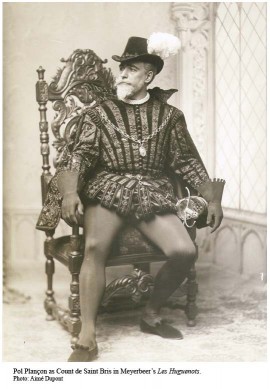
Squirrel as the Count de Saint Bris in Les Huguenots, Metropolitan Opera, 1895

The Real Winners:

1.  An overwhelming number of  votes (nine, by my count) were cast for Giacomo Meyerbeer‘s grandly grandiose Les Huguenots: this repertory staple was performed nearly every season between 1894 and 1905, and revived in 1910 before vanishing from the Met.

This must be a very satisfying moment for Leon Botstein. The Bard Festival produced this important and influential work to great acclaim last summer, but it seems obvious that the Met’s lavish production budget and casting muscle would make an even bigger spectacle. Also, Parterre denizen justanothertenor gets special mention for the brilliant, kooky idea to hire Patrice Chéreau as metteur en scène. (Squirrel will call him tonight.)

2. Gluck’s Armide: given its American premiere at the Met in 1910 with a jaw-dropping cast that included Olive Fremstad, Louise Homer, Alma Gluck, Pasquale Amato and Enrico Caruso — conducted by Arturo Toscanini! Last performed there in 1912.

3. Cherubini’s Médée (the French version seems to have the biggest lobby): never performed in any language at the Met. Given once in concert at Lincoln Center in the 1990s.

Honorable Mention: Some very popular runners-up included Guillaume Tell, Roberto Devereux, The Tsar’s Bride, Le Coq d’Or, Lucrezia Borgia, and La Vestale.  Squirrel is appalled that Der Freischütz got only two votes, and shames you all for leaving it to rot in the Met library!
50 comments

  • Sanford says:

    And last I heard, Aprile and OONY are still planning on doing Medea during the 2010/2011 season.

  • ellerveira says:

    Most interesting thing about Der Freischutz is the light that it casts on early Wagner.

    • Alto says:

      Weber lived in the Wagner (Geyer) household for a time when Richard was young.

      • ellerveira says:

        Actually in my opinion if you listen to Der Freischutz and the Flying Dutchman you could be excused for thinking they came from the same composer.

  • Lucky Pierre says:

    what, nobody voted for L’Africaine??????

    • kashania says:

      While there were a few votes for L’Africaine and Robert de Diable, I think the Meyerbeer vote was consolidated with Huegenots.

  • Camille says:

    I voted or proposed l’Africaine all the while knowing it would not make it, nor did I care, it was to fan the flame of the HugeNuts!

    Besides, l’Africaine is available to one and all via the very good San Francisco Opera production with Verrett/Domingo/Swenson.

    Poor Robert le Diable, though–maybe ABT or NYCB would do a dancing dead nuns ballet some day??

  • Noel Dahling says:

    Joyce DiDonato is Adalgisa in Salburg this summer. Co-starring with Gruberova and Giordani ( I’ll leave it to you to guess who plays what). She will be different from the great Adalgisas of recent memory who were dramatic mezzos: Stignani,Simionato,Cossotto,Zajick. But I imagine she will be more in line with the original Adalgisa.

  • Krunoslav says:

    “Joyce DiDonato is Adalgisa in Salburg this summer. Co-starring with Gruberova and Giordani ( I’ll leave it to you to guess who plays what). She will be different from the great Adalgisas of recent memory who were dramatic mezzos: Stignani,Simionato,Cossotto,Zajick. But I imagine she will be more in line with the original Adalgisa.”

    *Con rispetto*, I would not call Zajick, great in many things, remotely a great Adalgisa. DiDonato should be wonderful, more like the greatest Adalgisa I’ve ever heard ( better even than Verrett), Susanne Mentzer, who did it in Paris opposite Vaness and was absolutely heartbreaking, plus fresh and lyrical in timbre as opposed to the Obraztsova/ Zajick steamroller model.

    DiDonato has such wonderful Italian diction and phrasing and is such a good actress that her performance will surely not flatter Gruberova’s efforts.

  • MontyNostry says:

    DiDonato should, indeed, be ideal as Adalgisa, who, as a sweet young thing, shouldn’t sound like a barnstorming Eboli or Amneris. She is, however, matched with a lyrical Norma in Gruberova. How does the balance work in the theatre when a lyrical Adalgisa is matched with a dramatic-weight Norma (eg Cuberli with La Bumberina)? Who was Norma to von Stade’s Met Adalgisa? And, of course, things were round the other way with Sills and Verrett. (They would probably have done well to swop roles, actually …)

    I have only seen Norma live once, and that was in 1978 with Caballe and Bumbry, so it was big guns all the way. Pollione (Pedro Lavirgen on that occasion) didn’t really stand a chance … Vicar John of Wakefield will be delighted to hear that Elizabeth Bainbridge was a Clotilde for the ages, probably effacing memories of Commonwealth artist Joan Sutherland’s epoch-making appearance in this key role.

    • Sanford says:

      Rita Hunter was the Norma for von Stade in 3 performances in 1975. What I find fascinating is the amount of Floras and Flower Maidens she sang before hitting it big. She also sang Preziosilla once.

    • ellerveira says:

      Isn’t Gruberova a bit old to do a great Norma? Last I heard of her she was a bit “scratchy”.

    • Camille says:

      Mr. MontyN.

      That last bit was worthy of, even perhaps surpassed, the Vicar Himself!

  • MontyNostry says:

    Many thanks, Sanford. Hunter vs von Stade … No wonder Flicka never returned to the role. I can’t imagine her as Preziosilla, I must say. Not enough oomph in the voice.

  • richard says:

    Von Stade was a comprimario/cover singer Bing’s last three seasons. Except for Cherubino, the role she sang most often at the Met was Flora in Traviata, which I saw her do many times. I remember seeing her as Wowkle in Fanciulla too, as well as an unborn child in Frau and a genie in Magic Flute . she covered some larger roles, a number of them that would never suit her such as the Preziosilla , Maddalena, Bersi and Suzuki and got an occasional performance. She also covered things like Hansel, and Stephano and showed her stuff in the occasional performance she got.

    She seemed headed for bigger things from the beginning and me and my friends cheered her on when she got a Hansel, cherubino, Siebel or Nicklause. We were her earliest fan club and she always put us on her guest list to come backstage at the Met after the performance.

    After her three year journeyman stint she went to Europe and made a bigger splash. When she returned to the Met a few years later, she sang only leading parts
    in MOSTLY carefully selected repertory.

    The Norma didn’t work out well (but there were more than three I think). Hunter was out of sorts and sang
    less well than she supposedly did in San Fran. Corelli created drama by a will-he-won’t-he sing Pollione thing. And Von Stade sort of faded into the wall. She
    was wispy next to Hunter and she didn’t boom like some other Adalgisa’s had done in the preceding few years.
    Von Stade decided Adalgisa wasn’t for her. (It really could have been with the right partners) and never did it again.

    Von Stade’s other Met experiment was as Octavian. She was concerned about sounding sort of lightish in the role and never sang the full role in the house. She experimented on the Met tour, I saw her in Boston with Soderstrom (see Soderstrom thread!) with Battle. I absolutely loved all three ladies. But Von Stade was very sensitive to criticism and didn’t want to seem underpowered in a role sung by more robust voices.

    I don’t remember which role it was but I recall hearing
    that von Stade heard something like “she looks too old for that role” recently and quickly dropped the part.
    I guess she has remained very sensitive to criticism, and careful of what she does.

    Well why not. she had a long, successfull career which is still in it’s final stages. She’s come a loooong way
    since she sang the humming chorus in Butterfly as a solo role very very early in her career.

    • Graciella Scusi says:

      I believe that among the meager offers the Met had suggested for her before she declined and went to Europe….those two words guaranteed to strike fear in the heart of any ambitious lyric mezzo…Meg Page
      (even if the Alicia was Tebaldi).

    • messa di voce says:

      Richard: Thanks for the informative post. Von Stade never sang the Composer at the Met; did she sing it anywhere else?

    • Camille says:

      Hello, von Stade lovers.
      I should like to append that she sang a “Malibran??” version of La Sonnambula at San Francisco Opera, about twenty-five years ago, half of which I saw as I was unfortunately obliged to leave suddenly before Act II.

      At the time I felt as if Amina was a mistake for her, however, and in light of all that has floated down the river since, I wish I had been able to stay to see the finale wherein she may have really pulled a rabbit out of her chapeau. Also, I plead guilty to coming to the opera with the bells of Sutherland and the acrid accuracy of Callas in my ears.

      It’s a shame I wasn’t able to truly “listen” to what she had to offer.

  • MontyNostry says:

    Von Stade was in many ways a very appealing singer (and I’m sure a lovely person), but wasn’t she just a little monochromatic?

    • richard says:

      Perhaps, but to me she was just such an appealing performer. and she was interesting in so many ways.

      She had so much wit and charm (even as Flora!!!!)