
By acclamation
The results of the Repertory Poll are in! Squirrel asked which three Old Operas you would most like to see staged at the New New Met, and the people have spoken! Results after the jump.
First, good news. Though it wasn’t a top winner, a number of you asked for Maria Stuarda by Gaetano Donizetti. Well, your wish is coming true! Squirrel spoke last night via CNN Hologram™ with Met Boss Peter Gelb, and has arranged for this bel canto masterpiece to be staged in the 2012-2013 season, starring Joyce di Donato in a production by David McVicar! (All who voted for Maria Stuarda can thank me with a glass of scotch at the Parterre Box cantina.)
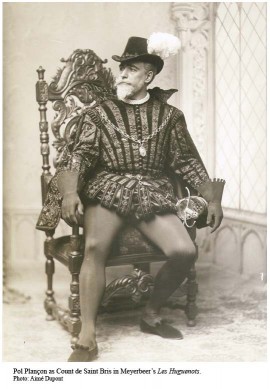
Squirrel as the Count de Saint Bris in Les Huguenots, Metropolitan Opera, 1895
The Real Winners:
1. An overwhelming number of votes (nine, by my count) were cast for Giacomo Meyerbeer‘s grandly grandiose Les Huguenots: this repertory staple was performed nearly every season between 1894 and 1905, and revived in 1910 before vanishing from the Met.
This must be a very satisfying moment for Leon Botstein. The Bard Festival produced this important and influential work to great acclaim last summer, but it seems obvious that the Met’s lavish production budget and casting muscle would make an even bigger spectacle. Also, Parterre denizen justanothertenor gets special mention for the brilliant, kooky idea to hire Patrice Chéreau as metteur en scène. (Squirrel will call him tonight.)
2. Gluck’s Armide: given its American premiere at the Met in 1910 with a jaw-dropping cast that included Olive Fremstad, Louise Homer, Alma Gluck, Pasquale Amato and Enrico Caruso — conducted by Arturo Toscanini! Last performed there in 1912.
3. Cherubini’s Médée (the French version seems to have the biggest lobby): never performed in any language at the Met. Given once in concert at Lincoln Center in the 1990s.
Honorable Mention: Some very popular runners-up included Guillaume Tell, Roberto Devereux, The Tsar’s Bride, Le Coq d’Or, Lucrezia Borgia, and La Vestale. Squirrel is appalled that Der Freischütz got only two votes, and shames you all for leaving it to rot in the Met library!
Squirrel is, in a way, right about Der Freischutz. Once upon a time, many years ago, when I was in College a local (Hartford) radio station’s classical music program had a write-in contest for the opera you wanted most to see revived. I suggested Der Freischutz, and won! Wow! I got a book and some LPs. Much later I got to hear DF live and on stage at the NYCOpera — and went to sleep. The enchanting scene of Agathe, the great aria of Max, the antics of Annechen all went for naught. I am to this day not certain why. I think it belongs in a small house — 1600 or so; it needs fresh lyric singers of charm and an Agathe with a voice that can also sing Vestale. I heard Steber sing the big scene in 1948 with the St. Louis Symhony and was much taken by it; I had Joan Hammond’s recording of Leise, leise in English, with words that were a real tongue twister — and “quaint.” But she could sing it. I had Maud Cunitz doing a great job in German of course, which it must be. But I don’t think our artistic times are right for DF; we need a quieter more innocent age with some very beautiful fresh singers. When the NY music establishment gets its act together and builds a Mozart-Bellini House (as I call it), then would be a time for DF — maybe a generation hence? Twenty-five years from now?
Delighted to see one of my choices, Médée, in the top three. I think I would feel as squirrel does about Freischutz but for the fact that I’ve seen it staged twice and sung in concert once and somehow or other a lot of really great music doesn’t come together as a satisfying opera.
The big disappointment for me has always been the Wolf’s Glenn scene. I don’t see much sense in doing the opera if this scene isn’t faced squarely head-on, which is very difficult to pull off; it was probably the fault of the two directors rather than Weber, but neither production I saw fielded a great or, in one instance, even an adequate Wolf’s Glenn. Even if they had, Weber doesn’t bring it to a satisfying conclusion–all that fearsome activity and vivid music just falls apart and peters out into nothing–a huge anti-climax. This is one opera I feel is better experienced in the theater of the mind–and believe me, I would ordinarily be the last person to suggest such a thing. The MET’s beautifully cast, most recent production of Freischutz had a very short life span.
You wonder what it is with these hotshot opera directors that they can get a reputation from throwing all sorts of random stuff onto a stage (period or modern) yet they can’t carry off a simple special effect or a few visions let alone a Wolf’s Glen scene…
I was happy to see two of my three choices–rather expected Huguenots, but was surprised by how well Armide did. I might have thought of a Met Freischuetz ten years ago, when Voigt & Heppner were still in good voice, but now…who would you get for Max? (Actually, I think Griffey would make a good Max with a sympathetic conductor, but not at the Met.)
Jonas Kaufman with Soile Isokoski.
I have to express similarly (regretfully) ambivalent thoughts about the viability (as opposed to the quality) of Der Freischütz. Weber was, for me, one of the great missed connections among opera composers: truly great invention (melodically, rhythmically, harmonically, orchestrally) which was brilliantly attuned to drama… and he never got hold of a really professionally put-together libretto. It must have been a tough time for librettists in Germany. Oberon and Euryanthe are commonly conceded on this point (the former, of course, falling victim to an inept English libretto), but I think DF suffers too.
Great story idea! Wonderfully evocative to think about, or to imagine while hearing a recording. But (I say with regret, having seen it in the theater more than once) the scenes just don’t go to the right places, the music is poorly “spotted” in the action and generally seems to be about the wrong things or off the point. (Max telling us what a selfish blowhard he is rather than making us understand his desires; the women introducing themselves to us by going on and on about the picture that fell off the wall.) People will never stop trying to stage it, nor should they, but I’m afraid it may be a lost cause.
Der Freischütz is ideal Regie material, provided it is handled by someone who just doesn’t want to take the piss out of the piece. I saw a DVD of the 1960s Liebermann production from Hamburg which, though more than a little cheesy, changed my view of the piece, at least as far as the music is concerned. Arlene Saunders in particular was fantastic, while the largely forgotten Ernst Kozub (the original choice of Siegfried for the Solti Ring, I believe) had a superb voice, if zilch presence.
I can see how Freischutz could be catnip to Regie Meisters, though Robert Wilson’s recent potted plant version in Baden-Baden, a bit of which was featured on a recent thread here, could stand as a cautionary tale. I don’t think Weber’s music, beautiful as it is, so much dramatizes the story as illustrates it. The forward momentum of action and character is missing. I would agree that listening to a great recording, where your imagination can fill in the blanks, is the way to go, though I wouldn’t dismiss the possibility that the right conductor, director, designer and cast could bring it to life again. I remember at the opening of the last Met production, in the first act shooting contest when Kilian takes his winning shot, a dead duck fell straight down from above with a hollow thud on Rudolph Heinrich’s raked rolling hill to scattered laughs in the audience. It was somehow symbolic of the unfortunate production which Heinrich had, perhaps unwisely, directed as well as designed
I saw it at the Komische Oper in Berlin, and for the life of me I still can’t figure out what all the balding middle-aged men in wedding dresses were meant to represent.
I attended one of the Bard performances of Les Huguenots this summer and although I was glad that I did I had no great desire to hear it again anytime soon. It has its moments–as do most of the other Meyerbeer I have heard–but they are too few and far between to be worth the cost and effort to mount such a demanding work.
Gluck’s Armide will be given in semi-staged concert performances in Washington, DC and NYC on February 1 and 3 respectively by Opera Lafayette conducted by Ryan Brown–the NYC performance is at the Rose Theater. Armide will be Dominique Labelle and Renaud, William Burden. Tickets (available from the Opera Lafayette website) cost only $15 for all seats to either performance. Opera Lafayette recently performed and recorded (it’s available on Naxos) Lully’s Armide. For those interested in the Lully, BAM will be showing a video of the recent Robert Carsen production from Paris during its big spring Les Arts Florissants opera festival.
Dominique Labelle has another string (or fibre — sorry fiber) to her bow …
http://www.dominiquelabelle.com/fiber_files/MyWork.htm
WHOAH
I especially like Dad’s cardigan. Can I get that in Austrian-style boiled wool? Hunter green, please!
1. THE BOATSWAIN’S MATE
2. THE CATILINE CONSPIRACY
3. SIR JOHN IN LOVE
gleichzeitig dargestellt:
“Sir John in Love with the Boatswain’s Mate”
“Dyke, ya know!” (Don’tcha hate those unrequited love relationships?)
Wakefield, why not ‘The Wreckers’ by
dame Ethel Smyth? That would allow
our local expert to come on and say,
“Dyke, you know!”
To the Vicar : I agree that Sir John In Love is a lovely opera!
Totally off-subject, but just read that Elisabeth Soderstrom died. Sad news.
http://www.nytimes.com/aponline/2009/11/20/world/AP-EU-Sweden-Obit-Soderstrom.html
Isn’t Armide (Armida) scheduled to return to the MET in the 2010/11 season??
thats Rossini’s Armida thats gonna be playin’.
Thanks – I just heard along the Grapewine “Armida” and made the wrong assumption.
My first experience with “Armide” came when I purchased a recording of Caballe’s “Rossini Armida” from some pirate label and when I played it it was that Gluck trash. It seems that it is a common mistake to mix up the two.
Gluck trash, eh Javier? Sure about that?
I don’t believe Caballe sang either Rossini’s Armide (although she did record the big aria)
or Gluck’s Armide.
However she did sing Dvorak’s Armida.
The words “Gluck” and “trash” do not belong in the same paragraph, let alone sentence. WTF?