
Headshot of La Cieca

Cher Public

  • grimoaldo: Has anybody posted the classical Grammy winners?Engineer...
  • almavivante: When I read an inspired extravaganza like DharmaBay's, I rea...
  • OpinionatedNeophyte: Is this the same Laquita Mitchell? Is she ready for prime ti...
  • Betsy_Ann_Bobolink: An interesting sidebar is that to be historically "accurate"...
  • grimoaldo: Yeah, I missed both of those too. Very good, very funny, con...
  • CruzSF: Congrats to DharmaBay and iltenoredigrazia. I don't know HOW...
  • OpinionatedNeophyte: *sigh* The far more interesting "racial edge" to the story i...
  • grimoaldo: There was an amazing production of Showboat by Ian Judge don...
  • OpinionatedNeophyte: Oh yes Monty, didn't you know? Its in the Opera-L bylaws tha...
  • grimoaldo: Searing finale of Luisa Miller with Taro Ichihara Eduard Tum...

blog advertising is good for you

Gentleman prefers brunettes

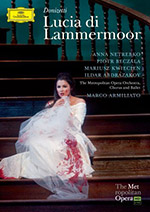
Anna Netrebko Lucia di Lammermoor DVD coverIt’s no easy easy task to “re-review” one of the most discussed and scrutinized opera productions of the last few years. Mary Zimmerman’s mise-en-scène of Donizetti’s Lucia di Lammermoor has been extensively examined since it was chosen to inaugurate the 2007/08 season of the Metropolitan Opera, provoking very mixed reactions both from the professional critics and the audience.  Some saw it as a compelling and original production, while others viewed it as an abysmal failure.

So much has been written about this Lucia, especially in light of the fact that in these past two years it has starred a group of extremely high-profile sopranos. In addition to Natalie Dessay, the “original” Lucia, two other superstars, Diana Damrau and Anna Netrebko, have appeared in it, prompting the press to attend the production again. A fourth, Annick Massis, albeit a highly respected artist, apparently lacked the diva status to drag the reviewers back to the opera house en masse.

But the Met’s Lucia requires a second look if only because it has just been released on DVD by Deutsche Grammophon with Netrebko in the title role.

Let us begin with the production itself.  Sir Walter Scott’s The Bride of Lammermoor, which provided the inspiration for Salvatore Cammarano’s libretto, sets the action in Scotland during the reign of Queen Anne (early 18th century);

Ms. Zimmerman has transposed the action to the Victorian age. Some have suggested that her reason for this update was to highlight the incipient collapse of the British empire through the depiction of the shattering of a woman’s mind, her family and a whole social system. Others have theorzied that the producer’s main intention was to recreate a true Gothic story, and that particular historical period, with its penchant for ghosts, was the ideal background. Yet others  implied that the revision was simply a gimmick to introduce into the story novel elements like the photographer or the hypodermic needle used to sedate Lucia.

Personally, I enjoyed the production and didn’t find many faults.

It is true that the change in epoch makes the story historically problematic (why would Edgardo have to flee to France?), but again, this doesn’t seem to be an element of concern for modern directors: consider the plethora of Toscas taking place in Fascist Italy, where the characters are still distressed about Napoleon’s victory at Marengo or the fall of the Roman republic.

I was not bothered by the presence of the photographer who, during the glorious sextet, frets about the stage gathering Lucia’s family members to take their picture and flashing his camera immediately after the last note of the music. It is probably true that this device was introduced because of the producer’s basic lack of trust and faith in what she must consider the epitome of artificiality, the concertato, where the action stops for several minutes. Yet, I didn’t find it obtrusive.

The appearance of ghosts has also been widely excoriated, but I found them to be an integral part of Ms. Zimmerman’s conception of the opera as a Gothic story. As the director herself comments in the DVD special features, “the ghosts are absolutely real in the Scott novel. He describes them and the readers see them. Even when the other characters aren’t there, they are described. … For me the ghosts are sort of a spirit of revenge that haunts the ground at Ravenswood and reaches through Lucia to get Edgardo”.

The tangible quality of the ghost in the Act One fountain scene is of vital importance for Ms. Zimmerman’s view that Lucia is sane at the beginning of the opera, her descent into insanity being a gradual process. Personally I am inclined to think that Donizetti’s music is suggestive of Lucia’s precarious state of mind from the start, but I am open to Ms. Zimmerman’s theory, because it is coherently developed.

There were a few ideas that didn’t quite work, the worst being the cutting of the murder to about half a minute by showing Lucia and her “sposino” going upstairs at the beginning of the third act.

The look of the production is fantastic (and I use this terms in both its meanings: exquisite and fairy-like) and it is clear that special attention was devoted to the singers’ acting. And yet, as is often the case when a controversial production is later revived, some of the most daring details have been excluded or toned down.

In the initial run, during the Larghetto “Ardon gl’incensi,” Natalie Dessay’s Lucia slowly removed her gloves and on the words “ogni piacer più grato” while lying on her back, she caressed her body in a provocative manner, imagining her wedding night with Edgardo. In this revival Ms. Netrebko does nothing of the sort. Whether this omission was due to the director’s second thoughts, or to the new diva’s insistence, we will never know.

Netrebko, the raison d’être of the DVD, was scheduled to appear in this Lucia earlier in the season, but had to cancel because of the birth of her first child. Here, despite some lingering signs of puffiness, the Russian soprano looks beautiful and glamorous. Her timbre is dark (my personal description is “melted chocolate”), rich and supple, agreeable and captivating. It is in a few words what is commonly called “a beautiful voice.”  She knows how to sing “sul fiato”, floating the sound, and is able to modulate the tone. Her voice is evenly produced through virtually the entire  extension, with no conspicuous gear shifts between registers.

“Regnava nel silenzio” was admirable for its expressiveness and use of legatos and pianos. Trills and mordents, on the other hands, seem not to be her forte, as she disregarded all of them. The rendition of the cabaletta, performed without the traditional higher variations, was nonetheless stirring.

Ms. Netrebko has a strong command of the demands of most of the role. The first act duet with the tenor, the second act duet with the baritone and the wedding scene are outstanding; it is clearly music where she can leave her mark. However, her singing is by no means flawless, as we hear when she faces the crucial test for any Lucia: the Mad Scene. Nothing she did was vocally embarrassing, yet there is no denying that her passagework was often less than tidy (let’s say even a bit sloppy) and her extreme high notes sounded fatigued. The famous flute cadenza (which, as everyone knows, Donizetti did not write) was undoubtedly the least impressive moment of Ms. Netrebko’s performance. She ducked the first E flat, and the final one turned out shrill and short.

Once more, no trills were to be heard, and in the cadenza this was particularly conspicuous because the flute trills and she did not. Ms. Netrebko could of course sing an entirely different cadenza, more suitable to her current vocal gifts, but audiences are used to the traditional one and often react with indifference (to say the least) when it is not performed. It is regrettable that a cadenza Donizetti never wrote has come to be considered the centerpiece of the opera, and a litmus test for any soprano who wishes to sing this work.

As a matter of fact, Donizetti’s original version of this opera, with its slightly higher keys, would be much more congenial to Ms. Netrebko’s voice. These are the composer’s keys and the ones traditionally used in performance, respectively: “Regnava nel silenzio” ( E flat/D); “Quando rapita in estasi” (A flat/G); “Il pallor funesto, orrendo” (A/G); Mad Scene (F/E flat).  Obviously, of course, when performing the Mad Scene in the original key, very few sopranos can end with the cadential high note of F.

As I said, I personally chose to close one eye over her imperfections as a virtuosa, not least because Ms. Netrebko is a consummate actress. She instinctively finds the pertinent movement, the appropriate glance for every moment of the opera.  Many are the details that caught my attention, such as the sarcastic shoulder shrug she gives her brother in the second act duet when he tells her “tuo fratello sono ancor”.

She draws you into Lucia’s drama and makes you believe in it. She is, in other words, a charismatic artist. Dumas père, speaking of Fanny Tacchinardi Persiani (the creator of the role of Lucia) and her apparent lack of intensity on stage, quipped: “She is a brunette who sings like a blonde.”  Anna Netrebko, though, is a brunette who sings like a brunette!

Judging by this performance (as well as by other recent appearances in bel canto roles), it seems Ms. Netrebko’s career would be better served by steering towards a more lyric, less virtuoso repertoire — especially roles where the high E flat is not considered essential.

This run of Lucia di Lammermoor performances and the taping of the DVD were supposed to reunite Netrebko with Rolando Villazon, but the “dream team” turned into a nightmare when the tenor’s voice spectacularly failed him in the first performance, cracking on the climax of the second act confrontation scene.

Piotr Beczala came to the rescue. The Polish tenor has an exquisite, full-bodied Italianate voice, with hints of that “sob” (“lacrima nella voce” is a better description of this quality) which makes a singer particularly endearing if used intelligently. It took him some time to warm up, and he yielded his best work in the final scene. Early in the opera some of his Bs flat showed a touch of metallic sound and impurity, but the B natural in the cadenza of “Fra poco a me ricovero” was splendid. “Tu che a Dio spiegasti l’ali” was moving and affecting. He actually managed to sound moribund without resorting to stifled yells.

His roughest moment, relatively speaking, was the Wolf’s Craig scene, where his top sounded at times perilously taxed by the high tessitura in such an intense, dramatic context.

Baritone Marius Kwiecen’s Enrico was less of a villain than he is generally portrayed, and rightly so: after all, this character is not an evil person; he is just a desperate man who is well aware that his (and his family’s) fortune and even his life depend on Lucia’s marriage. Mr. Kwiecen’s has a mid-sized, velvety voice; he is most of all capable of depicting Enrico’s rage without huffing and puffing and artificially enlarging the sound.

Russian bass Ildar Abdrazakov was almost wasted in the role of Raimondo, but grabbed every opportunity to show off his first-class talent. He can certainly be forgiven for holding the last note at the end of “Dalle stanze, ove Lucia” for what seemed an eternity , even though Donizetti requires the bass to stop with the chorus.

Marco Armiliato is a brilliant conductor. The sound he elicits from the orchestra is incisive, crisp, neat and attentive to each detail; he wraps the opera with an appropriate mysterious Romantic aura. Unfortunately he and the Metropolitan Opera don’t seem so respectful of the score from a philological point of view. Some of the daccapos are eliminated, and when they are present, they lack interesting variations. Most of the traditional internal cuts are still executed, including the whole second part of the act two finale “Esci, fuggi.” I firmly believe that nowadays, after decades of bel canto renaissance, a major opera house should perform the opera in its entirety and with variations in the daccapos, more so if the performance is to be recorded and commercially released.

One element that I particularly cherished was the use of the glass harmonica during the Mad Scene; as it is well known, Donizetti’s original intention was to employ this exotic instrument, which gives the scene an eerie, supernatural atmosphere.

Having heard this cast live in the opera house, I can attest to the high quality of the sound of this recording, which gives a very accurate idea of the actual size of the singers’ voices. I was also impressed at how sharply the various sections of the orchestra can be heard.

The DVD is exquisitely directed by Gary Halvorson. He is a Julliard trained pianist and, as with his other recent Met high-definition theater simulcasts, he knows quite well whom and what to capture. There are very few incongruities between the music and what is shown on film. The alternation between close-ups, mid shots and master shots is well balanced.

On the other hand, I am not fond of his occasional choice of filming the singers as they leave the stage while the music is still playing. This, together with his showing them in the wings (documentary style) at the end of the first act, disrupts the atmosphere. I believe this type of behind the scene action is best reserved for the DVD’s extras section, which features Natalie Dessay briefly interviewing cast and crew.
94 comments

  • Dan says:

    I agree with your sentiments completely. I have to admit that when I went to the HD, I was on the edge of my seat hoping she wouldn’t screw up too bad, which she did not.

    What has always drawn me to Netrebko, and compensated in my judgment for her increasingly labored and sloppy production of the virtuosic phrases, is the voice itself: rich, dark caramel. She can also float the most devastating pianissimi and can churn out some truly haunting legato.

    Her dramatic instincts are also top notch. We had Dessay and Damrau (both thrilling performers) gallivanting all over the stage. Sometimes I thought Lucia di Lammermoor was about to go all Lizzie Borden. But Netrebko was so subtle, gentle. It was a madness all the more threatening because it was kept bottled inside, always ready to burst out.

    I remember January 2008 when I saw Traviata at Covent Garden. I saw a performance in which Ermonela Jaho filled in for Netrebko. Two differences stuck in my mind.

    1. In “Addio del passato,” Jaho moved from one iece of furniture to another, grasping it and trying to wring life from it, falling all over each piece. Netrebko, on the other hand, plopped herself down in a chair for pretty much the whole thing, and just SANG. You could not take your eyes off of her. It was riveting.

    2. During the final scene, in which Richard Eyre’s production gives us the famous “Victory Lap,” as I believe they call it, Jaho (like Gheorghiu in the original production) trudged around the stage, leaning forward with her arms extended, before falling forward. Netrebko, again, just stood there, sang, and collapsed.

    The effects, the stillness, were devastating.

    So for all of her faults in her singing, I agree that she makes some boldly subtle–and effective-dramatic choices and risks. It reminds me of something Anthony Minghella said to the singers in rehearsal for Butterfly. They were trying so hard to resist “park and bark” that they wandered around the stage aimlessly. He asked them why, and said that if they didn’t NEED to move, then don’t. It’s something that Netrebko understands well.

    For those who saw her in the house for Lucia (during the performances when she didn’t sing the climactic notes half a step flat), did the subtle dramatic choices work as well on stage as they did on the HD?

    Great, in-depth, and well thought-out review, Ercole.

    • Valmont says:

      ‘`Dan says:
      November 18, 2009 at 11:01 PM
      I agree with your sentiments completely. I have to admit that when I went to the HD, I was on the edge of my seat hoping she wouldn’t screw up too bad, which she did not.’

      I’ve always felt that much of opera should ellicit this feeling. It’s not easy, and it’s not supposed to be. There should be some sort of ‘will it be great or will it fail’ question in our hearts as we see something this virtuosic.

      I once read a great description of Pavarotti vs. Florez singing Ah mes amis.. “With Pavarotti, each high C was exciting because you didn’t really know if he was going to hit it. And when he did, and it was beautiful, it’s so exciting. With Florez the high C’s are so well within his ability that they no longer become novel. You know he’s going to hit them, no problem, and it will be beautiful. What do you have to hope for after that?”

  • Thank you for a thoroughly delightful (and thorough!) review of this DVD. This particular “The Met: Live in HD” performance is one of only two I’ve deemed worthy of seeing a second time in its encore performance [Florez's "Barber" was the other], even though I’m entitled to free tickets to all Fathom productions.

    The tangential mention of Massis in this review encourages me to extol her vocal virtues to those who may not know of her. Annick’s 2005 performance in “Les Huguenots” at Liege was spectacular. She has done some superb recordings on the Opera Rara label, notably in Meyerbeer’s “Margherita d’Anjou” and Donizetti’s “Francesca di Foix.”

  • As much as I appreciate the details and thje care that went into the review, I find myself baffled at how Netrebko’s participation was handled.

    Nothing she did was vocally embarrassing, yet there is no denying that her passagework was often less than tidy (let’s say even a bit sloppy)

    I can not marry both concepte here. She did not embarras herself, but her singing was sloppy at times? Isn’t that quite embarrassing? She was able to handle the cantabile sections of the role, but the virtuosic sections were sloppy and that was not an embarrassment? Since when being good enough has been a good thing in opera, specialy at the international level that the met casts this opera?

    The famous flute cadenza (which, as everyone knows, Donizetti did not write) was undoubtedly the least impressive moment of Ms. Netrebko’s performance. She ducked the first E flat, and the final one turned out shrill and short.

    which spells to me an artist that is completely out of her element or poorly advised. When Ricciarelli sang Lucia she did not pretend she was a coloratura singing the role, she sang it as a lyric soprano and she ended the arias and duets in the lower note that Donizetti described. To some people this was a farce, to some it was revelatory, but she never sang it in anything less than HER abilities. By the way, she was also a lot more accurate in the passage work than Netrebko, and Riciarelli didn’t go around pretending to be a coloratura soprano.

    Once more, no trills were to be heard, and in the cadenza this was particularly conspicuous because the flute trills and she did not.

    So she didn’t have the trills, she didn’t have the fast notes and she decided to sing a cadenza that did not suit her and yet it was not an embarrassment. Why didn’t they telecast Boheme instead? Sounds that her voice would have been more appropriate to Mimi than to Lucia, given the fact that Mimi is all about cantinela and that was the only element of bel canto that she actually showed.

    Ms. Netrebko could of course sing an entirely different cadenza, more suitable to her current vocal gifts, but audiences are used to the traditional one and often react with indifference (to say the least) when it is not performed.

    And I have to challenge this proposition. For years every soprano has either adapted the Liebling cadenza or has had one written specifically for her. The Met has been no stranger to this: Sutherland, Peters, Moffo, Swenson, Sills, Rost and a contingency of other Lucias have all come to the met with one of these: The Liebling cadenza, a variation thereof, a completely new cadenza; and the met has accommodated every single one. Yes, the Liebling cadenza is an oldie-but-goodie because it is a model of refinement and is compact, but the met, to my knowledge does not have a specific cadenza that all Lucias must sing.

    It is regrettable that a cadenza Donizetti never wrote has come to be considered the centerpiece of the opera, and a litmus test for any soprano who wishes to sing this work.

    As I said in my last point, Netrebko was always in the liberty to have a cadenza written for her or sing the one that is in the score. Also, the audiences recognize when a cadenza truly showcases the voice to the best advantage and they respond to that, the Liebling might be a favorite because it is well known, but the audience is knowledgeable enough to know that different diva means different cadenza.

    As a matter of fact, Donizetti’s original version of this opera, with its slightly higher keys, would be much more congenial to Ms. Netrebko’s voice.

    I am not sure I agree with this 100%, but it should’ve been explored. The role as it is writtes sits in a very tricky place for many sopranos because it sits in the passagio most of the time. This means you get tired FAST because you are singing in an area of the voice that when it is not well manages, it is exposed and a magnet for disasters. I do not believe that Netrebko’s singing will allow her for surviving the role in the original keys. Her voice has a beautiful color, but the voice is not well placed, it sounds like it is muffled. When you are constantly singing in the aria of the voice that the role (as written) would require you need to have a forward placement that Netrebko does not have and a brilliance in the tone that Netrebko has lost since her first Lucias in California a while back.

    As I said, I personally chose to close one eye over her imperfections as a virtuosa, not least because Ms. Netrebko is a consummate actress.

    But the role as performed was meant to showcase specifically her virtuosa capabilites. Furthermore, the role’s central moment (Regnava and the Mad scene, even without the cadenza) are meant for a virtuosa performer, so if we are going to have to turn a blind ear because the Lucia at hand does not have the required elements, why are we watching Lucia and not Boheme?

    She instinctively finds the pertinent movement, the appropriate glance for every moment of the opera. Many are the details that caught my attention, such as the sarcastic shoulder shrug she gives her brother in the second act duet when he tells her “tuo fratello sono ancor”.

    In this we agree. Netrebko acts the role quite well, wonderful I would say. But this is not the stage (spoken) version of the book, this is the operatic version of the book and she should be able to sing it and act it just as well. The fact that she can act it well should not surprise anyone. Scotto and Moffo acted and sang the shit out of the role; so did Sills, Gianna d’Angelo, Patricia Brooks, Ricciarelli, Swenson (at least for a while), Elisabeth Frutal, Gianna Rolandi, Maureen O’Flynn, Annick Massis and the list goes on and on…

    I concur with Ercole in his views of both the staging and the production in general. As far as I am concerned, this Lucia is beautiful to look at.

    • ilpenedelmiocor says:

      I continue to be dumbfounded that Netrebko continues to get away with singing repertoire that everyone acknowledges she’s unsuited for. For me, she’s so consistently under the pitch (if not off it entirely) as to be unlistenable. I keep thinking I must be missing something, but every time I try again to listen to her, I’m clearly reminded why I usually try to avoid the experience in the first place (unless I want to gloat at her expense, because in my experience she never fails to disappoint). Can someone please convince her to sing repertoire that she can actually sing?

      As to her acting skills, everyone keeps acting as if she’s Callas. Yeah, OK, she’s not wooden, but Callas could *really* sing the shit out of anything she chose to sing, from Bruennhilde to Queen of the Night. Netrebko is hardly Callas just because she can pop off appropriate facial expressions.

      As Tim Gunn would say: student work.

      • DottoreMalatesta says:

        Callas DID NOT sing The Queen of the Night.

      • Dan says:

        I think a huge part of the problem was that she took on these things, and committed to these engagements, when her voice was lighter and more at ease in the coloratura.

        Then she did a shit ton of Travitas and Bohemes and Manons. But also–and I don’t want to impugn her professionalism, because it seems everyone does enjoy working with her–she just became sloppy. She came to Puritani embarrassingly underprepared (which, I admit, is not very professional). She probably came to Lucia unprepared, too, maybe thinking that a baby wouldn’t be TOO bad of an interruption.

        And, If I’m not mistaken, the MET made a big stink about a cadenza that WAS written for her. She juse never performed it.

        But all in all, Lindoro, good enough vocally is just that–good enough. She actually DOES fake a good trill that she doesn’t really have, and the effect is good enough. I didn’t find her passagework EMBARRASSINGLY sloppy, just sloppy enough for me to wish that she would do more with it.

        But in the adagio sections and the cavatinas, she actually did do some very good work.

        I think if she wants to sing this rep to keep her voice in good shape, keep it high and *somewhat* agile, then she should, maybe not at the MET. But she needs to perform roles for which she is suited, because I think a lot of us agree that she would be *stunning* in those, and what a waste it is for ehr not to perform them.

        • good enough vocally is just that–good enough. She actually DOES fake a good trill that she doesn’t really have, and the effect is good enough. I didn’t find her passagework EMBARRASSINGLY sloppy, just sloppy enough for me to wish that she would do more with it.

          That’s funny, Montserrat Caballe gets criticized for exactly the same problem and nobody says I wish I could hear more of the uninvolved, sloppy, fake trills, and ever so reliant of piannissimo Caballe. I just miss all that sloppiness and wish to hear more.

          Good enough is good enough, but since when have the standards been to be just good enough? Why is it that Nebby gets a pass for being good enough and a singer like Caballe does not, or for that matter, Studer?

        • Dan says:

          She doesn’t get a pass for the sloppiness. It’s just fair to acknowledge that she actually DOES sing much of it quite well. And it’s responsible to acknowledge that she brings certain dramatic qualities to the stage that are not trivial.

          Opera is, after all, also theatre.

          Believe me, I like good music, and if you could combine the musicality of Beverly Sills in Lucia with Netrebko’s beautiful colors and dramatic instincts, I would have to change my pants for a whole slew of reasons.

          But Lindoro, it just seems to me that you intensely dislike her and can’t find anything good. There are things I don’t like about a lot of musicians–I think the only exceptions are Uchida, Lady Gaga, and Jimi Hendrix–but they do all bring SOMETHING. Does EVERY performance of EVERY opera have to be spot on in order for there to be ANYTHING redeeming about the performances?

          I respect your opinions and your comments are some of the most informed here truly, but I just have to disagree here.

          And “good enough” has been the standard at the Met–and everywhere else–for a long time, not just voally. We very rarely get truly thrilling, magical performances. That’s what makes them so special.

        • and if you could combine the musicality of Beverly Sills in Lucia with Netrebko’s beautiful colors and dramatic instincts,

          I can understand the beautiful colors because they are there, that’s undeniable; but the rest?

          Gimme a break, Sills had dramatic convictions to spare; you just have to look at her Elisabetta and her Marie to understand that that woman could sing and act with conviction.

          That is the problem that I have with Netrebko, everything that she does, there is a slew of other sopranos (not necessarily from the past) who can do it just as well and less sloppy. Yet, around her people keep bringing names to compare her with that simply do not make sense.

          Sills made everyone believe that she was a petite woman when she sang Baby Doe, she made everyone believe that she was the Queen of England when she Sang Elisabetta, she made everyone believe that she was mad when she sang Lucia, why bring her name up and say, if we could bring Nebby’s dramatic instincts to any Sills performance it would be perfect. That is insulting because Sills WAS a great actress and a singer without par while she was singing (save the last 7 years, when she seemed to be playing herself)

          I don’t deny the fact that Nebby has a beautiful voice. I do not deny the fact that she is a good actress and is always committed on stage. I don’t deny the many physical attributes that she has, because they are obvious. What I do not get is why people keep clinging to her like a Titanic survivor clings to a lifesaver. Why do people keep clinging to her like she is the one and only, why do people cling to her like she is bel canto’s last life line? All the while, people keep saying well, yes, she is not good in bel canto, her coloratura is sketchy and sometimes sloppy, her trills are faked, her pitch sometimes waver, but that’s Ok because she can act. Have their fans never heard of Malfitano, Patricia Brooks, Sills, Scotto, Gheorghiu, Massis, Milkosa, Dunleavy, Damrau? They are all singing (or sang) many of the same roles that nebby does and they sang them better, and neither sacrificed their acting because they were singing.

          So, in summary, in Nebby we have a beautiful woman with top notch acting skills and a voice that proves there is a god wrapped in poor technique, sloppy coloratura (for her chosen repertoire), wavering pitch, poor attention to detail, poor attention to the text but a fantastic sense of cantinela. My question is, when is someone going to stand up and say the naked truth:the empress is NOT wearing Prada, she is wearing Walmart.

        • Dan says:

          Lindoro, Sills was tremendous. And the people you mention are much better to be sure in this repertoire than Netrebko. People like Sills had so much musical instinct that they conveyed a crapload with their voices alone.

          They are also good actresses, but not in the same way. Opera lends itself to really DRAMATIC acting that sometimes is really hammy and over the top. All I mean by thinking Netrebko is different is that she resists these tendencies. The control that she DOESN’T exercise with her voice she actually DOES exercise with her acting. It’s a trade-off I wish she didn’t make, but she does.

          I don’t think anyone is comparing Netrebko to Beverly Sills in her singing. That would be insane. It’s just that when Netrebko is on stage, the choices she makes are so often against the grain of “operatic” histrionics that it’s very touching and completely disarming, that’s all. That’s what makes her different. The others aren’t BAD actresses, but their instincts on the stage are not as poignant and surprising, if no less powerful.

          Now if she could do it more often in Iolanta and the like, it will be great. According to Met Futures, she’s scheduled to sing Tatiana in a new production in a couple years, which I think will be great.

        • CruzSF says:

          they conveyed a crapload with their voices alone

          it’s rare, and refreshing, that such a load would be used to indicate some thing desirable.

        • And that is where we disagree. I do not think the Nebby’s acting talents are that special to make her the ultimate. Sills conveys emotion and sometimes raw emotion, but she could also convey immense delicacy.

          Netrebkos dramatic instincts are good, but they are nothing so special as to put them above the rest of them, not above many singers who could do both. Since Sills’ name has been mentiones, her Elisabetta alone is enough to put all the but Nebby brought so much more into this than Sills (or anyone else) argument to the floor.

          But her Elisabetta was not the only piece of acting she ever did:

          Netrebko IS a wonderful actress, but she is not on a level all by herself despite the many excuses that may be brought forth and the many instances where the fans may want to mention her acting talents as an excuse to get her poor vocalism in the bel canto repertoire.

        • Dan says:

          I think we’re miscommunicating. I think I just like Netrebko’s acting STYLE more than Sills’. That’s a different league. Not a better one, or a more skilled one, or a more correct one, but just a different one.

          It’s not an excuse for sloppy technique at all, and I don’t think I ever said as much. I’d gladly sacrifice some of her acting for better vocal production.

        • Now, that is an argument that while i do not agree I can respect.

          Nebby is a subtle actress and that might atract people, I can understand that; but let’s get real; that kind of acting reads well in a TV monitor, but will it read in a 4K house?

          I can see why nebby is called a good actress, but to call the rest hammy in comparison is to say the least crude. they were acting for an audience, not for a TV camera.

  • javier says:

    You guys sure do write a lot, but for me, after a long day I’ll just keep this short. I didn’t have any problems with the production itself. Most traditional productions of Lucia are bland and there’s nothing interesting happening to progress the action. Zimmerman took chances to update the setting in a way that tells the story. I think it works. As for Netrebko’s singing, I have never heard in person, only in recordings. When I just listen to her voice without seeing her I usually find if very unexpressive and flat, but when I saw her in the telecast she really brought the character to life for me. So although her singing wasn’t on the same level as Sutherland or Sills, I was somehow able to get past that because after few bars into “Regnava nel silenzio” I forget that she wasn’t so focused on the fact that she was singing, but more on the story she was telling. I was transported into Lucia’s world and I didn’t care about silly trills and ornaments. That sounds really stupid as I read it back to myself. I’ll admit that I’m just a little bit stupid, but it still makes sense to me. :p

  • Constantine A. Papas says:

    This DVD, even with some slipups, is going to be a case study for all future Lucias, like Netrebko’s Violetta in the Salzburg production. The fact that the Met “by-passed” all the other Lucias, even Dessay for whom this production was staged, for the HD telecast and DVD it says something. Netrebko, even with her flaws, captivates and mesmerizes you. She doesn’t play or sing a heroine or a character, but she becomes one.

    • It says that the Met is willing to cast a person that is way over-parted with this role just as long as she looks good on the DVD.

      Says that even with Lucias around the world that can sing this mucis WAY better that Nebby does, the Met is willing to let the standards slide just she mesmerizes the audience with her acting.

      Says that these days, it is true what they say, You really don’t have to be talented to make it in the business. It is all about who you know and who well your tits look.

      • javier says:

        In fairness they also had Dessay, Damrau, and Molasses (Massis?) sing in this production. The HD broadcast and the DVD, with the original cast of Netrebko and Villazon in mind, was expected to sell well.

        You have to have talent to get your foot in the door, but after that it takes luck and likability to get tot he top. Not the best singers will make it to the top.

        In the 1980s the Met staged and telecast Lucia with Sutherland who was long past her prime because she was popular, not because she was still the best. This has gone on for many years.

        You just need to realize that when you’re running a business ticket sales and publicity are important. If you want to run an opera house without any stars and without any publicity then good luck.

        • And yet, this geriatric Lucia, with all the bad acting and the 65 year older pretending to be 15 is heads and shoulders above the new one because the singing is of a level that will make your jaw drop.

      • CruzSF says:

        But surely this is not new to the Met or to any opera house or to our time in history. As javier says, some singers have continued to get a pass because of past greatness, and that goes back as far as anyone can remember (and even before anyone can really remember, judging from some of the comments on this site). I agree with you that it’s bad policy for art, but if tickets sell, houses are going to continue the practice.

  • CruzSF says:

    Thanks for the review, Ercole. Even though my reaction to this HD broadcast was mostly the opposite of yours, I appreciate the chance to learn just what people see/hear in Netrebko. I’m afraid this was the first time I’d seen or heard her in anything, and after hearing about her for almost a year, I really looked forward to having the press justified. After seeing her in this, I wasn’t put out when she cancelled on the Traviata performance for which I had a ticket (here in SF).

    I found her coloratura runs very labored, and her subtle acting, while effective for some other commenters, struck me as cold and one note. I came out of the theater thinking that the role didn’t suit her in the slightest.

    Dan wrote: Netrebko, again, just stood there
    But I wonder ,would this indicate a “mannerism” since she is doing it in multiple roles?

    • ilpenedelmiocor says:

      Would that she would stand still in more of her mad scenes.

    • richard says:

      I think Netrebko’s stage acting, while it has a tremendous amount of charisma, which is extremely important, isn’t really all that individual.

      She does a very animated happy/sassy/sexy girl, very much in your face but it doesn’t vary from Manon to Violetta to Adina. Same sort of character.

      She does dramatic, which often includes a “numb” look to indicate intense emotion but she uses this in Lucia and Traviata and Boheme.

      she’s very free on stage and that’s a great gift, really, she draws your eye to her. but I don’t see her doing much that specific even with her stage acting.

      I’ve said before I’m a Kunst diva kind of guy, I don’t react to voices per se that way that many (most?) others do. they hear an indescribable beauty of sound in Netrebko and I hear a lovely voice that is artificially darkened by setting it in the back of her throat, giving it a swallowed quality which I find monotonous. Words, there are words? Yes, Anna. Please use them. Then I’ll listen to you.

      • Dan says:

        I don’t get the same from Netrebko in every role. There are certain roles, and even acts within operas, in which I do get similar things.

        But it depends on the role. There are certain roles which she just does well in, when you see her in the house. Violetta is one of them. Even though at times she is sloppy (mostly in Act I), the rest of the time, she is just absolutely riveting. I don’t know how else to describe it.

        Before I saw and heard her live, I had tremendous qualms about the effect she would have on me as a performer. After experiencing her live, I and everyone else in the theatre were actually moved beyond words.

        Sometimes she is tremendously sloppy, especially on live recordings. But see her live in the house, and she is tremendously compelling (if you grant yourself the freedom).

  • Vivaldi says:

    Well, since there are no good perfomances of Lucia on DVD the new one is very welcome, and actually it’s quite good.

    Netrebko has everything the role need except for a fluent coloratura, and that shows mainly at the mad-scene. She is very effective and persuasive dramatically, but in Lucia one wants a coloratura show as well. However in “Il pallor” she is glorious indeed.

    The problem, is, for me, Beczala. I know he came to the rescue in a very short notice, but fine singer as he is (wonderful Tamino in Salzburg few years ago) I couldn’t stop thinking he is more a Nemorino or Ernesto than Edgardo. He lacks the heroic and impulsive character of Edgardo, specially in the 2nd and 3rd acts. In the 1st one he is very good, but his outraged entrance to the wedding scene fail to convince me, and his contempt for Enrico in their scene afterwards is totally lacks dramatic impact from his part, more so when you get such a superb Enrico like Kwiecen. In his closing scene he is fine and the legato in “Fra poco” is very impressive. It’s a pity he shortens the final notes of the aria and the recit.

    As for the production I generally liked it very much, and the sage design is compelling but the wedding scene is directed too much as a comedy for my taste. Whene Arturo and Enrico talk quietly about Lucia’s affair with Edgardo all the guests (btw very unpleasant and raw sound from the chorus, with lots of wobble)turn their ear as to catch up the juicy details as if it was Don Pasquale, and the photographer directing the family picture is quite silly.

    Marco Armiliato’s conducting is very good, tight and dramatic, tempi are “righ” and let the music breath. One thing though, the use of cymbals at the 3rd Act opening was a bit overdone.

    • I beg to Defer:

      The DVD with Devia from La Scala is well sung and quite well acted. She is not the Lucia that runs all over the stage and throws herself against the scenery, but she gets the job done and arrives to the end in much better shape than Msmerizing Nebby.

      Bel Canto has released the performance with Ricciarelli and she is quite credible as Lucia. Her singing is good and her acting is just as good.

      The movie with Moffo is amazingly sung and fantastically acted. Moffo alone proves that there are many Lucias who sang and acted well in this repertory. Nebby is not the first one to act well.

      The Tokyo performance with Scotto is fantastically sung and rather well acted. Her Lucia is an acquired taste, but one that (like sushi) everyone should taste at least once.

      So let’s not get carried away here. If you like nebby, byt al means buy the performance. But don’t go around saying this is the only performance where there’s acting, because it isn’t.

    • Valmont says:

      I beg to differ on Beczala. I saw his Lensky, and he was very impulsive and heroic at times. He was absolutely my favorite of the night, Hampson was ok, Mattila good, but Beczala’s Kuda Kuda was out of this world. I will blame the lack of chemistry on the lack of rehearsal time, but this role is well withing Beczala’s dramatic and vocal range.

  • Sanford says:

    One glance through Amazon and the list of available Lucias on DVD boggles, not the least of which is Anna Moffo’s glorious film.

    While that was a beautifully written review, and I agree completely about the production, I couldn’t watch it on TV, because of the singing. I’m with Lindoro on this. There are too many other fine lyric-coloraturas on the Met roster. Not just Dessay and Damrau, but Erika Miklosa (not a “name” but that’s what your PR dept is for).

    I would like to add that if we’re going to perform the opera complete as was suggested earlier, that should include Donizetti’s glass harmonica. One of the most affecting things about Sill’s recording was the sound of that instrument. I think it does a much better job of conveying Lucia’s madness than the flute.

    • I agree with Samford. If the met was looking for a Lucia that looked the part, acted well and could sing it they had the perfect one in Miklosa. I am not a fan, but she would have been tons better than what they served up.

      I saw Massis in this production and her Lucia was all frailty, beautifully acted and sung with style that would make many Lucias half her age take notice.

    • Dan says:

      I wish I had had the opportunity to see Massis. I’ve listened to some clips on YouTube, and she is wonderful.

      • That woman’s Lucia was a mile above both Nebby and Dessay. Perfection in every sense.

        • dorion says:

          I saw Massis’ two performances and I agree 100%.

        • Dan says:

          I’m glad to hear this. Massis strikes me as one of those performers who really effing cares about the work, and just does it and does it incredibly well. I hope the MET engages her more productively in the coming years.

          She is truly astonishing.

  • dorion says:

    Why would someone buy this trash when they can buy the recently digitally remastered Sutherland dvd of Lucia on the same label?

    Not only is Sutherland the most spectacular Lucia on record but also each and every single member of the cast is vastly superior to this HD abomination. Furthermore, the old production is intelligent and classy, it has no idiotic distractions or cheap theater tricks such as the photographer, the doctor, the ghost etc.

    Zimmerman is a poor director, she never understood Donizetti or the story he was telling us with his masterful score. She used the music as mere background for her tricks. The sextet was ruined by the silly photographer and the actor playing him isn’t even an actor.

    Netrebko’s singing of the role is a sham for many reasons. The score is usually transposed down so the high notes can be added at the end of the numbers. If you don’t have the high notes there’s no point in singing the transposed version. Netrebko can’t sing the original version either, it’s too high for her limited range. There isn’t a possible scenario for Lucia di Lammermoor and Anna Netrebko. Plus she looks fat and the acting isn’t as vibrant as the Puritani of two years prior. In all fairness she’s a much better actress than the embarrassing Dessay and Damrau.

    I have it on tape and the only possible reason to watch it again would be Beczala and Kwiecen. But I’d just as soon put on the Sutherland dvd and hear Kraus and Elvira instead.

    • Dan says:

      You can certainly make the argument that Mary Zimmerman didn’t understand Lucia or Donizetti. I can see that. But to say she isn’t a good director…um…maybe not for this stuff, but she’s a brilliant director. I just wish she had done a little more homework here.

      And I hope I don’t get flamed for this, but I’m going to go on record and admit that I CANNOT STAND Joan Sutherland. I find her virtuosic singing completely amazing, incredible, but I’m just not moved by her, mostly because she always looks like she’s smiling. And the 80s Lucias she did at the MET weren’t her best, but they were good. Have you seen her farewell performance in Sydney? Ghastly.

      • CruzSF says:

        As most readers here probably know, I can’t stand Sutherland either, with her mushy diction and two-note acting. I just wanted to remind Dan that he’s not alone on this. I do think she’s great with chirping, though. When the score calls for notes without words, she’s in a league of her own.

        • Dan says:

          That is so good to know. There’s an interview on YouTube in which she and Dicky Bonynge address the “mushy diction” issue, and make the excuse that when you’re singing notes that high, you can’t pronounce things.

          Then I listened to Callas’ master classes at Juilliard, when she was coaching a young singer on “Come scoglio.” The young one said something to the effect of but it’s so hard to enunciate the consonants.

          Callas just said, “No one said it was. Who said singing was easy?”

          And I do agree that in tricky passages without words, or when she can go off on some insane melisma on a vowel, she is without equal. I just wish she wouldn’t smile so damn much.

      • dorion says:

        Fair, some people hate caviar, they’d rather have a cheeseburger. I think that Callas for instance has an utterly ugly voice, Scotto’s a minor-leaguer, Domingo a baritone, etc., to each his own. Sutherland’s Lucias in the 80s were a miracle for someone approaching 60, sopranos half her age only dream of singing that well. In her prime she was unbeatable.

      • dorion says:

        PS: you admit that Zimmerman didn’t do her homework directing Lucia di Lammermoor, a major staple of the repertory, and you call her “brilliant”? She’s anything but. I’ve worked closely with the woman, she’s an insecure hack who changes her mind every 5 minutes.

  • BelCantoDiva says:

    I saw this in the house with Dessay and in HD at the movies. I also DVR’d it. In video, a lot has to do with the video director. We see things the way he wants us to see them. Here I think way too much emphasis was placed on the photographer. I remember when I saw it live, the photographer didn’t seem as prominent, or maybe I should say, less of a distraction. He was off in a corner at the end. So it didn’t bother me as much.

    This is arguably my favorite opera. But I’ve only seen 3 productions. First was a miserable production in all aspects at City Opera back in the 1980′s and also the “mountain goat” version of the last Met production (Krause was 65 at the time and still good in the role). Zimmerman’s I found to be OK. Not great, but the best of the bunch I’ve seen. Yes, the glass harmonica certainly adds to the experience. Plus Levine isn’t conducting, not on the HD anyway.

    But honestly, on a long drive to Albany I popped the Sutherland, Pavarotti, Milnes Lucia into my cd player and that just made me realize how poor a Lucia Anna really is.

    At the movies I was with 6 other people, none of whom had ever heard Lucia before. They couldn’t understand why I was so critical and didn’t really enjoy it. A Lucia who can’t trill? I just can’t get past that. I thought the two Poles saved the day. Yes, Anna can act, and acting is a big part of it, but for me, the voice is more important in this rep.

    • Dan says:

      The trill is important for me, too, and one of my sticking points with Anna. The trill is just so important, not just because it’s an ornament that someone should have, but because it conveys so much emotion.

      When placed correctly in the context of an aria, it can express defiance, happiness, madness, fear. If you can’t do it, you lose a huge part of the drama in the music.

      Anna is pretty good at exaggerating her vibrato to fake a trill, and sometimes it works OK, but it’s no substitute.