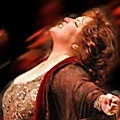
Furia orrenda!
For no particular reason, La Cieca has been thinking of the duet “E un anatema” from La Gioconda, and for a very particular reason, she’s been thinking of Aprile Millo. Anyway, to get the discussion started for the weekend, cher public, how’d you like to share your favorite performances of this duet, YouTube style, down in the comments?
Dear Cieca…
Better Verrett & Bumbry in You Tube.
But…my favourite? TEBALDI AND SIMIONATO from Chicago
It’s almost scary!!!.
Ah, I will never forget Shirl and Grace live in 1983 … After Shirl’s ringing challenge, Grace launched into the tune in that sumptuous lower register of hers … (Despite her protestations to the contrary, she was always a mezzo with top notes rather than a full-blown soprano. As for Shirl, I’m not quite sure what she was at that point in her career … but the two were quite a combo of vocal and star power.)
“Their fat little heads sit on their fat little bodies without a bit of connection…you can’t wring their necks if they got no necks to wring. Isn’t that right, honey?”
The ultimate soprano-mezzo cat fight duet! The Tebaldi/Simionato is wonderful indeed, but my favorite is the Callas/Barbieri from the 1952 Cetra recording. They are two blood-thirsty lionesses going for the kill, and it sounds like a chest voice competition. You realize that it’s hurting their voices, but you can’t help getting excited. Barbieri is one of the very few Lauras who doesn’t take a breath before “del creato” (Simionato seems to sneak a perfect virtually interceptable fiato rubato in there), probably because she was a real contralto and had no problems in that low tessitura.
I also like the Angeles Gulin/Bruna Baglioni version, which is also on Youtube. Gulin is one of the most underrated sopranos ever.
I saw Gulin’s Gioconda in Berlin opposite Placido and Livia Budai and she was LOUD – probably the biggest voice I’ve ever heard in the theatre. Not a pretty sight or sound, on the other hand.
I see that Ercole has already mentioned my favorite version.
A pumpkin wearing a mask!
Very funny, but CAN THAT PUMPKIN SING!
Someone I know that worked with her described her as “un po matta”. I don’t know what that was all about, but it is certainly an accomplished piece of singing in which she shows herself not skirting those high parts of the singing as is usually performed.
Still vote for Callas ’52 Cetra, though.
I recall having read something, somewhere, wish I knew,in which Callas stated that of the work she recorded, Gioconda, particularly in the 4th Act, was representative of what she was all about and what she was trying to effect from the music. I found that interesting as she was so much a belcantista, I would have thought she’d have indicated something in that repertory instead. Also love her Kundry, which proves it can be sung in a musical fashion, and not just caterwauled.
Yes, Callas used that line several times, referring specifically to side 6 (remember LPs?) of her second Gioconda recording.
I don’t have strong feelings about Ponchielli, but this same gala has a nice Carmen…remember the old chunky, cute Larmore?
You are going to get eaten alive on this site if you insist on saying things like “I don’t have strong feelings about Ponchielli.” At the very least, learn to say, “Oh, who cares, nobody has been able to sing that since Mancini, I hate the whole stupid garbage opera anyway” if only out of courtesy to the other commenters.
Squirrel, it’s time for a brain wash: we’ll have to tie you to a chair and force you to listen to every possible recording of Gioconda (plus other Ponchielli like I promessi sposi, I Lituani and Il figliuol prodigo) so that your mind makes tabula rasa of all that contemporary abstruseness (yes for me Schönberg is contemporary) you’re been recently subjected to.
i promise to shape up.
who is the old guy conducting, again?
Let us remember what it one day was:
God, even I could manage to launch into the “L’amo com’…) bit of the duet without needing to look at the score … Unlike Ms Grunewald here.
Thank you very much, indeed, for having posted this, complete with the information at the end which included the date (1994), which would have been my question to pose.
Poor Deborah! It was nothing at all like that last autumn.
I feel now as if I’ve had some of the money thrown away on that Gioconda returned to me in this video.
Sorry to be so off-topic, but I thought the residents of parterre would best be able to answer this:
At the NY Met, do you recommend family circle standing room or orchestra standing room? I hear that acoustically family circle is superb [somebody told me nosebleed section = you can hear it all very well]. However, orchestra is.. closer. But I hear that you only get a partial view with orch. Anyone?
Cheers,
Drammy
It’s a tradeoff. Family circle does have an excellent acoustic for fuller orchestrations and especially for bigger voices. Orch. standing room tends to cut off the tops of the sets visually, and the sound is mediocre. On the other hand, it’s fairly easy to find an empty seat downstairs after the first act or two.
So it’s a tradeoff.
Yes, I agree, since the orch. SR cuts off much of the top of the sets. But I think musically and visually the FC is a better deal. And you are sure to have no standers directly in front of you.
Better yet, buy a seat in the Sitting Room well ahead of time!
You can often find a seat upstairs fairly quickly, but the usher I think of as Cher’s Older Sister will make good and sure you don’t remain in it.
Family Circle, to just listen.
There are score desk seats (available through the auspices of the Met Opera Guild), for a mere pittance.
If you are in luck, you may snag a seat in the Family Box seats adjacent.
Orchestra– to snag a seat. — that’s the only reason to stand there as the sound is not so good, nor the sightline, naturally.
These days, with the Varis rush tickets on Mondays thru Thursdays, if you can STAND to stand online for a couple hours, at least you will have the recompense of viewing opera seated. Many times, helas, the seats are near or just under the overhang.
Well, I will say for ‘later’ Aprile: she certainly had the grand manner, over-drawn gestures and all. She is an opera singer, with emphasis on opera. This was eight years ago — and she was slighting the top notes but with such conviction she still convinces you. I loved Gulin; a just-right voice for Gioconda. Hell with Tebaldi — one of the most over-rated singers of our time. How does it work out that a soprano without the ‘money notes’ winds up making all the money? I never understood that success; her voice was a technical mess. Tebaldi was a singer for dumb listeners. Sorry, folks; that’s just how it was. Conductor looks to me like Julius Rudel.
I broadly agree with this assessment of Tebaldi (other than the bit about her being for dumb listeners), except that I will say that up until about the early 1960s, the timbre was something really special which is why I still have days where she’s all I want to hear, even with tight flat top notes and a tendency towards stridency and brittleness. So yes, a voice that had many unresolved technical issues, but with an awful lot of redeeming features in my view. I wouldn’t say she was over-rated, more that the case made for her is usually stated on the wrong grounds – often by those wanting to paint her as the complete opposite of Callas.
Well we put up with a lot of defects from Callas, Scotto, Jones, Rysanek, so why not Tebaldi’s? I’m with Cocky on this. Her virtues, especially in Puccini and the veristi, FAR outweigh her vices. If she were singing now, we’d be happy she was making the money, “money” notes or not. Well, I would anyway.
In the 50s, Tebaldi had the most equalized registers of any singer in her repertoire since Ponselle (and, at its best, the top was probably better then than Ponselle’s ever was): absolutely the same voice quality from top to bottom. Probably more a natural gift than the result of great technique.
Thanks Cocky, for your fine-tuning; I was a bit, just a bit, immoderate in my comments – let me elaborate. “Dumb listeners” is wide of the mark — ‘people who want volume at the expense of accuracy and finesse’ would be more like it. To use down-home language, much late T. impressed me as hog-calling — just yelling out as loud as possible and lunging for anything above the stave, devil take the hindmost. It drives me crazy; I am a creature of pitch and Mme T was not. Not an item, for sure. Very early
T., esp. that recording issued around 1950 on LP, showed the young voice truly voce di angelo, radiant high-C and pure floated tones. It think it is generally agreed that T. brought her big mid-voice tone up into the top register far too much and the inevitable result was to pull down and flatten the top — she had lots of power and too often she just bullied it through, so by the time of the Met Fanciullas and Giocondas it all became an ordeal, at least for this esthete.
She did grab my heart in the final scene with the miners in FDW, and she was in many ways a fine artist and dear lady — but I really cannot take back my previous comments. I do agree the famous on-voice performance on Forza avail. on DVD is mighty fine. But . . .
Dame della Fate, I bow to you – T. certainly had virtues, and I respect your valuation of the singer. Forgive me for being a money note banker
I’m very afraid, Mr. Mrmyster, that you make a very astute point regarding Tebaldi.
My listening to her began in the mid-sixties, when the bloom was long off the rose. I just could not understand why so many nice people got so worked up about her. I hardly had access to her work of the late 40′s or early 50′s, so I did not know that other voce d’angelo, then.
Still, there was always something beautiful about her personality and bella figura, that probably helped her to get away with the shouted out high notes.
We can only be grateful, in the end, for the beauty she did create in the very beginning. The La Wally of the early 50′s (with Scotto’s debut as Walther) has the most beautiful account of ‘Ebben ne andro lontano’, by anyone, ever. Replete with splendid high B’s and hysterical scaligera ovation.
Would someone please post it, if available?
Drammy: Problem is, in the orchestra s. r. you have the balcony overhang; you are way back. While the sound is OK, you will miss some brilliance and some of the dynamic punch. At F. C., yes a bit farther away (does that matter, really?), but you get a good walloping of the sound. I take the F. C. — voice over all!