


Headshot of La Cieca

Cher Public

  • scifisci: wow, what a nonsensical posting. I meant to say, wotan is s...
  • scifisci: i'm surprised no one mentioned the copenhagen ring, where wo...
  • Camille: grimoaldo --- Andre Breton said about Victor Hugo "He's a su...
  • Ruxxy: Yes Cocky - please accept my heartiest congrats and best wis...
  • Camille: "lived there my fair share". stupid old woman can't proof.
  • Camille: oh, you too? I generally liked what he did with the Hugue...
  • Camille: In El Lay, it's not only social death, you are considered an...
  • marshiemarkII: Grimoaldo you are the bestest :-), how fascinating to read w...
  • The Wistful Pelleastrian: OT announcement:George Steel will be a guest on the Leon...
  • willym: Thanks for such a wonderful review - well thought out addres...

blog advertising is good for you

Anticipation

The premiere of Hugo Weisgall’s 1993 Esther at New York City Opera occupied my mind for several days – though maybe not for the best reasons.  As I wrote earlier, it is a work that emanates, belatedly, from what might be called The Twelve-Tone Industrial Complex, that uptown conservatory lobby of the 1950s and 60s, which was based on a widely-held notion that Tonality Is Dead. 
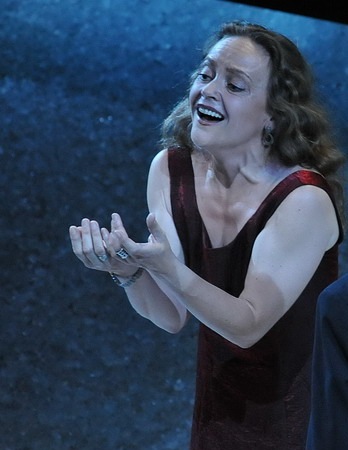
erwartung

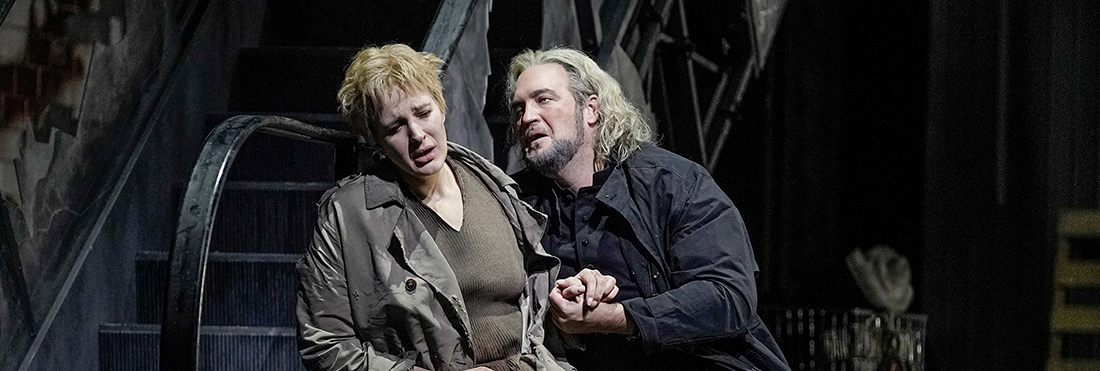
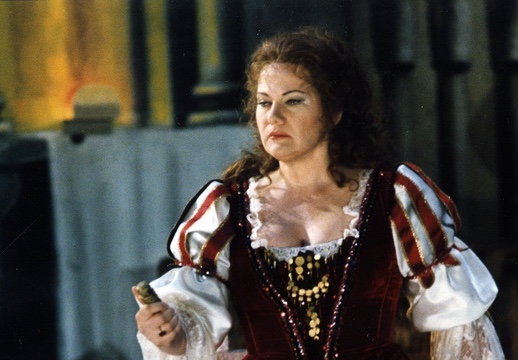
Evelyn Herlitzius singing Brünnhilde in Budapest

Tonight I’ll attend the Berlin Philharmonic’s concert at Carnegie Hall featuring Schoenberg’s Erwartung, sung by Evelyn Herlitzius. (Simon Rattle fills out the program conducting Schoenberg’s First Chamber Symphony and Brahms’ Second Symphony.)

The work is atonal but, unlike Esther, written before Schoenberg’s fleshing-out of Serialism. Though slim on plot, it is viscerally theatrical, and daring in its use of materials (Schoenberg’s score avoids any repetition of motives or themes – something of which Weisgall is suspected as well).

Vamping up, I re-read Charles Rosen‘s brief yet insightful 1975 monograph on Schoenberg, and came across some interesting passages that would have been very instructive back  in the 50s and 60s:

“[Schoenberg’s] works composed after the invention of Serialism in 1921 have, in a strange way, become a normal part of today’s music; they are not often heard, but they are the works that have been imitated by hundreds of composers all over the world.”

and

“To speak of the ‘breakdown of tonality’… is to beg the question, as we can see if we look to a similar late-nineteenth century development in literature… Free play of meaning is essential [to Mallarme] … we cannot speak of the breakdown of a linguistic system in Mallarme, or the decline of French. The ‘breakdown of tonality’ is similarly a fiction.”

Though this may not be precisely the point Rosen is making, I’d say that too many composers have believed the myth of the “breakdown of tonality”, an overly simplistic conceit, and a mandate that music not lean on a “broken” system. Tonal or not, it seems to me the work need only be true to its own materials, and be effective.

Or as our La Cieca once said, “Talent trumps everything – even hard work!”

I’ll report back later with some words about the performance. If you don’t have tickets, Herlitzius’ Erwartung is also available, in a performance from November 7 at Disney Concert Hall in Los Angeles, via the Berlin Philharmonic’s gorgeous new Digital Concert Hall mini-site. Alas, there is a download fee (€9.95), if you have that many Euros. (I don’t, and they refuse to accept acorns.)  While there’s no Herlitzius Erwartung to be found on the YouTube, here is some very rewarding Jessye:

12 comments

  • kashania says:

    I love it when the lights go up at the end. Spooky!

    Tonal or not, it seems to me the work need only be true to its own materials, and be effective.

    Wise words!

  • Buster says:

    Wow! Herlitzius did this with Sinopli in Vienna long time ago, I am amazed she still has this killer in her repertoire. How was she?

  • Alto says:

    “The premiere of Hugo Weisgall’s 1993 Esther at New York City Opera occupied my mind for several days …”

    “Several days” must be an understatement, since the premiere was in 1993.

    And why you would want to reiterate, above, your markedly ignorant description of this eloquent and elegant music is a mystery. A critic like George Loomis in MUSICAL AMERICA, who actually was able to *hear* the work and was not disposed to dismiss it with silly, cheap slogans, puts your Sarah Palin-like put-down of the piece to shame.

    • squirrel says:

      well aren’t you clever.

      see, this is exactly the kind of reverse-philistine attitude that concerns me. I get the impression that some (including alto) would defend ESTHER to the death because it is atonal, and then call anyone who doesn’t like it “ignorant”. Ridiculous. and sorry, Sarah Palin-like? wtf, as the kids say.

    • squirrel says:

      afterthought – should we treat tonal operas this way?

      “Don’t like Thomas??? You just don’t UNDERSTAND harmony!”

    • mrmyster says:

      Alto, would you elaborate on “reverse Philistine?” It’s a fascinating term, and in fact I think I know some of them; we may have one or two in Santa Fe. Further explanation would be appreciated! Thank you.

      • Alto says:

        Alto did NOT use the meaningless term “reverse Philistine”‘; that was Squirrel.

        Squirrel then sets up a straw-man concerning some imagined knee-jerk defense of atonalism — something I never even mentioned. The opera ESTHER is not, in any case, atonal but has clear tonal centers at, at least, crucial points. It’s treatment of the orchestra dramatically is clearly derived from Puccini. It is certainly not “serial” — as Squirrel, in what I again contend is a Palin-like reliance on slogans, half-truths, and falsehoods, keeps asserting. This is what I mean by ignorance. Throwing around uncomprehended jargon to make immoderate attacks on accomplished artistry is … what? I’m afraid Squirrel has after all provided the right appropriately Biblical metaphor. It’s Philistinism, and it pervades too much of our national life at the moment to sit quietly when it parades itself where serious operatic ventures are at stake.

        • squirrel says:

          I’m bowing out of this discussion. Are you 4 real??

        • longtimelistener says:

          I don’t think describing “Esther” as atonal is proof of Sarah Palinesque ignorance. The Schoenberg influence is pretty well documented. Funny how people fly off the handle at the littlest things.

          From the NY Times “Weisgall’s musical language is steeped in that of the Second Viennese School, he does not use 12-tone methods strictly. The score is rich with aching chromatic harmonies in the manner of Berg. In crucial moments Weisgall allows sturdy tonality to soften the spiky edges of his voice.”

          From Wiki: The opera remained post-modernist, with strong Second Viennese School influence, although not entirely atonal.

          More from Wiki: following Schoenberg’s own evolution, a totally-chromatic expressionism without firm tonal centre (often referred to as atonality) and later still Schoenberg’s serial twelve-tone technique…

          Lighten up Alto.

  • Alto says:

    Well … yes. And, again like your Alaskan model that I have with perhaps a little exaggeration teamed you with, you again ignore even any consideration of facts or argument and simply go for the meaningless sound-bite.

  • m. p. arazza says:

    I don’t know if one can rightly knock a work for drawing on, or even for being composed in (even if that’s the case), a supposedly outdated style, as if it were a hairdo or something. But even JJ’s review seemed to do this, or at least to suggest it: “even those Purim goodies, hamantaschen, wouldn’t make ‘Esther’ palatable. It’s written in a 12-tone style that was old hat when the opera premiered 16 years ago…” I found the score most listenable — Alto’s “elegant” seems a good word to describe it. Any idea if there’s any way of accessing Loomis’ Musical America review(s) without giving them credit card info?