no she was actually splendid,though a bit dark as Liu.
it wasn’t the performance… it was afterwards. i mean i can understand if she had a rough night but as I was waiting to get to say something to ms. linddstrom, she came out and when people were asking her for autographs and the like, she seemed like she did not want to be there at all, even responding a little coldly to some of the [possible] fans.
just my opinion… if you’re not a big star and youre still relatively unknown its best to be as bright and approachable as possible.
Rommie, I sincerely agree with you that fans can make a career outlandishly successful, or just middling and professional. It’s in singers’ best interests to be nice when their fans await them.
The second point was a little joke at my own expense. Please disregard.
I remember a thrilling RK Tosca in Verona with a sublime (vocally) Bergonzi and rough-sounding Glossop in the early 70s when her voice was still exciting and full-toned even if it was never unforgettable. Then a bit later she was my first Covent Garden Butterfly in the old Sophie Fedorovich sets and we all cried buckets. I’m still kicking myself that I missed her Desdemona to Vickers’ Otello, especially as it was the last time Vickers sang it at Covent Garden. She was never a “recording” artist, but she knew a lot about the theatre. I would love to have seen her as Adriana, Fedora (if she sang it) or Francesca da Rimini. Very few – do any? – singers really understand this repertory today. Is this a new Chéreau film by the way?
Richard (10.1#): I forgot about the Kabaivanska Francesca Di Rimini…..(I have the CD’s. There she was partnered by William Mateuzzi a fine tenor, often overlooked for appreciation.. Just like Kabaivanska , he now is a vocal teacher.. He was another singer of whom it could be said :’if only we have more like THAT, around today’.
What is really becoming apparent, such singers were fully schooled in the ‘true opera tradition’. One also thinks of examples like Simionato, Taddei, Gobbi, Scotto, Stignani and…..etc. They never lost their ‘technique’. It was almost their birthright .It stayed with them as if it was cast in stone.
Such much attention is paid to the ‘latest stars’ but how often do they measure up, even compared to the lesser known, or spoken of – from the past? Just because someone gets a passing gig at the MET or Covent Garden makes them totally memorable in the annals of enduring artistry.
The comparisons are not favorable to many of the present breed of singers. Many of these are creatures with very limited ranges of repertoire, unwilling to progressively ‘learn’ and incapable of personally knowing the safe adjustment of vocal technique to suit new different roles with safe and sensible challenge. What we get is a few roles infinitely hocked in numerous opera houses around the World. The hard knuckle effort ‘to grow’ is beyond them. After all they believe they have ‘made it’. By the time , role change is forced on them by the growing number of new youthful rivals, it is too late. Next we are not surprised to hear their voice ‘is in pieces’.
Harry, in all due respect, I am not sure anyone would long for the days of William Matteuzzi. In this day of excellent Rossini tenors, I have a feeling Matteuzzi would not have much of a career.
Re paragraph 2. and speaking of Taddei — I must say this: in ’86, once again in Rome, I saw Giuseppe Taddei, at age 69, come out of retirement to sing in Demofoonte. The story at the time was that he did so “because he was bored”!!!!
His singing at that time would have been the envy of any of the current crop of barihunks. What a sound.
If anyone wants a different smasher version of the Paulo / Francesca long love duet from Zandonai’s Di Rimini, seek out the Corelli/ Tebaldi version they did together on a Decca CD….I rate it as highly as the Pavarotti /Freni Chery Duet from L’Amico Fritz. The stuff of dreams.
Kabaivanska and Domingo were featured in a concert performance of Francesca da Rimini at Carnegie Hall sometime back in the 1960′s. There used to be a recording available.
Kabaivanska was always an interesting singer. When I first became interested in opera – early 1960′s – I wondered who this woman was who always got pretty bad reviews on the paper. (Newspapers then were not limited to reviewing only the first performance of an opera in a given season. Cast changes were also reviewed.) I hadn’t heard her but she was sort of a house soprano at the Met often appearing on second and third casts. Then all of a sudden, she started getting very good reviews. Sometime later in an interview she said that she had spent a summer coaching with Rosa Ponselle and had then realized that she had not known how to sing until then. A very humble and not-often-heard comment from a professional singer in mid-career. She seems to have had a solid career after than although she sang very little in the US after 1972 or so.
I saw her when La Scala came to the Kennedy Center in 1976 as Amelia Boccanegra. Without a doubt she was a very beautiful woman. But I must say that her singing that time was very inconsistent. She would produce some beautiful phrases and then fall apart for the next ones, on and on through the performance. Every time you thought she had pulled herself together, she would soon lose it again.
One should take into account that Amelia was practically not in her repertoire. I actually think this was the only performance. So you should consider yourself lucky. Than, every singer had his periods of vocal uncertainties, no one is for ever “perfect”. Another thing, La Kabaivanska acts with her voice, hence, modulation of certain type are by definition a device for interpretation of states of mind and soul.
Famous is her phrase that she rather would sacrifice the beauty of voice and perhaps the lenght of a tone than to sing inconsistantly with the state of the character. The philosphy behind the character, that’s what is the leading line with a interpreter like La Kabaivanska… and in the art in general.
Harry is very right speaking about the presented excerpt in terms of a cinematographic approach. The voice here expresses perplexity and torments of characters under cover of a conventional soiree’… the so called contrast. Seeking a “beautiful” singing is a superficial manner of deciphering the art with all my respect (I’m not refering to your comment though).
Finally, ~10 out of 50 years hardly could be considered mid-career but you’re absolutely right, such kind of sincerity and modesty is a rare behaviour…
I believe that the only reason Kabaivanska was singing in the Boccanegra in DC was because Freni, who was the original Amelia in that marvelous Strehler production, was at the same time singing Marguerite in Faust and Susanna in Figaro with the Paris Opera at the Met. (a cornucopia of bi-centenial gifts from the continent). Freni did fly down to sing in the final Boccanegra, but I preferred Kabaivanska, who was not at her best, but was far more involved and expressive than Mirella. But the circumstances were not ideal for either diva to be at her best. In the event, it didn’t matter, the opera belonged to Abbado, Cappuccilli and Ghiarov who were in their prime and magnificent, in a production that generously supported their greatness.
Graciella, I heard the final Boccanegra. I went down to DC for the weekend and heard Macbeth, Cenerantola, Boheme, and the stunning Boccanegra. Cappuccilli sang Macbeth Friday evening, so on the final matinee of Boccanegra, Silvano Carolli sang Simone. That production was very striking, one of the most beautiful I’ve seen.
After the perfomance, as a kind of encore/addio/tribute(the visit celebrated the US Bicentennial) the Scala chorus sang Va Pensiero acappella. It was a lovely moment.
Thanks, Richard, don’t know if my reply is going to end up in the right place, but I hadn’t remembered that Carolli sang the final performance with Freni; that might have contributed to my letdown. I liked Carolli (he was an excellent Ezio to Ghiarov’s Attila in Chicago) but I’m sorry you missed Cappuccilli, at his best with Abbado and especially in Boccanegra, capping the Council Chamber concertato with noble golden age vocalism. I was in DC for several days, primarily to see the Boccanegra and Macbeth. I skipped the Boheme (was it Cotrubas?), but remember seeing Valentini-Terrani in a Cenerentola rehearsal (did she alternate the role?) And yes, the Va Pensiero with that peerless Scala chorus. I’m terrible with timelines, but the Vienna State Opera came at some point too, bringing Salome with Rysanek, Figaro with Janowitz, Popp and Berry, and Ariadne with Janowitz, Gruberova, and Baltsa. Heady days! Plenty material for our anecdotage..lol.
on a different note,
marina poplavskaya is a good singer but a little bit of a bitch. lol.
Uh … I guess you know her? by all accounts a darling from peeps who know her intimately…
eh, she didn’t endear herself to the people who were trying to engage with her last night. she seemed annoyed and cold.
that doesn’t mean she’s not a darling to her intimates…just that she’s not really a darling to her [potential] fans.
rommie, did she have a bad night vocally?
well … the fans make the career. too bad for her then.
CRUZSF
no she was actually splendid,though a bit dark as Liu.
it wasn’t the performance… it was afterwards. i mean i can understand if she had a rough night but as I was waiting to get to say something to ms. linddstrom, she came out and when people were asking her for autographs and the like, she seemed like she did not want to be there at all, even responding a little coldly to some of the [possible] fans.
just my opinion… if you’re not a big star and youre still relatively unknown its best to be as bright and approachable as possible.
i also don’t know Ann Coulter but I know she’s a bitch.
if you’re not a big star and youre still relatively unknown its best to be as bright and approachable as possible.
I agree with you, rommie. I learned that lesson the hard way.
whatya mean CruzSF?
we got shushed for clapping after In Questa… we just applauded louder.
Rommie, I sincerely agree with you that fans can make a career outlandishly successful, or just middling and professional. It’s in singers’ best interests to be nice when their fans await them.
The second point was a little joke at my own expense. Please disregard.
Bravo for bravery!
No clapping in Parsifal maybe but HEY this is Italian opera, not Festbuhnenweihnachtspielen crapola!
Thank you, Camille, for cueing one of La Cieca’s favorite Parsifal stories.
The Met, early 1990s. The first act of the music drama is drawing to a close. We hear the following:
this is fabulous
same guy as “viva puccini”, perhaps?
Cieca augusta —
you mean someone said it IN ENGLISH?
What a PUTZ!
I remember a thrilling RK Tosca in Verona with a sublime (vocally) Bergonzi and rough-sounding Glossop in the early 70s when her voice was still exciting and full-toned even if it was never unforgettable. Then a bit later she was my first Covent Garden Butterfly in the old Sophie Fedorovich sets and we all cried buckets. I’m still kicking myself that I missed her Desdemona to Vickers’ Otello, especially as it was the last time Vickers sang it at Covent Garden. She was never a “recording” artist, but she knew a lot about the theatre. I would love to have seen her as Adriana, Fedora (if she sang it) or Francesca da Rimini. Very few – do any? – singers really understand this repertory today. Is this a new Chéreau film by the way?
Tamerlano – thanks for that clip! We wouldn’t be too sorry to hear singing like that in the theatre today, methinks.
Can anyone tell me the title of this film?
Gabrielle, but I am afraid it has nothing to do with Chanel.
Richard (10.1#): I forgot about the Kabaivanska Francesca Di Rimini…..(I have the CD’s. There she was partnered by William Mateuzzi a fine tenor, often overlooked for appreciation.. Just like Kabaivanska , he now is a vocal teacher.. He was another singer of whom it could be said :’if only we have more like THAT, around today’.
What is really becoming apparent, such singers were fully schooled in the ‘true opera tradition’. One also thinks of examples like Simionato, Taddei, Gobbi, Scotto, Stignani and…..etc. They never lost their ‘technique’. It was almost their birthright .It stayed with them as if it was cast in stone.
Such much attention is paid to the ‘latest stars’ but how often do they measure up, even compared to the lesser known, or spoken of – from the past? Just because someone gets a passing gig at the MET or Covent Garden makes them totally memorable in the annals of enduring artistry.
The comparisons are not favorable to many of the present breed of singers. Many of these are creatures with very limited ranges of repertoire, unwilling to progressively ‘learn’ and incapable of personally knowing the safe adjustment of vocal technique to suit new different roles with safe and sensible challenge. What we get is a few roles infinitely hocked in numerous opera houses around the World. The hard knuckle effort ‘to grow’ is beyond them. After all they believe they have ‘made it’. By the time , role change is forced on them by the growing number of new youthful rivals, it is too late. Next we are not surprised to hear their voice ‘is in pieces’.
Harry, in all due respect, I am not sure anyone would long for the days of William Matteuzzi. In this day of excellent Rossini tenors, I have a feeling Matteuzzi would not have much of a career.
Re paragraph 2. and speaking of Taddei —
I must say this: in ’86, once again in Rome, I saw Giuseppe Taddei, at age 69, come out of retirement to sing in Demofoonte. The story at the time was that he did so “because he was bored”!!!!
His singing at that time would have been the envy of any of the current crop of barihunks. What a sound.
And what an artist! His mid-80s Falstaff at the Met was one of the greatest things I ever saw.
If anyone wants a different smasher version of the Paulo / Francesca long love duet from Zandonai’s Di Rimini, seek out the Corelli/ Tebaldi version they did together on a Decca CD….I rate it as highly as the Pavarotti /Freni Chery Duet from L’Amico Fritz. The stuff of dreams.
Kabaivanska and Domingo were featured in a concert performance of Francesca da Rimini at Carnegie Hall sometime back in the 1960′s. There used to be a recording available.
Kabaivanska was always an interesting singer. When I first became interested in opera – early 1960′s – I wondered who this woman was who always got pretty bad reviews on the paper. (Newspapers then were not limited to reviewing only the first performance of an opera in a given season. Cast changes were also reviewed.) I hadn’t heard her but she was sort of a house soprano at the Met often appearing on second and third casts. Then all of a sudden, she started getting very good reviews. Sometime later in an interview she said that she had spent a summer coaching with Rosa Ponselle and had then realized that she had not known how to sing until then. A very humble and not-often-heard comment from a professional singer in mid-career. She seems to have had a solid career after than although she sang very little in the US after 1972 or so.
I saw her when La Scala came to the Kennedy Center in 1976 as Amelia Boccanegra. Without a doubt she was a very beautiful woman. But I must say that her singing that time was very inconsistent. She would produce some beautiful phrases and then fall apart for the next ones, on and on through the performance. Every time you thought she had pulled herself together, she would soon lose it again.
One should take into account that Amelia was practically not in her repertoire. I actually think this was the only performance. So you should consider yourself lucky.
Than, every singer had his periods of vocal uncertainties, no one is for ever “perfect”.
Another thing, La Kabaivanska acts with her voice, hence, modulation of certain type are by definition a device for interpretation of states of mind and soul.
Famous is her phrase that she rather would sacrifice the beauty of voice and perhaps the lenght of a tone than to sing inconsistantly with the state of the character. The philosphy behind the character, that’s what is the leading line with a interpreter like La Kabaivanska… and in the art in general.
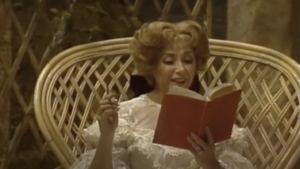
Harry is very right speaking about the presented excerpt in terms of a cinematographic approach. The voice here expresses perplexity and torments of characters under cover of a conventional soiree’… the so called contrast. Seeking a “beautiful” singing is a superficial manner of deciphering the art with all my respect (I’m not refering to your comment though).
Finally, ~10 out of 50 years hardly could be considered mid-career but you’re absolutely right, such kind of sincerity and modesty is a rare behaviour…
I believe that the only reason Kabaivanska was singing in the Boccanegra in DC was because Freni, who was the original Amelia in that marvelous Strehler production, was at the same time singing Marguerite in Faust and Susanna in Figaro with the Paris Opera at the Met. (a cornucopia of bi-centenial gifts from the continent). Freni did fly down to sing in the final Boccanegra, but I preferred Kabaivanska, who was not at her best, but was far more involved and expressive than Mirella. But the circumstances were not ideal for either diva to be at her best. In the event, it didn’t matter, the opera belonged to Abbado, Cappuccilli and Ghiarov who were in their prime and magnificent, in a production that generously supported their greatness.
Graciella, I heard the final Boccanegra. I went down to DC for the weekend and heard Macbeth, Cenerantola, Boheme, and the stunning
Boccanegra. Cappuccilli sang Macbeth Friday evening, so on the final matinee of Boccanegra, Silvano Carolli sang Simone. That production was very striking, one of the most beautiful I’ve seen.
After the perfomance, as a kind of encore/addio/tribute(the visit celebrated the US Bicentennial) the Scala chorus sang Va Pensiero acappella. It was a lovely moment.
Thanks, Richard, don’t know if my reply is going to end up in the right place, but I hadn’t remembered that Carolli sang the final performance with Freni; that might have contributed to my letdown. I liked Carolli (he was an excellent Ezio to Ghiarov’s Attila in Chicago) but I’m sorry you missed Cappuccilli, at his best with Abbado and especially in Boccanegra, capping the Council Chamber concertato with noble golden age vocalism. I was in DC for several days, primarily to see the Boccanegra and Macbeth. I skipped the Boheme (was it Cotrubas?), but remember seeing Valentini-Terrani in a Cenerentola rehearsal (did she alternate the role?) And yes, the Va Pensiero with that peerless Scala chorus. I’m terrible with timelines, but the Vienna State Opera came at some point too, bringing Salome with Rysanek, Figaro with Janowitz, Popp and Berry, and Ariadne with Janowitz, Gruberova, and Baltsa. Heady days! Plenty material for our anecdotage..lol.