
parterre fave Peter Konwitschny has returned to his métier, directing a new production of Salome — with a happy ending!
Following the jump are excerpts from an interview with the director in Volksrant, translated by Our Own Freniac.
“What caused my crisis?” One of Europe’s most notorious opera directors laughs shyly, the air coming out of his nose with short thrusts.
“Very simple. I fell in love with a young Russian girl. And I killed that love with rational arguments. She was too young, we came from a different social background, we didn’t even speak the same language. I followed my head instead of my heart. And the I fell into a depression. For four years I lacked the courage to direct a new production.”
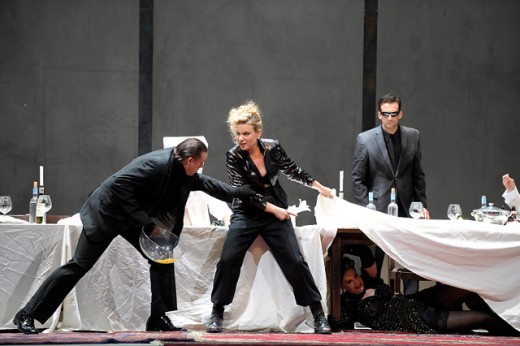
For Peter Konwitschny (65), talking also means sighing a bit at the same time. It’s also possible that he has to recuperate a bit in the small office of the Amsterdam Muziektheater from the rehearsals in which he persuades people to drink, shoot up, perform blowjobs, fuck, cannibalize and perform necrophilia.
Richard Strauss’ Salome, one-act opera after the play by Oscar Wilde. About a princess who’ll only dance if she’s presented with the head of John the Baptist on a silver platter. Premieres this Tuesday. It will be the first new Konwitschny since his crisis and the entire European music press is gathering for the occasion.
“Gut, serh gut!” the director had called, moments earlier, to the crowd of singers treating tenor Marce Reijans to a post-mortem rape. Now he stirs his latte macchiato calmly. Balding, grey pony tail.
He analyses: “Salome grows up in a perverse environment. But if you look carefully, you see that she has a quality others are missing: she sincerely want to know what love is. That’s crucial. To show this, I first have to go through all the dredge.”
[kml_flashembed movie="http://www.youtube.com/v/9YVk4uwgZEQ" width="425" height="350" wmode="transparent" /]
The director who grew up in former East-Germany is now known as an uncompromising thinker…. His primal theme: the unmasking of patriarchal society, the male-dominated world which is always accompanied by suppression, lack of freedom and terror. Humour and paradox are his main weapons.
He wrote down his first thoughts on Salome three years ago. Jochanaan is not beheaded. Salome eludes her execution. And as a romantic couple the princess and prophet exit the stage.
“Regard it as utopia”, Konwitschny explains. “I did not feel like doing an opera presents women as the Evil in the world. That’s a typically male ideology: first you use her, then you call her perverse.”
Sentence by sentence, bar by bar, he examined the piece. When the idea would misfire, he would give back the direction assignment. He knocks on the score and murmurs a motive from Salome’s final scene: four notes in a gently sliding ascent. “That does not sound perverse, does it? If it did not fit the music, I could never have staged it.”
. . . .
Salome’s ‘Dance of the Seven Veils’ will not end in a striptease at De Nederlandse Opera. It will not be necessary to retch when the princess kisses Jochanaan’s dead lips.
Konwitschny: “I let Salome speak to a living man. He bursts into tears. A woman you can talk to – this does not have a place in his ideology.”
But she certainly tastes his lips. “ Hat es nach Blut geschmeckt?” Salome wonders, textually accurate. “Nein? Doch es schmeckte vielleicht nach Liebe. Ich habe deinen Mund geküsst, Jochanaan. Ich habe ihn geküsst, deinen Mund.“
After this they toast with a brandy and the stage curtain closes behind them.
Konwitschny cites Jean Genet, the French playwright who thought that above all else, theatre should raise the desire for a better world.
“Philosophically, politically, socially: opera teaches us what we should and shouldn’t do. I realize that only a fraction of the entire population ever visits a performance. But still: opera can save us, it’s an important societal corrective.”
More love, that’s what it boils down to according to the director. “Only through love you become completely human. That’s why children always want their parents to love each other. When that’s not the case, they feel existentially threatened.”
He was 13 when his parents’ marriage hit the rocks. Franz, the conductor, was buried at Leizpig’s Südfriedhof in 1962. His ex-wife passed away in January 2009. Peter Konwitschny arranged a spot for his mother overlooking the monument of the Gewandhauskapellmeister.
Chuckling: “A reconciliation of sorts, which I’ve managed to bring about.”