
The day after opening the 2009-10 season with Hugo Weisgall’s Esther, New York City opera presented one of the most beloved operas in the entire repertoire, Mozart’s Don Giovanni, in a new production by Christopher Alden.
Due to the company’s notorious financial woes, Don Giovanni will be the only new production of the season, and it was immediately evident that not much of even a limited budget could have been spent on sets or props. The stage is almost bare: all the audience can see are two rows of chairs (plus one single chair on far stage right), five pendant lamps and a huge neon cross on the wall.
Just before the music begins, a large group of people, wearing what looked like costumes from the 1930s, take a seat on the chairs, while a masked man occupies the chair on the left. Then comes the first ingenious coup de théâtre. As the audience is led to believe that the people sitting on the stage are members of the chorus, some of them, one by one, turn out to be the principal characters of the opera. The loner is, of course, the Don himself.
Da Ponte, the librettist, called this opera a “dramma giocoso”, while Mozart in his own catalog defined it an “opera buffa”. There is very little “giocoso”, let alone “buffo”, in this production, where Alden accentuates the drama, almost neglecting the comic part of the work. It is a debatable decision, but it was consistent throughout the opera and in my opinion it worked, creating a complete, often viscerally gripping theatrical experience. The director had a specific vision of the work in mind and brought it to life in a coherent, consistent and logical manner.
The treatment of the most comic role of the opera, Leporello, was emblematic of this choice. Here Leporello, entirely dominated and brutalized by his master, moves around the stage always cowering in fear or crawling like a worm. There is hardly any cheerfulness in him, to the point that the wisecracks and the quips Da Ponte writes for him sound almost incongrous.
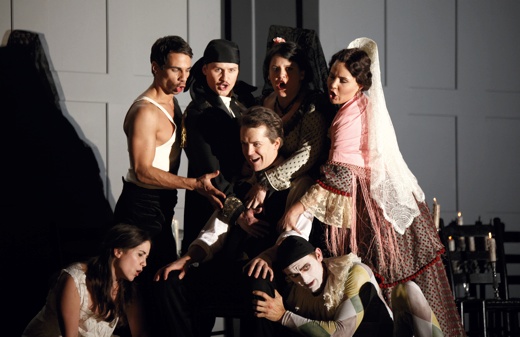
To his credit, Jason Hardy (Leporello) most appropriately recited them in a sort of removed, weary way. Don Giovanni at one point tries to reassure and soothe him by stroking his hair, then almost immediately drags him by one arm across the stage. As if this wasn’t enough, in the masked ball scene at the end of the first act Leporello wears the costume of Pierrot, sadness personified.
Don Giovanni is a brute, a sociopath without suavity. He doesn’t kill the Commendatore fighting sword to sword, but smashes the old man’s skull against the wall, and the blood stain remains up there until the end, perhaps the most conspicuous thing on the stage. Zerlina’s attempted rape is vicious; in the penultimate scene, the chords which should mark the Commendatore’s approaching steps instead accompany Don Giovanni’s sexual thrusts into the body of Donna Elvira’s maid.
At the very end, as if to dismiss the notion that Don Giovanni has a happy ending (and to lessen the importance of the moral of the finale), all the characters and the chorus return to their seats exactly as they were at the very beginning, with the villain showing up, wearing the same mask, in his place on the right. The original scoundrel may be punished and gone, but another one is in his place and the cycle of evil is about to begin again.
Terese Wadden’s costumes were mostly attractive and appropriately updated.
Gary Thor Wedow’s conducting was superlative. Under his baton the orchestra sounded crisp and precise. I especially appreciated Maestro Wedow’s effort to show that Mozart was after all a son of his own time, and his operas were subjected to the same performance practices of the period. Thus, the conductor allowed the use of appoggiaturas and tasteful variations in the da capos of the arias. I will never be able to understand why most conductors believe that it is acceptable to add variations in, say, Paisiello or Cimarosa, but no, Mozart cannot be altered. Even a minor trick like a messa di voce on the word “maestosa” in “Madamina, il catalogo è questo” can add an element of variety.
Another small detail I enjoyed was that the singers did not pause and take a breath between the end of a recitative and the beginning of the aria or duet itself. For instance, Don Giovanni sings “…e là, gioiello mio, ci sposeremo. Là ci darem la mano…” in a single breath, to refreshing effect.
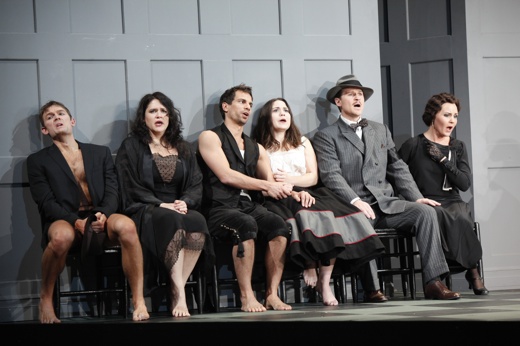
Backs against the wall: the sextet from "Don Giovanni" at NYCO. Photo: Carol Rosegg.
The cast all gave competent vocal performances, though none of them, with one single exception, really left an indelible impression. They all looked their respective parts and had the physique du rôle (and in a couple of cases, what physique it was indeed!)
Canadian bass-baritone Daniel Okulitch, who rose to prominence and made headlines baring all in Howard Shore’s The Fly, this time showed more modesty keeping his underwear on. Like all his other colleagues, he was scenically excellent and fully complied to the director’s vision. Vocally, he was passable without a particularly distinctive instrument. The same could be said for Hardy as Leporello. He spent most of the second act in various degrees of undress, revealing a body which wouldn’t look out of place on the cover of Playgirl.
Kelly Markgraf (Masetto), appearing in a tight wifebeater, also seems destined to swell the ranks, indeed the legions, of the barihunks. Bass Brian Kontes, who brought the appropriate gravitas to the role of the Commendatore, was the only one not requested to show some skin, but then he had to lie inside a coffin for most of the opera.
Tenor Gregory Turay’s instrument has noticeably darkened since the last time I heard him several years ago at the Met in the same role. From a typical tenorino leggero, Mr. Turay has almost become a full lyric tenor, but the voice reveals some spread and less focus on top. I would have liked more chiaroscuro, more differentiation in “Dalla sua pace,” an aria in which a tenor can work wonders by modulating its reprise with gradation of pianos and pianissimos. The agility in “Il mio tesoro intanto” was hardly the most accurate I have heard.
Ukrainian-American soprano Stefania Dovhan was debuting the arduous role of Donna Anna. She was not much more than adequate. I think her voice is a couple of sizes too small for “Or sai chi l’onore,” whereas “Non mi dir,” which would suit her lighter voice better, was burdened by barely acceptable coloratura: the picchiettati high As and Bs flat in the Allegretto moderato sounded forced and clumsy. This wasn’t certainly the virtuoso showpiece it usually becomes in the hands of expert belcantistas.
I regret to say I was not impressed with Joélle Harvey as Zerlina. Her soprano sounded too weak and thin in the middle register, where all of her music lies. It is a classic case of why it is often preferable to cast a lyric mezzo-soprano in this part.
Dulcis in fundo, the single exception was Keri Alkema as Donna Elvira. This role is ideal for this singer, who has just recently made the mezzo-to-soprano transition. Her voice is robust, even and homogenized, from a sonorous low register to a bright, penetrating and secure top. Thanks to the variations she was allowed, she had a real show-stopper with “Ah! Chi mi dice mai,” an aria which often goes unobserved for its brevity. “Mi tradì quell’alma ingrata” is a difficult piece especially for its tricky intervals, which Ms. Alkema nailed perfectly. This is a singer I would love to hear as Vitellia.
All the principals, to different degrees, struggled with proper Italian pronunciation, missing double consonants and producing very un-Italian r’s. Mr. Turay even sang “Morde mi dà!” Perhaps NYC Opera should invest in a better Italian coach.
One final positive note: the New York State Theater (pardon, the David H. Koch Theater at Lincoln Center) now seems to have better, brighter, less muffled acoustics, the result of extensive renovations which included the removal of much of the carpeting and a number of seats. Too bad they didn’t get rid of those awful gigantic statues.
Latest on Parterre

Sponsored
MET Opera Legend Leona Mitchell Live in Concert
Leona Mitchell, the MET Opera’s leading Verdi soprano for 18 seasons, is returning to the stage April 19th in New York City. Get Tickets →


parterre in your box?
Get our free weekly newsletter delivered to your email.



Comments