<?xml version="1.0" encoding="UTF-8"?><rss version="2.0"
	xmlns:content="http://purl.org/rss/1.0/modules/content/"
	xmlns:dc="http://purl.org/dc/elements/1.1/"
	xmlns:atom="http://www.w3.org/2005/Atom"
	xmlns:sy="http://purl.org/rss/1.0/modules/syndication/"
		>
<channel>
	<title>Comments on: Canon fodder</title>
	<atom:link href="http://parterre.com/2009/11/07/canon-fodder/feed/" rel="self" type="application/rss+xml" />
	<link>http://parterre.com/2009/11/07/canon-fodder/</link>
	<description>where opera is king and you, the readers, are queens</description>
	<lastBuildDate>Wed, 17 Mar 2010 01:47:28 -0400</lastBuildDate>
	<generator>http://wordpress.org/?v=2.8.5</generator>
	<sy:updatePeriod>hourly</sy:updatePeriod>
	<sy:updateFrequency>1</sy:updateFrequency>
		<item>
		<title>operaguy commented</title>
		<link>http://parterre.com/2009/11/07/canon-fodder/comment-page-1/#comment-105409</link>
		<dc:creator>operaguy</dc:creator>
		<pubDate>Mon, 09 Nov 2009 20:59:55 +0000</pubDate>
		<guid isPermaLink="false">http://parterre.com/?p=9514#comment-105409</guid>
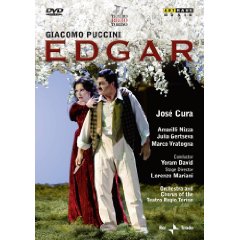
		<description>Actually, there are at least 4 (more likely 5) versions of Edgar.  The La Scala premiere version, the 1890 vocal score (in 4 acts), the version performed at Lucca 1891 (still in 4 acts) and the final version in 3 acts.  There may also be a version prepared for a production in Spain.  The Turin performance is a poor realization of the work, musically.  The choruses in the 4 act version of Edgar are massive and were significantly cut in Turin.  The manuscript for Edgar, a large portion of which was only &quot;discovered&quot; recently in the care of Simonetta Puccini, is very closely held, so I havn&#039;t seen it; but every sersion of Quest&#039;amor vergogna mia has climatic notes on &quot;F&quot; (in the Lucca version, on &quot;G&quot;) - the baritone in Turin ommitted these notes.  Throughout, the singing is distressingly out of tune.  I have performed in the 1890 version and, this weekend and next, will be performing in the 1891 Lucca version.  This Turin performance gives no indication of the power of this piece.  The full fourth act contains bits of music later used in Tosca, Butterfly, and Fanciulla.  Don&#039;t waste your time on this video - it does not do the opera justice either musically or dramatically.  It contains some of Puccini&#039;s finest music, but you would never know from this performance.</description>
		<content:encoded><![CDATA[<p>Actually, there are at least 4 (more likely 5) versions of Edgar.  The La Scala premiere version, the 1890 vocal score (in 4 acts), the version performed at Lucca 1891 (still in 4 acts) and the final version in 3 acts.  There may also be a version prepared for a production in Spain.  The Turin performance is a poor realization of the work, musically.  The choruses in the 4 act version of Edgar are massive and were significantly cut in Turin.  The manuscript for Edgar, a large portion of which was only &#8220;discovered&#8221; recently in the care of Simonetta Puccini, is very closely held, so I havn&#8217;t seen it; but every sersion of Quest&#8217;amor vergogna mia has climatic notes on &#8220;F&#8221; (in the Lucca version, on &#8220;G&#8221;) &#8211; the baritone in Turin ommitted these notes.  Throughout, the singing is distressingly out of tune.  I have performed in the 1890 version and, this weekend and next, will be performing in the 1891 Lucca version.  This Turin performance gives no indication of the power of this piece.  The full fourth act contains bits of music later used in Tosca, Butterfly, and Fanciulla.  Don&#8217;t waste your time on this video &#8211; it does not do the opera justice either musically or dramatically.  It contains some of Puccini&#8217;s finest music, but you would never know from this performance.</p>
]]></content:encoded>
	</item>
	<item>
		<title>Will commented</title>
		<link>http://parterre.com/2009/11/07/canon-fodder/comment-page-1/#comment-105335</link>
		<dc:creator>Will</dc:creator>
		<pubDate>Mon, 09 Nov 2009 04:21:23 +0000</pubDate>
		<guid isPermaLink="false">http://parterre.com/?p=9514#comment-105335</guid>
		<description>When Katerina Ismailova (Lady Macbeth of M.) leaps off the bridge to her death, she takes Sonyetka with her into the icy water.

Katerina also poisons her father-in-law, so you get one murder of each type in the same opera.  

The Kostelnicka kills Jenufa&#039;s baby son.

Lizzie Borden kills her stepmother.

Rusalka kills the Prince with a kiss.

Maddelena effecively kills Gilda by making a deal with Sparafucile to kill the first person who knocks on the inn&#039;s door instead of killing Rigoletto (Yes, I know this one&#039;s on a technicality).  Same is true for Amneris who unwittingly causes the death of Aida along with Rhadames.</description>
		<content:encoded><![CDATA[<p>When Katerina Ismailova (Lady Macbeth of M.) leaps off the bridge to her death, she takes Sonyetka with her into the icy water.</p>
<p>Katerina also poisons her father-in-law, so you get one murder of each type in the same opera.  </p>
<p>The Kostelnicka kills Jenufa&#8217;s baby son.</p>
<p>Lizzie Borden kills her stepmother.</p>
<p>Rusalka kills the Prince with a kiss.</p>
<p>Maddelena effecively kills Gilda by making a deal with Sparafucile to kill the first person who knocks on the inn&#8217;s door instead of killing Rigoletto (Yes, I know this one&#8217;s on a technicality).  Same is true for Amneris who unwittingly causes the death of Aida along with Rhadames.</p>
]]></content:encoded>
	</item>
	<item>
		<title>CruzSF commented</title>
		<link>http://parterre.com/2009/11/07/canon-fodder/comment-page-1/#comment-105216</link>
		<dc:creator>CruzSF</dc:creator>
		<pubDate>Sun, 08 Nov 2009 03:47:51 +0000</pubDate>
		<guid isPermaLink="false">http://parterre.com/?p=9514#comment-105216</guid>
		<description>Baritenor, I developed affection for Puccini late (after Verdi and Mozart), but my respect for his talent increased after hearing some orchestra musicians express admiration for his way with marrying music to story. I&#039;m interested in hearing all his music, but realize that composers make their own revisions for a reason! Thanks for helping us separate the must-own from the could-rent.</description>
		<content:encoded><![CDATA[<p>Baritenor, I developed affection for Puccini late (after Verdi and Mozart), but my respect for his talent increased after hearing some orchestra musicians express admiration for his way with marrying music to story. I&#8217;m interested in hearing all his music, but realize that composers make their own revisions for a reason! Thanks for helping us separate the must-own from the could-rent.</p>
]]></content:encoded>
	</item>
	<item>
		<title>CruzSF commented</title>
		<link>http://parterre.com/2009/11/07/canon-fodder/comment-page-1/#comment-105214</link>
		<dc:creator>CruzSF</dc:creator>
		<pubDate>Sun, 08 Nov 2009 03:11:07 +0000</pubDate>
		<guid isPermaLink="false">http://parterre.com/?p=9514#comment-105214</guid>
		<description>Were you able to attend? How was it?</description>
		<content:encoded><![CDATA[<p>Were you able to attend? How was it?</p>
]]></content:encoded>
	</item>
	<item>
		<title>Gualtier M commented</title>
		<link>http://parterre.com/2009/11/07/canon-fodder/comment-page-1/#comment-105208</link>
		<dc:creator>Gualtier M</dc:creator>
		<pubDate>Sun, 08 Nov 2009 01:20:28 +0000</pubDate>
		<guid isPermaLink="false">http://parterre.com/?p=9514#comment-105208</guid>
		<description>BTW: on Halloween Anton Coppola presented a version of the opera that went back to the libretto&#039;s source &quot;La Coupe et les Levres&quot; by de Musset.

Here was some of the promotional materials:

Michael Philip Davis, Stage director
INTER-CITIES PERFORMING ARTS, PRODUCER
World Premiere
Saturday, October 31, 7:30 pm
The Kaye Playhouse
at
Hunter College
695 Park Avenue, NYC

Statement by Anton Coppola
 
Giacomo Puccini’s opera, Edgar, is the only one of his otherwise successful and widely-acclaimed works to be largely rejected by worldwide opinion. The glaring weakness of the opera is the libretto by a mediocre poet, Ferdinando Fontana, who based it on Alfred De Musset’s “La Coupe et les Lèvres, “one of several drames de fauteuil.  In his treatment, Fontana ignored or superficially glossed over the poem’s dark and cynical reflections of life and love, which is the core of the subject.
           
Instead of its being a drama about spiritual quest, it became a trite absurdity, concentrating on the melodramatic elements.  In short, Fontana provided Puccini with the thankless task of creating suitable music to hackneyed verses.  Despite this handicap, the composer did succeed with some truly inspired moments in several of the arias and in the Requiem.
           
It is with this in mind that I undertook to resurrect the score, discarding almost all of Fontana’s libretto. However, I retained the aforementioned pieces which, in fact, had stimulated Puccini’s creative powers.  The opera contained so many felicitous pages of sheer beauty, that to condemn them to lasting indifference would unjustly deprive the world of opera in general.
           
All the thematic material is Puccini’s, but in order to accommodate some areas of Musset’s poetry as well as the structural changes generated by the stresses of the reconstructed libretto, it was sometimes necessary to employ extensions and modifications.
           
Anton Coppola
 
Anton Coppola brings many years of experience to the podium, having conducted for almost all of the important opera companies in the United States, including the San Francisco and New York City Opera.
 
He began his musical studies with Gennaro Papi and Paul Breisach, both of the Metropolitan Opera.  As a pupil of Vittorio Giannini, he earned a master’s degree in composition. In addition to a symphony and chamber music, his works include two operas, of which his Sacco and Vanzetti received enthusiastic acclaim at its premiere in 2001.
 
After serving for four years as an Army bandmaster during World War II, he moved on to conduct at Radio City Music Hall. For over 15 years, he was the director of the symphony and opera departments at the Manhattan School of Music, where he instituted the master’s program in conducting.
 
Known for his wide range and versatility, Coppola conducted a number of musicals, including New Faces of 1952, The Boy Friend, Silk Stockings, and the first national tours of My Fair Lady and The Most Happy Fella. For his nephew, Francis Ford Coppola, he conducted the music in the films Godfather III and Dracula. In opera, he conducted the world premieres of Lizzie Borden, Of Mice and Men and several others. 
 
Spanning the last six decades, Coppola conducted many of the important singers of the 20th century, ranging from Stignani and Kirsten to Merrill, Milnes, Del Monaco and Pavarotti.  He recently collaborated with Angela Gheorghiu in a highly-praised recording of Puccini arias.  He is also the recipient of honorary doctorates from the University of Tampa and Quinnipiac University, besides having received the Lasting Achievement Award from the Puccini Foundation. 
 
The conductor remains actively engaged with regional opera companies in addition to his duties as conductor and Artistic Director of Opera Tampa.
 
Michael Philip Davis made his operatic debut as Pinkerton in Madama Butterfly with the New York City Opera National Company, his New York City Opera debut in the title role of The Student Prince, and his European debut as Tamino in the Magic Flute at Cologne Opera. He recently directed Yours, Anne for the New York State Theater Institute. In 2006, he made his directorial debut at TodiMusicFest with the Tragedy of Carmen, followed by Bernstein’s Trouble in Tahiti.  He also staged Kurt Weill in Berlin in Graz, Austria, Bach’s Coffee Cantata, Weill’s Down in the Valley and Puccini’s Gianni Schicchi, Madama Butterfly and Il Tabarro for the California Opera Association, and Madama Butterfly and The Merry Widow at Opera in the Ozarks.
 
La Coupe et les Lèvres will be produced by Leonard and Carmela Altamura, founders of Inter-Cities Performing Arts, Inc., a New Jersey/New York-based philanthropic arts organization created for the purpose of improving ethnic, social, professional and cultural relations in the world through the arts. Among Inter-Cities’ programs are the bi-annual Altamura/Caruso International Voice Competition, the Cappuccino Concert Series and the Summer Institute “Encounter with the Masters,” conducted by Anton Coppola, which take place at the Altamura Center for Arts and Cultures in upstate New York. The world premiere of Puccini’s La Coupe et Les Lèvres is being produced under the aegis of Francesco Maria Taló’, Consul General of Italy, Renato Miracco, Director of the Italian Cultural Institute, and Andrea Barbaria, Consul of Italy in Newark, New Jersey.</description>
		<content:encoded><![CDATA[<p>BTW: on Halloween Anton Coppola presented a version of the opera that went back to the libretto&#8217;s source &#8220;La Coupe et les Levres&#8221; by de Musset.</p>
<p>Here was some of the promotional materials:</p>
<p>Michael Philip Davis, Stage director<br />
INTER-CITIES PERFORMING ARTS, PRODUCER<br />
World Premiere<br />
Saturday, October 31, 7:30 pm<br />
The Kaye Playhouse<br />
at<br />
Hunter College<br />
695 Park Avenue, NYC</p>
<p>Statement by Anton Coppola</p>
<p>Giacomo Puccini’s opera, Edgar, is the only one of his otherwise successful and widely-acclaimed works to be largely rejected by worldwide opinion. The glaring weakness of the opera is the libretto by a mediocre poet, Ferdinando Fontana, who based it on Alfred De Musset’s “La Coupe et les Lèvres, “one of several drames de fauteuil.  In his treatment, Fontana ignored or superficially glossed over the poem’s dark and cynical reflections of life and love, which is the core of the subject.</p>
<p>Instead of its being a drama about spiritual quest, it became a trite absurdity, concentrating on the melodramatic elements.  In short, Fontana provided Puccini with the thankless task of creating suitable music to hackneyed verses.  Despite this handicap, the composer did succeed with some truly inspired moments in several of the arias and in the Requiem.</p>
<p>It is with this in mind that I undertook to resurrect the score, discarding almost all of Fontana’s libretto. However, I retained the aforementioned pieces which, in fact, had stimulated Puccini’s creative powers.  The opera contained so many felicitous pages of sheer beauty, that to condemn them to lasting indifference would unjustly deprive the world of opera in general.</p>
<p>All the thematic material is Puccini’s, but in order to accommodate some areas of Musset’s poetry as well as the structural changes generated by the stresses of the reconstructed libretto, it was sometimes necessary to employ extensions and modifications.</p>
<p>Anton Coppola</p>
<p>Anton Coppola brings many years of experience to the podium, having conducted for almost all of the important opera companies in the United States, including the San Francisco and New York City Opera.</p>
<p>He began his musical studies with Gennaro Papi and Paul Breisach, both of the Metropolitan Opera.  As a pupil of Vittorio Giannini, he earned a master’s degree in composition. In addition to a symphony and chamber music, his works include two operas, of which his Sacco and Vanzetti received enthusiastic acclaim at its premiere in 2001.</p>
<p>After serving for four years as an Army bandmaster during World War II, he moved on to conduct at Radio City Music Hall. For over 15 years, he was the director of the symphony and opera departments at the Manhattan School of Music, where he instituted the master’s program in conducting.</p>
<p>Known for his wide range and versatility, Coppola conducted a number of musicals, including New Faces of 1952, The Boy Friend, Silk Stockings, and the first national tours of My Fair Lady and The Most Happy Fella. For his nephew, Francis Ford Coppola, he conducted the music in the films Godfather III and Dracula. In opera, he conducted the world premieres of Lizzie Borden, Of Mice and Men and several others. </p>
<p>Spanning the last six decades, Coppola conducted many of the important singers of the 20th century, ranging from Stignani and Kirsten to Merrill, Milnes, Del Monaco and Pavarotti.  He recently collaborated with Angela Gheorghiu in a highly-praised recording of Puccini arias.  He is also the recipient of honorary doctorates from the University of Tampa and Quinnipiac University, besides having received the Lasting Achievement Award from the Puccini Foundation. </p>
<p>The conductor remains actively engaged with regional opera companies in addition to his duties as conductor and Artistic Director of Opera Tampa.</p>
<p>Michael Philip Davis made his operatic debut as Pinkerton in Madama Butterfly with the New York City Opera National Company, his New York City Opera debut in the title role of The Student Prince, and his European debut as Tamino in the Magic Flute at Cologne Opera. He recently directed Yours, Anne for the New York State Theater Institute. In 2006, he made his directorial debut at TodiMusicFest with the Tragedy of Carmen, followed by Bernstein’s Trouble in Tahiti.  He also staged Kurt Weill in Berlin in Graz, Austria, Bach’s Coffee Cantata, Weill’s Down in the Valley and Puccini’s Gianni Schicchi, Madama Butterfly and Il Tabarro for the California Opera Association, and Madama Butterfly and The Merry Widow at Opera in the Ozarks.</p>
<p>La Coupe et les Lèvres will be produced by Leonard and Carmela Altamura, founders of Inter-Cities Performing Arts, Inc., a New Jersey/New York-based philanthropic arts organization created for the purpose of improving ethnic, social, professional and cultural relations in the world through the arts. Among Inter-Cities’ programs are the bi-annual Altamura/Caruso International Voice Competition, the Cappuccino Concert Series and the Summer Institute “Encounter with the Masters,” conducted by Anton Coppola, which take place at the Altamura Center for Arts and Cultures in upstate New York. The world premiere of Puccini’s La Coupe et Les Lèvres is being produced under the aegis of Francesco Maria Taló’, Consul General of Italy, Renato Miracco, Director of the Italian Cultural Institute, and Andrea Barbaria, Consul of Italy in Newark, New Jersey.</p>
]]></content:encoded>
	</item>
	<item>
		<title>J. G. Pastorkyna commented</title>
		<link>http://parterre.com/2009/11/07/canon-fodder/comment-page-1/#comment-105201</link>
		<dc:creator>J. G. Pastorkyna</dc:creator>
		<pubDate>Sun, 08 Nov 2009 00:03:35 +0000</pubDate>
		<guid isPermaLink="false">http://parterre.com/?p=9514#comment-105201</guid>
		<description>Adriana Lecouvreur is poisoned by the Princess of Bouillon.</description>
		<content:encoded><![CDATA[<p>Adriana Lecouvreur is poisoned by the Princess of Bouillon.</p>
]]></content:encoded>
	</item>
	<item>
		<title>Loge commented</title>
		<link>http://parterre.com/2009/11/07/canon-fodder/comment-page-1/#comment-105183</link>
		<dc:creator>Loge</dc:creator>
		<pubDate>Sat, 07 Nov 2009 21:28:05 +0000</pubDate>
		<guid isPermaLink="false">http://parterre.com/?p=9514#comment-105183</guid>
		<description>In a world of stupid stories Edgar is even too stupid for me.  The one time I saw it (probably the only time I need to see it) I remember the supertitles.  At one point Edgar said &quot;What an foul abyss my life has become, you Whore!&quot;  To which Tigrana replied &quot;You no longer love me!&quot;  I guess he meant foul abyss and whore in its nicest sense.  He also kept singing about her &quot;milky white breast&quot; which might have made some sense had Tigrana been white.</description>
		<content:encoded><![CDATA[<p>In a world of stupid stories Edgar is even too stupid for me.  The one time I saw it (probably the only time I need to see it) I remember the supertitles.  At one point Edgar said &#8220;What an foul abyss my life has become, you Whore!&#8221;  To which Tigrana replied &#8220;You no longer love me!&#8221;  I guess he meant foul abyss and whore in its nicest sense.  He also kept singing about her &#8220;milky white breast&#8221; which might have made some sense had Tigrana been white.</p>
]]></content:encoded>
	</item>
	<item>
		<title>javier commented</title>
		<link>http://parterre.com/2009/11/07/canon-fodder/comment-page-1/#comment-105180</link>
		<dc:creator>javier</dc:creator>
		<pubDate>Sat, 07 Nov 2009 21:22:41 +0000</pubDate>
		<guid isPermaLink="false">http://parterre.com/?p=9514#comment-105180</guid>
		<description>Rosmonda d&#039;inghilterra immediately popped up in my mind. Leonora stabs Rosmonda. But that is Donizetti and worlds away from Puccini.

Woman kills man...Lucia di Lammermoor. More Donizetti.</description>
		<content:encoded><![CDATA[<p>Rosmonda d&#8217;inghilterra immediately popped up in my mind. Leonora stabs Rosmonda. But that is Donizetti and worlds away from Puccini.</p>
<p>Woman kills man&#8230;Lucia di Lammermoor. More Donizetti.</p>
]]></content:encoded>
	</item>
	<item>
		<title>Malapasqua commented</title>
		<link>http://parterre.com/2009/11/07/canon-fodder/comment-page-1/#comment-105179</link>
		<dc:creator>Malapasqua</dc:creator>
		<pubDate>Sat, 07 Nov 2009 21:19:28 +0000</pubDate>
		<guid isPermaLink="false">http://parterre.com/?p=9514#comment-105179</guid>
		<description>Are there any other operas where woman kills woman?  Maria Stuarda, maybe, but that&#039;s indirect so doesn&#039;t count.  What else?  There aren&#039;t even so many where woman kills man.  
    -- Atela</description>
		<content:encoded><![CDATA[<p>Are there any other operas where woman kills woman?  Maria Stuarda, maybe, but that&#8217;s indirect so doesn&#8217;t count.  What else?  There aren&#8217;t even so many where woman kills man.<br />
    &#8212; Atela</p>
]]></content:encoded>
	</item>
	<item>
		<title>Baritenor commented</title>
		<link>http://parterre.com/2009/11/07/canon-fodder/comment-page-1/#comment-105121</link>
		<dc:creator>Baritenor</dc:creator>
		<pubDate>Sat, 07 Nov 2009 15:47:32 +0000</pubDate>
		<guid isPermaLink="false">http://parterre.com/?p=9514#comment-105121</guid>
		<description>The part of EDGAR in TOSCA is the part of the love duet beginning &quot;Amaro sol per te m&#039;era morire&quot;. The vocal line isn&#039;t exactly the same, but the orchestrations are unchanged.</description>
		<content:encoded><![CDATA[<p>The part of EDGAR in TOSCA is the part of the love duet beginning &#8220;Amaro sol per te m&#8217;era morire&#8221;. The vocal line isn&#8217;t exactly the same, but the orchestrations are unchanged.</p>
]]></content:encoded>
	</item>
	<item>
		<title>Will commented</title>
		<link>http://parterre.com/2009/11/07/canon-fodder/comment-page-1/#comment-105114</link>
		<dc:creator>Will</dc:creator>
		<pubDate>Sat, 07 Nov 2009 15:08:26 +0000</pubDate>
		<guid isPermaLink="false">http://parterre.com/?p=9514#comment-105114</guid>
		<description>Notes for the OONY performance didn&#039;t mention duet music going into Tosca but did mention E lucevan le stelle having originated in Edgar?  Is this accurate from what you heard?</description>
		<content:encoded><![CDATA[<p>Notes for the OONY performance didn&#8217;t mention duet music going into Tosca but did mention E lucevan le stelle having originated in Edgar?  Is this accurate from what you heard?</p>
]]></content:encoded>
	</item>
</channel>
</rss>