

Headshot of La Cieca

Cher Public

  • bobsnsane: Thank u Blue 4 the very detailed review… I loved this so much that I am driving (six hours total)... 3:04 AM
  • Camille: Caught in the shower, singing her Victory Cantata—La Divina CIECA!!!!!! httpv://www.you... 2:30 AM
  • CruzSF: Frighteningly plausible, APT. 2:02 AM
  • Baritenor: SAMSON ET DALILA 1. Ambelich and the Gran Pretre go all Gitmo on the Old Hebrew. 2. The High Priest has... 2:02 AM
  • A. Poggia Turra: Aside: The Tosca in the previous Regie quiz is the production in which a scenery wall collapsed... 1:39 AM
  • Camille: Parpignol–I& #8217;ve heard her simg Brünnehilde twice in Wallüre. It was a wonderful assumption of... 1:31 AM
  • Quanto Painy Fakor: DIE MEISTERSINGER 1:28 AM
  • La Cieca: httpv://www.youtub e.com/watch?v=OqbR cEulhos 1:24 AM

E poi morir, e poi morir!

sunsetblvdIn the year and half that New York City Opera has been absent from the musical milieu of our metropolis, Tony Tommasini has been sadly deprived of one of his favorite topics of conversation. 

No, cher public, you’re wrong, because I’m not talking about barihunks; NYCO hasn’t a monopoly on those, and the Times scribe in fact has of late moderate his wonted zeal for the strapping earthy darlings of the lyric stage. No, no: it’s something else. 

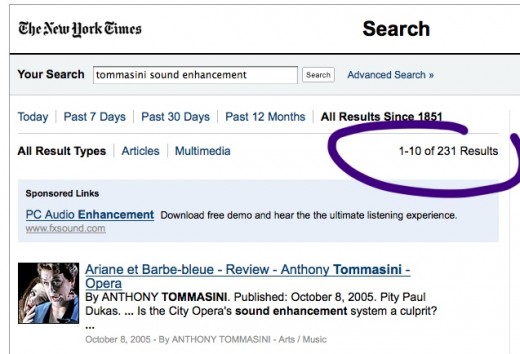
For the longest time, Tony’s tip-top topic, amounting almost to an obsession one might say, was the subject of the sound enhancement system installed in the New York State Theater a decade ago.

Over the past ten years, TT has returned to his subject, uh, occasionally.
231_results

If La Cieca were feeling less charitable, she might call the Tommasini v. Microphone feud an idée fixe, but La Cieca is feeling charitable, so she’ll just say, well, at last Tony has got his wish.

Though, as TT himself notes, an acoustic theater does not necessarily mean a voice-friendly theater; so we’ll have to wait and see, won’t we?

25 comments

  • Pelleas says:

    “A huge part of the magic of opera is the fact that these great voices can fill a large auditorium all by themselves”

    See, that statement is what I have a problem with in this sort of discussion. Because the acoustic of a given auditorium is a matter of science, not artistic principle: the damned house was unfriendly to voices to a degree sometimes damaging to the overall effect of a given piece in that it made parts difficult to hear. And this was not due to singers who couldn’t fill a large auditorium, because size isn’t the issue in the acoustic problems of that space.

    There’s a kind of denialism going on here that I respectfully suggest crosses over into magical thinking, and I can’t imagine who might benefit from it.

  • Cocky Kurwenal says:

    Pelleas, whether you think it’s magical thinking or not, it is, for many of us, a defining characteristic of opera. And the point of the article seems to be that they’ve addressed it, and found a way to make the theatre work for opera without electronic enhancement, even if the results remain to be heard. Assuming it has worked, it suggests that it wasn’t denialism or magical thinking going on, just a desire to uphold an artistic principle, which has now hopefully been achieved.

  • La Cieca says:

    Kurwenal: The issue of electronic vs. acoustic enhancement should be unimportant, assuming the enhancement can be done in an unobtrusive way. My impression at the State Theater especially after the first season of the dreaded miking was that the enhancement was fairly unobtrusive, or I should say less obtrusive than the experience of having to strain forward to hear voices hobbled by a dead auditorium.

    In other words, I think the City Opera’s solution was a valid compromise under the circumstances, particularly since it was put in place (as it was understood at the time) purely on a temporary basis while the company sought a new performing space. The “principle” really had to take a back seat in this particular circumstance of a company forced to perform in an acoustically unfriendly theater.

    And there were a lot more pressing problems at NYCO in the early 2000s than “amplification” — patchy casting, mediocre musical direction, and some serious lapses in taste in repertoire (that ghastly Central Park, for example: does anyone seriously believe that chunk of dreck should have come into town?)

  • Pelleas says:

    “Pelleas, whether you think it’s magical thinking or not, it is, for many of us, a defining characteristic of opera.”

    So what was the option? Shutting down operations entirely? They share the space with a company that would hear NOTHING about acoustic changes that might lead to louder footfall during dance performances. So…what’s the option? As it is I’m surprised they got these recent renovations agreed upon, much less completed.

    How unamplified singing as a defining characteristic of opera squares with the reverance for old recordings as benchmarks of vocal performance is isn’t quite clear to me, unless one only discusses recordings of performances one has actually seen. Because once you’ve involved a mic, you’ve involved some form of amplification, no? But I guess there are all sorts of slippery slopes, and it’s One of Those Days at the job, so I’m cranky.

  • Gianni B says:

    When you have a casting director and general manager that insist on hiring vocally underdeveloped, pretty, post teenagers to sing roles at a major theater with a dead acoustic “you gotta use duh micwophones.” I have never had a problem hearing the likes of Beverly Sills, Sam Ramey, Spiro Malas, Norman Triegel, Placido Domingo, Carol Bayard,Barry MacCauley, Ruth Golden, Diana Soviero, Alexandra Pendatchanska, Lauren Flanigan and hundreds of others in State Theater. It is only in the past seasons especially the advent of Paul Kellogg and his tenure did the vocal quality and volume diminish. Hopefully the new renovations will provide a better chance for the modern day City Opera singer to be heard. Or perhaps they could hire a casting director that understands what resonance is?

  • kashania says:

    In Toronto, we now have an opera house with brilliant acoustics. But prior to that, our hall (now called the Sony Centre) had seriously inadequate acoustics. The acoustic enhancement helped to make the music more audible, especially in the far corners of the overhang in the orchestra. It wasn’t an ideal situation but it was a solution that made the best of the circumstances. I think La Cieca raises an interesting question: What’s more intrusive — the acoustic enhancement or having to lean forward to try to better hear the singers?

    A purely acoustic hall is always the ideal but the alternative is an expensive new building or an expensive gutting and rebuilding of the exisitng hall. That’s not an option for most companies.

    What worries me about the State Theatre renovations is that, despite the price tag, not all that much has been done for the acoustics of the place (from what I’ve ready anyway). On the surface, it does not appear to be money well spent.

  • RDaggle says:

    Another critic who was obsessed with the NYCO amplification system was Martin Bernheimer.

    I don’t recall reading a single review where he didn’t throw in some gratuitous jab.

    ‘Cut and Paste’ is so useful isn’t it, Mr. B.?

  • m. p. arazza says:

    “Having to lean forward to hear the singers” was never really the problem at NYCO in my experience. Obviously the State Theater was not the most live acoustic, but you could hear the singers. The issue was more how you heard them. I gather the house’s acoustics may have been more problematic for the performers themselves.

    I think that leaning forward to hear the singers, at least some of the time, is part of the live operagoing experience anywhere. Some of the most thrilling moments have been spent leaning forward to hear the singers most intensely.

  • Alto says:

    “We still don’t know what the new acoustic in the State Theater is going to sound like, and Steel is whistling in the dark when he claps his hands and marvels at the echo …”

    I agree that he’s whistling in the dark, but not for the reason you insinuate. The empty theater’s acoustics have little relationship to those of the full theater. We’ll see about that tonight.

    And, by the way, he is not marveling at an “echo.” An echo would be disastrous in any hall. He’s trying for *resonance* or *reverberation*. An echo, which more or less distinctly reiterates a sound in a noncontinous manner, is another thing altogether. St. John the Divine has a 7-second reverberation but no echo at all.

  • Cocky Kurwenal says:

    Pelleas, the option is to carry out just such work as the state theatre has apparently done in the article cited by La Cieca in the original post. It has been dealt with, let’s hope it has been successful.

    I don’t really get the leap you make from my apparently purist stance on amplifying live performance to the invalidity of recordings – personally I have no difficulty thinking of them as separate and different ways to enjoy opera, and I don’t kid myself that the experience of hearing a voice on CD equates to hearing it live. I hope I am not guilty of the reverance and use of them for benchmarking which you mention.

    All I’m saying is that if I go to the opera in an opera house and find they’re using enhancement, I don’t feel like I’m getting the real thing, and it detracts from my enjoyment. If it doesn’t detract from yours, you’re fortunate.