Enigma

At this point, Maria Guleghina is still listed as tonight’s Turandot at the Met. Any of the cher public attending this performance are encouraged to share news, reviews and scuttlebutt about what did or did not happen (broad enough for you?) here in the comments section.
BigAl: you were “there” but you’re still not sure “she sang.” Huh?
Dorion: Why would the “Russian mafia” be interested in a singer who isn’t Russian?
Maria Guleghina is Ukrainian and Armenian and calling her “Russian” would be akin to calling Oscar Wilde “English.”
#10: I’m sorry that Guleghina ruined your performance of La Gioconda at the Met, especially sorry since I didn’t know that she sang that role at the Met; is this another instance of the phenomenon described by #8 of being at the opera house, being “pretty sure” about who is singing, but not really knowing in the end? Perhaps there is a Bernard Holland review of Guleghina singing La Gioconda at the Met?
According to Maria G’s website La Gioconda is not even in her repertoire
Maybe you mean Adrianna Lecouvreur?
I saw Ghuleghina last year as Turandot in Washington. I was expecting a complete disaster, but I was very curious about the Liu so I went anyway. Ghuleghina was in astonishing form that night, i wrote a review of that performance and this is what I thought of her:
“Casting Turandot as been as much of a challenge as casting Isolde in recent years, and WNO seems to have found a winner. Maria Ghuleghina has always been a divisive artist. Her instrument is not traditionally attractive, and her technique is questionable. She often loses breath support when trying to sing soft lines, which lends an acid tone to the straight tone this produces. However, Turandot’s music mostly calls for fierce, exulted and loud vocal lines. These are three qualities at which Ms. Ghuleghina excels. Her entrance aria and the riddles scene were absolutely thrilling. She never lost steam, remaining a vocal powerhouse until the very end end of the final duet. Her voice is enormous, she displayed a command of the long legato required, and blew the audience to the back wall by the sheer force of her voice. She also acted the role gracefully, shading it with many different emotions – she was not just a vengeful princess. She explored the fear, the doubt, and most importantly the love, that in turn haunt the title role.”
I was very hopeful that she would prove everyone wrong this year too with her run of Turandot at the Met. Don;t get me wrong, I am nof fan, but it is always wonderful to see a singer surprise the audience with how great they are. It appears this will not happen. What has occurred between Spring and now that made her incapable of singing this role as well as she did in April? Or is she just still sick, needs the paycheck and refuses to have Lindstrom steal her thunder?
Wow. She not only did and didn’t sing Turandot but she’s been seen giving phantom performances of Gioconda. She’s really redefining the term “interesting artist.”
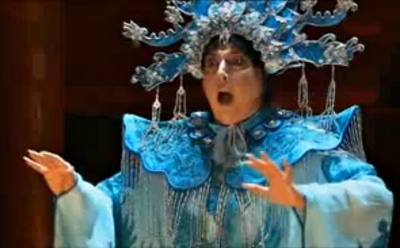
TURANDOT mightily pleased the Halloween audience in Saturday evening’s performance. The production is such a singular artifact, if the Met should replace it with another, it should be moved somewhere to a museum dedicated to the excesses of FZ. It is so much more than any theatrical presentation would ever need to be that it should be preserved, even should it be taken “off line,” like the Hoover Dam: the land and waters of the earth will be better off when the dam no longer obstructs, but as a sheer construct it would instruct and amuse the future if it were left intact but non-functional.
There is not a single example of possible Chinoiserie unrepresented by Franco. At one point, as the multitudes assembled for one scene, I wondered who had been left out. Well, there are no horses or elephants, but they are not missed. The multitudes are enough, and they happen to be the chorus, which performed at its current high level. Energy and invention never flag in the stage movements. The costumes are consistently detailed and beautiful, and effective in the mise-en-scene and movement. If I were Gil Wechsler, I would check back in with the lighting people, because either they don’t like Maria G or they were not paying attention in general, because they spoiled two of her entrances by leaving her in the dark. In this production that is a glaring event, as it is so dependent on these technical skills. The use of the stage machinery is consistently dramatic.
And by the way, there are prostitutes in the third act, so those who were disturbed by the prostitutes ministering to Scarpia in the new TOSCA should avoid this production if they have not seen it, and if they have seen it and have not complained, they should shut up about the TOSCA.
Maria Guleghina was the news in that she did sing. What will not be news to her fans and her detractors is that her performance was what you would have expected. She did some awesomely loud and effective singing where she should have, and in the music where the volume should not be forte or mezzo-forte she crafted with too visible artifice a reasonable approximation of the part. Her plastique also was reasonable for this archetype fairy tale.
Marcello Giordano had no surprises for us either. He has no low notes, which we already knew, but he doesn’t force to compensate, which is considerate, and he doesn’t obsess about it either, and just proceeds to his comfort zone whenever he is offered the opportunity, which is often in this part. He has charming Italianate habits, and is yet possessed of a really significant yell where it is required, which again happens often in this part. Altogether, his impersonation of Prince Calaf is a thoroughly enjoyable escapade if you are the type to just enjoy this folderol. As I obviously am, since I was there.
Marina Poplavskaya has a more complicated voice than is require for the part of Liu, but I do not believe that this should be held against her. She struggles to provide a Liu with more substance than the part provides, and understandably fails: but she does give the music as it is, and is in the end affecting.
I read some days ago comments about Charles Anthony and Samuel Ramey, both senior and seasoned artists at the MET, and both responsible for consistent and memorable performances in the past, and for a consistent wobble in this one. But they are playing old men, and as neither has any sustained phrases which would be distorted by a wobble, their performances proved effective.
Ping (Joshua Hopkins), Pang (Tony Stevenson), and Pong (Eduardo Valdes) were a sonorous and engaging trio. Keith Miller showed a voice and presence worthy of more elaborate roles than the mandarin herald. The Executioner (Antonio Demarco) never opened his mouth, but his gym fetish certainly augmented the drama. Surprisingly he was not mentioned in the Times review.
The orchestra played up to it’s considerable standard, largely unassisted but also unimpeded by the conductor, who settled for directing traffic, and at one point narrowly skirted a train wreck. It was a thrilling moment as the behemoth first tottered and then righted itself.
By the way, the audience grew impatient with the length of one of the intermissions, and engaged in a minute or more of rhythmical applause to signal its exasperation.
yeah yeah whatever, I meant Adriana, not Gioconda, I hadn’t had my coffee (still haven’t) and they’re two silly verismo pieces anyway. It doesn’t change the fact that Guleghina was terrible last night as Turandot as she was terrible as Adriana, Norma and Lady Macbeth.
In all fairness, I witnessed one good performance as Santuzza and another as Abigaille by her. But that was years ago.
If Guleghina is Ukrainian, she needs to stop labeling herself as Russian. The same goes for Netrebko and Hvorostovsky, two Ukrainians.
There was discussion on an earlier thread as to the amount of preparation Ms. Lindstrom had before her Turandot debut Wednesday night. I learned, directly from Ms. Lindstrom, she received the call at 6:15pm that evening as she was finishing an early dinner. Until that evening’s performance she “….had never before rehearsed on stage, in costume, with any of the others or the orchestra at all.”