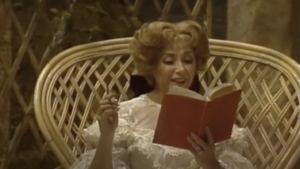
Happy birthday Edith Head
The legendary costume designer for film was born October 28, 1897 in Searchlight, Nevada. Miss Head dressed practically everyone in Hollywood, including Helen Traubel, seen after the jump in an outtake from the 1961 comedy The Ladies’ Man.
Not bad. Didn’t Bing try to get rid of her first by bringing back Flagstad to show New York how Wagner should really be sung? And when that didn’t work, he fired her for singing in night clubs.
As a “high culture” addict whose guilty pleasure is Hollywood sword and sandal epics (“O, Moses, Moses!”), I grew up with lots of Edith Head-designed movies under my belt. My husband actually met her once when he took his theater class into the studios to see production close up. He said she was delightful and very generous of her time with the students.
Traubel was lovely… I don’t know about the Bing story, but I know Erich Leinsdorf wrote in his memoirs that she was the “Laziest singer he ever worked with”. And kids, Leinsdorf had a long career.
According to that nasty-tongued Maestro, he had to take a taxi to her apartment to coach her in roles. It was impossible to get her to come to the Met for anything short of a full orchestra dress.
“Didn’t Bing try to get rid of her first by bringing back Flagstad to show New York how Wagner should really be sung?”
In what universe was Traubel ever considered inauthentic in this repertoire? She was known for being a bit lazy and unambitious, yes, but I can’t recall hearing that her Wagner was something other than the way it “should really be sung.”
Traubel and Melchior both felt threatened when
it was announced that Bing was going to take over the Met from Edward Johnson. Bing was more anxious to get rid of Melchior who he felt was old, fat, and lazy and one way or another, contract negotiations were managed so that Melchior felt insulted and quit.
Traubel had also behaved in a way that offended Bing’s acute sense of decorum. He felt she was fat and lazy too but also undignified. I think he would have liked to be rid of her too but probably felt he couldn’t risk losing an American soprano who more than any other held up the wagnerian roles during the war and later. So he made an uneasy truce with her, split the ring cycles between her and the returning Flagstad and gave her a new role, the Marschallin, that wasn’t too high . (Traubel’s upper register had receeded during the 40s to the point that it stopped around high A).
But the truce didn’t last long. Traubel and Bing came to grief again, the superficial reason being Traubel’s night club appearances.
Mostly Bing disliked her “hearty” persona and to be fair, unless she switched to contralto roles, had very little in the way of viable repertory. And so Traubel left.
But what was Bing thinking? when he came to NY in 1950, he had Traubel and Varnay as Wagnerian sopranos. He brought back Flagstad who was shamefully ignored by Johnson. So he had three. But Flagstad only did one season of Wagner after her return (and a second season of Alceste performances) and then left.
Traubel was forced out a year or so later.
But Bing then alienated Varnay a few seasons later. And Varany still had a lot of mileage on her with the heroic Wagner roles. Bing was left with Harshaw, who was a fine performer but not really of the Flagstad/Traubel/Varnay stature.
Bing may have been looking for a way to skip the regular Ring/Tristan performances that the MEt audiences were used to, using the lack of really top tier sopranos and tenors as a justification.
Once Nilsson came though, Bing was forced to present regularly in Wagner roles.
Richard, et. al.: I’m always diffident about assigning motives to people’s actions, particularly since the people involved don’t always understand why they’re behaving they way they do.
Bing does talk in his memoirs about lax discipline among star performers at the Met as regards to rehearsals, cancellations and so forth. He doesn’t talk about another factor that must have helped drive his decision to cold-shoulder stars like Melchior and Traubel, which is that they were expensive and that they had little future in the opera house. For stars in mid-career (e.g., Milanov, Albanese) Bing was willing to be more flexible, perhaps because he knew that the worry and time spent on them in 1950 would reap benefits through the rest of the decade.
Flagstad’s return to the stage in the late 1940s was one of the most stupendous events of the era, and it was a coup that Bing managed to get a couple of seasons of performances from her for the Met before she decided to retire for good. He did balance off performances between her and Traubel if only for the practical reason that Traubel was a Met favorite and overshadowing her would be bad public relations. She was also singing pretty well at the time.
The other issue relating to “discipline” was a kind of cheap showbiz atmosphere surrounding the Met during the late Johnson era, at least as Bing perceived it. His idea was to try to reposition the Met as high culture, art with a capital A. Obviously this would be difficult to do when one’s Isolde is most widely known for her nightclub work. You may argue that Bing’s theory was wrong or that he did single out Traubel as an example to try to scare other artists into toeing the line. But I don’t think he acted out of personal spite.
I’ve actually been to Searchlight, Nevada. It’s basically a wide spot on U.S. Highway 95 between Las Vegas and Laughlin, with one casino (Searchlight Nugget) alongside the only road in and out of town, and a cluster of homes directly behind it. Last time I was through there (1988), I was struck by the desolation of the area – I can’t even imagine what it must have been like 100 years before.
as far as i know (and what do i know?!) bing put a clause in singers contracts, forbidding/preventing them to do nightclub gigs and as traubel enjoyed her nightclub gigs (presumably they paid well too) she refused to sign such a contract for the 1953 season and that was the end of her met career.
wasn’t caballe supposed to be lazy too? didn’t do her career any harm eh?
yes, La Cieca has it…. Bing was totally Zeitgeist as far as the move toward making Opera and Classical Music worthy of the capital letters. This was a pervasive 50s arts marketing attitude. Flagstad’s Met return was an inevitably big moment regardless of Bing’s personal motivations.
Perhaps one of Bing’s reasons for being so hard on ALL these singers is his personal dislike of Wagner in general. Didn’t he more or less say he would prefer to have nothing to do with it?
Once there were true Wagnerian singers like Traubel, Flagstad, Varney and Nilsson.
Today in exchange all we have, are voice contorting ‘emoting actress singers’. Their individual interpretations are more to do with their attempts trying to negotiate their own limitations. The wonder of these performance ..to marvel and exclaim with loaded qualifications at cases of “Oh God, she survived it…but for how long?”