
Transfiguration

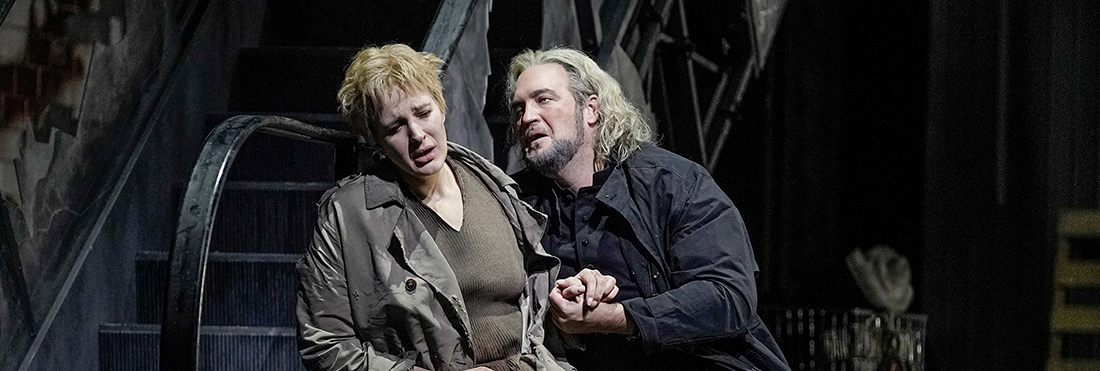
The best way to pay tribute to a legendary Wagner interpreter? Why, to perform the “Liebestod” as beautifully as Nina Stemme did at the first Birgit Nilsson Prize Award Ceremony just last week.
More details about The Birgit Nilsson Prize Award Ceremony 2009 are online.
CerquettiFarrell, speaking of lavish LP packaging, remember those great Soria Series issues from RCA. Those were the real “jewell boxes” of recordings! Ah well, gone are those days. Now we’re damned lucky to get a libretto.
You all mark — Our Own Janice Watson will be THE Isolde of the 21st century.
I don’t understand this talk of Varnay’s perfect bel canto technique. To me, even in her youngest recordings, it sounds like a voice with a lot of unresolved technical issues, with her getting through her roles as best she could in spite her difficulties. Her singing so seldom sounds easy in terms of getting from one note to another (volume is a different matter, of course). I’m not disputing that she studied Italian bel canto technique, but I would question how far she got with it and how much she managed to incorporate into her singing. Surely if she had mastered it, she’d have made a more idiomatic Amelia Grimaldi – as it is, it is one of the strangest pieces of Verdi singing I’ve ever heard. I absolutely adore Varnay, but it would never occur to me to praise her technique.
I agree with the comments about Price’s Isolde above – I too used to adore it without question, whereas now I have to be in the mood, I’m less sure it was such a great idea, and her idiosyncratic technique which can work in Mozart because the effect is almost instrumental feels odd in Wagner. She does get the attitude over well though, particularly the sarcasm. I’d never be without this recording though, for Kleiber, and for Fassbaender.
The Bernstein is just wonderful, and if he had used Fassbaender instead of Minton, it might be a clear first choice for me.
89. Thanks for these suggestions. I already know most of those artists – Bonitatibus in the live Pergolesi operas is especially thrilling!
The “Agitato” is a great reading of the aria! Sorry to be nit picking but that lady is slightly flat on the top but a really brilliant reading – nice, and difficult, ornaments too!
93. Varnay’s technique sounds pretty formidable. (Her main teacher was her mother who was a coloratura.) I agree her Italian stuff sounds odd – I only have her Lady M so maybe I’m not being fair. Although compared to Moedle she was bloody near perfect technically.
Monty Nostry (#66)asked about which post WW2 singers have Italiante, phayrngeal placement…Of course, Flagstad, Traubel, Farrell come to mind Steber, Kirsten…most of the great divas. Scotto did until she got too wordy and her voice became so overly bright emphasizing an over abundance of squillo..ditto Callas…Leontyne Price certainly had that quality, too. It is simply TECHNIQUE…not particularly German, Italian or any other nationality…it is just the way to sing. At the risk of infuriating everyone, I would submit that it all has to do with placement…and singing the AH vowel correctly. Most people sing too open of an AH. It makes the voice mouthy and throaty. The Italians eat pizzuh, not pizzAH…The opera is called Toscuh( NOT ToscAH,for example) Uhiduh, Luciuh…if you get my point. This will send voice teachers up the wall…but this is the way these words are actually pronounced…and if you sing the words like this, a beautiful, round, focused Italianate AH will emerge…It keeps the AH vowel pharyngeal and enclosed, like the rest of the vowels. Sorry for the mini voice lesson here…but this works for everyone I have shown it too…big time. Worth a shot, NO?
I want to like this Stemme performance more than I did. It’s a moving performance, which is the most important thing but the vocalisation isn’t as great as I would like. I also agree that the close miking doesn’t do her any favours. I much prefer the clips of her Senta that someone posted a few days ago.
For Isolde’s Transfiguration, I prefer big, warm voices that “envelop” the music. Flagstad and Norman are perfect fits. I’m going to post the Norman clip that LIndoro posted way earlier because I think it’s one of Jessye’s greatest accomplishments. Vocally, the piece sat perfeclty in her voice. And the long lines (and incredible breath control they require) provided the type of challenge to which Norman could rise so splendidly.
Very interesting, operaddict. Many thanks for the explanation. But what about Joan Sutherland’s ‘euh’ vowel?
More Stemme conversation.