
Headshot of La Cieca

Cher Public

  • Indiana Loiterer III: September 24 – Elisir 26 – Turandot September 27 – L’El...
  • oedipe: Let's not be reductionist ourselves: I don't believe the art...
  • armerjacquino: http://parterre.com/2011/08/08/rip-brad-wilbers-met-futures-...
  • grimoaldo: Has anybody posted the classical Grammy winners?Engineer...
  • almavivante: When I read an inspired extravaganza like DharmaBay's, I rea...
  • OpinionatedNeophyte: Is this the same Laquita Mitchell? Is she ready for prime ti...
  • Betsy_Ann_Bobolink: An interesting sidebar is that to be historically "accurate"...
  • grimoaldo: Yeah, I missed both of those too. Very good, very funny, con...
  • CruzSF: Congrats to DharmaBay and iltenoredigrazia. I don't know HOW...
  • OpinionatedNeophyte: *sigh* The far more interesting "racial edge" to the story i...

blog advertising is good for you

American Beauty Rosenkavalier

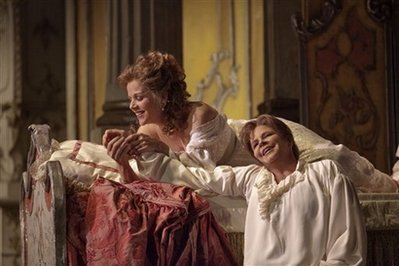
Metropolitan Opera, Ken Howard

[La Cieca is delighted to introduce a new reviewer, @scazzasofija.]

I found Rosenkavalier (Met, Oct. 13) to be mostly sublime. My quibbles come from a preference for Kleiber’s tempos. I found that de Waart was waving his arms as fast as he could for the beginning, but I think the prelude and up until the Marschallin’s monologue were too slow, not enough contrasts for the end of the act. I think this is the conservative American take on this opera, so I think it wasn’t a “problem.” However I felt that the Marschallin and Sophie lacked amusement and a real bright perkiness respectively partially due to the tempos.

Fleming looked a bit like Tatyana in bed, the wig basically the same and a similar nightgown. The relationship seemed troubled from the start. Her Marschallin was very relaxed in bed, no coyness or nervousness. However she was very affected by Octavian’s outbursts, exasperated rather than standing above and amused at her lover. She also did not seem in love with him, she looked more unhappy and besieged. Her lines “you’re like all men” and its like that run through the opera, stood out.

It came off that they were bickering and so the natural flow of the first act to their unhappy parting seemed natural, and more like a breakup, and I found myself thinking that she’s better off without him. The dramatic choices made a lot of sense, and at no point did I get the impression that the Marschallin was anything more than tolerant of her life and duties.

Vargas did not sound good in the house. I thought he had a cold. He lacked core, easy power, it felt pushed. Not like Onegin. He looked to be struggling.

Act 2 also lacked a fast enough tempo in the fast parts and Persson does lack enough perkiness to make Sophie really stand out in charm against the Marschallin. Also Persson’s voice has a darker color & round quality than what we’ve come to expect from Sophie (Damrau, Bonney, Battle) that some people might have a problem with. It was an interesting match with Graham in the duets; there were times when I couldn’t tell who was talking. I think the tempo, her acting, and the color of her voice did drain Sophie of her uniqueness a bit. Not enough contrast for me though. I found that the “Rosenkavalier” costume aged Graham and I had to focus on her acting to see her as the 17 year old boy. She was very amusing in the tavern scene.

Both Graham and Fleming sounded good. Fleming sounded lovely, none of her crazy habits, and nice low notes (though a bit inconsistent, but I’m really picking here). You really wanted to hear more. Fleming really shone in the third act The intervening time gave her voice a nice, relieving contrast from what we’d heard: silvery, narrow beauty. I’d never heard her like that.

The entire night she did well to emphasize the conversational-quality of the language and dialogue, and she seemed very naturally fluent (demonstrating how she is fluent) in her German conversation. This was especially in the beginning of the trio where she took a less reverent stance for “Hab mir’s gelobt” then that she was continuing a train of thought that she had been having throughout the opera. She wasn’t even turned to the audience yet. I found it very effective and real.

Ochs was good. He cracked once in Act 2 and seemed to struggle with his lowest notes. But he had verve, fit the bill. The production was unoffending, traditional, with occasional touches of the sublime with the Marschallin’s opulent lavender and silver, Schwarzkopf-like costume, complete with white wig and aigrette, contrasting with the brown and dark colors of the tavern. The music was consistent, singing lovely, and really a wonderful package overall for the Met.
60 comments

  • @scazzasofija says:

    Arianna a Nasso then you would be surprised too see the occasional push and pull from the singers to de Waart for tempo. Renee definitely wanted her slower tempos at times (beginning of the trio, he definitely was trying tog et her to go faster). Obviously Levine would have indulged her in that, it didn’t look like de Waart had much choice.

    Keep in mind the preparation staff is Levine’s. I know some of the coaches and they know exactly what Levine wants. That is how they prepare the singers. So yes, I still think it would be hard to retrain them, and I think it’s not really what de Waart was called on to do.

    He did a wonderful job, & thankfully not as sappy as Levine would have conducted many stretches of this opera.

  • @scazzasofija says:

    Anyway, why is there such a problem with my feeling that the Germans do this opera differently than the US/UK? On DVD Kiri & Solti are just slower and more restrained than Kleiber & Jones. I’m surprised since this is pretty obvious.

  • Sanford says:

    scazza, after the http add a v… httpv:// etc etc. That will embed the video

  • Gualtier M says:

    I wanted to post a picture – which I couldn’t figure out how to do in the last version. How do I do it now?

  • Arianna a Nasso says:

    @scazzasofija @32

    Interesting idea, but I’m not sure it’s quite so clear. Solti grew up in the same Central European tradition as Kleiber. He was music director in Munich and then Frankfurt for over a decade combined before going to Covent Garden. I would be surprised if working in London caused him to change his interpretation of Rosenkavalier which would have been formed by conducting the opera in Germany.

    Is Kna’s handling of this piece as broad as his Wagner or fleeter a la C. Kleiber?

  • squirrel says:

    I agree with Arianna, it’s naive to think this is LEVINE’S production as though Levine had even asserted himself in rehearsals so much, laying down the law about how things should go etc. Esp with the Met orchestra in the pit…
    Whoever is conducting that night – it’s THEIR Rosenkavalier.

  • squirrel says:

    language coaches and particularly astute native speakers (I hesitate to say any native speaker because we know what a can of worms that is!) would recommend Ms Steber change her mind, and pronounce is SSALOME instead of Zalome. The truth is in the middle and leans more toward the former.

    SSalome. I stand by it!

  • Cocky Kurwenal says:

    Squirrel @ #37 – why?

  • mrmyster says:

    squirrel – you are so right about this; give anyone two rehearsals with the orchestra, and it’s his show musically speaking.
    I’ve seen de Waart rehearse an orchestra many times in SFE and heard his Mozart and Strauss, and it does not take long at all for him to imprint the performance — he’s cleaner, lighter in texture, a bit swifter at times than Levine (or late Levine), and he is, in the best sense, more of a “theatre” conductor — he understands a given opera is a show — the show is on stage, it does not center in the pit. I expect you know what I mean.
    Scazzasofija, if I say may say my dear, don’t take it all so seriously. I don’t myself and I try not to take myself very seriously, dontcha know? No reason to be defensive about my comments — I surely respect you and intended nothing personal. It’s just that I go back to Irene Jessner and Eleanor Steber in Der R., and can’t help myself.
    Cheerio. MrM

  • squirrel says:

    kurwenal –
    because I said so? seriously, why would it be pronounced ZZ? Because your german teacher told you to pronounce all s’s like that? Seltsam, So, Singen all work according to that rule, but proper nouns are different. Siegmund is ziegmund indeed, but it’s a more native German word. Salome is a borrowed word, first from Hebrew or something (god knows) and then more directly from French.

    anyone who has another take on it is welcome to (politely) chime in.