
American Beauty Rosenkavalier

[La Cieca is delighted to introduce a new reviewer, @scazzasofija.]
I found Rosenkavalier (Met, Oct. 13) to be mostly sublime. My quibbles come from a preference for Kleiber’s tempos. I found that de Waart was waving his arms as fast as he could for the beginning, but I think the prelude and up until the Marschallin’s monologue were too slow, not enough contrasts for the end of the act. I think this is the conservative American take on this opera, so I think it wasn’t a “problem.” However I felt that the Marschallin and Sophie lacked amusement and a real bright perkiness respectively partially due to the tempos.
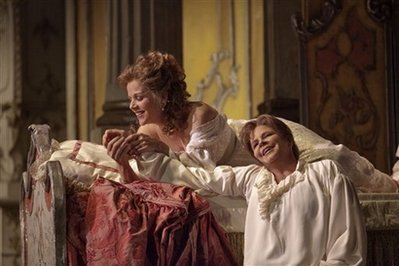
Fleming looked a bit like Tatyana in bed, the wig basically the same and a similar nightgown. The relationship seemed troubled from the start. Her Marschallin was very relaxed in bed, no coyness or nervousness. However she was very affected by Octavian’s outbursts, exasperated rather than standing above and amused at her lover. She also did not seem in love with him, she looked more unhappy and besieged. Her lines “you’re like all men” and its like that run through the opera, stood out.
It came off that they were bickering and so the natural flow of the first act to their unhappy parting seemed natural, and more like a breakup, and I found myself thinking that she’s better off without him. The dramatic choices made a lot of sense, and at no point did I get the impression that the Marschallin was anything more than tolerant of her life and duties.
Vargas did not sound good in the house. I thought he had a cold. He lacked core, easy power, it felt pushed. Not like Onegin. He looked to be struggling.
Act 2 also lacked a fast enough tempo in the fast parts and Persson does lack enough perkiness to make Sophie really stand out in charm against the Marschallin. Also Persson’s voice has a darker color & round quality than what we’ve come to expect from Sophie (Damrau, Bonney, Battle) that some people might have a problem with. It was an interesting match with Graham in the duets; there were times when I couldn’t tell who was talking. I think the tempo, her acting, and the color of her voice did drain Sophie of her uniqueness a bit. Not enough contrast for me though. I found that the “Rosenkavalier” costume aged Graham and I had to focus on her acting to see her as the 17 year old boy. She was very amusing in the tavern scene.
Both Graham and Fleming sounded good. Fleming sounded lovely, none of her crazy habits, and nice low notes (though a bit inconsistent, but I’m really picking here). You really wanted to hear more. Fleming really shone in the third act The intervening time gave her voice a nice, relieving contrast from what we’d heard: silvery, narrow beauty. I’d never heard her like that.
The entire night she did well to emphasize the conversational-quality of the language and dialogue, and she seemed very naturally fluent (demonstrating how she is fluent) in her German conversation. This was especially in the beginning of the trio where she took a less reverent stance for “Hab mir’s gelobt” then that she was continuing a train of thought that she had been having throughout the opera. She wasn’t even turned to the audience yet. I found it very effective and real.
Ochs was good. He cracked once in Act 2 and seemed to struggle with his lowest notes. But he had verve, fit the bill. The production was unoffending, traditional, with occasional touches of the sublime with the Marschallin’s opulent lavender and silver, Schwarzkopf-like costume, complete with white wig and aigrette, contrasting with the brown and dark colors of the tavern. The music was consistent, singing lovely, and really a wonderful package overall for the Met.
I have a Feeling that Mia Persson is the kind of singer that will grow with Rosenkavalier. She is not singing Sophie, but I would not be surprised to see her as Quin-Quin in the near future and as Marie-Therese eventually.
I love that woman.
But, Lindoro, will anyone have the courage to cast a soprano a Octavian these days?
“I found that de Waart was waving his arms as fast as he could for the beginning, but I think the prelude and up until the Marschallin’s monologue were too slow, not enough contrasts for the end of the act. I think this is the conservative American take on this opera …”
I know there are those who like to blame everything they don’t like in opera on “conservative American” influence, but it would surely surprise De Waart to be thought of as an American, conservative or otherwise.
Madame La Cieca, I do so hope you have not signed The Scazzasofija music critic to a long term contract.
Lack of ‘perkyness?’ A lack of perkyness in any any Rosenkavalier perf. would be a decided asset in my view. Remember 1949 — well of course you don’t, but in that year Eleanor Steber sang both Sophie and the Feldmarschallin within six months at the Met. Steber, considered the finest Sophie of her day, had not one ounce of ‘perkyness.’ Pensez-la!
Fleming’s Marschallin was too “relaxed in bed….no coyness or nervousness.” What a startling comment, considering the Marschallin has just had a three-trombone orgasm as very clearly described to us by the orchestra. I am surprised we find her awake!
mrmyster: You make a fascinating point. I did NOT see Steber in either of those roles — honest. But you convey a vivid idea. A shy, rather backward Sophie could be far more endearing — and true to her music — than the proto-vixen that we often see.
Which also gives me a feeble pretext to trot out one of my favorite sallies from an Andrew Porter review of a Count in Figaro. He said that the person had played the Count as a young Baron Ochs, whereas he should be an older Octavian.
P.S. Of course Steber’s whole idea of the work came from many, many performances of it with Lotte Lehmann. She was completely inexperienced — had sung one opera role, a performance as Senta, in English, with Boris Goldofskky in Boston — when she made her Met debut, as Sophie opposite Lehmann. I remember a review of Olin Downes that I once looked up, in which he spoke of how fortunate New York was to have, night after night, the world’s greatest trio for the piece performing it: Lehmann, Risë Stevens, and Steber.
Oh, to have been there.
Miah Persson started very nicely, but it looks like she’s aiming to become Renee’s little sister, looks and all. Besides, she sings flat like hell, nowadays. Her Glyndebourne Fiordiligi was quite tragic
This is terribly flat, constantly :
Bonney is etheral here, a very good case of a singer focussing on being a musician
I’ve NEVER pegged Sophie as a “vixen”, proto or otherwise. Mind you, I’m not as familiar with Rosenkavalier as I am with some of the other Strauss works, but every time I listen to it, she strikes me as a character…how can I put this…she’s not necessarily naive, but she isn’t really prepared for the lifestyle she is now leading.
Sophie and Fanninal are New Money (given how Fanninal has to be instructed in the social niceties by his haushoffmeister, probably VERY new money) and while she’s been prepped to hobnob with aristocracy, she’s still ill at ease among the upper classes. In Her first attempts at conversation with Octavian, she talks to him about himself like he’s a movie star or something (“I’ve memorized all your middle names!”). Octavian is unasuming, polite, and of course they’ve just fallen in love at first sight, so she quickly becomes more comfortable around him, but when Ochs comes in you can tell it throws her. She has no idea how to handle this boorish oaf, and is quickly reduced to tears. She’s not shy, but she’s not a “vixen” either. Rosina is a vixen. Susanna is a vixen. Musetta is a vixen, and when it comes down to it, Mimi is too, a bit. Sophie? not a Vixen.
Sophie is coquettish. If you want a Strauss vixen, try Zerbinetta. For us older folk, the current Met production when brand new was conducted by Bohml and when I saw first saw it, Rysanek, Ludwig, Reri Grist, and Walter Berry were in the cast. Even after a “Hair” matinee and way too much pasta and wine at that awful Mama Leone’s restaurant, that evening’s Rosenkavalier was mesmerizing, surpassed only by a Kleiber-conducted performance in Muenchen in 1979 about a decade later. Sorry to harp on the good old days, but they really were quite extraordinary.
From what I heard last night, a decent performance but not yet at the same level that entranced Verlyn Klinkenborg when Fleming and Graham first appeared together in the opera at the Met. Klinkenborg’s essay, which ran in the NY Times editoral section, was one of the most evocative pieces I’ve read about opera.