Dawn of the Philistines

I’m not sure who I find more annoying – the partisans who vigorously defend Luc Bondy’s production of Tosca at the Met or those who decry it. As Bondy’s production replaces one of the Met’s signature offerings, both groups have seized on this event as a watershed event in the history of opera in America and have been flogging their opinions of the production endlessly so as to advance their broader agenda. So once again, poor Floria Tosca has become a victim in a war that she wanted nothing to do with.
Let’s start with the pro-Bondy faction. For them the booing of the production represents the latest and most egregious example of American cultural provincialism. We’re nothing but a bunch of small-minded yokels who judge any opera production by how much we like the scenery and costumes.
In America, opera is a Las Vegas floor show with better music and the boobs sitting in the expensive seats. They imagine the Met’s audience to be composed entirely of literalist Antonin Scalias who don’t see any penumbras of interpretive possibility within the standard repertoire. In other words, anyone who dares to dislike the Bondy Tosca is a close-minded moron.
Conveniently, this leaves no room in which to criticize Bondy’s work. Sure, Luc Bondy is a justly famous director who was long overdue for an engagement at the Metropolitan Opera. Still, the audience is not there to pass judgment on Bondy’s résumé; they are there to see Tosca. And he gave the Met a Tosca that was dead long before the heroine made her final non-leap.
Part of what makes Tosca such compelling theater is that all the lust, betrayals, and depravity unfold in dazzling, famous settings and the tension between venue and action adds a special edge to the drama. If the typical James Bond film unfolded in council flats and office cubicles, there would not be much a 007 franchise.
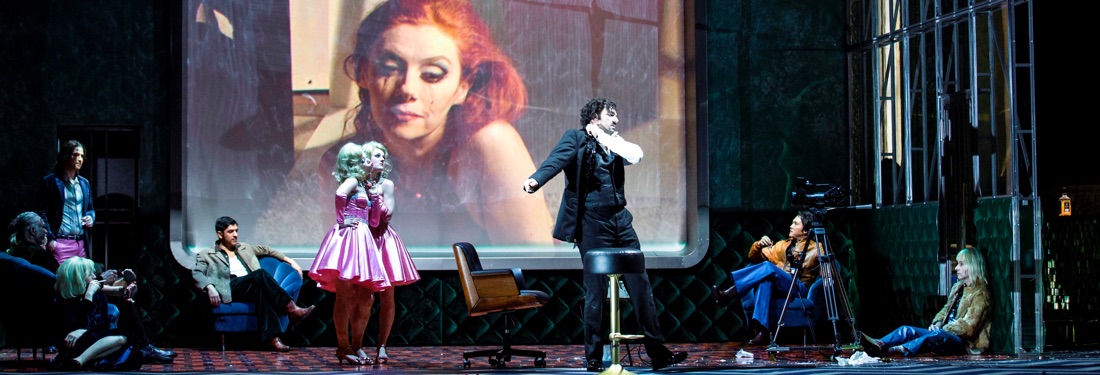
Yet Act I of Bondy’s Tosca takes place in what looks like whatever is the catholic analogue to a rehearsal studio; Baron Scarpia conducts his campaign of torture and seduction in a room that robbed him of his taste and elegance that make his evil that much more shocking; Act III dispensed with the skyline of Rome looming large in the distance as well as Puccini’s carefully orchestrated dawn and put us down on the riverbank for no particular reason (why didn’t Tosca swim away?).
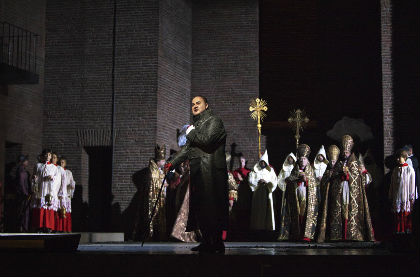
What did this achieve for the drama? Nothing at all. And Scarpia’s rug really made my eyes hurt. There were numerous other directorial interventions in the long slog to the finish and none of them brought the audience any closer to Tosca.
Somehow I’ve become a philistine just because I didn’t like the production. That, to me, is the essence of philistinism – making snap judgments without probing or questioning. I’m amazed at how many Bondyphiles have decried the stupidity of American opera audiences without even having even seen the production in question. And no, the HD broadcast does not count as experiencing the production any more than reading National Geographic qualifies as traveling.
American audiences are actually open to a broader range of approaches to the standard operatic repertoire than the Bondy-philes would give us credit for. Herbert Wernicke’s Die Frau Ohne Schatten was warmly applauded at its premiere, even though it represented a significant departure from the previous iconic production.
Met audiences have even come to see the virtues of the Robert Wilson Lohengrin, despite the controversy at its premiere, where the booers and the cheerers each tried to drown each other out. A second viewing and a different cast better capable of responding to the unique physical demands of that production made all the difference.
I doubt, however, that Bondy’s Tosca will find its public at the Met as the Lohengrin did. And frankly, given Bondy’s condescending remarks about American opera audiences, it doesn’t deserve another chance. Why the heck did he bother to accept the engagement of directing Tosca here if he knew the audience wasn’t going to appreciate his work? Did he need the money that badly or did he feel compelled to cross Tosca off his to-do list? It couldn’t have been satisfying for him and sadly, it wasn’t satisfying for the audience either.
The decriers are just as insufferable. As they see it, the greatest threat to modern culture is director-driven opera production. The Sybil Harrington era Met productions are a precious endangered species that must be protected from the killing machine of the regie-industrial complex.
The problem is that the Zeffirelli Tosca is an awfully shaky piece of ground for the operatic Éponines to build their barricades on. That Tosca was never his best achievement; that would probably be the Otello. Sure the set designs were impressive in their realer than real evocation of the locations specified in the libretto, but the director seemed to focus most of his energy on drawing oohs and aahs from the audience at the expense of creating much actual drama.
The big coup de theatre was to have the action in Act III shift between the roof of the Castel Sant’Angelo to Cavaradossi’s cell below by means of the Met’s stage elevators. Never mind that it distracted from a carefully planned introspective moment in the music, it was fabulous. In this production, Liberace’s candelabra would have fit in just fine flanking the deceased Scarpia.
Otherwise, the director did not manage to elicit particularly convincing acting from his principals (even by the standards of other performances they gave at the Met) and Tosca was burdened with a Procrustean pink prom dress that no diva could ever fit comfortably into. Despite its supporters assertions, little about this Tosca could be considered “definitive.”
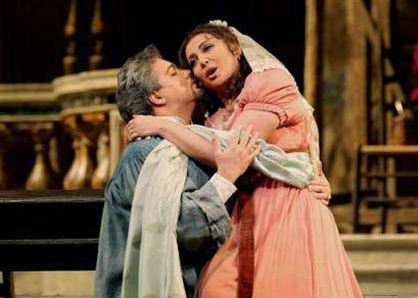
Moreover, Zeffirelli only directed this production in its first season. Assistant directors took over starting in the second season, and as in the game of telephone, what transpired on stage in subsequent performances bore less and less resemblance to whatever Zeffirelli intended. The Met has only seen performances of the “Zeffirelli production of Tosca” during one season. That production was replaced years ago by performances using the Zeffirelli scenery and whatever business and dramatic ideas that year’s protagonists brought with them.
Good opera aspires to be more than that. Puccini chose Tosca as the subject for an opera because of a performance he saw of the work in the theater. He wanted to capture the essence of the drama he saw on stage; not mollify his audience with pretty music and pretty scenery.
A good director can bring us closer to realizing what Puccini desired and we shouldn’t settle for the Zeffirelli Tosca simply because it doesn’t challenge the received wisdom of what a traditional Tosca should look like. In its own way it’s just as half baked as the Bondy one – overdone on the outside; undercooked on the inside. And the Met deserves a better Tosca than either producer was able to give us. I can only hope that we don’t have to wait 25 years for the next one.

[...]the Met deserves a better Tosca than either producer was able to give us.
But will it get it? Can it get it, in the current system of jet-lagged repertory opera? Tosca, unlike Die Frau ohne Schatten or even Lohengrin, is an opera central enough to the current Met repertory that it’s bound to show up almost every season, Zeffirelli or no Zeffirelli. Your description of what happened to the Met Zeffirelli Tosca–”Assistant directors took over starting in the second season, and as in the game of telephone, what transpired on stage in subsequent performances bore less and less resemblance to whatever Zef[f]irelli intended”–is pretty much inevitable when it comes to a repertory production of an old favorite. Ideally, such a production would be entrusted to a resident stage director, who could be assumed to be around for the next few revivals to adjust things for new casts. But the Met hasn’t had such an animal, except for John Dexter–and even he got frustrated at the Met after a while.
Under the circumstances, it’s depressing but not surprising that opera directors like Zeffirelli (and even his less traditionally minded colleagues) tend to emphasize the sort of budget-busting visual spectacle that can be depended upon for the “wow!” factor even when the original Personenregie (such as it was) has crumbled into dust.
brava! a well thought out and written comparision. absolutely dead on.
brava
I for one am sick of talking about it, and I think you said it all very well.
oh PS Cieca Brava for not commenting on Bondy’s embarrassing (repeated) mistake when trying to explain the Murder Scene at the NYPL in such english: He comes, then he comes again, then she comes, then she stabs…”
The whole production was going to be far racier with the bukkake element. I guess Peter Gelb nixed that before the Gala.
The author of the piece is Dawn Fatale, isn’t it, rather than La Cieca?
apologies, dawn – have we met before?
I would say this was an excellent post…but I only saw the HD broadcast, so what do I know?
“And no, the HD broadcast does not count as experiencing the production any more than reading National Geographic qualifies as traveling.”
A great line, Mme. Fatale. It should be engraved on the entablature of every opera house in the world–and next to it, “Yes you DO have to see the production before you can review it, one way or the other.”
Fortunately you don’t actually have to have visited Philistia….
Mme Fatale remains a treasure — besides having the world’s best drag-name.
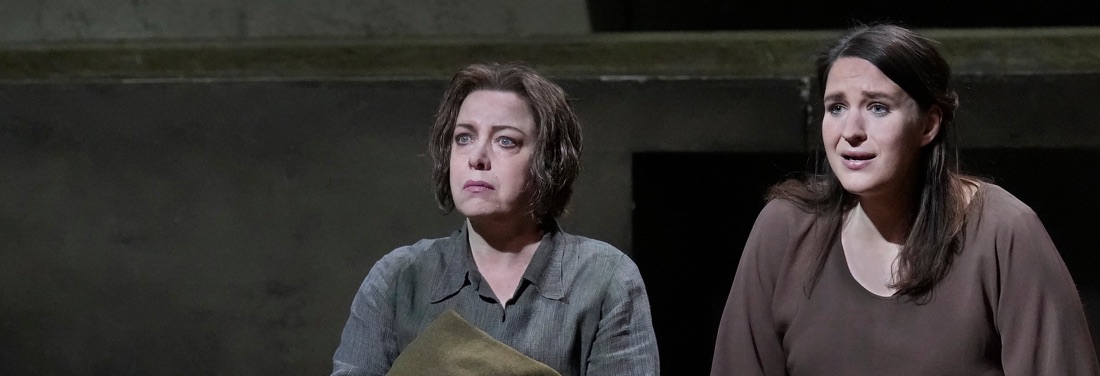
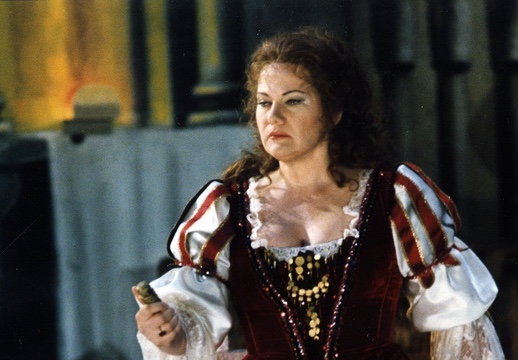
An excellant precis of the whole bloody affair! BTW: is that Ghulegina in the pink? If so thats a good picture of her.
Speaking of Philistines, I need to ask a question about whether Milton Host has jumped ship? Last night while watching the Jets game (that’s the Philistine angle) I heard a commercial for Wayne, NJ Toyota that seemed,for all the world, to feature the voice of Milton Host. So I wonder, has Milton Host abandoned Unnatural Acts of Opera for more lucrative gigs?
PS And yes, thank you La Cieca for your comments. It seems to me that those critics/fans who stridently wish to denounce any opera production that is too novel/too anachronistic have become the Scylla and Charybdis of modern opera through whom opera productions must carefully sail.
That’s one great review. Although I do wonder as to what is it that people find in this shabby little shocker and why do they go to it again and again and again? Vissi d’arte is a nice piece of music, even better out of context but for me the whole opera is embarrassing and not interesting enough, boasting three operatic monsters. So essentially the scope for character-development is tiny to non-existent. Scarpia is a very very poor operatic creation, one of the most uninteresting baddies in my experience. Even Jack Rance is far more interesting. For me the baddies carry the day, and just compare scarpia with Don Giovanni, the eternal enigma, or Alberich (IS he a baddie?) or Klytemntestra, or Poppea, or the Figaro count, or Golaud, you get the idea. I guess grand guignol is not really my thing. But La Gioconda I adore because besides being grand guignol it’s a lot of fun, and Tosca ain’t. Besides, I personally think that setting a torture scene as a symphonic trio with a soaring melody shows extreme bad taste and it always rubs me the wrong way. To be excited about Tosca when you’re 20-something I can understand, but spending a lifetime of opera-going and still go and see the damn thing again and again is beyond me. It’s like having posters of your pop idols all around when you’re past being a teenager. Tosca just gets less interesting as time goes by and shows little to no scope for personal interpretation. Sure it’s effective musical theatre, but so is Phantom of the Opera. Once or twice is more than enough.
Of course, I have to add that I’m only speaking my mind here, so don’t get excited if you worship the ground Floria walks on. I just don’t understand why spend so much money on a new production of a piece nobody nowadays can really sing well anyway, instead of mounting something more interesting, like La Fiamma which has fabulous music, is great musical theatre and is as much evocative, if not more, than Tosca.
#4 Squirrel, that’s an absolutely silly comment. Bondy speaks French and German fluently, his Italian is pretty good and his English is better than that of millions of people who live in the States. How many foreign languages do you speak? Let me guess: none? It’s one thing to dislike a director or his work, but it’s pretty stupid to ridicule him for his mistakes when he is being interviewed in a language that is not his own.
La Cieca, in your piece you talk only about two camps, the pro Bondy and the anti Bondy faction, but I believe there’s a third one (to which I belong myself) – those who don’t think the production is particularly brilliant, insightful, or anywhere near intellectually refined, surprising, imaginative Regietheater, but who don’t understand what all the fuss is about – why several newspapers and blogs were all upset about the prostitutes, Scarpia kissing the statue of the Madonna, the bear-breasted painting of Attavanti, the missing candles and crucifix, etc. I think many people just can’t understand how this could upset anybody, and even less how it could be considered “modern”.
And if I may say so, IMHO, you are going to far when you are saying anybody who saw the “Tosca” just in a movie theater and not at the MET is not entitled to have an opinion and can not possibly critisize the performance. So that means the thousands and thousands of opera lovers who perhaps never in their lives have a chance to attend a performance at the MET (or at any other great, world famous opera house), but who instead flock to the HD broadcasts or watch opera DVDs – those people are just clueless, sort of second class “opera consumers” who should shut up because they didn’t see “the real thing” in the house?
#13:
“Besides, I personally think that setting a torture scene as a symphonic trio with a soaring melody shows extreme bad taste and it always rubs me the wrong way”
..BUT..how about the “Auto-de-Fe”, in Don Carlo(s)?…lol..!
#16. I even have a problem with the auto-da-fe. But at least during the opening chorus they don’t get executed, only by the end of the scene, and then you have the celestial voice, not one of Verdi’s most felicitious ideas. The Konwitschny production was shockingly successful in that respect, treating Verdi’s setting with due (for me) irony.
BillyButt
Lighten up, it was funny at the time. If you had been there, you would have felt as queasy as we all did pretending that Bondy’s words did not have a double entendre.
And you are quaint to speculate about my language skills. So right you are! I didn’t even finish middle school.
Billy Butt:
Sorry, your post was so odious and stupid that I can’t help but add a few things
This “Third Camp” you suggest is actually the position that Dawn Fatale is taking here, but you are apparently too dim to get that out of reading it.
However there is a difference between your “third camp” and the Poster’s, which is that you seem all caught up in who was offended by what liberties the director took, whereas I think it’s pretty clear that negative reaction against the Bondy Tosca was not out of prudishness or even this supposed Traditionalism; rather the boos, and most of the press attacks, concern how flat and uninspired Bondy’s staging was. Really, I think I’ve missed all the newspaper and blog criticism that focuses on being offended by prostitutes. Please share.
I’ll bet you don’t even read newspapers, in fact you possibly can’t even read. Just speculating, since I don’t have any idea who you are.
squirrel: Allow La Cieca to suggest you try to find more civil ways to indicate your disagreement. Hmm?
@15 Billy Butts…
I would like to add myself to the middle-of-the-road third camp you suggested. In my opinion, both sides need to get over it. Just sit back and enjoy the show, people.
How ironic is it for us to have the same opinion since I saw the same performance live at the Met while you saw it at an HD screening?
But in all seriousness, how one watches it should not be the dividing line when it comes to opinion. If we were debating sound or audience reaction, perhaps it would make sense to make that a factor but when judging production, I think we are all entitled to an opinion.
It would be a sad day in opera if it came down to dismissing the opinions of those who sit in the Family Circle in favor of the opinions of those in the Parterre boxes.
@18- Squirrel
I was in attendance for the discussion at NYPL and did not think the double-entendre was intentional on Bondy’s part. English is not my family’s first language and it’s quite common for them to put together sentences similar to the way that Bondy did.
Perhaps I’m the only person who feels this way.
I for one mentioned the prostitutes in my review (also available if you click on my name) but my question has always been: 1: Would a sadist that gets his kicks out of rape would engage a willing partner? and 2: Would a man that says “I’m looking forward to todays rape” be cavorting and waisting sperm with a willing partner? I think those are fair questions.
The prostitutes didn’t offend me, I just thought they were one of those things that Bondy used to push the envelope where it was not necessary, or supported by the drama.
Brava to Dawn for that excellent piece. very well written.
As I said in my review, this production had elements of both and what we were left with was neither: Not kink, but not vanilla either.
Squirrel: Really, I think I’ve missed all the newspaper and blog criticism that focuses on being offended by prostitutes.
Well, there’s offended and then there’s offended. I don’t think there are all that many people who were shocked at the idea of prostitutes being depicted on the Met stage, or even that the performances of the actresses were offensively vulgar or suggestive. I did notice a certain level of outrage at what was perceived to be an unpardonable liberty taken with the libretto, varying along the continuum from “Puccini didn’t write any music for prostitutes here, so they shouldn’t be onstage” to “Why would Scarpia have hookers servicing him when he’s already planning to bang Tosca later that night?” I have to say a lot of the objection seemed to devolve down to “I’ve never seen it done this way before.” (Yes, there were also a significant number of objections along the lines of “the hookers didn’t seem realistic enough — I mean, what’s the deal with those shoes? — and the production chickened out when the one whore gave Scarpia a blowjob without unzipping his pants.”)
But, to get back to the subject, there were and are a lot of objections made using some reasoning on the model of “Tosca would never do that.” Tosca would never wear a black dress, or go into church without a full-scale mantilla, or slash the painting, or get the idea for the murder a few minutes before, or any number of others. This “criticism” I think is rarely valid because we all tend to base our idea of what a fictional character “should” or “would never” do on our experience of previous productions of the work. In the case of New Yorkers, a large fraction of that “experience” is necessarily going to be the Zeffirelli production, which in some ways was vastly conventional and in some others had, well, its own quirks. (For example, where exactly is that torture chamber supposed to be, in the adjoining room or under the trap door? Or, in the first act, if the church is supposed to be locked up tighter than a drum, who are all these tourists and nuns and peasant ladies wandering about? And don’t get me started on that roaring fireplace in the middle of July!)
CerquettiFarrell: I can only speak to my own feelings about Tosca, so bear the following in mind:
I think it’s a great starter opera. I’ve only been listening to it for 8 months and one of the things I like about it — or liked about it — is that I always knew where I was in the story, even before I ever read the libretto. The listener can’t get lost, even not knowing the language. Now that I’m past that early stage with it and know the story, I like that it is so compact and direct. There’s very little, if any, wasted space. (I’m still not sure about the opening of Act III — I find the pre-dawn music to be filler but lovers of this work are beginning to persuade me that this music serves the overall purpose of the opera.)
I now view Tosca as comfort food. It’s not the deepest, most psychologically probing opera out there, but when I want to hear some music well-married to its subject, and I’m not in the mood for some heavy thinking, I put it on.
Maybe in 5, 10, 20 years, I’ll have “outgrown” it. But for now, I just kick back and enjoy the ride.
I know nothing about La Fiamma and had to look it up to know what you were writing about. I have no idea why this opera hasn’t become embedded in the standard repertoire, but I’m sure other commenters here will share their thoughts.
One more thing: wouldn’t a person miss out on half of the extant operas if he or she avoided the ones that displayed “bad taste”? Cosi and Trovatore, Jenufa and Faust, for starters…
But to paraphrase former President Clinton: it depends on what your definition of bad taste is.
La Fiamma seems to recall Trovatore. Given how often the Verdi work is performed, I don’t know why the Respighi one is hard to find. I’d give it a chance, certainly.
While we’re on the subject, cher public, you might be interested in the source material for the Tosca libretto, the Sardou play, conveniently translated and annotated by Deborah Burton:
La Tosca, Act I
La Tosca, Act II
La Tosca, Act III
La Tosca, Act IV
La Tosca, Act V
CruzSF #25,26, thanks for the heartfelt comments. I hope I haven’t been impolite in my reactions to Tosca. You are absolutely right about the compactness and sense of architecture. By bad taste I don’t necessarily mean the subject matter. So Cosi is irrelevant. But Trovatore I prefer to see as more classical, because of the construction and the bel-canto modelling. Most of the melodies have something Mozartean about them (especially tacea la notte, il balen and of course Ma tu ben mio). The purple passages work along with the melodic fecundity, and the psychological insight is considerable (the Azucena monologue) so I tend to regard Trovatore as a very great work of art, working through the stylistical restrictions. I don’t see anything vulgar about Jenufa. Falstaff is great fun, grand guignol like Gioconda but still very entertaining and the melodic invention is staggering.
By bad taste I mean that I don’t mind there being a torture scene in Tosca, but the composer’s decision to stir your blood by using a symphonic development of a showpiece tune is very, very vulgar by the very conception of it. Extremely manipulative I think. Scarpia’s murder isn’t – this is theatre music pure and simple, and it works, and doesn’t offend me in a similar way because it is direct and brutal.
On the whole I think Tosca lacks, for me, psychological insight and subtext. It sounds like a major composer writing a film score. Nothing wrong about that, but in opera I expect something more. When I think of Don Carlo, for example, the characters live, for me, a very full life, regardless of various interpretations. They live within the score because Verdi loved them and lived them through his music. I don’t feel that kind of emotional commitment from Puccini in Tosca, so he reverts to piling effect upon effect. By the end of the 1st act the level of hysteria is so high that there’s nowhere to go by the time you reach high drama. With the character of Butterfly, as a contrast, I do feel that there’s total emotional immersion on behalf of the composer.
BTW La Fiamma had a great recording on Hungaroton with a really great cast: Ilona Tokody, Klara TaKacs, Peter Kelen and Josef Gregor. The soprano role is really a Puccini part and Tokody sings it admirably. Gardelli is great in this repertoire. I don’t think this is available at the moment, which is a pity. Perhaps Brilliant will re-issue it, they have us in our debt for restoring so many great recordings – the Keilberth Frau is just out.
There’s also another very interesting Respighi opera – La Campagna Sommersa – there’s a very good recording on Accord with a singer I love, Laura Aikin.
Sorry in #29 I meant Faust, not Falstaff, of course
Quoth CerquettiFarrell: and then you have the celestial voice, not one of Verdi’s most felicitious ideas. The Konwitschny production was shockingly successful in that respect, treating Verdi’s setting with due (for me) irony.
I wonder if the direction in the libretto that the voice is totally disregarded by those on stage who go about their appreciation of watching people burned to death ISN’T ironic.
Quoth LaCieca: And don’t get me started on that roaring fireplace in the middle of July!)
Cieca cara, the Battle of Marengo took place on June 14 and, in history as in the play and opera, a false account of Napoleon’s defeat reached Rome several hours before the truth.
Actually, my comment is just nit-picking because one wouldn’t want a roaring fire in June in Rome any more than in July. The moment the curtain rose on act 2 during the Zeffirelli production’s premiere, I knew immediately he was going as usual for picturesque effect, with no interest in the reality of the situation, as usual.
LA Cieca/28:
THANKS SO MUCH FOR PROVIDING THE TRANSLATION OF “LA TOSCA”…!!
CerquettiFarrell: No offense taken here. I don’t disagree with anything you’ve written above @29 re: Tosca. One of the things I find is a weak point at the opening of Act III is precisely what you identify in general: it feels like a film soundtrack.
I’ve heard friends object to the baby killing elements of Jenufa and Trovatore, which is the reason I listed them as potential examples of “bad taste.”
Re: Tosca, I agree with you that as written, the lead characters don’t have much external life, are not full and rounded characters. I’ve come to see this as a benefit (and note that I didn’t view it this way at first) in that it mostly succeeds, for me, on the singers’ ability to act. They have to bring it, as the kids say, inventing a background for the characters. This allows Tosca to take on different colors and shadings with each cast change.
The opera probably works well enough if the singers don’t make that investment, because of Puccini’s directness — the production I saw live had a Tosca who brought it, a Scarpia who might have misplaced it, and a Cavaradossi who left it at home. That night, the machine rolled along well enough for me to have fun.
CerquettiFarrell: Thanks for the recommendations at 30.
At 31: I was confused by Falstaff. LOL. I thought I was missing something so I didn’t argue.
Lindoro @22 re the prostitutes:
I was actually thinking about your mentioning this when I went to see the HD telecast. My feelings are that while he ultimately gets off (sexually) on rape, he’s not adverse to owning people — and just because you’ve got prostitutes doesn’t mean they’re just 100% sexually available either. It’s fairly easy to brutalize an (unwilling) prostitute, too, which was hinted at when Scarpia threw when on the ground.
An analogy that came to mind: just because someone finds ultimately (sexual) fulfillment with another participant doesn’t suddenly make masturbation unappealing.
Re the Celestial Voice (#32), it always makes me think of Veterinarians’ Hosptial on the Muppet Show, when the announcers voice would boom out at the end and all the characters in the operating theatre would look up and around to try and find out where it was coming from.
Don Carlo is still Boy Joe’s greatest opera, though. Way ahead of Otello and Falstaff in my book!
whoops, errant apostrophe … I meant ‘announcer’s’
… and Hospital. It’s late here in Europe, so please excuse me.
#37 For me Falstaf is the greatest of them all, not just Joe’s. I always cry come the little scene II duets for Anne and Fenton. Amazing for a near-octagenarian to write love music that is so fresh and, well, young! And the way it is all put together, the second scene, like a scherzo with two trios. And the way one beautiful melody pops up after another, like bubbles, to pop out into thin air after a tiny developement, or none at all, like the beautiful wind theme when the girls sing “domani, si si”. Everything is so beautiful, original and sincere. Of course the Don is great too, but in a very different way. Otello I fint too unrelenting at times, and it really is a number opera: the seams show. Falstaff is symphonical from beginning to end. All three are great works of art.
La Cieca @ 28: A little thread between threads here. Do you know that your Puccini scholar Deborah Burton is Amy’s older sister — the “actual soprano” who will take on the big aria from Rufus’s masterpiece at the NYCO Gala?
Alto: And guess which French-language opera composer/leggy diseur was at Rosenkavalier tonight?
Better late than never, but since I was in the audience this past Saturday, I feel compelled to comment.
#13: I am the last person who you would expect to come to NYC to see the shabby little shocker, as I much prefer my opera either obscure, contemporary or both. My rationale for coming to NYC was to see Ms. Matilla in a new production. Her qualifications to sing this role aside, I find her a fabulous singing actess, always giving 110%. I’ve seen her Fidelio, Jenufa and Salome.
As for all the hullabaloo about the new production and her ability to sing it, I thought the gals in NY just had their knickers in a bunch over nothing. It was my expectation that I would find the production engaging and sung beautifully.
Having seen the production, the oft quoted adjective ‘flat’ (not for tonality, or even the sets) describes what I saw perfectly. There truly was no there there, and there was cautiousness that pervaded the entire production.
All the detractors going on about stage directions not being followed seems rather petty. Why even bother changing the set from the original production (insert irony here)?
And although it was my opinion that Karita could do no wrong, this role really wasn’t suited to her voice. I am glad, however, to have seen the production live and in person. I just had more fun at Hair.
Overheard as we were leaving, “She was really sharp; especially during the recitative.” Nuff said.
Nice catch, Cieca. And here’s another cross-link for the web we weave: while you were in the House avoiding R.H.’s lecherous looks at your comely figure and mien, I was up the street at the opening of the NYFOS season, hearing La Burton singing Poulenc — an actual French person — and Musto.