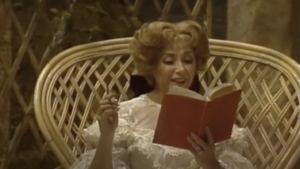
Many singers have remarked that in the studio, there is no scenery, no audience and therefore they relax with added animation of ‘body speak’ -getting into ‘the mood of things’. The advent of stereo micro-phoning allowed that freedom to come into play, rather than virtually having their feet nailed to the floor. Did not Caballe say that- being rather unfamiliar at the start of her career with recording processes: on listening to her RCA Lucretia Borgia – she felt it was ‘a little dead’ on characterization for a listener at home. How she learned to add expression : just for a recording. Nilsson of course we knew had to ‘step back’ on her fortissimo notes as she tended to ‘overload’ the microphones. In the finale of her RCA 1961 Turandot with Bjorling under Leinsdorf – there is plain evidence of the microphones and /or tapes being stressed. Perhaps,, that probably helped RCA quickly change from 15 inch per second tape machines to that of 30 Inch per second..
It probably has to do with the temperament of the singer. Nilsson was Scandinavian and very business-like during recordings. As La Cieca said she had been asked to pull back from the microphones for the high notes. In other parts of the recording she would move from one square on the floor to another according to a choreography designed for the stereo recording.
I for one act up a storm when I sing along with recordings.
What’s even funnier is to set the Bartoli and Steber fragments performing….together and sliding the picture frame on your screen back and forwards between the two ,while the confused ‘dim’ rages..
Lindoro, the last time I checked, singing requires air and availability of bone structure to resonate along with proper non-tension of the lips, tongue, etc. Arm flailing, forearm muscles, shoulder joints have absolutely nothing to do with singing. Those arches of phrases are not produced by someone’s arm making a wide gesture across the air; it’s produced by the brain/mind and thereby the voice. If the singer can’t sing without the gesticulating, then something is wrong with their technique.
I simply cannot keep quit on this. You, sir, are an idiot.
At the very least, you have a very poor understanding of basic physiology. You do realize that the ENTIRE body is involved in singing, right? You do know that the muscles that stabilize the larynx are attached to other parts of the body? Including the shoulders? You do realize that the process of breathing, that most important part of singing, utilizes everything from the muscles you use to control your pee, to your back muscles?
Just because someone in the past didn’t do something doesn’t mean that’s the best way and only way to do it! For christ’s sake, back in the 50′s, much of the scientific community thought that the vibration of the cords were caused by a sort of neural tic!
And trying to do your singing via the brain only is the best way to get your body to lock up, and completely and truly ruin your voice. Moving around in a studio session is necessary if you don’t want to end up croaking by the end!
And one further thing, phrasing, if you want to call it that, is created physically. Yes, the mind may state the intent, but the act itself is completely a physical response — changes in the vocal tract, changes in the flow of air, etc. None of which, of course, can happen if your body is tense and stiff!
“They have private rehearsals with piano before the sessions (day before or day of), which don’t cost a thing (i.e., the Kassarova clip above).”
Amazing. Do you actually think that orchestral musicians’ time or that of studio crews is expensive and that of international conductors and soloists is free and unencumbered?
I know I’m type-cast around here as a Steber queen. And with good reason. But that clip above of her, which I had never seen before, really sets me off. She never stopped talking, if you gave her half a chance, about her idea of bel canto technique. That Verdi makes me wish she were starting her career about now with the repertorial opportunities that would now be on offer for someone with her endowments.
Many singers have remarked that in the studio, there is no scenery, no audience and therefore they relax with added animation of ‘body speak’ -getting into ‘the mood of things’. The advent of stereo micro-phoning allowed that freedom to come into play, rather than virtually having their feet nailed to the floor. Did not Caballe say that- being rather unfamiliar at the start of her career with recording processes: on listening to her RCA Lucretia Borgia – she felt it was ‘a little dead’ on characterization for a listener at home. How she learned to add expression : just for a recording.
Nilsson of course we knew had to ‘step back’ on her fortissimo notes as she tended to ‘overload’ the microphones. In the finale of her RCA 1961 Turandot with Bjorling under Leinsdorf – there is plain evidence of the microphones and /or tapes being stressed. Perhaps,, that probably helped RCA quickly change from 15 inch per second tape machines to that of 30 Inch per second..
It probably has to do with the temperament of the singer. Nilsson was Scandinavian and very business-like during recordings. As La Cieca said she had been asked to pull back from the microphones for the high notes. In other parts of the recording she would move from one square on the floor to another according to a choreography designed for the stereo recording.
I for one act up a storm when I sing along with recordings.
What’s even funnier is to set the Bartoli and Steber fragments performing….together and sliding the picture frame on your screen back and forwards between the two ,while the confused ‘dim’ rages..
Lindoro, the last time I checked, singing requires air and availability of bone structure to resonate along with proper non-tension of the lips, tongue, etc. Arm flailing, forearm muscles, shoulder joints have absolutely nothing to do with singing. Those arches of phrases are not produced by someone’s arm making a wide gesture across the air; it’s produced by the brain/mind and thereby the voice. If the singer can’t sing without the gesticulating, then something is wrong with their technique.
I simply cannot keep quit on this. You, sir, are an idiot.
At the very least, you have a very poor understanding of basic physiology. You do realize that the ENTIRE body is involved in singing, right? You do know that the muscles that stabilize the larynx are attached to other parts of the body? Including the shoulders? You do realize that the process of breathing, that most important part of singing, utilizes everything from the muscles you use to control your pee, to your back muscles?
Just because someone in the past didn’t do something doesn’t mean that’s the best way and only way to do it! For christ’s sake, back in the 50′s, much of the scientific community thought that the vibration of the cords were caused by a sort of neural tic!
And trying to do your singing via the brain only is the best way to get your body to lock up, and completely and truly ruin your voice. Moving around in a studio session is necessary if you don’t want to end up croaking by the end!
And one further thing, phrasing, if you want to call it that, is created physically. Yes, the mind may state the intent, but the act itself is completely a physical response — changes in the vocal tract, changes in the flow of air, etc. None of which, of course, can happen if your body is tense and stiff!
“They have private rehearsals with piano before the sessions (day before or day of), which don’t cost a thing (i.e., the Kassarova clip above).”
Amazing. Do you actually think that orchestral musicians’ time or that of studio crews is expensive and that of international conductors and soloists is free and unencumbered?
I know I’m type-cast around here as a Steber queen. And with good reason. But that clip above of her, which I had never seen before, really sets me off. She never stopped talking, if you gave her half a chance, about her idea of bel canto technique. That Verdi makes me wish she were starting her career about now with the repertorial opportunities that would now be on offer for someone with her endowments.
Alto- EVERYONE round here is a Steber queen. And quite right too.
Add me to the list of Steber queens. Alto, we might not see eye to eye in things, but when it comes to Steber we worship at the same altar.
Anonymous Soprano:
Thank you, seems like the couch coaches are here to teach us how to sing.