The headlined phrase is a neologism (La Cieca should know, because she just made it up) and therefore will require a bit of explanation. Bear with your doyenne, cher public, because there’s eventually going to be a CD review in here somewhere.
So. Many, many years ago, ere the earth was young and all that, La Cieca took it into her pretty little head that she was going to be, if not the next Vera Galupe-Borszkh, perhaps the Mary Curtis-Verna to Mme. Galupe-Borszkh’s Renata Tebaldi. Which is to say, La Cieca was dizzily stagestruck at the idea of performing as a company member of La Gran Scena Opera Co. di New York, and therefore she put herself to work preparing audition repertoire for this august troupe.
“Suicido!” worked for some reason in my voice, perhaps because more than one soprano has gotten away with screaming this aria in the pretense that unmusical singing was “dramatic.” There were various other arias attempted and discarded, mostly for the reason that I really couldn’t sing, just make vaguely singing-like noises. (But, again, that doesn’t exactly disqualify one for the operatic stage, now does it; though La Cieca isn’t going to name names here.)
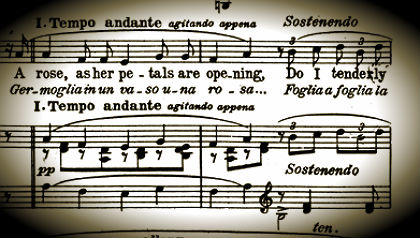
Eventually La Cieca and her coach worked her way to “Mi chiamano Mimì,” which was perhaps a little less screamy sounding than, say, “Tacea la notte placida,” and it was during that aria that La Cieca was able to grasp (though not to duplicate, unfortunately) a mystery of the singer’s art that she had until then only dimly understood. The lines in question were
Mi piaccion quelle cose
che han si dolce malia,
che parlano d’amor, di primavere,
che parlano di sogni e di chimere
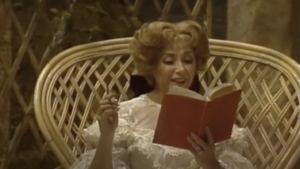
Now, La Cieca’s favorite reading of this section is by Renata Scotto, and that from the 1977 Met telecast of La bohème, when the soprano, never exactly “simple,” was not really girlish either. No, she was clearly a 40-something, rather stout and very intelligent and experienced artist. But she refined all that intelligence and experience into a line of great purity and simplicity — not a “natural” simplicity, as when, for example, the young Mirella Freni sang the role, but a created, crafted simplicity. Her singing was both naive and sophisticated, layered.
That’s when La Cieca marked her score “con grande semplicità,” because what she realized she wanted to convey in this aria was that Scotto quality of a naturalness as imagined and depicted by a great intellect. (Understand that La Cieca never considered herself a great intellect, but after all she was not aiming for real art but rather for burlesque. But you knew that, of course.)
So, most circuitously, we arrive at the thesis of this little essay, which is that verismo music (considered in the broadest sense) requires that “grand simplicity” to communicate to a modern audience. Magda Olivero had it, and so did Diana Soviero. Though she does not work in such minutely detailed terms, Aprile Millo is a present-day exponent of “grande semplicità.”
Now, someone who mostly just doesn’t get “grand simplicity?’ Well, I’m afraid that’s Renée Fleming, at least on the evidence of her new Verismo CD. Now, don’t get La Cieca wrong. Fleming is in very good voice here, with astonishingly well-preserved warmth of tone. She has obviously studied this music diligently, and it’s admirable that she has used her clout to document interesting bits of underrecorded operas like Conchita, Gloria, Siberia and Zazà.
She does have some successes among the many attempts here. Best in show, I think, is the extended scene for Liù where Fleming spins out the legato lines smoothly and has plenty of play of pp to ff (well, f anyway) in the high B-flats. It’s a one-emotion scene, and Fleming does have a pretty solid notion of how pathos is supposed to sound (i.e., beautiful), so that works.
The little “spitfire” number from Conchita sounds appropriately devilish, and there is some sensitive singing in “O mia cuna fiorita.” The selections from Iris and Lodoletta suggest that the classic Renata Scotto – Italian Opera Arias has an honored place in the Fleming library.
Here and there I hear lapses of taste: the too-open “ah” sound Fleming favors when she brings the chest tone up high (“Quando in cielo con te potrò saaalire?” in the Suor Angelica aria). She is attentive to the marked portamenti in the scores but doesn’t add any at points that would seem intuitively obvious, e.g., “Dir che ci sono al mon-do” in the Zazà. So the general effect is on the studious side, correct but not quite authentic.
The one vocal weakness I note on this CD is an obvious huskiness and lack of center to notes in the lower-middle range, say from just above the chest break to maybe third line B-flat. Curiously, that veiled timbre is reminiscent of Leontyne Price in the same register and at more or less the same time of life, say the time around the late 1970s. (Listen, for example, to the opening phrases of “Senza mamma.”)
It’s not unattractive per se (something like a flute playing in its low register) but there’s a definite lack of color and clarity in a piece like the Fedora death scene. It doesn’t call for loud singing (the orchestration is very light) but I think it profits from some kind of core in the fil di voce. Fleming has the breath control to manage the phrases, but the tone is fuzzy and veiled. Now, you might argue, “hey, she’s supposed to be dying, right?” but I think the weakness and fatigue are already depicted in the music — that’s one reason the tessitura is so low. Breathy tone here is, in my opinion anyway, overkill.
The breathiness shows up elsewhere too, though not always (as in the Giordano) an attempt to make a virtue of necessity. In the “Ore dolce e divine,” she does the little sighing noise alternatively in the skittish bits (i.e., Magda is breathless with excitement) and in the sentimental moments (i.e., Magda is trembling with deep emotion). In “Flammen perdonami,” the breathy quality is supposed to indicate fatigue. And so forth. The problem is that there are cleaner, less unmusical ways to express all these varied feelings, but Fleming tends always to reach for the tool closest at hand.
When Fleming sings the “Mi chiamano, she inserts the little breathy effect on “che han si dolce malia” I guess to try to express Mimì’s enchantment, but that, I think, is the wrong way to do it. Mimì isn’t putting on a show here, she’s trying to speak in the most straightforward way of what is important to her. Yes, she’s feeling great emotion, but the singer doesn’t need to layer it on; she needs wait only a few measure more for the musical climax on “di primavere.” I would even go so far as to say that by trying to fuss with the lines preceding, Fleming robs herself of the impact she should be making with that first high A, which ironically is probably the most gorgeous note in her entire range.
So that’s what La Cieca means by the title of this petit propos: what Fleming lacks is the ability to pare down her effects, to edit so that the admittedly beautiful stuff she has to offer can be heard in proper context.
The CD goes on sale Tuesday, and La Cieca will be interested in hearing your reactions, cher public.