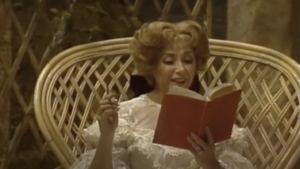
Did nobody tell her that in baroque / classical rep the stress is ALWAYS on the leading note and not on the resolve? I’m talking about 00:58-01:00. It’s mia FE-e and not mia Fe-E.
I think what you hear is something that many English speaking singers do when singing in Italian (and French a lot too). I have heard it in Steber, Voigt, Fleming, Zajick, and many other so called “American” singers.
I describe it as mistakes in the inflection of the words more than lacl of knowledge of the technique. Sometimes these singers do not know where to apply the stress in a syllable and/or elongate the last syllable for too long, which creates a false stress.
I can not begin to tell you how many times I have heard sopranos completely miss the piccina voglietina section of Un bel di. I hear piccina voglietinaaaaaa more than piccina voglietiiina.
That mistake is still passed on in major conservatories and music schools to this day. I saw it all too often.
#102 Lindoro this has nothing to do with unawareness of the lie of the language and everything to do with basic musicianship, stylistic awareness and sensitivity to the underlying harmony beneath the vocal line. Singers trained in baroque I highly aware of this, as Tuva Semmingsen shows here in her singing of the sublime duet from Giulio Cesare:
If all these singers would only sing opera in good, clean English there would not be these problems.
This Steber woman elbowed her way into a Glyndebourne visit to Edinburgh. Her Countess was hardly in the class of Our Own Joan Cross — one’s standard for the role — or of the Garden’s subsequent Una Hale.
#105 Wakefield, you are close to the abyss. One does not talk that way about Steber’s Countess. It was one of the great assumptions of the century, and you know it. You cannot speak of Steber’s Mozart in the same breath with Cross or Hale (whoever that is).
Walter Susskind told me Steber had “a unique success” with Rosina
at Edinburgh, and I have good reason to believe him. It was 1947, I
believe; were you there?
On another mater, Opera In English is one of the curses in opera.
It is my belief opera should always be sung in the language of composition, for the language is part of the music. I believe that is a given that cannot be denied. Thus I richly enjoy Grimes and Herring in English, but when Massenet’s Manon is sung at the ENO it sounds
like Gilbert & Sullivan and that will not do.
Wakefield, I am contacting the State Department to speak to them about the viability of your visa for visiting the US; it may be time to give us a rest from your lavishly approving attentions. On the other hand, I like to think that a gentleman of your cogency and wit is really just pulling our leg with these nonsensical comments, and your future behavior may indeed improve if you would acknowledge your real intent. As Hillary ays, “We are waiting to see.”
106. I’m also a firm believer in opera in the original language. However many composers were ok about translating to make their works accessible: Don Carlos; Tannhaueser (?); Vespri and Dialogues to name a few. In addition I believe that works like Poppea benefit greatly from bring done in the local language. I never thought I’d say this but the Hytner translation of Xerses is an example of a translation seeming as successful if not preferable to the original.
#108. Since when can’t a drunken hoyden
of dubious morals sing a world class Rosina
for the ages? Huh?
If we apply “morals” to success or competence
in opera singing, I fear, Sir, we shall be out of business.
So there! Take that!
(that should have read..”your”…and “this”..ooops..!)
Did nobody tell her that in baroque / classical rep the stress is ALWAYS on the leading note and not on the resolve? I’m talking about 00:58-01:00. It’s mia FE-e and not mia Fe-E.
I think what you hear is something that many English speaking singers do when singing in Italian (and French a lot too). I have heard it in Steber, Voigt, Fleming, Zajick, and many other so called “American” singers.
I describe it as mistakes in the inflection of the words more than lacl of knowledge of the technique. Sometimes these singers do not know where to apply the stress in a syllable and/or elongate the last syllable for too long, which creates a false stress.
I can not begin to tell you how many times I have heard sopranos completely miss the piccina voglietina section of Un bel di. I hear piccina voglietinaaaaaa more than piccina voglietiiina.
That mistake is still passed on in major conservatories and music schools to this day. I saw it all too often.
#102 Lindoro this has nothing to do with unawareness of the lie of the language and everything to do with basic musicianship, stylistic awareness and sensitivity to the underlying harmony beneath the vocal line. Singers trained in baroque I highly aware of this, as Tuva Semmingsen shows here in her singing of the sublime duet from Giulio Cesare:
I prefer it when they sing ‘mogliettina’, myself.
If all these singers would only sing opera in good, clean English there would not be these problems.
This Steber woman elbowed her way into a Glyndebourne visit to Edinburgh. Her Countess was hardly in the class of Our Own Joan Cross — one’s standard for the role — or of the Garden’s subsequent Una Hale.
#105 Wakefield, you are close to the abyss. One does not talk that way about Steber’s Countess. It was one of the great assumptions of the century, and you know it. You cannot speak of Steber’s Mozart in the same breath with Cross or Hale (whoever that is).
Walter Susskind told me Steber had “a unique success” with Rosina
at Edinburgh, and I have good reason to believe him. It was 1947, I
believe; were you there?
On another mater, Opera In English is one of the curses in opera.
It is my belief opera should always be sung in the language of composition, for the language is part of the music. I believe that is a given that cannot be denied. Thus I richly enjoy Grimes and Herring in English, but when Massenet’s Manon is sung at the ENO it sounds
like Gilbert & Sullivan and that will not do.
Wakefield, I am contacting the State Department to speak to them about the viability of your visa for visiting the US; it may be time to give us a rest from your lavishly approving attentions. On the other hand, I like to think that a gentleman of your cogency and wit is really just pulling our leg with these nonsensical comments, and your future behavior may indeed improve if you would acknowledge your real intent. As Hillary ays, “We are waiting to see.”
106. I’m also a firm believer in opera in the original language. However many composers were ok about translating to make their works accessible: Don Carlos; Tannhaueser (?); Vespri and Dialogues to name a few. In addition I believe that works like Poppea benefit greatly from bring done in the local language. I never thought I’d say this but the Hytner translation of Xerses is an example of a translation seeming as successful if not preferable to the original.
106 Tosh. A drunken hoyden of dubious morals.
Hardly the Elsa that Margaret Curphey was at the “Wells”, either.
@103 CerquettiFarrell:
It must help that Semmingsen speaks perfect Italian, and, most impressively, sounds like a native speaker, with a lovely Venetian inflection.
#108. Since when can’t a drunken hoyden
of dubious morals sing a world class Rosina
for the ages? Huh?
If we apply “morals” to success or competence
in opera singing, I fear, Sir, we shall be out of business.
So there! Take that!