
delicate exotic fruit

“We live in an age in which everyone is encouraged to express themselves, from inane blogging, Twittering and voting in mediocre talent shows. Please, let’s keep this out of the concert hall.” Jonathan Lennie admonishes over-enthusiastic applauders. (PS: the quotation sounds particularly funny if you do the voice.) [Time Out London]

Trust me, I’m not advocating a return to lights up during the performance, people talking and moving around the theater, or audience applauding at odd points during the performance.
BUT, the fact is that until Wagner’s reform of the entire experience via his imposed protocol at the Festspielhaus, that’s precisely the way all operas were experienced in opera houses everywhere. I remember a comment in a book on Rossini that during his career, when things were going well during a performance, an opera house sounded like a giant cat purring. It was when there was silence gthat performers were terrified and things could become dangerous really fast.
How things change!
I say we bring in Patti Lupone for every performance and let her ream out anyone who applauds before the music has ended.
I mind the applause less at the end of a performance than I do between movements or songs (in a cycle).
I actually have this problem with movies also. I long ago began watching final credits, because I like to read the music credits, and because many movies include either outtakes or extra scenes. Last week, I had to complain to the manager because the usher not only sat in the theater texting, but he opened the doors and started cleaning right as the final scene of The Proposal started and there were more scenes.
While we’re discussing our “audience pet peeves,” what about a standing ovation after EVERY FRIGGING PERFORMANCE! Well, perhaps this is less common in our centers of high operatic art (New York, Chicago, San Francisco), but it’s mind-numbingly ubiquitous in Denver.
I attended a Central City Opera performance of “Lucia” last Sunday. It was pretty good for what it was (i.e., a second- or third-tier U.S. company). The soprano and tenor were quite good, although the latter ran out of gas midway through the final act — can hardly blame him at almost 9000 feet above sea level — and the bass was superb. The baritone — crappy. Nice production, well-directed and -conducted, and the chorus was charming and always on key. The orchestra was a bit too loud for my taste but, whatever….
It was NOT a S/O-worthy performance by any means — but there it was. Harumph.
Nos 4 and 5: Are you actually under the impression that the poor person lowering the curtain does so at his/her own whim and is thus the villain in the case? Such things are minutely regulated by the director.
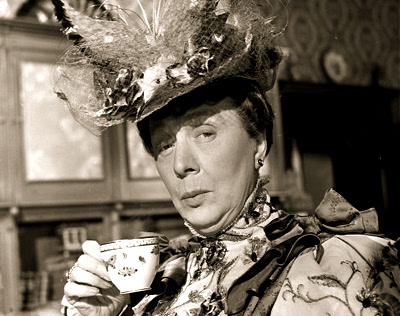
And thanks, Cieca, for the lovely photo of Aunt Edith above. (She is now singing baritone in the choir invisible.)
I would encourage the houses to flash the message to the audience before the performance: “Please do not clap before the music ends and ruin the pleasure of others in the audience.” That might tend to solve the problem. One of the worst situations is the end of Faust where there is a long organ coda ruined by precipitate clapping.
mrmyster – Lady Bracknell or Charlie’s Aunt? You know the one…”Ah. Brazil. Where the wax comes from!”
operablogger. I can so empathise. Here in Portland OR all you have to do to secure a standing O is turn up and remember most of the words and music. The currency has become devalued to the point almost of worthlessness.
Standing ovations? The Washington audience is convinced that they are required. Lately I’ve seen people standing to applaud half-way through a couple of concerts. But to be fair, standing ovations are standard in New York too whether at Broadway show or the Met.
Clapping in the middle of a song is worse. The almost retired Elly Ameling once hold the pause in the middle of the Gods of Greece so long that eventually a very loud applause broke out. After thanking the audience for that, she anounced that she nevertheless would like to finish her song. It took a while before people even dared to move after she was finally done with the freaking thing. Very uncomfortable.
In Atlanta I grew up thinking that Amneris was just standing there moving her mouth at the end of Aida as, once Aida and Radames sang that last high note, the audience always started clapping and cheering. Of course we couldn’t hear the last lines of the opera. I wondered why they thought the conductor continued to wave his arms. Atlanta is another city where, if you don’t fall off the stage (and maybe if you do), you ALWAYS get a standing ovation.