
Headshot of La Cieca

Cher Public

  • WindyCityOperaman: Born on this day in 1929 soprano Beverly Sills httpv://www.youtub e.com/watch?v=zxBW r6GbqE0... 12:17 AM
  • parpignol: huge New York success for Stemme who is clearly going to be the great Straussian and Wagnerian soprano... 11:59 PM
  • Andie Musique: I kept thinking Welzer-Moet had just read Strauss’ injunction to the orchestra If you can... 11:43 PM
  • bluecabochon: CAST: Nina Stemme, Salome Jane Henschel, Herodias Rudolf Schasching, Herod Garrett Sorenson,... 11:35 PM
  • A. Poggia Turra: They should have gotten this one: httpv://www.youtub e.com/watch?v=2bH8 q1SEHvQ 11:31 PM
  • Signor Bruschino: I was down in the orchestra and was surprised how well behaved the elderly set were this... 11:20 PM
  • Camille: Hey, mucho spasibo, Salomanda!! Already heard from husband–he said the Austrian guy who played... 10:56 PM
  • Salomanda: Quick impressions from tonight’s Salome: The orchestra sounded great but it sounded like... 10:39 PM

stork club?

Earlier today Opera Chic reported on a still fairly vague rumor that Anna Netrebko is pregnant again. Here in New York the information is also pretty vague, but La Cieca has heard that Erwin Schrott (currently in Naples) is spilling spilled beans as proud papas will do.

Whispers in New York indicate that the Met is on alert that Anna may not be available for the December-January Contes d’Hoffmann or even for the March revival of La boheme. The reasoning here is that Netrebko and some of the public believed the first Babypause wasn’t quite long enough, so the second time around she would take her time returning to the stage. 

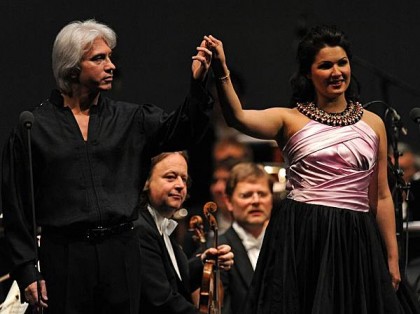
At the moment, La Cieca is going to call this one “speculation,” though the following photo from taken last night at a concert in Braunschweig) reveals that Netrebko remains on the plump side.
126 comments

  • Cocky Kurwenal says:

    That’s interesting Ika, I had the reverse experience. I knew her only from recordings and found her extremely irritating and frustrating, until last year when I saw her give a recital in London. The mannerisms were even worse of course, but it was a real revelation to me just how beautiful the voice was when experienced live. That has helped me to to enjoy her recordings from her prime far more than before, because I now realise what a beautiful sound it was.

  • mrmyster says:

    Well, Cocky and Even, just to jump briefly into your broth, one of the most noted sopranos of the 20th C. must be on your menu for mannerisms — Mme Varnay and her attacks. Even from the very first, and that early recording of Gotterdammerung from Bayreuth (1951?), is an interesting example, A. V.’s attacks are always little scoops — tiny scoops, just the hint of one sometimes, but always there. As a singer said listening with me to A.V. one time, “What does it MEAN?” Indeed!!
    Now, I am not one to get in a knot over mannerisms if they are musical and to the point, but I could never understand what Astrid V. was up to, and it was especially interesting because her husband Hermann Wiegert was a strict task-master coach and conductor who was no-nonsense on accurate readings of a score, who taught her most of her roles. But the question still hangs in the air: what does it mean? What does any mannerism mean? Your thoughts?
    For me it’s very hard to say!

  • Cocky Kurwenal says:

    MrMyster, I nearly brought Varnay up earlier in connection with this, but couldn’t really face it because it seems so complicated. Somebody on here the other week was talking about her bel canto schooling and how you can really hear it in her Walkure Act III Brunnhilde. This is a very far cry from my listening experience of Varnay, who I’ve always thought just never quite got on top of a very complex, large instrument – hardly surprising, given how young she was when she hit the big time, and given the roles she took on pretty mercilessly for years on end. I should say at this point that I sort of love her but at the same time find her voice rather ugly. Her voice has such a one of a kind, idiosyncratic make-up that the fact that it was used in a similarly unique way works for me. But as to why she sung like that, or where it came from, I couldn’t possibly speculate, except to say that it sounds as if she never found it easy to sing beautifully, so perhaps it resulted from lack of technical security, or perhaps from a desire to make her singing interesting in the absence of intrinsic beauty. Responses to voices are so personal, and maybe never more so than with a voice like Varnay’s – the above might make no sense to the next reader who might find Varnay’s voice a paragon of beauty and an exemplar of ideal technique.

  • Grimgerde says:

    I don’t find Varnay’s vocal mannerisms half as irritating as some other great singers who have more obviously attractive voices. The great thing about AV is that she goes beyond the notes and words and gets to the core of what she is portraying with a committment that, to my simple mind and ears, effaces any vocal predictability. I will add that it took me almost 25 years of listening to opera to get to this very personal assessment of AV.

  • La marquise de Merteuil says:

    114. AV is to Wagner what Callas was to bel canto.

  • Niel Rishoi says:

    Tamerlano, I can see a point where one might not wish to hear a singer who is less than what they used to be, but with a singer loved by her audiences from long-standing, I think it goes further than just the aged-condition of the voice. OK, you might think that “Martern” is ‘not great’ – but does a few off notes mean she’s to be put out to pasture like an old barnyard cow? There is not a wobble; the scalework is still fluid and malleable, and the aria is sung with great gusto.

    I heard from a friend who was there in person, and she said Gruberova caused pandemonium as she usually does now – still. You say something about paying to “deliver”. I think why audiences still cause sell-out houses is for something deeper. She is still out there, delivering a very personal art. It’s not about perfection. It’s about what you’ve created in terms of a rapport and standing with the public.

    As to her mannerisms, and quirks. Every singer has them. As to whether her technique is flawed or perfect. It’s perfect to me, because if you read scores, the notes are delivered more accurately than most. Her ear is not perfect. In an interview once, she admitted she’d been asked to do Lulu on a number of occasions, but stated that her ear was not infallible enough. It takes guts to admit that.

    As far as technique goes, if you want to hear perfection of technique, her 3 volumes of Mozart concert arias, especially the 1980-81 DG selections under Hager, provide ample proof. These araias, man written for Aloysia Weber, Elisabeth Wendling and some castratos, are the most heinously difficult pieces of music ever written. Yet Gruberova conquers them like no one else has.

    As to her style: I’ve revised my opinion on this issue. I bought into the scooping thing until I discovered some major revelations just a few years ago. Philip Gossett in his book “Divas and Scholars” discusses the term “puntature,” which is a practice of making a slight change in the music to make it easier. One of the most notable ones is in Violetta’s ‘sempre libera.’ In the part where she sings ‘ritrovi,’ the soprano usually sings ‘ritrovi’ then goes into the trill on “ha” before going into the high C. Verdi wrote it that the word has the trill written into the word, then the ‘vi’ is sung on the high C.

    In the sets of ascending, downward scales near the end of ‘Vien diletto,’ Bellini has written in the score these should be sung on the word ‘riedi,’ yet every soprano substitutes “ha” with the aitch making them sound pearly; but from my research, Gruberova is the only one who sings these scales on the word, with no aitch – and it makes it sound less “clean.”

    But if you listen to the majority of coloraturas, you will hear they begin the upper note of passages on a “ha” or “ho” – go to Sills, Fleming and Te Kanawa’s “Let The Bright Seraphim” on YouTube – hear how they sing the word ‘blow’ – blo-ho-ho-ho-ho-how…there are bumpy, unclean aitches; and go to Gruberova’s – clean, silky, not an aitch in sight (or sound, rather). Sills did not scoop, but she used the aitch liberally. Her high notes – “ha-HAAAA” – the leap from the lower into the upper is always by the use of this. As is many sopranos. Gruberova, in her attempt to avoid this common effect, nearly almost always sings the high note on the word – ‘il PEN-sier,’ ‘pie-TA’ – ‘di gioi-A’ and if it is wordless, attaches the upper note from the bottom directly through the vowel. Sometimes this does backfire; the pitch will not always center perfectly.

    In her Norma DVD, in the “Ah bello a me ritorna,” she is the only soprano I can find who sings all of the words to the florid passages. Really. Most sopranos shift these to a kind of wordless aitching – “ha-HA-ha-HA, ha, ha, ha, HAAAh-Ha…” And because Gruberova sings these passages to words, it sounds alien, because we’re used to hearing the puntatura’ed way.

    I could cite, page after page, instances where Gruberova sings the written note to the written words without make an “adjustment” – Elisabetta’s “il tradimento orribile, la sua perfidia” – a fiendish passage where most sopranos tank, but which she sings perfectly as it was written.

    It took me a long time to figure out these unorthodox factors and choices that Gruberova has often made; but as far as her actual technique is concerned, I feel it is one of the best, because what I’ve mentioned above are factors which, going back into the history of recorded sound, are things no one else has ever done. And I think what I’ve always liked about her is that she, like any other controversial singer, does things which are singular, unique and original to herself.

    Academics hate her: they like everything smooth, bland and free of personality. To them, everything is exclusively about numbers, meters, intervals, precision and tick-tock precision.

  • Niel Rishoi says:

    I offer proof: listen to all the first 3 ladies ha-hahaaaing their way through, then listen to Gruberova. Odious indeed.

    Sills:

    http://www.youtube.com/watch?v=fFVePXzoUw4

    Fleming:
    http://www.youtube.com/watch?v=hwu_3TOpEHI

    Te Kanawa:
    http://www.youtube.com/watch?v=5SNj1AQ8r3w

    Gruberova:
    http://www.youtube.com/watch?v=j-oR555aUrY

  • Monty Nostry says:

    I never thought this before, but Edita (especially with that decolletage) looks like the late great British comic actress Joan Sims … Carry On Coloratura!

  • mrmyster says:

    #113 Dear Herr Kurwenal — I cannot disagree with you in any way in your comments on the A.V. voice; it was often, very often, not beautiful to hear. In some roles her qualities were much to the point (Ortrud, Klytemn. etc.), but can you imagine her tone as Amneris? As Die Marschallin? As Amelia Grimaldi? My own voice teacher once joked that Leonard Warren must have had a hand in casting A. V. in his excerpts disc of SImon Boccanegra — made him sound all the better. I am not that cynical, and she was singing it at the Met with Warren (replacing Harshaw, I have heard, who had hoped to sing it).
    My own analysis is that Varnay did not think she had a less-than-beautiful voice; she was very hard working and seemed convinced that her work would pay off in every necessary way (see her book for lots of that). I agree with the Marquise that in Wagner, A.V. was very often the gold standard, not only because of her range, her strong upper register, but her diction and very pointed way with words. No mush there!
    She had a solid, reliable technique; her voice was well placed and supported; so……it was physiology and the way she was taught, and I for one can’t argue much with her. Even so, those goddam little attack-scoops drive me nuts. Without them her work would be even better.
    You have to wonder if she wasn’t told about that quite a lot. Her memoirs reveal an unusually self-preoccupied woman, so maybe she could not hear it. Many singers are ‘deaf’ in that way.

  • Maddalena di Coigny says:

    Quoth the Maven-
    Thank you for the notes. Yes, I misspelled, apologies. But no apologies for the comments. Yes, I was in the audience sadly enough and it was a mess. Ditto Rondine. San Fran did it better, cleaner. Busby Berkely did in fact, use quick cuts- look again. Management isn’t responisble for how a stage production looks? Are you nuts? Where are you? The emphasis on what looks good HD is informing many more aspects of staging that you are missing. Respectfully..
    Still, thank you anyway.