Headshot of La Cieca

Cher Public

  • CruzSF: Excellent. Thanks, web team, for the alert. 5:30 PM
  • web team: For those of you into new works, the InsightALT Festival will be live streamed with video:... 4:38 PM
  • kashania: It’s funny that Meier’s Klytemnästra has come up today. Just the other day, a friend of mine... 4:36 PM
  • marshiemarkII: My carisssssissimo Cocky your comments are not only always welcome, but actually we miss them as... 4:16 PM
  • Batty Masetto: And I loved it in the HD when she jumped his bones in the wheat field. Funny and sweet. 3:56 PM
  • Quanto Painy Fakor: Don’t cry Camille. Leonie is locked in our hearts and the joy she gave us is eternal. We... 3:36 PM
  • oedipe: Oh, there is no embarrassment or convoluted story here, just the way living languages tend to evolve.... 3:35 PM
  • alejandro: I had no real problems with Elisir … yeah, some of the Risorgimento stuff was wrong. As well as... 3:14 PM

drammy per musica

New Kid on the Plaza Drammy writes:

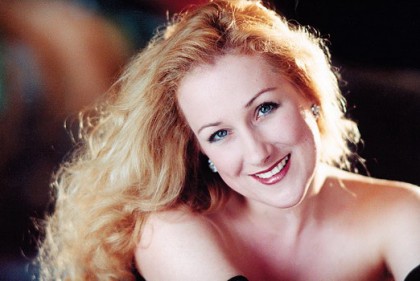
April 9, 2009. A traditional Otto Schenk production featuring Diana Damrau as Gilda and who cares but.. Frizza conducting, Viktoria Vizin as Maddalena, Calleja as the Duke, Frontali as Rigoletto, Aceto as Sparafucile.

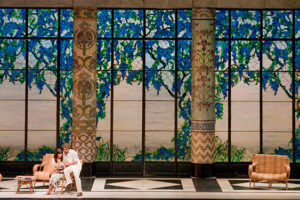
Stellar performances from the entire cast, excepting poor Mr Frontali. The set was phenomenal – this coming from someone who has now seen 3 operas live to date…i.e. I’ve low standards and I can’t stomach Regie – yet. The first set change – from Duke’s court to shady courtyard – took a whopping 5 minutes and people were getting frisky. I wondered when Gelb would be coming out to announce the death of a certain principal and her replacement.  Singing in general was EXCELLENT. Tenor and coloratura soprano outdid themselves. Damrau lost a lot of air during “Addio addio” and dropped out a few lines…and according to my lovely friend Luis Murillo the tenor opted out of the optional high D-flat. Frontali sang “Si vendetta” too piano, according to Luis again [I know nothing about music so I’ll just defer to the real singer, namely Luis]. I didn’t really like Frontali – have been spoiled by the Dresden Rigoletto featuring Mr. Zeljko Lucic.

“Caro nome” was so good my hands were shaking and I couldn’t hold the binoculars straight. Hey, don’t judge me. How can such exquisite coloratura passages and such silvery timbre come out of a human being?! Still don’t believe she is for real, anyways. “A nymph or a goddess?” – Lo frate ‘nnamorato. Most hilarious pickup line ever, and very relevant. “Bella figlia dell’amore,” the quartet, was damn amazing. I rather liked the duettos with Gilda and Rigoletto ; Gilda and Duke. Hell, I rather liked anything and everything involving Gilda. I basically fixated on Gilda during “La donna e mobile,” because Calleja has neither the dramatic presence nor the eye-candy-ness to trump Frl. Damrau.

Alas, Damrau’s costumes were not quite up to par. Had a baggy blue number all the way up to her neck during Act I, switched to a -very- lowcut white number after ducal rape…was this a symbol of newfound putain-hood? As curtain closed on Act II, her girls were quite literally popping out of the lowcut frilly white number. Same issue she had in Tucker Gala “Glitter & Be Gay”. I wonder if this constant boob-tastic exhibition is on purpose. L’attaque du décolleté, n’est-ce pas? Act III, she had on a Red Riding Hood’s male alter ego’s outfit. Last outfit was actually decent, IMHO. The dress in the blue room Dresden Rigoletto was definitely plus sexy, en tout cas.

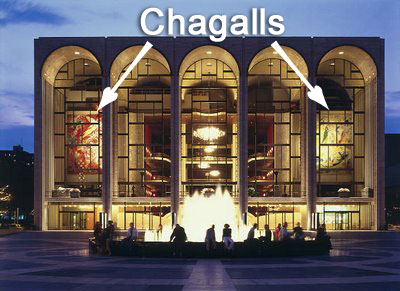
Someone in a parterre box, stage left, was snapping flash photos at curtain calls. The usher lady on Dress Circle was unkind and snapped at us when we were on the wrong floor. We wandered into Starr Theatre before we got to the Met. The Met is really posh. The Met program sucks compared to Chicago Lyric’s – craptastic little mag without all the gratuitous targeted-at-wealthy-dowager advertisements of Renee Fleming pimping a Rolex or a bottle of La Voce. The Met museum and Met shop are both pretty cool. Chicago Lyric take a leaf outta the book, please. I didn’t see the Chagalls – where are they, incidentally?
So I run down from the grand tier box 39 towards the stage door, getting a few nasty looks on the way. I was the first there, but then figured I was in the wrong place so I ran around those tunnels blindly for a bit. Then I returned and there were two Quebecois. Snobs, both of them. I ask in French, “Do you come from France?” [To be fair to me, they didn’t sound nasal =at all=!]. Them: NON, [stupide] … nous venons de Quebec. Then they proceeded to ignore me for the rest of the time – but what gives? I probably look like a rabid fan and a philistine to the untrained eye. When in reality, one ought to admit that I know next to nothing about music and have questionable taste – Callas is bad, giusti dei.

Well anyways, a nice fellow young woman [not yet on Medicare] came up and we chatted while I worked myself up into that obligatory pre-diva frenzy, tapping my heels loudly on the floor. Fairly early on, Viktoria Vizin came out. That lady is -tall-, must be 5’ 10’’, je te jure. Her dress was the only hot piece of clothing in the entire opera – the duetto with her and the duke was leggy and smokin’. It was weird hearing perfect English [one was convinced she was an Italian dancing girl of questionable virtue] come out of her mouth as she bid all the creepers adieu and briskly made her way to the parking lot. She didn’t make nice with anyone and some guy came out shortly after Ms. Vizin and was all “A star is coming…wait, you [creepers] let her through? Wow.” Then later another orchestra member came and sniffed at Lois or Linda and said “She’s a regular.”

Back to stage door – Linda and Lois made their way in too, right on cue. One of them – I think Lois, was let in backstage by some fellow ol’ lady. Security served her a plate of rejection and she wandered back out shortly. Schadenfreude ensued. The line began to grow in 3 directions, as people clumped around the tenor and baritone. There was a pretentious young man in a suit who said loudly “I plan on singing at the Met one day. I am a singer too.” I hope he’s a tenor…HA. And later, this gem from him to Frl. Damrau, “So why did you choose to retire [Queen of the Night]? Was this decision artistic or stylistic?” My internal monologue: “Wow, quel stupide!” Damrau gave her canned “it’s too intense” response.

I said Bravo inaudibly to Frontali and he said Grazie!

When Damrau came out, I blurted out ‘Oh my God!’ as the people began to clump around her. She was accompanied by a big-eyed, overbearing man with a Riccardo Muti haircut. Looked Italian or Spanish, but apparently I’m wrong and she has no Italian/Spanish boyfriend. I rushed over there and stood awkwardly for a bit…then she signed my copy of Des Knaben Wunderhorn. I was speechless. I then blurted “OMG can I take a picture with you?” In that voice one employs with very sensitive, very special small children, she says “Of course.” And then the mahvelous K. took a pic. I then rushed out so as to not keep R. waiting.

69 comments

  • Tonto Lavita says:

    Reading these postings about people seeing their first operas in the 80s and 90s is wonderful, but it makes me feel so old. I started out with Carmen, starring Stevens and Tucker at Maple Leaf Gardens in Toronto, in the very early 50s. As I recall, it was wonderful.

  • Sanford says:

    Tonto…. “Butcha Ah, Blanche, butcha ah!”

  • Carlo Nome says:

    My first live opera was Il barbiere di Siviglia in what was subsequently my high school gymnasium presented by Western Opera Theater, a touring group of young singers presented by the San Francisco Opera. The star was Allan James (?) Monk, who subequently dropped his middle name. My second live opera was Rigoletto with Anne Elgar, Harry Theyard and Seymour Schwartzman at San Francisco Spring Opera at the War Memorial Opera House. My first regular opera at San Francisco Opera was Ernani with Price, Cioni, Glossop and Flagello. As the beginning of the Ernani prelude sounded to a fourteen-year old a bit like the Rigoletto prelude I had heard at home on LP, I was quite concerned and upset. I considered informing somebody -- maybe the conductor -- that they were doing the wrong opera. By the time I decided I should probably tell one of the ushers about this catastrophe, I realized that they really were performing Ernani after all. Consequently I didn’t enjoy the first scene. The second scene of course featured the entrance of Mme. Price. I was seated in one of the front rows of the Orchestra section (very expensive, about ten dollars -- a birthday gift from my parents) and had a good view of her facial expression. She looked annoyed, so I spent most of the rest of the first act trying to figure out what could have annoyed the diva. I was exhausted by the first intermission.

    My first recording of an opera was supposed to be the Tebaldi/Bergonzi Aida, but after I saw the cover of the old London LP set at a tobacco/record store at the corner of Telegraph and Bancroft in Berkeley, I made an important decision -- Mme. Tebaldi’s necklace looked like cheap plastic, she herself didn’t look very pleasant, and so the opera couldn’t be much better no matter the cast. (It took me some time to decide that Mme. Tebaldi could be much of an artist and that Aida could be much of an opera.) Since I had read and enjoyed Scott’s The Bride of Lammermoor and since the edition I read mentioned Donizetti’s opera, I saved my allowance and bought highlights from Joan Sutherland’s first recording of the work and then some months later the complete recording, having first ascertained that the photographs on both the back and front of the complete LP set passed muster. I chose the Sutherland recording because my father had a reel-to-reel tape of excerpts from her first Messiah recording and my mother said she had read in Time that Miss Sutherland had one of the world’s great voices. I listened to the first three sides of the Lucia recording, simultaneously recording the LPs onto a reel-to-reel tape, so as not to wear out the LPs. Unfortunately, the turntable broke at that point, so I couldn’t hear the rest of the opera for several months until my father took the turntable into a repair shop. I listened to that reel-to-reel tape of the first half of the opera for what seemed to be about fifty times until I heard the rest of the opera. It is still one of my favorite operas.

    I was quite excited when the Met broadcast Lucia in February 1969 with Anna Moffo. Miss Moffo didn’t sound anything like Miss Sutherland in her recording -- I decided that Moffo must be a very important dramatic artiste who valued expression over pretty sounds. I even announced my opinion in my high school French class the following Monday.

  • Carlo Nome says:

    My first live opera performance was Il barbiere di Siviglia in what later became my high school gymnasium with Allan James (?) Monk, who later apparently dropped his middle name. The company was the San Francisco Opera’s touring group, Western Opera Theatre. My first opera at the War Memorial Opera House was the Spring Opera’s Rigoletto with Anne Elgar, Harry Theyard and Seymour Schwartzman. My first opera at a regular San Francisco Opera performance was Ernani with Price, Cioni, Glossop and Flagello. Ernani’s prelude sounded to a fourteen-year old like Rigoletto’s prelude. I was upset that the orchestra had obviously made a mistake – performing Rigoletto instead of Ernani. I seriously considered who I should inform of this catastrophe. By the time I decided that I should inform an usher instead of the conductor, I realized that Ernani really was being performed. By this time, Mme Price had made her entrance. I was sitting in the orchestra section, close up (very expensive seats –about ten dollars – a birthday present) and had a good view of the expression on Mme Price’s face – she seemed annoyed at something. I spent the rest of the first act trying to figure out what could have possible annoyed the diva. I didn’t enjoy the first act and was exhausted by the time the intermission began.

    My first opera recording, apart from Gilbert and Sullivan, was to be the Tebaldi/Bergonzi Aida. Having saved my allowance, I inspected the photograph on the cover of the LP set at a tobacco/record store at the corner of Telegraph and Bancroft in Berkeley. I thought Mme. Tebaldi’s necklace looked cheap and that Tebaldi herself did not look pleasant. Not wishing to waste my money and having read The Bride of Lammermoor, I inspected the photographs on Joan Sutherland’s first recording of Lucia. The future Dame Joan looked much more promising than did Tebaldi, and my mother said she had read in Time magazine that Sutherland had a great voice, so I bought the highlights and a few months later the complete recording. I listened to the first three sides of the complete recording, simultaneously copying it to my father’s reel-to-reel tape recorder. Then the turntable broke. I was unable to hear the rest of Lucia until my father finally took the turntable to a repair shop. Instead, I listened to the first half of Lucia for what seemed like fifty times. It is still one of my favorite operas.

    I was quite excited when the Met broadcast Lucia in February 1969 with Anna Moffo. Miss Moffo did not sound anything like Joan Sutherland! At that time I was sitting next to the blackboard in my high school French class, and writing on the blackboard announcements about Met broadcasts and other similar events, with the evident approval of the French teacher. I duly informed the class that Miss Moffo was one of those dramatic artistes who valued expression over vocal prettiness. I later learned that may not have been exactly the case that particular Saturday.

  • Rock DeLash says:

    In youthtude Ed Sullivan had all the current opera singers on each Sunday night, but I never got what they were singing in them foreign languages. The first opera performance I must have ever seen was The Butcher of Seville, with Oil Can Harry trying to steal the milkmaid’s cow, till tenor Mighty Mouse flew in and saved The Day.

  • Jay says:

    First and only opera at the Old Met: Dec. 1965 Faust, when a certain Spanish diva and American baritone both made their debuts. Standing room. Lots of fun (after the performance even more fun!).

    First tour performance: 1968, Philadelphia, Luisa Miller with the aforementioned Spanish diva.

    First performance in the new house: Dec. 1968, Don G with Siepi, Arroyo, Zylis-Gara.

    All time best performance at the Met: FROSCH in Feb. 1969 with Rysanek, Ludwig, et al. Incomparable and after 40 years I’m still waiting for its equal!

    Thanks for sharing your experiences, Drammy. Sounds like you had a lot of fun.

  • Hans Lick says:

    It was an all-around excellent Rigoletto, and I was delighted there were so many newbs there to see it done more or less right for once. (It was my date’s first Rigoletto, after many a Strauss and Wagner.) No optional high notes were taken by anyone, Damrau has no trill to speak of, and the trail-off after Caro Nome was also omitted … as La Cieca once said, “Come scritto -- I’ve never been sure what that means.” But all the singing was very respectable, the conductor was very into the subtleties, the acting was better than passable.

    The most overwhelming thing I’ve ever seen on the Met stage was Ruggiero Raimondi’s Sparafucile in 1972, standing there SINGING while holding a sack over his shoulder, a sack containing Joan Sutherland. He had it a couple of feet off the ground, too. Then he eased it to the floor, handed it off to Sherill Milnes, who hauled it to center stage, kicked it a few times, and only when the Pav sang, opened it up … and out popped Joanie, dying only after thirty seconds of ever more diminuendo perfect trill. For the next performance, Ivo Vinco sang Sparafucile -- he brought in an attendant ruffian to hold the sack.

    And everyone (but RR) took optional high notes. It was to die. Old ways are best….

  • Carlo Nome says:

    My first live opera performance was Il barbiere di Siviglia in what later became my high school gymnasium with Allan James (?) Monk, who later apparently dropped his middle name. The company was the San Francisco Opera’s touring group, Western Opera Theatre. My first opera at the War Memorial Opera House was the Spring Opera’s Rigoletto with Anne Elgar, Harry Theyard and Seymour Schwartzman. My first opera at a regular San Francisco Opera performance was Ernani with Price, Cioni, Glossop and Flagello. Ernani’s prelude sounded to a fourteen-year old like Rigoletto’s prelude. I was upset that the orchestra had obviously made a mistake – performing Rigoletto instead of Ernani. I seriously considered who I should inform of this catastrophe. By the time I decided that should inform an usher instead of the conductor, I realized that Ernani really was being performed. By this time, Mme Price had made her entrance. I was sitting in the orchestra section, close up (very expensive seats –about ten dollars – a birthday present) and had a good view of the expression on Mme Price’s face – she seemed annoyed at something. I spent the rest of the first act trying to figure out what could have possible annoyed the diva. I didn’t enjoy the first act and was exhausted by the time the intermission began.

    My first opera recording, apart from Gilbert and Sullivan, was to be the Tebaldi/Bergonzi Aida. Having saved my allowance, I inspected the photograph on the cover of the LP set at a tobacco/record store at the corner of Telegraph and Bancroft in Berkeley. I thought Mme. Tebaldi’s necklace looked cheap and that Tebaldi herself did not look pleasant. Not wishing to waste my money and having read The Bride of Lammermoor, I inspected the photographs on Joan Sutherland’s first recording of Lucia. The future Dame Joan looked much more promising than did Tebaldi, and my mother said she had read in Time magazine that Sutherland had a great voice, so I bought the highlights and a few months later the complete recording. I listened to the first three sides of the complete recording, simultaneously copying it to my father’s reel-to-reel tape recorder. Then the turntable broke. I was unable to hear the rest of Lucia until my father finally took the turntable to a repair shop. Instead, I listened to the first half of Lucia for what seemed like fifty times. It is still one of my favorite operas.

    I was quite excited when the Met broadcast Lucia in February 1969 with Anna Moffo. Miss Moffo did not sound anything like Joan Sutherland! At that time I was sitting next to the blackboard in my high school French class, and writing on the blackboard announcements about Met broadcasts and other similar events, with the evident approval of the French teacher. I duly informed the class that Miss Moffo was one of those dramatic artistes who valued expression over vocal prettiness. I later learned that may not have been exactly the case that particular Saturday.

  • Aurora says:

    Drammy, it’s ME (the not yet on Medicare one who takes really fabulous pictures).

    Poor Linda. Are we sure she’s 86′d forever? I loved her attempt to get inside. “A” for effort.

    In response to someone’s question: I think Damrau is the real deal: a sweet person who loves what she does. The kindness will last because that’s her real personality! I don’t see her getting a big head about her success like some other Met leading ladies…

    Her Gilda was lovely, but I’m dying for more of her Lucia. I would travel around the world for that treat again.