
Headshot of La Cieca

Cher Public

  • Regina delle fate: Meier gave several series of Isolden in the UK - in German f...
  • brooklynpunk: whatever:..BTW...did you ever make it in to t...
  • whatever: much obliged for the kindness of strangers, armerj ...
  • brooklynpunk: " it does not follow that as many people will embrace opera”...
  • MontyNostry: Presumably JDD was singing that aria, so some of the standin...
  • quoth the maven: Entirely unfair. The union agreed to the contract; the cast,...
  • The Wistful Pelleastrian: That Grammy crowd gave a standing ovation to an opera ari...
  • marshiemarkII: Bravo tenorino!!!!! much as I thoroughly enjoyed the other o...
  • iltenoredigrazia: Thank you, thank you (bow down to the floor, hands to my che...
  • Betsy_Ann_Bobolink: Is it all right to say "John Huston," "Angelica Huston," or ...

blog advertising is good for you

an atmosphere that simply reeks with class

A member of the cher public who attended last night’s premiere of Verdi’s Macbeth at the Opéra national de Paris filed this report:

It was Paris Opera GM Gerard Mortier‘s penultimate opportunity – his term ends in July –  to moon opening night Parisian audiences and he did just that. He flew in bad-boy director Dmitri Tchernlakov from an opera house in Novosibirsk, Russia, to wreak havoc on Verdi’s Macbeth.

Before the overture, we see a ugly town square where someone shows up in a backpack, drawing people from the surrounding buildings who shout a welcome. During the overture, we see projected images of Google Earth circling a town; ironically,  it was Google Earth I was using earlier in an unsuccessful attempt to locate Novosibirsk. We float down to a lifeless house and look through window at a plain room with a happily flaming gas fireplace.
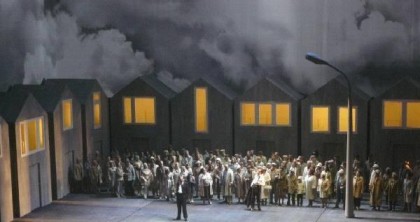
Clueless stage direction rule number one: when crowds drink, never put a table for the empty glasses. Macbeth set his on a chair and later, when he has his banquet mad scene the couple managed their rough-housing while holding champagne goblets. The departing crowd had to place their goblets precariously on the various chairs when leaving.

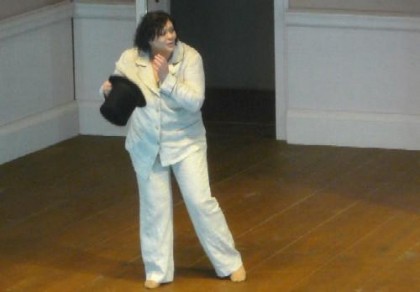
Lady M. appears, inexplicably, with a top hat during her mad scene. The Soviet-style pants suit she was given was credited to the director but resembled rather the fashion house of Hormel. Macduff sings his sole aria in a wooden playpen complete with toys. Men are wearing ill-fitting Kruschev-era cheap suits. The costumes for the crowds are 20th Century Refugee. They could have brought the entire lot at the Salvation Army store for $375 but, as the costume shop made them, you can add three or four zeros to the cost. The witches were judged expendable as were the assassins of Banquo – roles assumed by the shabby crowd.
The chorus, although unannounced, was apparently on strike (or the variation the French call service minimum) the first half, singing mezza voce, and make only a little more effort later. You could count on the
fingers of one hand when they entered on the beat – and, remember, the chorus plays a key role in this opera.

The conductor, Teodor Currentzis, was standing on every phone book in the building, partially obstructing the view of anyone with orchestra seats. He managed to convince the lazy orchestra, however, that he actually was 10 feet tall and they played like the polished ensemble they could be but never are. If you can imagine a young John Cleese doing his out-of-control conductor bit, you can come close to the fun I had watching him in action. The good news: he stirred the orchestra into such a pitch, they drowned out most of the singing.
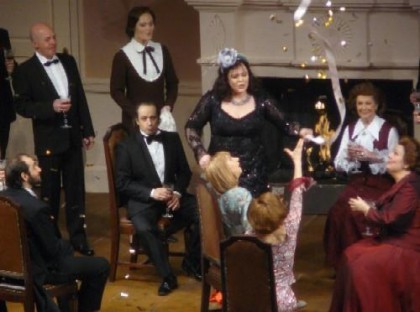
Just as well. Our Macbeth was Dimitris Tiliakos whose approximate Italian, raspy voice and limp delivery was uncomfortable to watch and hear. His wife, Violeta Urmana, took about a half-hour to find the right key but even then sang with an painful edge. Clearly theatrically challenged, she was awkward from first to last and obviously was getting no help from the stage director. There was not a single gesture by anyone this night that seemed real.

Ferruccio Furlanetto‘s Banquo sounded shopworn but fortunately his character is dispatched early. Stefano Secco, a well-known tenor in this house, was the parka-wearing Macduff. His new rafter-raising voice, winning large applause for his only aria, had regulars speculating that he was miked.

The production dispenses with the action which ends the opera – the director couldn’t be further bothered. We seen Macbeth alone on stage encouraging the audience to fight while the backstage chorus, well-amplified, reply. The celebratory chorus ending the opera, one of the most stirring Verdi every wrote, is sung offstage as we leave the building and float back up to Google heaven. It was Verdi drained of meaning, passion, truth and purpose. The ones who disemboweled this early masterwork were roundly booed at the curtain but Mortier somewhere was certainly smiling.
37 comments

  • Regina delle fate says:

    I may be wrong, but wasn’t the first Princesse d’Eboli also the same singer as the Lady Macbeth of the Paris revision of Macbeth?

  • Esa-Pekka D'Innocente says:

    Whichever way the director’s last name is transliterated (preferably Tcherniakov IMHO), it wouldn’t have an “L” in it. Thanks for the report. I did enjoy his Onegin from last year but this Macbeth does sound like a mess.

  • Alto says:

    “Benita Valente was apparently a Harshaw student and we all know that she has had a long and illustrious career.”

    We do?

    “MH said, and this is a close paraphrase, ’singing teachers don’t teach the basics as well as they should and young singers don’t work as hard as they should, and it takes time and diligence to develop a Verdi voice.’”

    That would explain why Ponselle was such a miserable failure in TROVATORE Met debut at 21.

  • armerjacquino says:

    Ponselle’s debut was FORZA, no?

  • Will says:

    Alto, there are always miracles that one cannot explain and there always will be.

    That said, note the length of Ponselle’s career and the fact that the top began to fade early. Legend that she is and as sumptuous as the voice was, the great Normas she sang were negotiated with a lot of downward transposition. (I, for one, do not hold transposition against any singer, because I know that the 18th and 19th centuries regarded transposition as a common and perfectly normal practice. Today I hear contempt heaped on singers who transpose, but in the century that created the works that form the basis of the Italian romantic repertory, transposition was an everyday occurrence–and the orchestral pitch was lower then into the bargain.)

    So, yes, Ponselle and Rysanek and Peters and Varnay burst onto the scene singing the most demanding roles in their respective fachs. But they’re the exception and creation of spinto and dramatic voices in particular generally takes longer and more intense training. The entire set-up today is geared to shorter contact with the teacher and the training costs a fortune, making it necessary for most singers to start income-producing careers far earlier in the training process than was the case a hundred years ago, far earlier than may be wise.

    From my own opera-going over the past half century and my own work with opera companies designing productions, I’ve gotten to hear hundreds of potentially beautiful young voices in early stages of development already strained or with holes or in the wrong repertory. They succumb to demands for more volume created jointly by many conductors who view even a chamber orchestra as a potential major symphonic opportunity, and by a segment of the public that demands and values volume first, musicianship and other niceties being given a lesser priority.

    It is generally agreed, I believe, that we live in an era of pretty good to great Baroque and Mozart singing. The voices for Bellini, Donizetti, Wagner (who revered Bellini’s vocal writing) and Verdi developed from singers trained in the Baroque/Mozart tradition, and I wonder if we shouldn’t be exploring how that development was managed and see if we can’t replicate the process–IF here are enough teachers with the brains, time enough to do the necessary work, and some way to subsidize it all so that good, strong and well-placed voices can again emerge for the big dramatic roles.

  • WindyCityOperaman says:

    My voice teacher studied with Harshaw for a period of time, and agrees that she worked better with the big-voiced folks. Novices and small-voiced folks wouldn’t survive under her.

    Marilyn Horne has said that Ponselle told her, “You know, I think I really was a mezzo. . . ” Beverly Sills said the trouble with Ponselle’s top voice was that she didn’t have enough head voice “space” in her top notes, and that is what shortened her range.

    BTW, I really loved “Damnation of Faust” Met delayed telecast yesterday. You see – can have a “modern” production with dramatic and technical innovations and not have it distort the composers original intentions. Want to see it “live” when it comes to the Lyric next season.

  • Indiana Loiterer III says:

    Will@25: You are, of course, right about almost everything in that post (except that Roberta Peters never tried to be a spinto/dramatic and so her early debut isn’t relevant here). But if the conductors are in part to blame for oversymphonizing everything–and I agree with you on this–aren’t better-informed conductors as important to any effort to reform opera singing as better-informed teachers?

    Also, at least in the States, the entire set-up of vocal training is determined generally by its being part of an undergraduate four-year college major program, which all too often assumes that a voice student will be able to go out into the world in four years. This isn’t even true of business executives any more (look at all those MBAs); why should it be true of opera singers?

  • Will says:

    Indiana, I put Peters in there as an example of a young singer–a “kid” really–who was very early out of the gate in only lead roles, even though she was not in the spinto/dramatic class. It certainly is possible to destroy a voice and career very quickly if you don’t know how to sing, and the myth that Mozart will cure all ills vocally is very misguided. The length and vocal health of the Peters career is testimony to the fact that she did know how to sing, and knew what repertory to do and when.

    Yes, I agree totally that conductors are part of the problem and must become part of the solution. Von Karajan was a notorious voice killer, encouraging dreadfully dangerous and destructive role assumptions, and there are others in the pit who do the same.

    Of company managers and/or casting directors, much the same can be said–actually, even more so. As teachers and the teaching system seems to have a poor grasp of how to develop voices, so do managers and casting directors demonstrate frequent ignorance of how to use voices.

    As to singers, they’re caught in a system that is supposed to be know what they are and what kind of voice they have, but that seems to betray them with great regularity. This is one reason I become impatient with the contempt that is shown for singers so often on this forum. I truly believe our singers are ill-trained, ill-advised, and ill-cast in a system that is frequently concerned only with getting through the season and selling tickets rather than being part of a knowledgeable and mutually supportive community of artists.

  • not telling says:

    Lindoro Almaviva,

    Violeta Urmana’s husband is the Italian tenor Alfredo Negri. I believe that the original commentator was referring to Dimitris Tiliakos as her husband with regards to the production; as in, they are Macbeth and Lady Macbeth, husband and wife.

  • Le_Chiffre says:

    Will and Indiana Loiterer III,

    I totally agree with the two of you regarding the general observances posited. The most frustrating question that rattles around in my brain is how do we rehab opera into being a “healthy” business, and work to restore (repair?) what is broken? I am not under the impression that opera is broken beyond repair in the U.S., nor do I live under the impression that there ever was a glorious “age of opera” in music history where all of our current problems weren’t manifested in various/sundry other forms.